eBook - ePub
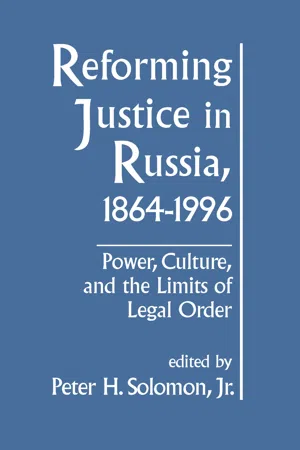
Reforming Justice in Russia, 1864-1994
Power, Culture and the Limits of Legal Order
- 416 pages
- English
- ePUB (mobile friendly)
- Available on iOS & Android
eBook - ePub
Reforming Justice in Russia, 1864-1994
Power, Culture and the Limits of Legal Order
About this book
Measuring Russian legal reform in relation to the rule-of-law ideal, this study also examines the legal institutions, culture and reform goals that have actually prevailed in Russia. Judgements about future prospects are measured, adding new dimensions to our understanding of the Soviet legacy.
1
Courts and Their Reform in Russian History
More than once in Russian history the liberalization of politics set in motion a reform of justice and law. Gorbachev’s glasnost’ and the process of democratization in post-Soviet Russia saw a struggle by jurists in Russia to make their courts independent, powerful, and fair. The judicial reforms that resulted from their efforts reminded observers of the era of the Great Reforms and the adoption by the tsarist leaders of the Judicial Reform of 1864, over whose realization jurists and officials fought for half a century. Between these two eras of reform came the seventy years of Soviet power, during which successive generations of Soviet leaders tried to shape courts and the law to suit their interests and visions. To a considerable degree, they turned back the clock, undoing many of the achievements of the tsarist judicial reform. At the same time, the Soviet experience left a stamp of its own on law and the courts, which made the challenge of judicial reform in the 1990s differ from that of the 1860s.
The contributors to this jointly authored volume explore the attempts to reform or reshape the administration of justice in tsarist, Soviet and post-Soviet Russia. The authors do not try to provide a full or systematic account of the panoply of changes attempted during the century and a half of its purview. Rather they offer a joint exploration of some key issues in the interpretation of that experience. The studies range over a variety of subjects—from the high politics of reform to the way clients and officials reshaped particular initiatives; from civil law disputes to the uses of the criminal sanction; from the role of various courts to alternative forms of complaint and dispute resolution; from the institutions of the law to the types of legal cultures. The authors believe that their adoption of an historical perspective will illuminate the reform of justice in today’s Russia. This approach helps them to consider both the cumulative effects of different waves of reforms and the lessons of past reform efforts, as well as to make cross-temporal comparisons.
One of the questions addressed in this book is how the obstacles to the attainment of modem legal order in Russia of 1994 compared with those in Russia of 1864 and 1914. This comparison called for a focus on the difference that the Soviet, and especially Stalinist, experience made for the goal of independent courts. In posing this question, the authors do not assume that there is or should be a universal model for the administration of justice or that Russian reformers of any particular period adhered to the goals that Western observers might consider appropriate. To understand why the outcomes of particular reform initiatives over the 130 years often differed from common Western standards, the authors seek to discover what kinds of legality prevailed in practice, and why, and to probe the aspirations of the reformers themselves. Only in this context can one properly assess the fate of any particular vision of legal order.
Another of the authors’ concerns is the realities of political power during the 130 years under consideration, especially the relationship between law and politics. At least until 1992, Russia had an authoritarian political system, in which the ruler—be it Tsar or General Secretary—stood above the law and treated laws as an instrument of rule. The decision in 1864 to create independent courts ran counter to the bases of autocracy and threatened to deprive the ruler of his prerogative to dispense justice. For this reason, if no other, the fifty years of realizing these reforms were marked by tension and by attempts, sometimes successful, to check their impact. For their part Soviet leaders did not even aspire to establishing independent and impartial courts. They gave judges discretion but expected them to implement the policies of the regime and often to heed the advice of authorities in individual cases as well. In contrast, the leaders of post-Soviet Russia were at least formally committed to developing independent courts, but as of 1997 they lacked the resources to realize this goal.
The position of Russia’s rulers above the law helped to reinforce a traditional emphasis on the substance of dispute resolution as opposed to the means or procedures employed. This de-emphasis on procedures had a number of consequences. One was a strong and lasting interest in alternatives to the courts, among them a variety of mechanisms for handling of complaints. Another less benign result was the common and expedient use of extra-judicial coercion, especially in the Soviet period.
While the reality of power placed limits on the development of legal order, the real world of courts was also shaped by the attitudes toward the law on the part of different sectors of the population. In the classic study of law in Russian history, Harold Berman argued that before the Bolshevik Revolution Russia had achieved the institutions and forms of law that existed in the West but not their core principles and underlying assumptions.1 The historians of tsarist justice in this book take this insight further by exploring the actual legal cultures of particular social groups. Thus, in studies of the ways peasants used the volost’ courts and their resort to such alternatives to the law as arson, the authors develop a portrait of a rural legal culture that was complex and nuanced—”layered” and “fragmented”—one in which the same persons might, on a pragmatic basis, display different legal mentalities at the same time.
In the Soviet period, even the institutions of the law no longer met the Western standards of which Berman wrote. Consequently, the students of Soviet justice in this volume devote more attention to the institutional factors that influenced the nature and quality of justice in Russia. A number of them analyze the development by Soviet leaders during the Stalin and post-Stalin years of new and more reliable ways of ensuring that the courts delivered the results that they desired. In so doing, they detect shifts in the relative weight among the factors limiting the autonomy of the courts (e.g., the influence of local Party officials versus that of the central legal agencies). At the same time, the essays on the Soviet period also demonstrate how from 1930 the special emphasis on criminal law, along with the presence of extra-legal coercion, produced a negative public image of the courts and a diminution in public trust in their capacity to resolve disputes fairly.
Two further issues that receive special attention in this volume are the process of adapting legal institutions imported from the West and the nature of one peculiarly Russian legal institution, the procuracy. Many features of the Judicial Reform of 1864, including trial by jury, were based upon models from England and Western Europe, which in the Russian context took on new features. Thus, the placement of the jury within the context of an inquisitorial pre-trial procedure and a collegial tradition in the courtroom led to a new kind of”consensualjustice” that may find replication in the post-Soviet revival of the jury. The tsarist procuracy began as an agency for supervising justice, but in 1864 was converted into a prosecutorial body. The Soviet leaders revived its supervisory functions, which stood as the equal to the prosecutorial ones throughout most of the Soviet period. In post-Soviet Russia legal reformers identified the twin functions of the procuracy and the special power that they produced as a key obstacle to the development of Russian courts.
The essays in this book are arranged in three groups, covering the tsarist, Soviet, and post-Soviet periods, respectively. Here I introduce each group of essays with brief accounts of relevant background-the highlights of the Judicial Reform of 1864, the development of the Soviet system of justice, and the origins of judicial reform in late Soviet and post-Soviet Russia.
The Judicial Reform of 1864 was sufficiently radical in its aspirations, if not also its achievements, to qualifY as revolutionary. To support this characterization one has only to compare the Reform with the institutions and practices of justice that preceded it,2 Until 1775 most adjudication in Russia was conducted not by specialized officials or courts but by administrators who performed other functions. In 1775 the Empress Catherine established an intricate system of courts, but it had important limitations. To begin, each of the major free estates-gentry, merchants, and state peasants-had its own structure of courts; but serfs were denied access to the courts and received their justice from the gentry. Moreover, although some of the judgeships were elective, the courts were not independent of political authority. Thus, governors of the provinces had responsibility for supervising the courts, which included protesting unjust decisions to the Senate or Tsar and confirming all death sentences. For their part, most of the judges, many of whom were local notables, had little inclination to stand up to political officials. The typical judge was uneducated in law, depended on his clerks to explain cases, and accepted bribes.
To encourage fulfillment of their laws and decrees, the tsars of pre-Reform Russia gave their courts a pure form of inquisitorial procedure, something that no longer existed in Western Europe. This meant a complete reliance on written documents, to the point where there were no trials as such, only office reviews of relevant documentation. In civil cases, the requirement of providing not only the essence of the case but also references to relevant laws (which were unavailable without writing the capital) made the process complicated, expensive, time consuming, and impractical for most complainants. In the criminal realm inquisitorial procedure helped to create a bias in favor of the prosecution. Trials consisted of office reviews of the written documentation produced by the pre-trial investigations, and judges had little discretion in applying the law. The results of the investigation were unlikely to be challenged, since there were no lawyers present and no oral testimony. To acquit, as well as to convict, required proof, and most cases ended instead in “leaving [the accused] under suspicion,” as a result of which he or she often had to move to a new location. The crucially important pre-trial investigation was conducted by police and other administrators. Confessions were encouraged and treated as the best form of evidence; the reputation of the accused (known as “moral evidence”) also carried weight along with the material evidence.
Needless to say, since neither civil nor criminal procedure called for the services of lawyers, few were trained. There were no state prosecutors, nor was there a defense bar. To the tsars, lawyers represented a potential threat to their unlimited power.
The Judicial Reform of 1864 changed most of these features of pre-Reform courts and their procedures.3 First, the system of class courts under the control of the governors was replaced by a new hierarchy of courts open to all citizens, including the former serfs. These courts were designed to be separate from the executive and independent. Consequently, in the higher levels (the district courts and the judicial chambers) judges had life tenure, with removal only for cause. Furthermore, judges gained new discretion in applying the law, including a duty to rely in part upon their conscience, and, at least in the higher courts, the right to interpret the law. To be sure, the Reform statutes included special procedures for cases involving government officials and some political cases as well. The Reform also established two simple courts-the justice of the peace courts and the volost’ courts-that were accessible to ordinary persons (townsfolk and peasants), could handle petty disputes without much expense or written documentation, and, in the case of the volost’ courts, could apply customary law.
At the same time, the Judicial Reform introduced an overdue modernization of court procedures, moving them away from the pure inquisitorial mode to a mixture of inquisitorial and adversarial elements. In civil and criminal cases alike, the days of the office review were over. A trial was a trial, with the parties, if not also their lawyers, contesting the issues in public before a judge or panel of judges. In the criminal realm in particular, the inquisitorial tradition of compiling a written record was retained, but once introduced at trial that record was subject to challenge, as trials became contests between the sides, open, public, with oral testimony, and representation by lawyers. For the most serious cases trial by jury became an option, with all of the unpredictability of outcome which that institution entailed. The new oral testimony gave impetus to the development of a defense bar. It also required lawyers to prosecute at trial, and, as we shall see, procurators were asked to assume this function.
The development and adoption of this judicial reform was an extraordinary event, possible only in unusual times. The context, of course, was the mounting of a whole series of reforms all emanating from and related to the Emancipation of the serfs. But other ingredients also made the reform process possible. One was the presence of a small cadre of enlightened jurists in high places in the bureaucracy, individuals who promoted and helped write the reform legislation. Second, this group had the advantage of working against the background of a broad consensus that the old system of justice was so bad as to constitute an embarrassment to Russia. Third, the reform was facilitated by the recognition among many of the gentry dispossessed by the Emancipation that the protection of their new property rights required strong law and courts. All of these conditions helped, but the Judicial Reform of 1864 depended equally on the actions of particular persons and on chance.
The 1864 reform produced a judicial system that was bound to challenge the unlimited power of the tsar. No doubt the officials who drafted the reform saw things differently. They assumed that independent courts staffed by legal specialists not only were compatible with autocratic power, but would even strengthen it by ensuring the observance of the tsar’s laws. In practice, however, some judicial decisions failed to meet the interests or expectations of the tsar, and it became clear that the law was no longer a reliable instrument of autocratic power. As a result, over the decades of implementing the reform, the tsars and their ministers tried to minimize the loss of imperial prerogatives. They decided to remove more political offenses from the regular courts (and trial by jury) and to introduce special emergency regimes in parts of the country. In addition, they limited the scope of the justice of the peace courts and placed some adjudicatory functions again in the hands of an administrative official, the district land captain. A law in 1885 gave the Minister of Justice the right to ask judges to explain any of their actions and to issue instructions about decisions in cases completed or procedure in future cases. The law also facilitated disciplinary proceedings against judges, increased the grounds for their removal, and allowed for the transfer of judges from one bench or court to another by the Ministry. Through these and other new powers of management, judges in Russia became subject to pressures to conform to the interests of their bureaucratic and political masters. All the same, the bulk of the achievements embodied in the Judicial Reform of 1864 lasted for the five decades preceding World War I, despite serious attempts at counter-reform, and represented an extraordinary innovation, perhaps the most successful of the reforms initiated in the 1860s.4
Each of the five chapters of this book dealing with the tsarist period (chapters 2–6) casts new light on the implementation of the Judicial Reform of 1864 and contributes to an assessment of what its fifty years achieved.
William Wagner’s study of judicial activism presents one of the previously unknown successes of the Judicial Reform, namely the assertion by judges on the top appellate courts of the right to develop the meaning of the laws through interpretation. The Civil Cassation department proved particularly active when during the 1870s its decisions effectively changed the laws on marital separation by granting to wives the right to choose to live apart from their husbands and receive financial support, if for reasons beyond their control cohabitation had become impossible. As long as the courts found the reasons for separation valid, the separation itself was legal. This example of judicial interpretation, which Wagner tells us was not atypical, suggests that the court system had achieved, at least in the civil realm, not only a good deal of independence from political authority but power as well.
One pre-existing legal institution especially affected by the Judicial Reform of 1864 was the procuracy. According to Sergei Kazantsev, in his essay on that body’s history, the reform led to the abandonment of the procuracy’s main pre-reform role, the supervision ofthe legality ofpublic administration (known as “general supervision”), in favor of supervising the courts and conducting criminal prosecutions, an entirely new function for the procuracy. Kazantsev contends that this change was for the better. Not only was the procuracy far more successful and powerful as a prosecutorial body than it had been when attempting to supervise “everything,” but also the new functions of the procuracy were more compatible than the old with the goal of strengthening the courts. As we shall see, tsarist experience bequeathed to the Soviet and post-Soviet leaders two models of the procuracy’s role, the choice or mixture of which would become an issue of controversy once again.
Perhaps the best known new institution of the Judicial Reform was trial by jury, an institution that the Soviets would reject but their successors in 1992 decide to restore. Ghirish Bhat offers insight into both the design and practice of the jury trial in tsarist Russia, with an emphasis on its procedures. He...
Table of contents
- Cover Page
- Title Page
- Copyright Page
- Table of Contents
- Acknowledgments
- ABOUT THE CONTRIBUTORS
- 1 Courts and Their Reform in Russian History
- 2 Civil Law, Individual Rights, and Judicial Activism in Late Imperial Russia
- 3 The Judicial Reform of 1864 and the Procuracy in Russia
- 4 The Consensual Dimension of Late Imperial Russian Criminal Procedure: The Example of Trial By Jury
- 5 Legal Culture, Citizenship, and Peasant Jurisprudence: Perspectives from the Early Twentieth Century
- 6 Of Red Roosters, Revenge, and the Search for Justice: Rural Arson in European Russia in the Late Imperial Era
- 7 The Trials of the Proletarka: Sexual Harassment Claims in the 1920s
- 8 Exposing Illegality and Oneself: Complaint and Risk in Stalin’s Russia
- 9 The Politburo, Penal Policy, and “Legal Reforms” in the 1930s
- 10 Extra-Judicial Repression and the Courts: Their Relationship in the 1930s
- 11 The Bureaucratization of Criminal Justice Under Stalin
- 12 Political Reform and Local Party Interventions Under Khrushchev
- 13 The Reform of Criminal Justice and Evolution of Judicial Dependence in Late Soviet Russia
- 14 Russian Judicial Reform After Communism
- 15 The Struggle over the Procuracy
- 16 Drawing Upon the Past: Jury Trials in Modern Russia
- Index
Trusted by 375,005 students
Access to over 1.5 million titles for a fair monthly price.
Study more efficiently using our study tools.
Frequently asked questions
Yes, you can cancel anytime from the Subscription tab in your account settings on the Perlego website. Your subscription will stay active until the end of your current billing period. Learn how to cancel your subscription
No, books cannot be downloaded as external files, such as PDFs, for use outside of Perlego. However, you can download books within the Perlego app for offline reading on mobile or tablet. Learn how to download books offline
Perlego offers two plans: Essential and Complete
- Essential is ideal for learners and professionals who enjoy exploring a wide range of subjects. Access the Essential Library with 800,000+ trusted titles and best-sellers across business, personal growth, and the humanities. Includes unlimited reading time and Standard Read Aloud voice.
- Complete: Perfect for advanced learners and researchers needing full, unrestricted access. Unlock 1.5M+ books across hundreds of subjects, including academic and specialized titles. The Complete Plan also includes advanced features like Premium Read Aloud and Research Assistant.
We are an online textbook subscription service, where you can get access to an entire online library for less than the price of a single book per month. With over 1.5 million books across 990+ topics, we’ve got you covered! Learn about our mission
Look out for the read-aloud symbol on your next book to see if you can listen to it. The read-aloud tool reads text aloud for you, highlighting the text as it is being read. You can pause it, speed it up and slow it down. Learn more about Read Aloud
Yes! You can use the Perlego app on both iOS and Android devices to read anytime, anywhere — even offline. Perfect for commutes or when you’re on the go.
Please note we cannot support devices running on iOS 13 and Android 7 or earlier. Learn more about using the app
Please note we cannot support devices running on iOS 13 and Android 7 or earlier. Learn more about using the app
Yes, you can access Reforming Justice in Russia, 1864-1994 by Peter H. Solomon,PeterH. Solomon in PDF and/or ePUB format, as well as other popular books in Law & Russian History. We have over 1.5 million books available in our catalogue for you to explore.