- 206 pages
- English
- ePUB (mobile friendly)
- Available on iOS & Android
eBook - ePub
About this book
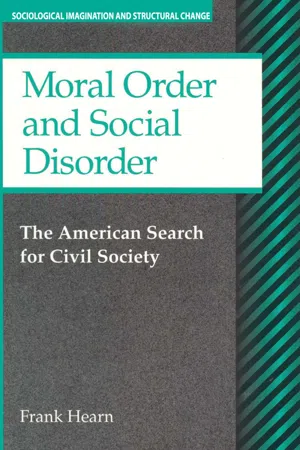
Drawing upon both classical insights and more recent writings, Hearn provides a compelling account of social breakdown in the United States. The book examines the conditions most responsible for the deterioration of social institutions, notably the family, and of communitarian interdependencies, such as those that support neighborhoods. More specifically, Hearn analyzes the defining forces of liberal modernity--among them, especially, the market economy (favored by the political right) and the democratic welfare state (endorsed by the political left)--whose steady expansion has diminished the social contexts that nurture trust, mutuality, and a robust sense of both personal responsibility and social obligation. The originality of Hearn's book lies in the solutions he proposes, which differ from those rooted in what Hearn calls ""the languages of modernity."" Hearn advocates modes that would serve instead to renew solidarity and reclaim social virtue, a repertory of strategies that would answer Emile Durkheim's call for the creation of moral individualism. He assesses various approaches to revitalizing the social settings, the social institutions, and communitarian structures within which people become moral individuals capable of care about and taking responsibility for the fates of others. Readers of this book are invited to draw their own conclusions by relying in larger part on themselves as parents, neighbors, community members, and citizen-participants in a civil society in restoration. As the American Journal of Sociology notes, ""the book succeeds in its goals, and it deserves to be widely read.""Frank Hearn was professor of sociology at the State University of New York, College of Cortland, and the author of Reason and Freedom in Sociological Thought and The Transformation of Industrial Organization.
Information
CHAPTER
1
Bad Parents
Parents have an obligation to raise and care for their children in ways that enable them to become competent and responsible adults and productive members of society. This age-old obligation is difficult to discharge, requiring as it does continuous, massive investments of attentive involvement and financial resources. Good parents recognize, take seriously, and strive to meet this obligation. In so doing, they make an indispensable contribution to the sustenance of a tolerable social existence. If a society is to endure, it must be capable of assuring that the parental obligation, the most basic and fundamental social obligation of all, is carried out effectively.
A large and growing number of parents in the United States fail the test of good parenting. The damage this has done to children and to social life is enormous. There is a long list of impressive reports and studies that support these claims. A 1994 Carnegie Corporation report, “Starting Points: Meeting the Needs of Our Youngest Children,” found that “millions of infants and toddlers are so deprived of medical care, loving supervision and intellectual supervision that growth into healthy and responsible adults is threatened” (Chira 1994). The report gives substance to Barbara Dafoe Whitehead’s (1993) claim that the current generation of American children is the first “in the nation’s history to do worse psychologically, socially, and economically than its parents” (p. 84). David Hamburg (1992:34) identifies a “generation in crisis,” a generation marked by rising rates of educational failure, delinquency, suicide, homicide, and teen pregnancy, fueled in part by “the decreasing commitment of parents to their children. Two-thirds of parents now report that they are less willing to make sacrifices for their children than their own parents would have been.” Mihaly Csikszentmihayli (1993), a leading student of childhood development, concludes his survey of the recent literature by noting that
the condition of our children seems to be getting worse from year to year, decade after decade. More of them live in poverty, fewer grow up in homes under the protection and guidance of two parents—and if they do, they seem to be getting less and less attention and comfort. More children are killed or commit suicide, are sexually or physically abused, become addicted to deadly substances, fall into chronic depression. Those who survive learn less in school than do their peers in most comparable countries, and are, therefore, less well prepared for a productive adulthood. (p. 31)
Propelling these developments, according to Whitehead (1993), is a shift in attitudes that started in the 1970s. As adult well-being took precedence over child well-being, what “had once been regarded as hostile to children’s best interests was now considered essential to adults’ happiness” (p. 52).
Currently, there are twice as many American children in substitute care as there were ten years ago, one sign that parents are relinquishing responsibility for their children (Ingrassia and McCormick 1994:53). There are other signs as well. In response to the growing incivility, unruliness, and violence unleashed by children of bad parents, towns and cities throughout the country have been implementing curfews; schools have installed armed security guards, electronic monitoring systems, and dogs trained to search out drugs; the federal government has threatened to regulate the television young people watch and the music they hear. Parental support for these and like measures is strong. “Feeling thwarted in trying to rear their children and enforce standards of behavior that at one time seemed clear and universal,” the New York Times (November 19, 1993, p. E4) reports, “parents are increasingly reaching out for help and welcoming any help that is volunteered. Many appear willing to subcontract a portion of their role to government, schools, and whatever communal vestiges remain in a mobile and complex society.”
Social problems in the United States tend to be addressed in terms of the “great divide” that has for so long characterized American politics, and the social problems attendant upon inept parenting are no different. On one side of the divide is the political Right, deriving solutions from the principles of the capitalist market economy; on the other is the political Left, resting its solutions on the extension of the principles of the democratic welfare state. The two views and the solutions they propose have real and significant differences, which often obscure what the two have in common. Both views embrace liberalism’s celebration of the individual, and both solutions have the same consequence, namely, the weakening of the social contexts within which people learn how to meet their obligations to others, to take those obligations seriously, and to develop the social control and self-control that enable them to regulate their interactions without the assistance of government-imposed curfews, armed security guards, and trained dogs. This is demonstrated by two representative and reputable proposals for dealing with the problem of bad parenting. The first is a market-based solution offered by James Coleman, who until his recent death was one of the most prominent and influential sociologists in the United States. The second solution draws on the principles and the resources of the democratic welfare state, and is advocated by Hillary Clinton, a lawyer and long-time activist in the children’s rights movement and an advisor and wife of President Clinton.
TWO SOLUTIONS
Working with market principles, James Coleman (1993) attributes the growing frequency of cases of bad parenting in modern society to the deterioration of the once-powerful self-interested motives parents had for devoting themselves to the resource-consuming tasks of effective child-rearing. This, Coleman argues, is the primary force driving the steady decline in parental attention to and involvement in the lives of their children, especially over the past quarter-century. In this context, increasing numbers of children never adequately develop their capacity to take responsibility for themselves and others, nor cultivate their skills and desires for working cooperatively in pursuit of common goals. Psychologically if not socially abandoned by the time they reach adolescence, they perform poorly in school, fuel ever-climbing rates of criminal and delinquent behavior and alcohol and drug abuse, and reach adulthood lacking both the social competencies that permit people to live together civilly and the technical skills and knowledge demanded by the modern world.
Forced to incur the steadily mounting costs of the welfare dependency, the unemployment, the antisocial behavior, and the general social decay that accompany the diminution of parental obligation, the state, Coleman claims, has a particularly strong interest in reversing this development. To do so effectively and efficiently, he argues, the state should establish a system of economic incentives designed to motivate more responsible parenting. The system would work by means of a bounty placed on the head of each child in society. Social scientists would make a statistical prediction of each child’s costs and benefits to the government, factoring into the prediction conditions such as the income level and family structure of the child’s household so that the bounty’s value would be higher “for the ‘difficult’ child than for the average child, because the potential gains for the state would be greater. It would be at least as strong for bringing a child from a prospective future of crime and drugs to self-sufficiency as it would be for bringing a child from a prospective middle income to a higher income” (Coleman 1993:14). At some future point, the prediction would be assessed against the person’s actual costs and benefits to the government up to that time. A percentage of benefits beyond the predicted amount and a percentage of savings from the expected costs would go to make up the value of each person’s bounty. The right to each child’s bounty would be vested in his or her parents, who would be free to transfer it contractually to others.
In Coleman’s view, the bounty system would elicit two responses, both of which would promote a more serious undertaking of the childrearing practices demanded by the parental obligation. First, the prospect of the bounty would have many parents conclude that it is in their economic self-interest to promote the care and involvement necessary for their children to become socially competent and productive members of society. Second, the recognition that many other parents would find the promise of future reward too distant or too meager would spur the growth of a market in childrearing. Private vendors would step forward in sufficient numbers to assume the all-important responsibility of raising children in ways that lower their costs and increase their benefits to the state, having purchased from parents their rights to the children’s bounties. With the proper enticements in place, Coleman insists, the parental obligation to raise children to become capable, competent, cooperative persons once again would be taken seriously, if not by parents themselves than by the profit-making sellers of good parenting to whom they have contractually transferred their children’s bounties.
Coleman’s proposal is couched in the rhetoric of the market. It presumes that the market offers the most effective way of regulating human behavior. If the state, or for that matter any agent, wishes compliance with a preferred form of conduct it simply needs to make that option economically attractive enough so that the benefits of compliance outweigh the costs. Drenched in the language of the market, Coleman’s solution sees parents as maximizers of utility, it portrays parental obligations as heavily dependent on selfish interests, it characterizes parent-child relations in terms of opportunity costs, and it is designed to facilitate the commodification of parental responsibility. The market principle, deemed “dollars for deeds” by Time magazine (May 16, 1994, p. 51), already operates in a variety of ostensibly nonmarket settings: An East Baltimore health clinic entices pregnant women to come in for monthly checkups with ten-dollar vouchers; a Massachusetts high school offers discounts at local businesses as a way of motivating students to pursue high grades; teenage girls in Leadville, Colorado, are promised one dollar for each day they avoid getting pregnant. The message is the one heralded by the market: people will meet their obligations to others only when it is in their own interests to do so.
A second solution to the problem of bad parenting draws from a rhetoric of rights, and in contrast to Coleman’s call for the expansion of market principles, demands the extension of the judicial and administrative principles of the welfare state. Currently, the two best-known proponents of this solution are Hillary Clinton and Penelope Leach, one of the world’s most influential experts on child care and development. Clinton and Leach have been long active in the effort to give children and adolescents the same rights as adults, so they too may have access to the protections afforded by the legal system and benefits provided by the welfare state.
“Human rights must include children, because they are human,” Leach (1994:204) argues. “Children’s rights must therefore, by definition, be the same as everyone else’s,” and thus should include the right to protection against physical punishment and the right to have a say in matters affecting one’s well-being. In the absence of these rights, Leach (1994:211, 213) avers, parents “can imprison children, extending time-out to hours spent locked in a bedroom or worse, or ‘grounding’ to days of house arrest, with virtual impunity,” and can commit bodily indignities on their children, ranging from corporal punishment to changing a toddler’s diaper and wiping her nose without asking for her permission and cooperation. As rights-bearing individuals, children would be accorded the protection of the state against arbitrary authority—including, and perhaps most especially parental authority, the exercise of which would be more tightly regulated and more subject to due process procedures. The force of law presumably would lessen the frequency of bad parenting by compelling parents to take more seriously the rights of their children.
Additionally, children as rights-holders would become entitled to state-provided benefits and programs deemed necessary for the satisfaction of their right to healthy development. The welfare state as guarantor of individual rights would assume ever-greater childrearing responsibilities—ranging from prenatal care to day care, to pre- and after-school programs, particularly where those rights-satisfying responsibilities were abridged by parents, and thus would bring more areas of childrearing under the control of legal regulations and administrative procedures. In the name of individual rights, the state would have an easier time intervening in the parent-child relation.
To facilitate this, Hillary Clinton (cited in Lasch 1992:78) opposes the existing “rebuttable presumption of childhood incompetency,” which requires “children and their allies” (namely, lawyers and state protective agencies) to prove the need for state interference in the exercise of parental authority, in favor of a “presumption of childhood competency,” which would give parents the burden of proving the wrongfulness of any state interference requested by their child. Leach endorses Clinton’s argument that children should be presumed competent unless proven otherwise, and thus have the right to be consulted on all matters involving their welfare. “If children’s human rights are to be respected and their childish needs met, they themselves must decide when, and if, it is in their best interests to be removed from their home and/or parents, and their care and protection must then be provided for accordingly” (Leach 1994:20). A demonstrably abused child should not be compelled to leave her parents and home if she prefers to stay. “Instead, the resources needed to deal with the current emergency or chronic situation should be taken to her” (p. 21). At the other extreme, courts should grant the request of a child to be removed from her parents and home “even if the parenting adult objects and abuse is not apparent and is denied” (p. 21). In both cases, the children’s right to decide is defended by the legal system, and their right to care and protection is met by services administered by the welfare state.
The title of Clinton’s recent book extols the village, not the welfare state, as the indispensable friend of parental obligation. Yet, underlying the book’s celebration of attentive parents supported by grandparents and friends, churches, PTAs, and grassroots community organizations is Clinton’s continued conviction that responsible parenting ultimately depends on the welfare state and its professional, legal, and therapeutic experts as the most reliable allies of children. Indeed, early on the village becomes the welfare state: “In the terrible times when no adequate parenting is available and the village itself must act in place of parents, it accepts those responsibilities in all our names through the authority we vest in government. That means our city, county, and state social welfare services…intervene in families to protect children on our behalf” (Clinton 1996:46). The increased frequency of inadequate parenting demands both an expansion of resources that permit child protective agencies to monitor suspect families, remove children if necessary, and counsel or decide to prosecute parents, and the “recruitment of qualified citizens to share with overworked social workers, lawyers, and judges the burden of moving children’s cases through the courts” (p. 49). In addition, the village as welfare state provides all parents “expert ‘coaching’ in children’s development” to allow them to base their practical childrearing decisions on the latest research (p. 54).
None of this, Clinton insists throughout, is designed to discourage the structures of mutual reliance and the systems of informal control that prompted responsible behavior in the village of old. There is much to be said for counting on kin and neighbors and peer pressure, but after it is said, we must conclude that “informal means of monitoring care are no substitute for formal systems” maintained by the welfare state (Clinton 1996:76). Dressed in village clothing, the welfare state not only supplies benefits and defends children’s rights, it also protects the family “from influences that threaten to undermine parental authority” (p. 313), most of which, in Clinton’s view, are promoted by the market—“consumer culture’s assault on values,” downsizing corporations, greedy executives, and the debilitating consequences of turbocharged capitalism (p. 293).
The road established by the Clinton-Leach argument takes us not to the village, but to the legalization and administrative oversight of the parent-child relation. This is recognized by Jack Westman, child psychiatrist and proponent of the effort to legally guarantee the basic civil rights of children. Westman advocates a national parenting policy, implemented by child advocacy teams comprised of well-trained professionals. Such a policy would give legal recognition to a child’s right to adequate parenting by establishing parent licenses that certify the childrearing competence of their holders. Currently, Westman (1994:217) notes, the government’s regulation of parenting is limited by child abuse and neglect laws, and the result is that “children now must suffer from incompetent parenting until they are damaged,” before they can be rescued by child protective teams. “With a licensing process the question of parental fitness would be faced before rather than after damage to a child. Licensing would hold a parent responsible for being competent rather than forcing children to endure incompetent parenting. The responsibility for demonstrating parental competence before a child is damaged would be with the parent, rather than the responsibility being with the state to demonstrate parental incompetence…as now is the case” (p. 239). Parental licensure thus would both shift the burden of proof from the state to the parents and make it easier for the state to intervene in families for the purpose of satisfying the rights of children.
In short, according to this view the problem of bad parenting is resolvable by extending to children the civil rights now possessed by adults. Such rights would circumscribe the exercise of parental authority, and parents, sensitive to the coercive power of the courts and the state responsible for defending these rights, would honor them more regularly. If the marketplace assumptions underlying Coleman’s proposed solution imply that people will meet their obligations only when it is in their self-interest to do so, the rights assumptions informing the Clinton-Leach solution suggest that people most likely will satisfy their obligations to others when pressured to do so by some coercive power or authority. Fear of reprisal, not economic incentive, plays the motivating role. When the state’s promise or threat to defend the rights of children fails to correct bad parenting, the state is obliged to honor these rights to respectful treatment and healthy development. In consultation with the affected children, the state, through its welfare programs, provides the resources required for their well-being and growth into competent and productive rights-bearing adults.
COMMODIFICATION AND JURIDIFICATION
Users of market rhetoric, like Coleman, find market principles and the market calculus at work in all areas of life. Coleman is very much influenced by the Chicago school of economics, home to the most articulate speakers of market rhetoric, the Nobel Laureates Milton Friedman and Gary Becker among them. They tell us, Alan Wolfe writes,
that marriage is not so much about love as about supply and demand as regulated through markets for spouses;…people should have the right to sell their body parts, after they are dead, to any willing buyer;…the best solutions to the problems of surrogate mothering is to allow parties to contract freely on the market with no government regulation; and a man commits suicide “when the total discounted lifetime utility remaining to him reaches zero.” (1989:32)
In market rhetor...
Table of contents
- Cover
- Half Title
- Title Page
- Copyright Page
- Dedication
- Table of Contents
- Acknowledgments
- Introduction
- Chapter 1. Bad Parents
- Chapter 2. Bad Neighbors
- Chapter 3. In The Absence Of Society: Liberal Individualism and Anomie
- Chapter 4. Moral Individuals: In The Presence of Society
- Chapter 5. Social Capital: Gifts and Sacredness In Society
- Chapter 6. The Politics Of Social Breakdown: Revitalizing Civil Society
- References
- Author Index
- Subject Index
Trusted by 375,005 students
Access to over 1.5 million titles for a fair monthly price.
Study more efficiently using our study tools.
Frequently asked questions
Yes, you can cancel anytime from the Subscription tab in your account settings on the Perlego website. Your subscription will stay active until the end of your current billing period. Learn how to cancel your subscription
No, books cannot be downloaded as external files, such as PDFs, for use outside of Perlego. However, you can download books within the Perlego app for offline reading on mobile or tablet. Learn how to download books offline
Perlego offers two plans: Essential and Complete
- Essential is ideal for learners and professionals who enjoy exploring a wide range of subjects. Access the Essential Library with 800,000+ trusted titles and best-sellers across business, personal growth, and the humanities. Includes unlimited reading time and Standard Read Aloud voice.
- Complete: Perfect for advanced learners and researchers needing full, unrestricted access. Unlock 1.5M+ books across hundreds of subjects, including academic and specialized titles. The Complete Plan also includes advanced features like Premium Read Aloud and Research Assistant.
We are an online textbook subscription service, where you can get access to an entire online library for less than the price of a single book per month. With over 1.5 million books across 990+ topics, we’ve got you covered! Learn about our mission
Look out for the read-aloud symbol on your next book to see if you can listen to it. The read-aloud tool reads text aloud for you, highlighting the text as it is being read. You can pause it, speed it up and slow it down. Learn more about Read Aloud
Yes! You can use the Perlego app on both iOS and Android devices to read anytime, anywhere — even offline. Perfect for commutes or when you’re on the go.
Please note we cannot support devices running on iOS 13 and Android 7 or earlier. Learn more about using the app
Please note we cannot support devices running on iOS 13 and Android 7 or earlier. Learn more about using the app
Yes, you can access Moral Order and Social Disorder by Frank Hearn in PDF and/or ePUB format, as well as other popular books in Social Sciences & Marriage & Family Sociology. We have over 1.5 million books available in our catalogue for you to explore.