eBook - ePub
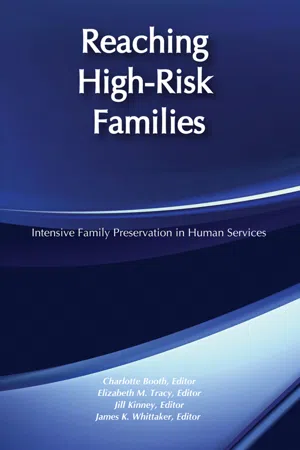
Reaching High-Risk Families
Intensive Family Preservation in Human Services - Modern Applications of Social Work
- 206 pages
- English
- ePUB (mobile friendly)
- Available on iOS & Android
eBook - ePub
Reaching High-Risk Families
Intensive Family Preservation in Human Services - Modern Applications of Social Work
About this book
Focusing on a program (""Homebuilders"") that has attracted national attention, this book develops implications for family-centered curricula in such areas as social policy, direct practice, program design/management, practice research, theory and prevention.
Information
Chapter 1
Family Preservation Services and Education for Social Work Practice: Stimulus and Response
James K. Whittaker and Elizabeth M. Tracy
Rationale for Family Preservation Services
Families with children at risk for out-of-home placement have long been a concern in the child welfare field. Traditionally, parents of children at risk for placement were viewed more as part of the problem, rather than as part of the solution. Out-of-home placement was seen as a substitute for an inadequate family. Few attempts were made to include parents in the decision making process prior to placement, or in the treatment process during placement (Whittaker, 1979). As a result of a renewed emphasis on “permanency,” however, child welfare services have experienced a shift from an overriding emphasis on child placement to a focus on family support (Stehno, 1986). This shift has affected the entire continuum of child welfare services. Placement and in-home services need no longer be viewed as mutually exclusive (Small and Whittaker, 1979).
In its broadest sense, permanency planning refers to activities undertaken to ensure continuity of care for children, whether that be action to keep families together, to reunite families, or to find permanent homes for children (Maluccio, Fein, and Olmstead, 1986). Strengthening the family’s knowledge, skills, and resources for parenting has become a critical concern. A variety of services designed to strengthen families and to prevent out-ofhome placement have emerged. In addition, supportive family services are increasingly recognized as elements in the aftercare service plan following placement (Whittaker and Maluccio, 1988). A still small but increasing number of residential programs incorporate services to families as part of preplacement and after care, as well as during the placement process. Overall, there is increased commitment to families of children in placement, as well as those at risk of placement.
Definition and Components of Intensive Family Preservation Services
Intensive family preservation services (IFPS), as discussed in this volume, are characterized by highly intensive services, delivered generally in the client’s home, for a relatively brief period of time. Family preservation services are closely related to “family-centered social services” (Hutchinson, 1983; Bryce and Lloyd, 1981; Lloyd and Bryce, 1984) in philosophy and rationale, but generally provide more intensive services to families over a shorter time period. The primary goals of IFPS are (1) to protect children, (2) to maintain and strengthen family bonds, (3) to stabilize the crisis situation, (4) to increase the family’s skills and competencies, and (5) to facilitate the family’s use of a variety of formal and informal helping resources. Typically, IFPS focus on the current situation; the intent is not to “cure” the family. The time-limited nature of these services sets upper limits on what outcomes can reasonably be expected, but the intensity of service, coupled with referral at the point of imminent risk of placement, produces a situation capable of dramatic change.
While there is no clear consensus on the exact nature of family preservation services and wide variation in how such services are delivered—or even by what name they should be called—such services are increasingly popular in child welfare. The National Resource Center on Family-Based Services, in Iowa City, currently lists over 200 such programs; by comparison, the first directory in 1982 listed only 20 programs. Over 60 separate programs are administered by state and county agencies, and a number of states have passed home-based legislation and are developing statewide programs. Still, many communities have limited preventive services.
Family preservation services differ along a number of dimensions: staffing patterns, auspices (public/private), target population, client eligibility, intensity of service, and components of service. Pecora, Fraser, Haapala, and Bartlome (1987) have identified key dimensions in the areas of treatment technique and services, program structure, and program outcomes, which can be used to compare and contrast different IFPS programs. These dimensions are helpful in making comparisons among different programs and in identifying key components of IFPS. The primary focus of this volume is the Homebuilders model, which is described more fully by Kinney et al. (this volume, Chapter 3), and which represents one end of the continuum of intensity and brevity of services.
Notwithstanding the differences among programs, there are a number of shared characteristics and features. Some reflect the nature of services delivered, while others reflect staff attitudes and values which are distinctive to this type of service. Elements common to both Homebuilders and other family preservation services programs include:
- Only families at risk of imminent placement are accepted.
- Services are crisis-oriented. Families are seen as soon as possible after referral is made.
- Staff are accessible, maintaining flexible hours 7 days a week. For example, Homebuilders give out their home phone numbers to families.
- Intake and assessment processes ensure that no child is left in danger.
- Although problems of individuals may be addressed, the focus is on the family as a unit, rather than on parents or children as problematic individuals.
- Workers see families in the families’ homes, making frequent visits convenient to each family’s schedule. Many services are also provided in school and neighborhood settings.
- The service approach combines teaching skills to family members, helping the family obtain necessary resources and services, and counseling based on an understanding of how each family functions as a unit.
- Services are generally based on identified family needs rather than strict eligibility categories.
- Each worker carries a small caseload at any given time. A limited number of programs make use of teams. Homebuilders work individually with team back up but have caseloads of only two families at a time.
- Programs limit the length of involvement with the family to a short period, typically between 1 and 5 months. Homebuilders typically work with a family over a 4-to 6-week period.
In short, the service delivery features of intensive preservation programs are designed to engage families in service (even those families who have “failed” in other counseling attempts), to keep them in service intensively for a time-limited period, and to increase the likelihood that they will benefit from service. IFPS provide a combination of services designed to deal with crisis situations, to enhance family functioning, to meet both concrete and clinical service needs, and to decrease the family’s isolation. Most IFPS work from family strengths and include use of extended family, community, and neighborhood resources (Lloyd and Bryce, 1984). These services make maximum use of a variety of worker tasks and roles-counselor, parent trainer, advocate, consultant, and resource broker.
Conceptual Framework
While the notion of providing support to parents is not necessarily new (Sinanoglu and Maluccio, 1981), a number of emerging trends within child welfare services are congruent with and have added to the impetus for family preservation services. The development, expansion, and future of family preservation programs take on more meaning when viewed in the broader context of child welfare service systems.
Theoretical Perspectives
The child’s need for continuity and stability, and the need to protect the parent-child bond from unnecessary state intervention have been recurring themes (Goldstein, Freud, and Solnit, 1973). The significance of the biological tie to the child’s identity (Laird, 1979), and the impact of separation on parent and child (Jenkins, 1981) are also important theoretical factors. Family integrity and the primacy of the parent-child attachment are among the strongest values in American society. Family preservation programs are congruent with this perspective since the primary purpose of these services is to avert unnecessary placement and to enable the child to remain at home safely.
Another theoretical perspective related to family preservation programs is the shift within human development research from a personalistic to an ecological perspective (Bronfenbrenner, 1979; Garbarino, 1982), which looks to the environment as both the source of and solution to children’s and families’ problems. This view considers both client’s competencies and clients’ environments (Whittaker, Schinke, and Gilchrist, 1986). The implications of this perspective are: (1) view the family as the unit of service, (2) increase parental skills and competencies, and (3) remove or reduce obstacles that interfere with coping (Maluccio, Fein, and Olmstead, 1986). This perspective is also congruent with the goals and methods of family preservation programs.
Child Welfare Reforms
Growing dissatisfaction with out-of-home placement, particularly foster care, has led to the search for alternatives and major policy shifts in legislation. During the 1960s and 1970s, the most frequent criticisms of the placement process within child welfare services included: (1) children were often removed from homes more frequently than necessary and often by default, due to the lack of alternatives; (2) children from minority, poor, and single parents were greatly overrepresented in foster care; (3) children were often placed in unstable and unnecessarily restrictive settings; and (4) little effort was made to keep biological parents involved, or to facilitate reunification of children and parents (Knitzer, Allan, and McGowan, 1978; Maas and Engler, 1959; Shyne and Schroeder, 1978). Fiscal policies favored out-of-home placement as opposed to preventive or supportive services. In many cases, biological families had continuing needs for services and supports even after the child’s return home (Fein, Maluccio, Hamilton, and Ward, 1983; Barth and Berry, 1987). The underlying hypothesis for family preservation services is that many more children could remain with their families if services were provided earlier and more intensively.
The passage of PL 96-272, The Adoption Assistance and Child Welfare Act of 1980, added new impetus to family preservation services. PL 96-272 requires that “reasonable efforts” be made to prevent family disruption, to reunite families where separation has been necessary, and to enable chil...
Table of contents
- Cover
- Half Title
- Title Page
- Copyright Page
- Table of Contents
- List of Contributors
- Foreword
- Introduction to the Volume
- Chapter 1. Family Preservation Services and Education for Social Work Practice: Stimulus and Response
- Chapter 2. Recognizing and Realizing the Potential of “Family Preservation”
- Chapter 3. The Homebuilders Model
- Chapter 4. Family-Based Services and Public Policy: Context and Implications
- Chapter 5. Theories Guiding Home-Based Intensive Family Preservation Services
- Chapter 6. Family Preservation Services and Social Work Practice Sequence
- Chapter 7. Designing and Managing Family Preservation Services: Implications for Human Services Administration Curricula
- Chapter 8. Applying Practice Research Methods in Intensive Family Preservation Services
- Chapter 9. Creating Social Change: “Mission-Oriented” Research and Entrepreneurship
- Chapter 10. Intensive Family Preservation Services: Broadening the Vision for Prevention
- Afterword
- Authsor Index
- Subject Index
Trusted by 375,005 students
Access to over 1.5 million titles for a fair monthly price.
Study more efficiently using our study tools.
Frequently asked questions
Yes, you can cancel anytime from the Subscription tab in your account settings on the Perlego website. Your subscription will stay active until the end of your current billing period. Learn how to cancel your subscription
No, books cannot be downloaded as external files, such as PDFs, for use outside of Perlego. However, you can download books within the Perlego app for offline reading on mobile or tablet. Learn how to download books offline
Perlego offers two plans: Essential and Complete
- Essential is ideal for learners and professionals who enjoy exploring a wide range of subjects. Access the Essential Library with 800,000+ trusted titles and best-sellers across business, personal growth, and the humanities. Includes unlimited reading time and Standard Read Aloud voice.
- Complete: Perfect for advanced learners and researchers needing full, unrestricted access. Unlock 1.5M+ books across hundreds of subjects, including academic and specialized titles. The Complete Plan also includes advanced features like Premium Read Aloud and Research Assistant.
We are an online textbook subscription service, where you can get access to an entire online library for less than the price of a single book per month. With over 1.5 million books across 990+ topics, we’ve got you covered! Learn about our mission
Look out for the read-aloud symbol on your next book to see if you can listen to it. The read-aloud tool reads text aloud for you, highlighting the text as it is being read. You can pause it, speed it up and slow it down. Learn more about Read Aloud
Yes! You can use the Perlego app on both iOS and Android devices to read anytime, anywhere — even offline. Perfect for commutes or when you’re on the go.
Please note we cannot support devices running on iOS 13 and Android 7 or earlier. Learn more about using the app
Please note we cannot support devices running on iOS 13 and Android 7 or earlier. Learn more about using the app
Yes, you can access Reaching High-Risk Families by Elizabeth Tracy in PDF and/or ePUB format, as well as other popular books in Social Sciences & Social Policy. We have over 1.5 million books available in our catalogue for you to explore.