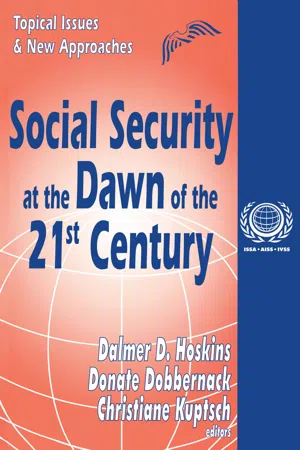
Presenting a periodic overview of the most significant developments and trends in the field of social security has become, for the International Social Security Association, a tradition and a firm commitment. Benefiting from the vast quantity of information uniquely available to the ISSA, its triennial review takes stock of the current state of social security world wide and focuses, through expert analyses, on some of the most pressing social security issues. Social Security at the Dawn of the 21st Century, the outcome of the most recent review, is intended to significantly extend the access of an international readership to accurate and up-to-date information and analyses on social security, which has without question developed during the twentieth century into one of the most important publicly financed and administered institutions in modern society. The chapters are grouped into two parts. Part one treats subjects related to policy trends and regional developments, with special emphasis on such important issues as redesigning social security programs, new management practices, and the informal care dilemma. It features major aspects of developments in Asia-Pacific and Latin America. Part two focuses on specific program areas, with special emphasis on problems and reforms in employment policy, pension systems, and public disability schemes. Information is also provided on new approaches to ensuring adequate access to health care and on policies in response to changes in family structures as well as an recent experience with social assistance programs.
eBook - ePub
Social Security at the Dawn of the 21st Century
Topical Issues and New Approaches
- 352 pages
- English
- ePUB (mobile friendly)
- Available on iOS & Android
eBook - ePub
Social Security at the Dawn of the 21st Century
Topical Issues and New Approaches
About this book
Information
Part 1
Policy Trends and Regional Developments
1
The Redesign of Social Security
As the 20th century draws to a close, it is appropriate to pause and to take stock of the current status of social security in the world and to reflect on the future possible directions of one of the most successful social and economic innovations of the current century. A worldwide consensus has emerged that social security is at a critical juncture in its development and that an objective and broad-based discussion, involving all of the social partners, is needed to redefine social security—to render it ever more relevant and understandable to the citizens of the world who will live in the next century.
The Rising Debate about the Future of Social Security
It is fair to say that social security policies have always been the object of intense criticism since their initial formulation over a century ago. Critics have long predicted a series of dire results stemming from the introduction of social security, such as the end of traditional family ties, the undermining of the work ethic or the elimination of individual savings. Public criticism of social security is in itself therefore nothing new or original.
What is striking in the present circumstance is however the growing intensity and even hostility of the debate about social security and the fact that the debate has spread into every corner of the world, regardless of the level of economic development or the extent of social security protection currently enjoyed by the populations. While social security managers and policymakers are accustomed to responding to criticisms of current social security arrangements, they are today surprised by the apparent loss of public confidence in the programs they administer and by the frequent questioning of the fundamental principles underpinning social security arrangements.
The reasons behind such a widespread phenomenon are many and complex but among the leading causes are the following:
- Globalization of national economies: Fewer and fewer countries can stand apart from worldwide economic trends. The growing divisions of labor in the world’s market place affects virtually every country. Industries which were formerly the mainstay of a national economy have within a few years been made obsolete by economic developments on the other side of the globe. Capital moves at incredible rapidity, as witnessed by the continuing economic crisis in Asia, taking advantage of currency fluctuations and brighter prospects for investment returns elsewhere. Even highly developed industrialized nations are unable to defend their economic interests on their own and are obliged to seek the assistance of the international financial institutions. It is thus hardly surprising that growing doubts are being expressed about the capacity of governments to decide on the kind and level of social security protection to be provided to their populations in a world where they are less and less in control of their own economic and financial destinies. One of the striking realities of globalization is that while governments are still able to tax labor, they have a far more difficult time taxing the ebb and flow of international investments and financial transactions. The irony is that just when governments need most to provide protection against unemployment and loss of income security, globalization renders them less able to do so.
- Dominance of market-oriented thinking : The close of the present century is strongly marked by the triumph of market-oriented approaches over other socio-economic models which have been formulated and tried in the modern era. The very notion that social protection can be in harmony with or even a positive factor in promoting economic growth has been called into question. Criticisms that have been around for decades, such as the charge that social security discourages savings or contributes to higher unemployment, have resurfaced with increased force. The critics of public pension provisions, in particular, have marshalled a growing number of supporters, both inside and outside of government, in favour of funded individual savings accounts by arguing that such schemes are able to create new savings and thereby foster higher economic growth. Ironically political support for funded pension schemes has increased in many parts of the world in spite of the fact that there exists little consensus among the economists themselves about the validity of these assertions.
- Loss of confidence in the ability of governments to plan for the future: Perhaps the gravest charge raised against social security at the end of this century relates to the lack of confidence, particularly among the younger generations, in the ability of nations to take collective and democratic decisions to ensure economic prosperity while, at the same time, maintaining a degree of social justice—solidarity—among the members of the population. This “crisis of legitimacy” of the public sector is not restricted to any particular country or region of the world. It may be closely related to the globalization of the flow of ideas and technology, but private solutions are routinely advocated instead of public solutions. State institutions are constantly accused of inefficiencies and poor service which the private sector could supposedly overcome. Most serious of all, citizens are more often expressing doubts about the ability of the political process to decide on the “fairness” of social security benefits (i.e., do those in need receive too little while those less in need receive too much or are some populations at risk more deserving of social security protection than others?).
There is no question that these worldwide trends in thinking and behaviour have left many social security managers and policymakers in a perplexed and even discouraged frame of mind. They are daily reminded of the fact that the debate about the future of social security is not being framed by social policy experts and specialists, who are the most knowledgeable about the operations and results of social security programs, but rather by the critics, particularly by those interested less in social protection than in fiscal policy and diminishing the role of the State.
A Turning Point in the Debate about the Future?
Evidence collected from the ISSA member organizations and elsewhere indicates that there is a sea-change occurring in the current debate about social security. The content of the debate is gradually shifting towards a more balanced discussion of reform options. The tone of the debate is becoming less polemical and less ideological. What has brought this about?
Recognition that the Risks Covered by Social Security are not Diminishing
The societies which embrace most citizens of the world have not become freer of risks and social security officials have been among the first to point out that the risks have in many parts of the world even increased. In a large number of the industrialized countries of the world, widespread unemployment remains a sad reality. Many OECD countries continue to display double digit unemployment figures in spite of the fact that such high rates have persisted for well over a decade and in spite of the fact that in some countries economic indicators have in recent years begun to take an upward turn. Employment creation in other lesser-developed countries has not markedly improved, particularly in Africa, and the risk of millions of persons losing their jobs, perhaps for the first time in their working lives, is a growing spectre in many countries affected by the spreading economic havoc in Asia.
The risk of poverty strikes large numbers of citizens even in the industrialized countries. The European Commission estimates, for example, that even after income transfers and other forms of social assistance, around 17 percent of all households in the European Union have income levels below half the national average, the measure conventionally used as an indicator to define that part of population at risk of deprivation.1 Without income maintenance and other forms of support provided by social protection schemes, the Commission estimates that almost 40 percent of all EU households would have income levels of under 50 percent of national averages.
The risk factor in old-age is equally striking in other parts of the world. In the United States, for example, the Social Security Administration estimates that without their national old-age pension program, 42 percent of the retired population would fall below the poverty line.
And, according to the World Bank’s World Development Report 1997, certain parts of the world have been particularly hard hit by economic restructuring, resulting in markedly higher poverty rates among their populations. Central and Eastern Europe and the countries of the Commonwealth of Independent States (CIS) have suffered one of the greatest deteriorations in the past decade. Poverty based on lack of income has spread from a small part of their populations to about a third, estimated at about 120 million people living below the poverty line. Sub-Saharan Africa has the highest proportion of people in—and the fastest growth in—poverty. Some 220 million people in the region are income poor. The World Bank estimates that by the year 2000 half of the people in Sub-Saharan Africa will be living below the poverty line.
No one would deny the fact that economic development is a powerful means of reducing poverty levels and is critical as well for sustaining a viable national social security system. However, the transition from planned economies to market economies has proven to be more difficult than anyone expected and has provided fresh evidence that economic development does not automatically ensure the desired level of social development. The short and medium-term costs of structural readjustment have not only been economic, following on the steep declines in GNP experienced by many countries. The costs have also been in terms of falling standards for health care and education, rising crime rates and in some countries actual reductions in life expectancy. While the transition to market economies and increased globalization of national economies have no doubt benefited certain categories of the population and even some nations more than others, there have been winners and losers both within countries and among countries.
The lesson is thus that economic growth and increasing globalization does not necessarily reduce poverty or increase the social security protection of citizens. As pointed out by the World Bank in its 1997 report, this lesson holds true even for certain advanced industrialized countries in Europe, North America and elsewhere which experienced good average growth during the period 1975-1995, yet the proportion of those in poverty increased.
It should be noted with a certain sense of irony that at the same time as the welfare state has been called into question, the number of those living in poverty has increased in many countries around the world.
Growing Evidence that Societies, if Willing to Plan,Can Afford to Grow Old
The “greying” of the population has been well documented and discussed; the implications of this worldwide trend for pensions, health and other branches of social security will continue to be the subject of research and evaluation for the foreseeable future. However, the noteworthy point to be made within the context of the current debate is that an impressive number of countries have succeeded in taking steps to ensure the financial stability of their public pension and other social security schemes well into the next century, thereby counteracting the charge that the 21st century will witness a bitter inter-generational warfare between the old and young. The reform approaches are as varied as the countries themselves, but there have been concerted efforts to reduce the widespread recourse to taking early retirement before the statutory retirement age, to gradually raise the statutory retirement age for both men and women, and to lessen the burden on public pension programs by encouraging the development of “multi-pillar” pension systems, financed by both pay-as-you-go and obligatory or voluntary funded pillars.
The debate over future pension policy is therefore slowly evolving into a more reasoned debate about how societies can strike a balance between the current consumption of workers and the aspirations for an adequate retirement income for today’s and tomorrow’s older citizens. There is a growing recognition that privatization is not the “magic bullet” and that a mix of financing approaches is a prudent way of guarding against the unpredictable performance of the market and other factors which impact on the level of economic output. The role of the State in ensuring adequate retirement income is no longer contested, since even the proponents of private and funded approaches concede that the State must provide a “decent” safety net to those who are not able to save for their old age and that the State must serve as the regulator (and some would even argue as guarantor) of privately managed pension arrangements.2
There are also a number of indications, including a major research effort by the OECD and the G9 countries, that the focus on retirement is shifting from being almost exclusively about financing to include considerations about the nature of retirement itself.3 Reform discussions are increasingly taking into account that existing pension arrangements often have powerful work disincentives embedded in their provisions which penalize people who would like to continue to work longer. And, more generally, there is a growing recognition that pension programs need to reflect the profound changes which have occurred in society due to the massive entry of women into the labor force, the trend toward smaller families, the much longer periods spent in education and the fact that the elderly are in general healthier in their later years than was the case for previous generations. This implies taking more explicitly into account a life-cycle perspective which will permit people to opt more readily for non-traditional work patterns, for family care periods, for lifelong learning and for gradual retirement. Retirement as a social concept is of relatively recent origin, having become widely established in national legislation only after the Second World War. The next century will no doubt witness a profound rethinking of the very definition of retirement.
While a certain optimism has begun to emerge about the capacity of societies to reform and reshape their old-age pension policies, the future of health care, particularly for the elderly, remains far less predictable. Since there will be more older people living to advanced ages in the future in all societies, it is naturally expected that the health care costs devoted to the elderly will increase, but by how much? It is anticipated for example that preventive health measures (anti-smoking, preventive screening, better exercise and nutrition, etc.) will have a positive impact on their physical well-being, but how much of an impact? One of the problems facing health care planners in assessing how much age-related health costs will rise is that there are not enough reliable data on the medical histories of individuals throughout their lifetimes. Are older people living longer today because they are receiving more and better medical care now than in the past? Or perhaps the health of the elderly has become much better because they were healthier throughout their lifetimes than previous generations. They are thus able to put off disabling and chronic conditions until later in life.
What is known is that the expenditure on health care rises dramatically in the year or two before death, irrespective of the actual age at death. Will it be possible to better control this sharp increase in medical expenditures just before death? Some new medical technologies and procedures may bring real savings at this juncture in the life cycle, whereas others, such as body parts transplants and prolonged intensive care, may bring brief quality of life improvements but also significant increases in expenditures in the last stages of life. Long-term care is thus becoming a major preoccupation in countries at all stages of development. As only a handful of countries have tackled the long-term care problem within the framework of social security protection, care of this sort has in almost all cases to be paid for out of the income and assets of the person concerned or of his or her family, until their resources are exhausted or the older person dies before that point is reached. It is for millions of the elderly around the world a distressing and financially ruinous way to end their lives. As the debate about old-age pension reform shifts into a more pragmatic phase, it is inevitable that social security planners and lawmakers will increasingly take up the issue of health care for the elderly, since there is growing concern that failure to tackle this issue could have potentially severe consequences on the availability of financing of other social security benefits.
Health care for the elderly cannot of course be separated from the on-going attempts in all countries to control health care costs while ensuring both access and quality care for the largest possible numbers of the population. There is ample evidence that more rationing of health services, including preventive care, is being introduced as well as more shifting of costs to the patient in order to slow down the rate of increase in health care costs. This development is not only triggering ethical problems about access to health services but also growing concern about falling standards in the quality of services.
Similar to the pension sector, the reform strategies to address the future financial solvency of health care systems often involve developing new patte...
Table of contents
- Cover
- Half Title
- Title Page
- Copyright
- Table of Contents
- Foreword
- Part 1: Policy Trends and Regional Developments
- Part 2: Program Areas: Issues and Reforms
- Contributors
- Index
Trusted by 375,005 students
Access to over 1.5 million titles for a fair monthly price.
Study more efficiently using our study tools.
Frequently asked questions
Yes, you can cancel anytime from the Subscription tab in your account settings on the Perlego website. Your subscription will stay active until the end of your current billing period. Learn how to cancel your subscription
No, books cannot be downloaded as external files, such as PDFs, for use outside of Perlego. However, you can download books within the Perlego app for offline reading on mobile or tablet. Learn how to download books offline
Perlego offers two plans: Essential and Complete
- Essential is ideal for learners and professionals who enjoy exploring a wide range of subjects. Access the Essential Library with 800,000+ trusted titles and best-sellers across business, personal growth, and the humanities. Includes unlimited reading time and Standard Read Aloud voice.
- Complete: Perfect for advanced learners and researchers needing full, unrestricted access. Unlock 1.5M+ books across hundreds of subjects, including academic and specialized titles. The Complete Plan also includes advanced features like Premium Read Aloud and Research Assistant.
We are an online textbook subscription service, where you can get access to an entire online library for less than the price of a single book per month. With over 1.5 million books across 990+ topics, we’ve got you covered! Learn about our mission
Look out for the read-aloud symbol on your next book to see if you can listen to it. The read-aloud tool reads text aloud for you, highlighting the text as it is being read. You can pause it, speed it up and slow it down. Learn more about Read Aloud
Yes! You can use the Perlego app on both iOS and Android devices to read anytime, anywhere — even offline. Perfect for commutes or when you’re on the go.
Please note we cannot support devices running on iOS 13 and Android 7 or earlier. Learn more about using the app
Please note we cannot support devices running on iOS 13 and Android 7 or earlier. Learn more about using the app
Yes, you can access Social Security at the Dawn of the 21st Century by Eugene Bardach,Donate Dobbernack in PDF and/or ePUB format, as well as other popular books in Politics & International Relations & Labour & Industrial Relations. We have over 1.5 million books available in our catalogue for you to explore.