- 272 pages
- English
- ePUB (mobile friendly)
- Available on iOS & Android
eBook - ePub
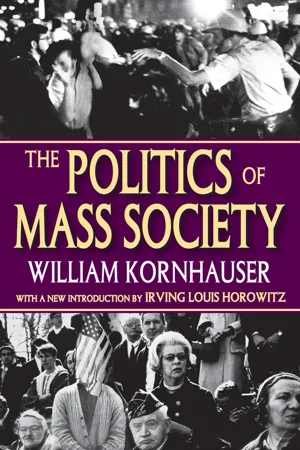
The Politics of Mass Society
About this book
The Politics of Mass Society explores the social conditions necessary for democracy and the vulnerabilities of large scale society to totalitarian systems. Mass movements mobilize people who are alienated from the social system, who do not believe in the legitimacy of the established order, and who are therefore ready to engage in efforts to destroy. Contrary to the psychological approach prevalent in European doctrines of mass movements, Kornhauser persuasively argues that social order is the critical factor. The greatest number of people available to mass movements are located in those segments of society that have the fewest ties to social order. The book draws on a wide range of materials--from classical political theory contemporary sociological analysis, historical and intuitional studies, public opinion surveys, and other published and unpublished data. Kornhauser selected political phenomena in organizations, communities, classes, and whole societies. He examined support for communism and fascism in a variety of countries in relation to rates of urbanization and industrialization, employment, and suicide and homicide among other phenomena. In his new introduction, Irving Louis Horowitz identifies Kornhauser's book as a seminal work of the great tradition in political sociology in the mid-twentieth century. Kornhauser points out that modern democratic systems possess a distinct vulnerability to mass movements. He spells out and identifies factors that tend to increase or decrease this vulnerability--not least the health and strength of elites. In this way, the book reveals new clues to the origins and nature of mass political movements. The Politics of Mass Society remains the most complete analytical account of the sociological approach to mass society in advanced industrial societies.
Information
Part I
Theory of Mass Society
Chapter 1
Two Views of Mass Society
THE THEORY of mass society has two major intellectual sources, one in the nineteenth century reaction to the revolutionary changes in European (especially French) society, and the other in the twentieth century reaction to the rise of totalitarianism, especially in Russia and Germany. The first and major source may be termed the aristocratic criticism of mass society; the second, the democratic criticism of mass society. The first centers in the intellectual defense of elite values against the rise of mass participation. The second centers in the intellectual defense of democratic values against the rise of elites bent on total domination. The defensive posture of the aristocrats has been adopted by democrats who, having won the nineteenth century war of ideas and institutions with the former, now seek to preserve their values against the totalitarian challenge.
Not all intellectual rejections of: revolutionary change have been based on the idea of mass society. Criticisms of nineteenth century trends that may properly be termed theories of mass society found the decisive social process to be the loss of exclusiveness of elites and the rise of mass participation in cultural and political life. Burckhardt (1955) * and Gustave Le Bon (1947) were among the leading aristocratic critics of mass tendencies in the nineteenth century; Ortega y Gasset (1932), and Karl Mannheim (1940, pp. 79-96), in his discussions of elites, are twentieth century representatives of this approach.1
Similarly, not all democratic criticisms of totalitarianism are based on a theory of mass society. Those which may properly be termed theories of mass society find the decisive social process to be the loss of insulation of non-elites and the rise of elites bent on total mobilization of a population. Emil Lederer (1940) and Hannah Arendt (1951) are leading representatives of this conception of the nature of mass society.2
Paradoxical as it may appear to be, these democratic critics have come to rely heavily on the intellectual weapons employed by aristocratic thinkers against the rising flood of democratic ideologists during the nineteenth century. The central idea taken over by these democratic theorists from their aristocratic critics is that the preservation of critical values (especially freedom) requires the social insulation of those segments of society that embody them. Aristocratic and democratic critics of mass society agree on this, even as they disagree on the content of the values to be preserved—especially the nature of freedom—and, correspondingly, on the segments of society that embody them.
The aristocratic notion of freedom emphasizes the conditions that permit men to act as they ought to act, that is, in accordance with standards of right conduct, Mannheim has noted that this idea of freedom is counterposed to an egalitarian conception: "Men,. . . [the aristocratic theorists] claimed are essentially unequal, unequal in their gifts and abilities, and unequal to the very core of their beings" (1953, p. 106). Standards of right conduct are most highly developed in the upper reaches of society, and therefore the "true bearers," the "true subjects" of liberty are the "organic communities" of aristocratic elites. "The 'liberty' of the different estates under feudalism which meant their 'privileges,' and the distinctly qualitative and non-egalitarian flavour which was contained in the medieval concept, is here revived once more" (Mannheim, 1953, p. 107). The traditional order based on moral law insulates aristocratic elites and thereby preserves liberty.
The democratic notion of freedom, on the other hand, implies the minimizing of social control (including that of the traditional order), that is, the removal of as many external constraints on the individual as is consistent with the freedom of his fellows. Freedom so conceived is dependent on equality of rights. This value is embodied in the whole community. Therefore, it is the independent group life of the non-elite which functions to preserve liberty, as independent groups insulate people from domination by elites.
In sum, these two versions of the mass society differ in their conception of freedom and the social foundations of freedom. One sees mass society as a set of conditions under which elites are exposed to mass pressures. The other conceives of mass society as a set of conditions under which noe-elites are exposed to elite pressures. Nevertheless, they share a common image of mass society as the naked society, where the direct exposure of social units to outside forces makes freedom precarious. We shall attempt to formulate a general theory of mass society that incorporates elements from both the aristocratic and democratic criticism. This is our objective in Part I of the present study.
But to reach this goal, it is necessary to explicate partial and polemical versions of the theory. Therefore, we consider first the major argument of the aristocratic criticism of mass society, and then we analyze the democratic criticism of mass society. First a word about the bases for distinguishing these two views.
Our interest is in analyzing the theoretical basis of each approach, rather than in examining the value orientation typically associated with each of them. The two approaches have been distinguished according to whether the condition of elites or the condition of non-elites is identified as the basic criterion of "mass society." This means that any theory that locates the decisive feature of mass society in the exposure of accessible elites to mass intervention is classified as "aristocratic," while any theory that, locates the essential feature of mass society in the exposure of atomized non-elites to elite domination is classified as "democratic." The choice of the terms "aristocratic" and "democratic" to describe these two theories should not obscure the fact that the classification is based on an analytical rather than a value distinction. However, there is an affinity between each of these theoretical positions and each value orientation. Most writers on mass society whose theories have focused on the loss of insulation of elites have also advocated aristocratic values, while most of those whose theories have focused on the loss of insulation of non-elites have also advocated democratic values. Nevertheless, there are some exceptions, for some writers hold values of the one type and expound theories of the other. When this occurs, the contributions are classified according to the theoretical, not the value, position of the Writer, This explains why Mannheim, for example, is cited as a representative of the "aristocratic" approach; though committed to the preservation of democratic values, his theory of mass society tends to stress the way in which mass participation undermines elite functions.3
There is a second point, relating to the theoretical nature of the classification (rather than its value relevance), that should be borne in mind. Our interest is in the logic of each argument, rather than in the work of particular theorists. A separate series of logically connected propositions about the nature of mass society is related to the major premise of each approach. A particular theorist may well incorporate aspects of both arguments in his writings, without thereby providing a clear outline of either argument or a general and systematic statement of the theory of mass society. It may sometimes happen, therefore, that the same writer is at one time cited in support of a proposition embodied in the aristocratic approach, and at another time cited in support of a proposition embodied in the democratic approach. This will occasion no confusion if it is recalled that ideas, not men, are the objects of classification. On the whole, it is true that those who adopt the major premise of one school tend to ignore the social processes central to the major premise of the other school. Yet there are some exceptions, particularly De Tocqueville, who analyzed not only the need for insulation of elites, but also the role played by multiple autonomous groups in the insulation of non-elites.
What follows is not an historical reconstruction of ideas on mass society, but a logical reconstruction of two major intellectual traditions that are intermingled in the literature on mass society. Our integrated statement of mass-society theory is based on elements drawn from both traditions. At the same time, it accepts the democratic concern with the identification of conditions favorable to the preservation of democratic values.
The Loss of Authority in Mass Society
During the nineteenth century, aristocratic critics of bourgeois society spun a rhetoric of pessimism concerning the value-standards men live by in an age of increasing materialism and equalitarianism. Le Bon crystallized this theme in sociological terms when he depicted the times as an "era of crowds," and spoke bitingly of crowds as vehicles in the downfall of civilization: "the populace is sovereign, and the tide of barbarism mounts" (1947, pp. 14, 207). Ortega popularized this thesis as the "revolt of the masses," a situation which leads to the "sovereignty of the unqualified" (1932, p. 25), Such present-day critics as T. S. Eliot (1948) use the term "mass society" in this pejorative sense to designate the alleged destructiveness of popular pressures on traditional values and elites.
Aristocratic theorists believe that liberty and equality are incompatible: "The spread, of democratic equal rights facilitates, as Nietzsche prophesied, the equal violation of rights" (Viereck, 1955, p. 96). The paradigmatic experiences underlying this imagery were the French Revolution and the 1848 revolutions against the ancient regimes. The heart of the imagery itself is the equalitarian society, without excellence, distinction, style, meaning. Such a (mass) society is viewed as lacking the moral basis for resisting Caesarism, for preventing political tryanny as well as cultural decay.
Thus De Tocqueville has written:
I believe that it is easier to establish an absolute and despotic government among a people in which the conditions of society are equal than among any other; and I think that if such a government were once established among such a people, it not only would oppress men, but would eventually strip each of them of several of the highest qualities of humanity. (1945, v. II, p. 322)
Thus Burckhardt has written:
So long as the masses can bring pressure on their leaders, one value after another must be sacrificed: position, property, religion, distinguished tradition, higher learning. (Quoted by Viereck, 1956, p. 159)
Thus Mannheim has written:
The open character of democratic mass society, together with its growth in size and the tendency towards general public participation, not only produces far too many elites but also deprives these elites of the exclusiveness which they need [to perform their functions]. . . . The lack of leadership in late liberal mass society can . . . be . . . diagnosed as the result of the change for the worse in selecting the elite. We must recognize further that it is this general lack of direction in modern mass society that gives the opportunity to groups with dictatorial ambitions. (1940, pp. 86-7)
Thus Lippmann has written:
Where mass opinion dominates the government, there is a morbid derangement of the true functions of power. The derangement brings about the enfeeblement, verging on paralysis, of the capacity to govern. (1956, p. 19)
The conception of mass society contained in such writings as these includes three major terms: (a) growing equalitarianism (loss of traditional authority); (b) widespread readiness to support anti-aristocratic forms of rule (quest for popular authority); (c) rule by the masses (domination by pseudo-authority). In this universe of discourse, "mass society" is the opposite of aristocratic order. Mass society is the condition under which rule by the masses —either directly or through the popularly supported demagogue—displaces aristocratic rule. This condition is equality of voice in the determination of social policy. Therefore, mass society is the equalitarian society, in which the masses seek to raise up leaders in their own image. As a result, it produces rule by the incompetent.
However, the incompetence of the many is not what distinguishes mass society, according to the aristocratic criticism., Mass society is new, whereas there always has been widespread ignorance in society.4 Mannheim observes in this connection that the student of such changes as the loss of distinctive art styles, the increasing intellectual indecisiveness, or the decline of leadership, "if he is not used to noticing the social mechanisms at work behind the immediate concrete events is inclined to believe . . . that human beings are today less talented and less creative and have less initiative than in...
Table of contents
- Cover
- Half Title
- Title
- Copyright
- Dedication
- Introduction to the Transaction Edition
- Preface
- Acknowledgments
- Contents
- List of Tables
- Introduction
- PART I THEORY OF MASS SOCIETY
- PART II SOCIAL SOURCES OF MASS MOVEMENTS
- PART III SOCIAL COMPOSITION OF MASS MOVEMENTS
- CONCLUSION
- References
- Index
Trusted by 375,005 students
Access to over 1.5 million titles for a fair monthly price.
Study more efficiently using our study tools.
Frequently asked questions
Yes, you can cancel anytime from the Subscription tab in your account settings on the Perlego website. Your subscription will stay active until the end of your current billing period. Learn how to cancel your subscription
No, books cannot be downloaded as external files, such as PDFs, for use outside of Perlego. However, you can download books within the Perlego app for offline reading on mobile or tablet. Learn how to download books offline
Perlego offers two plans: Essential and Complete
- Essential is ideal for learners and professionals who enjoy exploring a wide range of subjects. Access the Essential Library with 800,000+ trusted titles and best-sellers across business, personal growth, and the humanities. Includes unlimited reading time and Standard Read Aloud voice.
- Complete: Perfect for advanced learners and researchers needing full, unrestricted access. Unlock 1.5M+ books across hundreds of subjects, including academic and specialized titles. The Complete Plan also includes advanced features like Premium Read Aloud and Research Assistant.
We are an online textbook subscription service, where you can get access to an entire online library for less than the price of a single book per month. With over 1.5 million books across 990+ topics, we’ve got you covered! Learn about our mission
Look out for the read-aloud symbol on your next book to see if you can listen to it. The read-aloud tool reads text aloud for you, highlighting the text as it is being read. You can pause it, speed it up and slow it down. Learn more about Read Aloud
Yes! You can use the Perlego app on both iOS and Android devices to read anytime, anywhere — even offline. Perfect for commutes or when you’re on the go.
Please note we cannot support devices running on iOS 13 and Android 7 or earlier. Learn more about using the app
Please note we cannot support devices running on iOS 13 and Android 7 or earlier. Learn more about using the app
Yes, you can access The Politics of Mass Society by William Kornhauser in PDF and/or ePUB format, as well as other popular books in Social Sciences & Political Process. We have over 1.5 million books available in our catalogue for you to explore.