- 304 pages
- English
- ePUB (mobile friendly)
- Available on iOS & Android
eBook - ePub
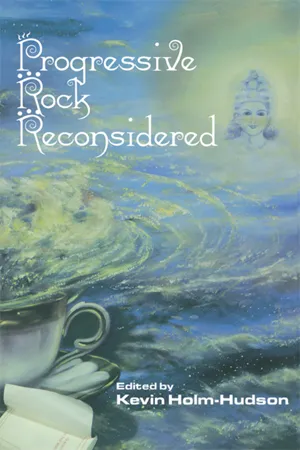
Progressive Rock Reconsidered
About this book
In this book, the glory days of progressive rock are relived in a series of insightful essays about the key bands, songwriters and songs that made prog-rock such an innovative style.
Information
 | History & Context |

Progressive Rock and the Inversion of Musical Values
Critical response to 1970s progressive rock was often brutal. Critics decried the genres virtuosity, complexity, and indebtedness to “classical,” or “art” music as a betrayal of rock’s origins. At its core, rock journalists’ reaction against the style stemmed from a countercultural political agenda: rock is supposed to be a rebellious music, a music that shocks the “establishment” and challenges its conventions. A style of rock so influenced by the music of the establishment—which seemed to aspire to the privileged status held by that music—could only be met with derision; indeed, progressive rock musicians were seen as no less than “war criminals.”1 Critics did not assert their program baldly in reviews, however; these were, after all, supposedly well-reasoned considerations of a given album. Writers hunted for a mode of criticism that would seem to attack the “music itself” to justify their preformed final judgment. “Authenticity” was characteristically the key weapon: the farther a progressive rock album was from rock’s rhythm-and-blues roots, from the ideals of a “natural” unstudied simplicity, the more seditious and treasonous the result.2
In John Koegel’s Rolling Stone review of The Yes Album (1971),3 for example, the simplicity represented by brief radio-friendly singles is missed: “The material consists of fewer short songs and more lengthy pieces. The only three-minute tracks on this record are ’The Clap,’ Steve Howe’s acoustic guitar quickie recorded at one of Yes’ concerts in London, and ’A Venture,’ a straightforward rocker sandwiched between a pair of longer compositions on the second side.” Songs of the desired length are not very important—they come across like “quickies” and “straightforward” tunes—while the focus is on the long pieces, characteristically described as “compositions.” The musical complexities are seen as unfortunate: Richard Cromelin’s review of Fragile (1972) asserts that “they’re good and they know it, so they tend to succumb to the show-off syndrome.”4 Self-consciousness is at issue here; “authentic” artists engage their music intuitively, while these musicians highlight surface virtuosity simply because they can. Their music is always mediated by technical display, which stands between artist and audience, and distances listeners from the music. The opening words of the Yes entry in The Rolling Stone Album Guide neatly summarize critical opinion: “Pointlessly intricate guitar and bass solos, caterwauling keyboards, quasi-mystical lyrics proclaimed in an alien falsetto, acid-dipped album-cover illustrations: this British group wrote the book on art-rock excess.”5 From the perspective of rock journalists, the displays of technique don’t communicate deep feelings and important messages; the strange and excessive tone colors stand in the way of natural expression; and the difficult-to-understand lyrics and visuals are not aimed at the common listener. All of the things that rock music should be doing, in their view, are not accomplished—or even attempted—in the progressive rock style.
Thus, when considering progressive rock within a more general history of rock music, the style and its chief progenitors appear as little more than a blip on the radar screen. In Robert Palmer’s Rock and Roll: An Unruly History, the longtime contributing editor to Rolling Stone includes no discussion at all of the progressive rock phenomenon during the early 1970s, nor are there even references to most of the major bands.6 Even more telling is John Rockwell’s “Art Rock” essay in the Rolling Stone Illustrated History of Rock and Roll.7 His portrait of rock history, from the perspective of the mid-1970s, takes the shape of an “organic” narrative chronicling a rise, maturity, and decline.8 While the progressive label would seem to imply forward movement, Rockwell instead sees the style as a clear sign of rock’s decadence and decay: “[T]here is a morphology to artistic movements. They begin with a rude and innocent vigor, pass into a healthy adulthood and finally decline into an overwrought, feeble old age. Something of this process can be observed in the passage of rock and roll from the three-chord primitivism of the Fifties through the burgeoning vitality and experimentation of the Sixties to the hollow emptiness of much of the so-called progressive or ’art’ rock of the Seventies.”9 Authenticity is once again the key. Rock’s roots are wrapped up in notions of the natural and simple, and a second stage of “vital” maturity occurs in the 1960s rock of the politically conscious counterculture. But progressive rock, which supposedly eschews those roots in favor of “artistic” complexities, results in a “hollow emptiness,” in a degeneration of rock’s former glory.
These considerations tie together the very different examples included in Jimmy Guterman and Owen O’Donnell’s humorous book The Worst Rock ’n’ Roll Records of All Time.10 The entries on their list are almost always one of two types: either crass commercial product— think Milli Vanilli—or pretentious, self-indulgent progressive rock. The poles come together with respect to the hallowed concept of authenticity, for both “slick product” and “incomprehensible complexities” are seen as avoiding the natural and simple, the province of “real rock.” Given progressive rock’s supposedly small role in rock history, the style warrants more than its fair share of attention in the book. Over 20 percent of the “33 1/3 Rules of Rock and Roll” are addressed to the style: “Rock-and-roll songs with an orchestral choir are bound to be horrible. … Rock lyrics are not poetry…. The quality of a rock-and-roll song is inversely proportional to the number of instruments on it.” Subtlety is not exactly the order of the day; rule 22 states that “formidable technical proficiency is never sufficient. This rule explains why art rock is always bad.”11 Signs associated with the art music tradition—whether the sound of a choir, poetic texts, the grandiosity of thick instrumentation, or even polished technique itself—are all seen as masking an inherent emptiness at the core.
Taken as a whole, the conventional criticisms of progressive rock highlight a special sort of value problem for the style. What is notable is not the critical disdain itself, but the mode of criticism, because it draws upon a value system diametrically opposed to the one most often used to evaluate music in Western society. Consider table 1.1, which outlines many of the ways genres, styles, repertories, or even individual pieces are often split into “high” and “low” categories. The parameters considered here cover “the music itself,” as well as aspects of context and reception. Of course, the list does not represent any sort of “truth"; rather, these are common strategies used to argue that a given piece of music is worthy (a “high” piece) or not (a “low” piece).
Although these notions often masquerade as objective evaluations, we can more properly recognize them as windows to certain biases and agendas. Indeed, the dichotomies listed are all familiar ones. “High” music in the Western tradition uses the tone colors and forces of the art-music tradition, while “low” music is filled with the trendiest sounds of artificial electric and electronic instruments. “High” music is said to be unified through organic processes of thematic development, distinct from the mere machine-like repetitions of “low” music. “High” music is complicated and innovative, stemming from people with high degrees of professional training, while “low” music is simple and derivative, the product of natural, casual craftspeople. “High” music is created by a composer, ideally a genius, who fixes the piece in a score, while “low” music is reproduced by performers who take liberties with the “music itself” at each playing. A related notion, then, is that “high” music is timeless, removed from its context and only about its internal structures; “low” music is instead a part of its context, which is inherently fleeting. The audience for “high” music is a well-educated elite who allow the music to work on their intellect as they sit, well-dressed, at silent attention; their “low” counterparts come from lower social strata, and allow music to entertain them and to affect their bodies as they dance, talk, and respond with applause when so moved. These qualities don’t really tell us much about the music at all, but they speak volumes on what we conventionally value.12
Table 1.1. Conventional “High"/"Low” Dichotomies.
| “High” | “Low” | |
| Label: | “Classical” | “Pop,” “Rock,” etc. |
| Forces: | Orchestra | Electric/electronic instruments |
| Coherence: | “Unified,” with “development"— material repeated, but with important differences | “Repetitive” |
| Historical force: | Traditional | Trendy, momentary in importance |
| Site: | Mind (intellectual) | Body (sexual) |
| Difficulty: | Complicated | Simple, common |
| Response: | Moving | Uninteresting |
| Background: | Professional training | Rough, casual, natural |
| Audience: | Fancy dress; silent attention | Comfortable; talking and applause |
| Class and Education: | Upper class, elite, well educated | Middle and low social strata, not highly educated |
| Purpose: | Abstract contemplation | Entertainment, background |
| “Author": | Composer | Performer |
| Originality: | Innovative | Derivative |
| Skill: | Genius | Craftsperson |
What is fascinating about the critical reception of progressive rock, however, is that the very signs commonly held as sources of value in the reception of Western music in general have become signs of the very opposite within the context of rock criticism. Table 1.2 lists many characteristics associated with progressive rock, and as can easily be seen, on its face the style appears to strive toward the realm of “high” music. The treatment of thematic material, rhythm and meter, harmony, and formal shape all tend toward the complex, at least from the point of view of standard rock music. Long compositions, multi movement structures, a focus on virtuosic instrumental sections, and an evocation of “orchestral” timbres all signal parallels to the symphonic repertory. And the audience, especially in the original context for the style (late 1960s-early 1970s southern England), is drawn from the white, educated, male, upper middle class—a privileged socioeconomic stratum, to be sure.
Table 1.2. Stylistic Characteristics of Progressive Rock (Derived from Edward Macan).
| Soundscape: | Reaching “beyond” conventional rock instrumentation; explorations of sound; focus on keyboards; acoustic versus electric sections |
| Thematic material: | Use of riffs (short repeating ideas); potential for “development” reminiscent of classical music |
| Rhythm & meter: | Syncopations, tricky rhythms; less reliance on 4/4 time signature |
| Harmonic progression: | Less reliance on “three-chord” songs, and the simplest chords |
| Lyrical material: | Mythology, nature, Utopia versus technology, modernism; surrealism |
| Visual material: | Elaborate surrealistic album covers; elaborate stage shows |
| Influences: | Use of blues, jazz, classical, folk, the Anglican Church, “exotic” musics |
| Length: | Longer songs; toward whole album (concept album) structures |
| Deployment of band: | Long instrumental sections; less focus on singer (tenor); virtuoso playing; “choral” vocal arrangements |
| Form: | Embellishment of traditional shapes (AABA, verse-chorus); less reliance on traditional shapes; unconventional forms |
| Site: | Toward the mind; less focus on the (dancing) body |
| Historical period: | Considered “flourishing” in the early- to mid-1970s |
| Historical setting: | Originally southern England, especially the London area; then, in the United States |
| Cultural influences: | Psychedelia, late-1960s counterculture (against “establishment, “largely metaphorical) |
| Audience: | White, educated, upper middle class; slight differences in the United States. |
| Gender: | Primarily male musicians; primarily male audience |
However, from the point of view o...
Table of contents
- Cover Page
- Half Title page
- Title Page
- Copyright Page
- Contents
- Acknowledgments
- Introduction
- Part 1 History & Context
- Part 2 Analytical Perspectives
- Part 3 “Don't Dare Call Us ‘Progressive’” “Post-Prog” and Other Legacies
- Notes on Contributors
- Index
Trusted by 375,005 students
Access to over 1.5 million titles for a fair monthly price.
Study more efficiently using our study tools.
Frequently asked questions
Yes, you can cancel anytime from the Subscription tab in your account settings on the Perlego website. Your subscription will stay active until the end of your current billing period. Learn how to cancel your subscription
No, books cannot be downloaded as external files, such as PDFs, for use outside of Perlego. However, you can download books within the Perlego app for offline reading on mobile or tablet. Learn how to download books offline
Perlego offers two plans: Essential and Complete
- Essential is ideal for learners and professionals who enjoy exploring a wide range of subjects. Access the Essential Library with 800,000+ trusted titles and best-sellers across business, personal growth, and the humanities. Includes unlimited reading time and Standard Read Aloud voice.
- Complete: Perfect for advanced learners and researchers needing full, unrestricted access. Unlock 1.5M+ books across hundreds of subjects, including academic and specialized titles. The Complete Plan also includes advanced features like Premium Read Aloud and Research Assistant.
We are an online textbook subscription service, where you can get access to an entire online library for less than the price of a single book per month. With over 1.5 million books across 990+ topics, we’ve got you covered! Learn about our mission
Look out for the read-aloud symbol on your next book to see if you can listen to it. The read-aloud tool reads text aloud for you, highlighting the text as it is being read. You can pause it, speed it up and slow it down. Learn more about Read Aloud
Yes! You can use the Perlego app on both iOS and Android devices to read anytime, anywhere — even offline. Perfect for commutes or when you’re on the go.
Please note we cannot support devices running on iOS 13 and Android 7 or earlier. Learn more about using the app
Please note we cannot support devices running on iOS 13 and Android 7 or earlier. Learn more about using the app
Yes, you can access Progressive Rock Reconsidered by Kevin Holm-Hudson in PDF and/or ePUB format, as well as other popular books in Media & Performing Arts & Music. We have over 1.5 million books available in our catalogue for you to explore.