eBook - ePub
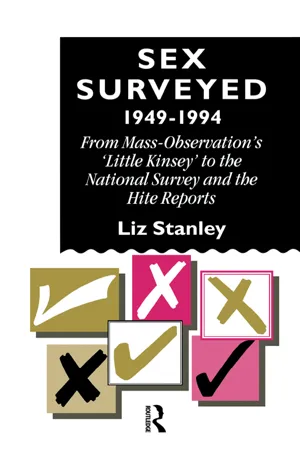
Sex Surveyed, 1949-1994
From Mass-Observation's "Little Kinsey" To The National Survey And The Hite Reports
- 258 pages
- English
- ePUB (mobile friendly)
- Available on iOS & Android
eBook - ePub
Sex Surveyed, 1949-1994
From Mass-Observation's "Little Kinsey" To The National Survey And The Hite Reports
About this book
First published in 1995. This book provides the only feminist overview of the development of both the mainstream and the feminist variant of the survey as a means of investigating sexual attitude and behaviour. Illuminating reading for the general reader, essential for students on Sexuality, Methodology, Women's Studies a d British Modern Social History courses and key text for all Sociologists.
Information
Publisher
Taylor & FrancisYear
2014Print ISBN
9780748403684
9780748403677
Edition
1eBook ISBN
9781135346577
Section Two
‘Little Kinsey’: Mass-Observation’s Sexy Survey of 1949
Editorial Annotations
[word/s] indicates either a doubtful reading of the original text, or an editorial insertion using material from elsewhere in the ‘Little Kinsey’ manuscripts
[….] indicates a gap in the original text or the editorial omission of repititions
Preface
The present report by Mass-Observation, the 18th it has published, breaks rather new ground, not only for Mass-Observation but for social research in this country generally.
A report of this character is liable to lead to considerable controversy. Accuracy of method is particularly difficult. And the prejudices which all factual reports evoke from biased persons are likely to be especially acute in dealing with the present subject.
Although closely associated with Mass-Observation since its inception, I happen to have had no direct part in this survey of sex life in Britain. So, perhaps, a brief word here may clarify certain points both from the position of one with inside knowledge and one without direct interest in the outcome of the particular case.
In the first place, it cannot be too emphatically stated that this is not an attempt to do a British Kinsey Report. The Kinsey investigation lasted for years and covered 12,000 people. It relied on exhaustive methods of interviewing – so exhaustive that it has been severely criticised on the grounds of method. The Kinsey sample has also been severely criticised by Crossley, Gallop and others on the grounds that it is not representative. Nevertheless, Kinsey has lifted the lid off problems which before have seldom or never been discussed from any sort of factual basis.
The present report attempts both something less and something more than Kinsey. The less is evident to the most casual reader. Here he will find none of those gigantic tables of correlations or imposing bibliographies. On the other hand, here he may find more of the actuality, the real life, the personal stuff of the problem, freed from an excess of methodological and statistical background. In subjects of this character, no known method of social research at present produces results which can be called statistically accurate on any far-reaching analysis. On the contrary, in seeking after such a superficial and easily misleading validity of the exact percentage, the human material behind the figures can easily be lost – as it is, I think, in parts of the Kinsey Report.
In the second place, this report requires special comment with regard to its finances and origins. For a very long time Mass-Observation has been wanting to do a survey of this character, just as from the very beginnings of Mass-Observation we have been wanting to study other broad and fundamental problems. It has seldom been possible to do what we want, because money has usually only been forthcoming to make practical or consumer research studies of a short-term nature. Or, during the war, to do ad hoc investigations for the Government. We have always been glad to undertake this work. No social research organisation should ignore the every-day problems of practical life, economics and administration. But far too seldom have we had the opportunity to carry out fundamental research in fields where, for various reasons, the technique which we have developed over the past twelve years would contribute something special. In the present instance, once the Kinsey Report had been published in America the idea of work on this particular subject became suddenly fashionable in England. Even so, it is remarkably difficult to get funds to carry out anything which is realistic and not embedded in academic qualifications. The Sunday Pictorial’s offer to buy newspaper rights in the survey, therefore, made our task much easier.
For this, we are deeply grateful to the Sunday Pictorial. It left us entirely free to do the survey in any way we liked. In character and presentation it differs in no way from many other[s] of our published reports. The Sunday Pictorial had the right to read this report in the first place, and from it to extract material for a series of articles. This they have done. In the past dozen years Mass-Observation has dealt, I think, with practically every national daily, weekly and monthly, as well as with innumerable local and technical papers. One of the greatest difficulties has always been to prevent many of these papers from presenting our material in a manner liable to over-emphasize certain points or distort the over-all emphasis – e.g. by sub-editing our phrases, putting in cross-heads or editorial commentary. The Sunday Pictorial played the game by our results, and have (as far as Mass-Observation is concerned) provided an object lesson of editorial good manners.
The scale of this survey is very much less than that of Kinsey. It has been carried out by only two dozen whole-time investigators, talking to 2,052 people, watching [many more], with additional information from about [450] voluntary observers, over a total period of months. It is essentially a preliminary reconnaissance of the field. It makes no claim to be any more than that. For Mass-Observation, the reconnaissance has been invaluable and we now see our way clearly to making much fuller studies with the machinery of investigation already established and the numerous co-operative contacts already made. It remains to be seen if there is anyone ready to finance what is next required – a very extensive survey carrying on from where this one leaves off, yet still realistic and alive and in touch, not pedagogically concerned with fractional differences and decimal distinctions in place of deep meanings and detailed understanding.
The work throughout has been assisted by the helpful advice of several people who have specialised in the study of sex from various points of view. They have assisted in planning the research and have made many helpful comments on the presentation of the material and the conclusions drawn from it. They are not in any way to be held responsible for the report as a whole, but the report has certainly benefited from their generous interest and in nearly every case the suggestions they have made have been adopted. We therefore have gratefully to thank them.
Tom Harrisson, 8 June 1949
Chapter One: Sex Surveyed
The first problem confronting Mass-Observation when it undertook to make a survey of sex was, quite simply, ‘is it possible?’. Kinsey in America had already achieved a detailed investigation into the sex habits of the American male. But it seemed likely that English people, less accustomed to questioning, and living in a social atmosphere less heavily charged with the publicity of sex, would prove a more difficult proposition.
It was partly because of these doubts that we decided, reluctantly, more or less to by-pass sex habit for the time being, instead to confine ourselves largely to the study of attitudes. Other equally important reasons for this decision were the limitations of time and money, necessitating concentration on one main aspect of sex, as well as, above all, our conviction that a picture of habit alone, detached from its dynamic context of motive and opinion, is liable to be to some extent misleading. In order not to fall into the opposite trap of producing a sketch of attitudes totally unsupported by the relevant facts of behaviour, we planned to supplement our large-scale survey of attitudes with a smaller investigation into the sex habits of a single group, not necessarily representative of people in general; Mass Observation’s National Panel of Voluntary Observers (note 1), a group of people accustomed to regular questioning on all aspects of their life and outlook, proved suitable for this purpose. In addition we intended to carry out a penetrative observational investigation into the social set-up of sex in two study areas – in this report called ‘Churchtown’ and ‘Steeltown’ – chatting informally with inhabitants, observing pubs, dance halls, parks etc., interviewing officials, generally penetrating (note 2) deeply, probing into the life of the area.
These were three of the [four] main facets of our scheme: a national sample of attitudes to sex – forming the basic framework to the survey; the sex habits of a single group; and the study of our investigators into varying social patterns of sex. The fourth aspect that we felt necessary to investigate at least superficially was the nature of contemporary opinion forming influences; following up on this we sent postal questionnaires to groups of randomly selected doctors, teachers, and clergymen; we also attempted to collect a sample of the popular literature of sex. Appendix 3 (note 3) discusses in detail the scope and methodology of the whole survey.
Plans for surveys are relatively easy to make; it is more difficult to carry them out, and an even greater problem to decide whether or not they have proved successful. But preliminary piloting of questionnaires soon showed at least that most British people are willing – even pleased – to talk about sex to an unembarrassed interviewer. Throughout our survey we were constantly surprised by the contrast between our own initial expectation of inhibition, embarrassment and rebuff – and the friendly and co-operative manner with which questions were answered. Of all the 2,052 people interviewed, fewer than 20 (less than 1%) refused to continue once the questionnaire’s emphasis on sex had been disclosed. On the contrary, 11% agreed to give their name and address in order that they might answer later questions of a more intimate and personal nature. During the whole survey there were no ‘scenes’ or incidents more unpleasant than that involving the very untypical middle class housewife, who terminated her interview before it had properly begun, by saying that: “We never mention the word sex in the class of society I belong to.” (68 year old housewife, Oxford).
If willingness to talk freely and co-operatively is a guide to honesty, then for the most part our results genuinely reflect at least what people think they think. Glibness, on the other hand, may conceal a tendency to give the socially correct answer; it may be quicker and less embarrassing, for instance, to say that extra-marital relations are ‘disgusting’ than to confess to a more unconventional opinion. It is most unlikely that our results are unaffected by this prestige tendency to give the ‘correct’ reply – particularly since many people are at least partly unaware of their ‘dishonesty’. On the other hand, it is often possible to detect distortion at whatever level of conversation it occurs; the M-O technique of broadly framed open-end questions with replies recorded verbatim is partly designed to counter this problem. It is possible to weigh up each reply thoroughly, setting it in its context of the tenor of the whole interview, as well relating it to the general background of the respondent. Assessing and reassessing our material in this way, both investigators and analysts felt that results, on the whole, represented what people think – in so far as they are themselves aware of their own opinions.
On the subject of honesty, the final word had best come from an outside source. One of the expert board of Assessors (note 4) that M-O persuaded to advise it on this survey spent a morning with a regular M-O investigator, not only watching interviews, but also making notes himself. He reported:
“It proved possible to question people on their attitudes to sex, & their replies seem, on the whole, to have been fairly honest. But even so, our investigation inevitably has many limitations. It was intended only as a piloting survey and as such the field it covered was deliberately narrowed; but even as a survey of sex attitudes is by no means comprehensive. It is essentially a superficial survey, incapable of penetrating deeply into the dynamics of sexual attitudes and feelings. In addition we were only able to cover attitudes to the broader aspects of sex, and to its most prominent institutions – marriage, divorce and prostitution. We have only indirect measures, for instance, of […] opinion on the less socially acceptable sources of sex outlet – notably homosexuality and masturbation. Moreover, carrying out a survey which is unprecedented in this country, our inexperience inevitably led to errors, largely of terminology, which later investigations should be better able to avoid. But above all, future surveys on the subject of sex will be emboldened by the knowledge that it is possible – at least for a stranger who is himself not embarrassed – to question people on almost any aspect of sex. Had we realised this earlier we would have extended our survey to include popular attitudes to homosexuality and masturbation”.
But although most people have shown themselves prepared to speak freely about sex, this does not mean that the tradition of British reticence on this subject is a popular figment. Many lengthy interviews retained a faint suggestion of uneasiness lurking behind them, sometimes a barely perceptible suggestion of relief when all the questioning was over; and most started off with something of an initial show of surprise or embarrassment, even when the firmly matter of fact tone of the interview quickly transformed this into interest and even pleasure. Our questions quite clearly elicited interesting reactions not only between types of personalities, but often also within single individuals; many people are anxious and pleased to discuss sex – but remain faintly uneasy in a discussion which they seem otherwise to enjoy. Outside the sphere...
Table of contents
- Cover
- Half Title
- Title Page
- Copyright Page
- Table of Contents
- Acknowledgements
- Section One: Mass-Observation, ‘Little Kinsey’ and the Sex Survey Tradition
- Section Two: ‘Little Kinsey’: Mass-Observation‘s Sex Survey of 1949
- Section Three: The Feminist Surveys Back
- References
- Subject Index
- Author Index
Trusted by 375,005 students
Access to over 1.5 million titles for a fair monthly price.
Study more efficiently using our study tools.
Frequently asked questions
Yes, you can cancel anytime from the Subscription tab in your account settings on the Perlego website. Your subscription will stay active until the end of your current billing period. Learn how to cancel your subscription
No, books cannot be downloaded as external files, such as PDFs, for use outside of Perlego. However, you can download books within the Perlego app for offline reading on mobile or tablet. Learn how to download books offline
Perlego offers two plans: Essential and Complete
- Essential is ideal for learners and professionals who enjoy exploring a wide range of subjects. Access the Essential Library with 800,000+ trusted titles and best-sellers across business, personal growth, and the humanities. Includes unlimited reading time and Standard Read Aloud voice.
- Complete: Perfect for advanced learners and researchers needing full, unrestricted access. Unlock 1.5M+ books across hundreds of subjects, including academic and specialized titles. The Complete Plan also includes advanced features like Premium Read Aloud and Research Assistant.
We are an online textbook subscription service, where you can get access to an entire online library for less than the price of a single book per month. With over 1.5 million books across 990+ topics, we’ve got you covered! Learn about our mission
Look out for the read-aloud symbol on your next book to see if you can listen to it. The read-aloud tool reads text aloud for you, highlighting the text as it is being read. You can pause it, speed it up and slow it down. Learn more about Read Aloud
Yes! You can use the Perlego app on both iOS and Android devices to read anytime, anywhere — even offline. Perfect for commutes or when you’re on the go.
Please note we cannot support devices running on iOS 13 and Android 7 or earlier. Learn more about using the app
Please note we cannot support devices running on iOS 13 and Android 7 or earlier. Learn more about using the app
Yes, you can access Sex Surveyed, 1949-1994 by Liz Stanley in PDF and/or ePUB format, as well as other popular books in Social Sciences & Health Care Delivery. We have over 1.5 million books available in our catalogue for you to explore.