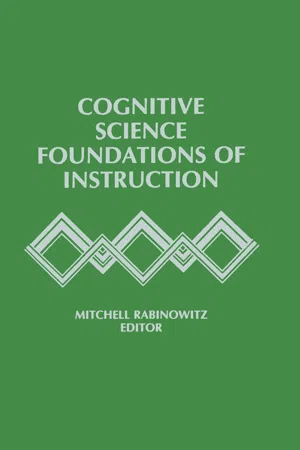
This volume presents and discusses current research that makes the connection between cognitive theory and instructional application. Addressing two general issues, the first set of chapters specifies the relation between cognitive theory and the development and evaluation of instruction, while the second set deals with the questions involved in understanding and assessing cognitive skills.
The outstanding feature of these chapters is that they all present in-depth discussions of the theoretical issues underlying instructional decisions. Many present specific implementations that provide examples of concrete applications of theory. In addition, the settings for implementing these examples span a broad range of instructional areas and environments, illustrating the generality and transferability of the application of theory to practice.
- 256 pages
- English
- ePUB (mobile friendly)
- Available on iOS & Android
eBook - ePub
Cognitive Science Foundations of Instruction
About this book
Information
1 Proficient Autonomous Learning: Problems and Prospects
John W. Thomas
William D. Rohwer Jr
University of California, Berkeley
Current portrayals of productive outcomes of learning often contrast sharply with actual outcomes of learning. Cognitive science approaches to education, for example, have described productive learning outcomes as consisting of knowledge structures, including embedded skills, that are organized around the central principles of a specific domain. These structures furnish experts in a domain with powerful resources for representing and solving a wide range of problems, whether classic or novel.
In contrast, descriptions of the capabilities of high school and college graduates portray students whose learning outcomes equip them, at best, to solve only stylized textbook problems (Schoenfeld, 1985). Confronted with problems cloaked in the garb of the real world, these students evidently lack the resources to frame the problems with reference to principled knowledge structures, and thus to solve them on their own. Their learning, then, has not resulted in the construction of productive knowledge structures.
In addition to identifying the character of productive outcomes of learning, cognitive scientists have also furnished analyses of the sources of dysfunctional learning outcomes. Schoenfeld, for example, has argued that the construction of powerful knowledge structures in the domain of mathematics requires the kind of learning that results from participation in courses that embody a culture of mathematical inquiry. In contrast to such minicultures of mathematical inquiry, Schoenfeld’s observations revealed that actual mathematics courses embody instead a culture that induces students to believe that mathematics is useful in finding single right answers to stylized textbook problems, but not for mapping real-world problems into a system that offers powerful solutions. Similarly, Bereiter (1990) described the “schoolwork module” that operates in secondary school settings. According to this module, responsibility for learning is vested in the teacher; the role of the student is to carry out assigned work. Bereiter (1990) stated: “Fully situated in the school environment, the schoolwork module tends to prevent the activation of modules adapted to larger contexts of learning and makes it likely that what is learned will be too closely tied to characteristics of the school environment to transfer beyond it” (p. 619).
These analyses suggest that the proper outcomes of learning are not only domain specific; they are course specific as well. The proposition is that learning outcomes associated with academic courses vary with the manner in which those courses are conducted as well as with the subject matter addressed. In our research we have undertaken to verify this proposition and related ones as well.
Recent research on studying reveals that an understanding of its character and effects requires attention to the concurrent influence of several factors. These factors include entering characteristics of students, the cognitive and self-management activities that students engage in while studying, the proximate aspects of the study task, including materials and directions, and the more distal aspects of the setting, including the nature of the criterion and other features of the course of instruction (Brown, Bransford, Ferrara, & Campione, 1983; Entwistle, 1987; Thomas & Rohwer, 1986).
Studying involves learning that is isolated, effortful, often ill defined, and largely under a learner’s direction and control. Students engaged in academic studying must process the to-be-learned material on their own. Often, they must play the role of the teacher, selecting material to study, reminding themselves of the criterial task, developing integrative study aids, and providing rewards. Moreover, students are largely responsible for carrying out task management activities as well, allocating study time, initiating study sessions, monitoring progress, evaluating readiness, and so forth. For these reasons, we refer to academic studying as autonomous learning, to distinguish it from the kind of studying in which direction and control are largely vested in an instructor or supervisor.
In the four sections of this chapter we describe prospects and problems associated with the development of autonomous learning proficiency. First, we set forth heuristic models of the cognitive and noncognitive components that autonomous learning comprises. Second, we discuss some of the educational policies and practices that stand in the way of improving autonomous learning proficiency. Finally, we present a projection of the characteristics of courses that act to promote or impede students’ engagement in autonomous learning and the development of autonomous learning proficiency.
Components of Autonomous Learning Proficiency
Two major approaches have been followed in attempting to define the components of proficiency in autonomous learning. When such learning is equated with studying, the traditional approach has been psychometric, through the use of factor analytic and correlational methods. A second means of establishing the component aspects of autonomous learning has been to compare examples of proficient and less than proficient studying, either through comparing the behaviors of experts and novices or through comparing the performance of trained and untrained students.
The psychometric approach has largely relied on the administration of questionnaires designed to assess students’ styles of or approaches to learning (Biggs, 1978; Entwistle, 1988; Goldman & Warren, 1973; Pask, 1976; Schmeck & Grove, 1979), or more recently, their study strategies (Weinstein, Zimmerman, & Palmer, 1988) or study activities (Christopoulos, Rohwer, & Thomas, 1987). Particular study factors or scales are then defined and the relationship of these factors or scales to other personological variables or to outcome measures are examined. The strength of this approach is its potential for revealing relationships among a wide variety of psychological constructs. Biggs and Entwistle, for example, described three kinds of students, each having distinct approaches to studying and motivational characteristics.
Unfortunately, the psychometric approach has not been entirely satisfactory for providing a foundation for a psychology of studying (Rohwer, 1984). Most of the inventories upon which these investigations are based have low subscale reliability, have not been validated as diagnostic tools, have been administered without reference to particular subject matter domains, contexts, or course demands, and have questionable validity, in part because they are easy to fake (Rohwer, 1984; Weinstein et al., 1988). In addition, these instruments have not yielded information on the developmental or hierarchical relationships among particular study activities.
The expert–novice approach has revealed that successful students seem to differ from their less successful peers on the basis of the number and nature of strategies they bring to bear on a task (Paris, Lipson, & Wixson, 1983) and on the basis of their facility at selecting and monitoring strategies in task-appropriate ways (Pressley, Borkowski, & O’Sullivan, 1985; Rigney, Munro, & Crook, 1979; Smith, 1967). Three general classes of study activities have been singled out as the hallmark of the successful or expert learner: selective allocation activities, generative integrative processing activities, and cognitive monitoring activities (Rohwer & Thomas, 1987).
Selective allocation activities include the ability to encode idea units of high structural importance in a text (Einstein, Morris, & Smith, 1985; Meyer, Brandt, & Bluth, 1980), to ask appropriate questions (Bransford, Nitsch, & Franks, 1977), and to establish, in detective-like fashion, what has to be done to satisfy criterion requirements (Armbruster & Anderson, 1981; Bransford, Stein, Shelton, & Owings, 1981).
Engagement in generative processing activities during studying, which includes the transformation (Brooks & Dansereau, 1983), reorganization (Day, 1986), and elaboration (Mayer, 1987) of learning material, has been consistently associated with performance benefits in laboratory studies. Likewise, expert as opposed to novice learners tend to ask themselves questions concerning the significance of to-be-learned information (Brown et al., 1983), to relate new information to previous knowledge (Bransford et al., 1981), to engage in deep-level processing (Fransson, 1977), and to reorganize and recontextualize knowledge (Bransford e...
Table of contents
- Cover
- Half Title
- Title Page
- Copyright Page
- Table of Contents
- Preface
- List of Contributors
- 1. Proficient Autonomous Learning: Problems and Prospects
- 2. Toward Integrated Curricula: Possibilities From Anchored Instruction
- 3. The Role of Self-Referent Cognitions in Goal Setting, Motivation, and Performance
- 4. Cognitive Task Analysis as a Basis for Instructional Design
- 5. Learning by Problem Solving in a Coached Apprenticeship System
- 6. Question Asking During Tutoring and in the Design of Educational Software
- 7. Inserting Context into our Thinking About Thinking: Implications for a Theory of Everyday Intelligent Behavior
- 8. Medical Cognition: Research and Evaluation
- 9. Seeing the Invisible: Perceptual-Cognitive Aspects of Expertise
- Author Index
- Subject Index
Trusted by 375,005 students
Access to over 1.5 million titles for a fair monthly price.
Study more efficiently using our study tools.
Frequently asked questions
Yes, you can cancel anytime from the Subscription tab in your account settings on the Perlego website. Your subscription will stay active until the end of your current billing period. Learn how to cancel your subscription
No, books cannot be downloaded as external files, such as PDFs, for use outside of Perlego. However, you can download books within the Perlego app for offline reading on mobile or tablet. Learn how to download books offline
Perlego offers two plans: Essential and Complete
- Essential is ideal for learners and professionals who enjoy exploring a wide range of subjects. Access the Essential Library with 800,000+ trusted titles and best-sellers across business, personal growth, and the humanities. Includes unlimited reading time and Standard Read Aloud voice.
- Complete: Perfect for advanced learners and researchers needing full, unrestricted access. Unlock 1.5M+ books across hundreds of subjects, including academic and specialized titles. The Complete Plan also includes advanced features like Premium Read Aloud and Research Assistant.
We are an online textbook subscription service, where you can get access to an entire online library for less than the price of a single book per month. With over 1.5 million books across 990+ topics, we’ve got you covered! Learn about our mission
Look out for the read-aloud symbol on your next book to see if you can listen to it. The read-aloud tool reads text aloud for you, highlighting the text as it is being read. You can pause it, speed it up and slow it down. Learn more about Read Aloud
Yes! You can use the Perlego app on both iOS and Android devices to read anytime, anywhere — even offline. Perfect for commutes or when you’re on the go.
Please note we cannot support devices running on iOS 13 and Android 7 or earlier. Learn more about using the app
Please note we cannot support devices running on iOS 13 and Android 7 or earlier. Learn more about using the app
Yes, you can access Cognitive Science Foundations of Instruction by Mitchell Rabinowitz in PDF and/or ePUB format, as well as other popular books in Education & Education General. We have over 1.5 million books available in our catalogue for you to explore.