- 186 pages
- English
- ePUB (mobile friendly)
- Available on iOS & Android
eBook - ePub
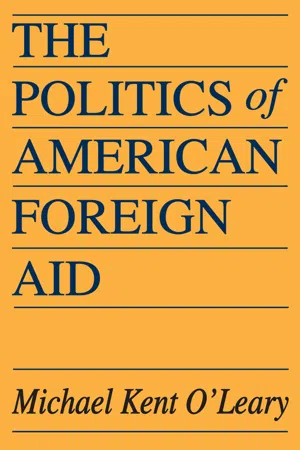
The Politics of American Foreign Aid
About this book
Every year the Administration and the Congress battle stubbornly and often bitterly over appropriations for foreign aid. Clearly much more is at stake than a difference of opinion over a small fraction of the annual budget: the tug-of-war stems from clashes of basic political philosophies, divergent approaches to one of the most important elements of our foreign policy, and inherent conflicts among various domestic power blocs.In his book, which adds a much-needed dimension to the discussion and analysis of United States foreign policy, O'Leary reveals the many complex factors that go into the making of American foreign aid policy. While placing the emphasis on the political system as a whole--its components, the relative power of actors in the system, and the manner in which they interact to create policy--the author presents a detailed and enlightening picture of the attitudes of the general public, the political parties, the pressure groups, and Congress itself to the issue of foreign aid.Basing his work on poll data, press comment, Congressional and Executive documents, Congressional roll-call votes, and interviews with congressmen, their assistants, foreign aid officials, and lobbyists, O'Leary makes clear how the workings of the American political system affect our foreign aid policy and programs. Originally published in 1967, it remains useful for all courses dealing with our foreign relations, Congress, or the specifics of the operation of our government.
Information
1
Background to Foreign Aid
Many signposts point to America’s changing course in world affairs. Among the most striking are Presidential responses to economic hardships abroad. In the 1920s, the nations of Europe were in debt to the United States because of loans made during World War I and were unable to make repayments largely because of American trade restrictions. As they headed toward economic and ultimately political disaster, the American mood was all too well expressed by President Calvin Coolidge, who tartly dismissed suggestions that America render assistance with the observation, “They hired the money, didn’t they?” Less than forty years later, President John F. Kennedy voiced a new mood in America’s response to the economic plight of peoples abroad when he not only affirmed America’s concern but also added a moral commitment: “To those peoples in the huts and villages of half the globe struggling to break the bonds of mass misery, we pledge our best efforts to help them help themselves, for whatever period is required . . . because it is right.”
This sharp about-face in American orientation toward world economic problems has, understandably, been accompanied by doubt and criticisms. Yet the trend of policies has been such that when Henry Hazlitt, a severe critic of foreign aid, facetiously asks, “Will dollars save the world?”1 there is at least a partial reply: The United States Government has in fact become committed to the use of dollars to try to save a world in which Americans can live with freedom and security.
Yet official government commitment is not enough. American foreign aid policy, like many American policies since World War II, operates in a paradoxical context. Officials have at their disposal physical and intellectual resources of a magnitude unprecedented in the history of international relations. These stores of potential power, however, can often accomplish very little by themselves. American officials must, as never before, rely on the cooperation of others—at home and abroad—for the successful conduct of policy. In our concern with what vast and fearful consequences might ensue from the secret decisions of a small handful of officials, we must not lose sight of how current national and international political forces actually restrict the actions of policy-makers.
Foreign aid is a primary case in point. A successful policy requires both technical knowledge to analyze problems and access to the material resources necessary to solve the problems. More than this, assistance programs must be acceptable to those for whom the aid is intended. They must also be actively supported by the American public and Congress. The failure to satisfy this latter requirement, no less than the others, can mean the failure of the entire program.
In the past, governments needed to mobilize widespread public support on foreign policy matters only in times of war. Today, however, if the “long twilight struggle” for economic development is to succeed, it must be constantly supported at every level of American society. The best intentions of policy-makers, the shrewdest analyses of experts, the immense national wealth will be useless if citizens turn against officials who strive to provide assistance abroad, if experts are unwilling to apply their skills overseas, or if Congress will not support the policies.
Any study of foreign aid must come to grips with the difficult problem of definitions. The American government’s economic policies range from permitting normal commercial trade, to encouraging trade through various subsidies, to loans with varying terms of repayment, to direct grants. Experts disagree as to where trade leaves off and aid begins. Furthermore, the composition of aid involves everything from surplus food to the skills of technicians, to military, industrial and consumer goods, to direct dollar payments.
Much of the public malaise about foreign aid can be attributed to this ambiguity. Unhappily, a search for the historic origins of foreign aid does not clarify matters. In one sense, America has been in the business of foreign aid for its entire history. When Thomas Paine said, “The cause of America is the cause of all mankind,” he expressed a faith that has shaped American thought and action to this day. The American experiment in politics and economics has been judged to be not only for internal use; in the words of Charles Burton Marshall, Americans considered their “new nation ... an exemplar for all mankind—a nation with a world mission, the guide to a new Jerusalem.”2 Such enthusiasms have transformed trade relations, diplomatic recognition and exchange, and all other political intercourse into opportunities for extending the American way of life as “foreign aid” to willing or unwilling nations.
Much of the “foreign aid” in our early history consisted of admonition and was consequently neither expensive nor effective. At the same time, the American government and people were becoming increasingly engaged in a variety of overseas programs—trade delegations, missionary work, and technical assistance missions—which bear striking, if embryonic, resemblance to more recent activities.3
Until just before World War II, there was little explicit government policy to establish precedents for current foreign aid. American actions abroad were the natural, unplanned results of a vigorous and self-assertive society’s contacts with the rest of the world. Government’s primary contribution came in the years of prewar international crisis when President Franklin Roosevelt embarked on a series of specific, ad hoc decisions pointing toward “aid short of war” to the hard-pressed allies. The “destroyers for bases” deal, repeal of the arms embargo, lend lease, and similar measures added a military dimension to American foreign assistance.
The sharp dichotomy in the style of foreign aiddivided between the dispensing of vague, philosophical statements and specific, pragmatic actions in response to foreign threats—was continued after World War II. Although foreign assistance programs multiplied in number and expense, and changed in character, there was scarcely any debate to articulate the implications of a long-range commitment to foreign aid; nothing, for example, comparable to the extensive public and private discussions about establishing the United Nations or stationing troops in Europe during peacetime. From this lack of debate opponents of foreign aid delight in inferring a cunning conspiracy by which the government hoodwinked Americans into accepting foreign aid bit by bit. The fact is, however, that decisions were made rapidly in response to repeated threats, which precluded any long-range public (and most private) discussion.
At the end of World War II the United States was giving assistance to war-torn lands through the United Nations Relief and Rehabilitation Administration (UNRRA) and was planning for long-run cooperation through the International Bank for Reconstruction and Development (IBRD) and the International Monetary Fund. And in 1946, President Truman received authority to loan Great Britain $3.75 billion for reconstruction and relief.
By 1947 the magnitude of the task of rebuilding Europe, plus the fear of Russian expansion, convinced policy-makers that something more had to be done. The result was the European Recovery Program, more commonly known as the Marshall Plan, after Secretary of State George C. Marshall. As submitted to Congress, the plan called for a four-year program of $17 billion in American grants and loans, which was about 5 per cent of the anticipated total required to rebuild the sixteen countries of Europe. After initial opposition, the plan received the endorsement of both Republicans and Democrats in a degree of bipartisanship unique in the congressional treatment of foreign aid policy.4
Even as the Marshall Plan was moving toward a successful conclusion, events outside Europe presented new challenges to thinking about foreign economic assistance. What had been feared in Europe—Communist military advances or the growth of Communist movements within unstable societies—was actually occurring in Korea and China, and was threatening elsewhere in Asia. Responding to these challenges, the Truman administration embarked on still broader foreign military and economic assistance policies, to the Philippines, to Chiang Kai Shek’s forces in China, to Korea, and to India. Most significantly, President Truman, in the famous “Point Four” of his inaugural address on January 20, 1949, called upon Americans to look beyond immediate problems, and to “embark on a bold new program” not just to ward off military threat or to compensate for natural disaster, but to promote “improvement and growth of underdeveloped areas.”
These two themes—helping others defend themselves against military threat, and cooperating in economic and social development—have continued to serve as the prime justification for the foreign aid policies which have become more or less institutionalized in the late 1960s. The bulk of foreign aid is now approved in a legislative package of military and economic assistance through loans and grants averaging slightly less than $4 billion annually. (During this period, the magnitude has declined from about 2 per cent of the Gross National Product in 1946 to about one-half of one per cent of the GNP in 1966.)
Besides the basic foreign aid program, additional foreign assistance has been rendered through several special channels. The Export-Import Bank, originally established by the Roosevelt Administration as an antiDepression measure to promote American trade, has come to be considered an aid-giving agency since it makes foreign loans at less than market interest rates. Since 1954, surplus agricultural products have been made available to foreign nations as grants or low-cost sales. In 1961 the Peace Corps was established to make effective use of another kind of “surplus”—American talents and energies for teaching and other tasks to promote growth and development abroad.
The government has also contributed to several multilateral programs—the United Nations, the IBRD and its subsidiary agencies, the International Finance Corporation and the International Development Association, and more recently the Inter-American and Asian Development Banks.5
The growing complex of assistance policies has been subjected to careful analysis by scholars and experts from many fields. Economists have addressed themselves to the problems of understanding and defining the process of economic development, and have tried to assess the effectiveness of alternative means of spurring development. Sociologists and anthropologists have investigated the varieties of cultural settings to which assistance programs must conform in order to succeed. Specialists in agriculture, education, public health, public administration, public finance, and many other fields have applied their technical knowledge to the needs and policies of recipient nations. And, somewhat belatedly, political scientists have begun to explore the many questions of international behavior and influence involved in this newly expanded aspect of American foreign policy.
Rather than considering the continuing problems of implementing aid policy and of evaluating the successes and failures of foreign aid, this book will give an introspective look at the subject—an examination of the domestic political process which helps shape American foreign aid policy. The uncertain and often conflicting responses provoked by the issues of foreign aid have prompted commentators to treat domestic policymaking decisions with contempt or dismay, or to ignore them altogether. At best, domestic politics are treated in an episodic fashion as the interests of the analyst dictate, with attention directed to a certain congressional speech favoring or criticizing aid, a particular legislative decision to raise or lower portions of foreign-aid funds, or a single speech by a prominent citizen on some question of foreign aid. However, the general and continuing patterns of public and congressional responses are important for several reasons.
First, the somewhat haphazard political debate over foreign aid is itself significant, for it reflects the fact that the practitioners of aid have rarely tried, in public at least, to establish clearly the temporal, financial, and political limits of the program. It remains uncertain whether the notions of the man in the street about foreign aid are only slightly more hazy than those of the policy-makers themselves. In any event, the public and Congress—whether knowledgeable, rational and farsighted, or uninformed, prejudiced, and impatient—have a vital and inescapable role in helping make the fundamental national decisions as to whether, and to what degree, the United States should be committed to, and therefore partly responsible for, economic and social growth overseas.
This assumption that the public view of foreign aid is important forms the rationale for the first step in our investigation of American politics and foreign aid. As we concern ourselves with the elusive and fascinating topic of how general traits in the American political culture condition the perceptions and judgments of broad elements of the public, we will inquire into the mood of the public concerning foreign aid.6 From this starting point, we shall turn to such personal attributes as social background and political beliefs, which have an important bearing on who is for and who against different parts of the foreign aid policies. In our complex society, opinions isolated from politics have little weight; we shall, therefore, also look at those institutions, such as parties and pressure groups, which normally “fix” opinion—in the chemical sense—and channel it to the government in more concentrated forms.
Next we shall consider the essentials of the congressional treatment of foreign aid, concerning ourselves with the question of the extent to which forces motivating the public are also operative in legislative decisions. Finally, we shall examine the executive branch’s attempt to win support for its aid policies within the conflicting forces of the American political system.
An overview such as this can necessarily pay but brief attention to each component of the system. The choice of comprehensiveness at the expense of detail has been made with some reluctance, but with a belief that it has some merit. We have already argued that the prime issues of foreign aid are not only technical and external but also philosophical and internal. We are also convinced that these issues are not the preserve of any particular party or faction of the public, or of any one institution of the government, but are so profound and widespread as to constitute a challenge to the comprehension and resolve of the whole nation.
2
Foreign Aid and American
Political Culture
We can best begin to appreciate American thinking about foreign aid by considering the general cultural and ideological environment in which public judgments and evaluations are made. Foreign policy is physically and psychologically remote from most people. Events are so complex and obscure that detailed understanding is beyond the capabilities of all but the expert. As a substitute for sufficient knowledge most people, occasionally even experts, will interpret events in terms analogous to their own experiences, their own traditions, and their own previously established judgments of right and wrong in matters of public policy. We laugh at the sign, “My mind is made up, don’t confuse me with facts.” Yet this is a slogan we all follow to some degree in making comprehensible an otherwise intolerably complex and uncertain world.1 We fashion judgments, especially about new policies, on the basis of what we already know and believe.2
Our concern with the cultural underpinnings of opinion leads us to expect opinions and attitudes to be formed not so much through deliberate thought and analysis as through reactio...
Table of contents
- Cover
- Half Title
- Title Page
- Copyright Page
- Dedication
- Foreword
- Acknowledgments
- Table of Contents
- Chapter 1. Background to Foreign Aid
- Chapter 2. Foreign Aid and American Political Culture
- Chapter 3. The Political Distribution of Opinion
- Chapter 4. Congress and Foreign Aid
- Chapter 5. The Executive As Organizer of Attitudes
- Chapter 6. Foreign Aid and the Political System
- Appendix. The Ranking of Values with Respect to Foreign Aid
- Notes
- Bibliography
- Index
Trusted by 375,005 students
Access to over 1.5 million titles for a fair monthly price.
Study more efficiently using our study tools.
Frequently asked questions
Yes, you can cancel anytime from the Subscription tab in your account settings on the Perlego website. Your subscription will stay active until the end of your current billing period. Learn how to cancel your subscription
No, books cannot be downloaded as external files, such as PDFs, for use outside of Perlego. However, you can download books within the Perlego app for offline reading on mobile or tablet. Learn how to download books offline
We are an online textbook subscription service, where you can get access to an entire online library for less than the price of a single book per month. With over 1.5 million books across 990+ topics, we’ve got you covered! Learn about our mission
Look out for the read-aloud symbol on your next book to see if you can listen to it. The read-aloud tool reads text aloud for you, highlighting the text as it is being read. You can pause it, speed it up and slow it down. Learn more about Read Aloud
Yes! You can use the Perlego app on both iOS and Android devices to read anytime, anywhere — even offline. Perfect for commutes or when you’re on the go.
Please note we cannot support devices running on iOS 13 and Android 7 or earlier. Learn more about using the app
Please note we cannot support devices running on iOS 13 and Android 7 or earlier. Learn more about using the app
Yes, you can access The Politics of American Foreign Aid by Michael O'Leary in PDF and/or ePUB format, as well as other popular books in Politics & International Relations & American Government. We have over 1.5 million books available in our catalogue for you to explore.