- 224 pages
- English
- ePUB (mobile friendly)
- Available on iOS & Android
eBook - ePub
About this book
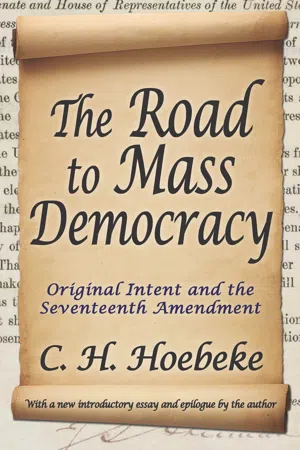
Until 1913 and passage of the Seventeenth Amendment to the United States Constitution, US senators were elected by state legislatures, not directly by the people. Progressive Era reformers urged this revision in answer to the corruption of state "machines" under the dominance of party bosses. They also believed that direct elections would make the Senate more responsive to popular concerns regarding the concentrations of business, capital, and labor that in the industrial era gave rise to a growing sense of individual voicelessness. Popular control over the higher affairs of government was thought to be possible, since the spread of information and communications technology was seen as rendering indirect representation through state legislators unnecessary. However sincerely such reasons were advanced, C. H. Hoebeke contends, none of them accorded with the original intent of the Constitution's framers.The driving force behind the Seventeenth Amendment was the furtherance of democracy exactly what the founders were trying to prevent in placing the Senate out of direct popular reach. Democracy was not synonymous with liberty as it is today, but simply meant the absolute rule of the majority. In full reaction to the egalitarian theories of the Enlightenment, and to the excesses of popular government under the Articles of Confederation, the Constitution's framers sought a "mixed" Constitution, an ancient ideal under which democracy was only one element in a balanced republic. Accordingly, only the House of Representatives answered immediately to the people. But as Hoebeke demonstrates, the states never resisted egalitarian encroachments, and had settled for popular expedients when electing both presidents and senators long before the formal cry for amendment. The Progressives' charge that a corrupt and unresponsive Senate could never be reformed until placed directly in the hands of the people was refuted by the amendment itself. As required by the Constitutio
Information
1
The Progressive Myth
A dangerous ambition more often lurks behind the specious mask of zeal for the rights of the people than under the forbidding appearance of zeal for the firmness and efficiency of government.
—Alexander Hamilton
Under the original terms for a more perfect Union, the United States Senate was elected by the legislatures of the several states. This provision admirably suited the political conditions of the time, when considerable popular sentiment still favored a loose alliance of the former colonies, and members of Congress were looked upon less as legislators for the Union than as ambassadors for the “sovereign” states which sent them. A familiar vestige of the old Confederation, the legislative appointment of one branch of the federal legislature maintained the states as “constituent parts of the national sovereignty,”1 and thus gave the Constitution’s supporters a vital defense against the charge that they were erecting an overbearing central authority.
Yet this method was also conceived with a far more fundamental end in view. The statesmen at Independence Hall in Philadelphia, convened ostensibly for the purpose of merely amending the Articles of Confederation, shared a common foreboding that the government outlined in that document was critically ill-equipped to prevent the popular excesses which all too frequently disturbed the public tranquility. Freed from the fetters of an unresponsive and irresponsible monarchy, the new nation seemed to be heading toward an opposite extreme. Insurrection, economic chaos, and a dangerous “mutability of legislation,” offered ample proof that “liberty may be endangered by the abuses of liberty as well as by the abuses of power; . . . and that the former, rather than the latter, are apparently most to be apprehended by the United States.” The critical task before the men assembled in Philadelphia was to strike a balance between freedom and authority, to retain a government which was accountable to those whom it governed, yet was still capable of putting forth a restraining hand upon any and all who threatened the general welfare. At the heart of this attempt to find the middle ground was a faith that popular government was a workable possibility if the majority of citizens were given the necessary time to reflect and reconsider before committing themselves to action. Patriotism, intelligence, and fairness may not have been instinctive, but given an opportunity for second thought, such qualities would surface in most people most of the time. The Constitution’s renowned system of “checks and balances” was instituted precisely for the purpose of suspending “the blow meditated by the people against themselves, until reason, justice, and truth can regain their authority over the public mind.”2
In the scheme of 1787, therefore, the Senate played a crucial role in maintaining this governmental stability. Its check upon all legislative proposals of the lower house, its prerogative to reject any treaty or refuse any appointment desired by the president, in essence, its negative on nearly every function of government (indirectly, senatorial concurrence in appointments and the power to try impeachments checked the judiciary as well), made the Senate the figurative center of gravity in the federal sphere. Conservatism was its indispensable characteristic, and as such, every employable means was adopted to cultivate and sustain it. A six-year term permitted greater consideration of those “well chosen and well-connected measures, which have a gradual and perhaps [popularly] unobserved operation.” A division of senatorial seats into three classes, elected successively in two year intervals, would “obviate the inconvenience of periodically transferring those great affairs entirely to new men.” New men brought new opinions; new opinions new measures; and as the founders knew from experience, “a continual change even of good measures” was “inconsistent with every rule of prudence and every prospect of success.”3
As a final insurance that it remain “an anchor against popular fluctuations,” the Senate was elected by the state legislatures. Because the uninhibited discussions for which it was intended required a smaller membership, which in turn entailed broader, state-wide constituencies, popular election was ruled out, even in those days of sparse population, as a mockery of the true principles of representation. Candidates would have too little acquaintance with any but the largest or most vocal interests. Conversely, the individual citizen’s vote, as well as the knowledge upon which it would be cast, counted for so little among the mass electorate as to favor the intrigues of a well-organized few, adept at “taking advantage of the supineness, the ignorance, and the hopes and fears of the unwary and interested.”4
Hence, state legislators, selected with greater competence on the part of the people, served as intermediaries to raise to America’s highest lawmaking body “those men only who have become the most distinguished by their abilities and virtue.” Then, too, such discernment as the senators possessed was of little avail without the ability to speak candidly, a further advantage of a body one degree removed from the popular tumult. Lastly,—and for the purposes of this thesis, certainly not least—in the event that the wisdom and probity of the Senate, like all things mortal, should temporarily subside, it would be checked by a coequal branch of the legislature, drawn in its immediate respects from an essentially different constituency. In factious times, “the dissimilarity in the genius of the two bodies,” each with a reciprocal hold on the other, reduced the likelihood that the same interests could gain the upper hand in both houses, and thus monopolize the legislative power for their own ambitions.5
Thus was the two-fold purpose of the original method of Senate elections: On the one hand, it allayed the suspicions of the Anti-Federalists; on the other, it was considered instrumental in keeping popular government on an even keel. But in 1913, the Seventeenth Amendment transferred the election of U.S. Senators directly to the people. For a number of reasons, it was thought that the nation’s highest legislative body was no longer serving the country in the capacity for which it was intended. Steadily since the Civil War, it seemed whatever esteem a senator might claim lay more in “money-making talent” than in any civic or intellectual virtues, as E. L. Godkin’s reform magazine, The Nation, complained.6 Senatorial elections had ceased to be determined by the deliberated concurrence of the state legislators, hinging instead on the dictates of the party bosses who ruled the legislative “machines.” The senators, themselves, no longer valued as the sagacious and disinterested legislators of the national welfare, more closely approximated, in the opinion of historian Henry Jones Ford, a “Diet of party lords, wielding their powers without scruple or restraint in behalf of those particular interests” responsible for placing them in office.7
The direct election of senators was also seen as a necessary revision to maintain the original constitutional principles against the social and economic transformations of the post-Civil War Era. Huge concentrations of business, capital and labor had diminished the significance of the individual and rendered him voiceless in many of the decisions which affected his daily existence. To restore control to the ordinary citizen, he needed to be invested with more direct methods of governing. Here, the Seventeenth Amendment was part of a sweeping reform movement that brought direct popular legislation in the form of the initiative and the referendum in many states, and in still others, an opportunity to remove unpopular officials by means of the direct recall election. Considering the wide range of a senator’s responsibilities, and the tremendous effects which his decisions had upon the entire nation, the restoration of popular government would hardly have been complete as long he was allowed to retain his distance from the will of his constituents.
In the dawn of mass communications, moreover, it was now possible to disseminate the news of national events across the countryside, and reciprocally, to register the will of the people on the highest affairs without the aid of representative intermediaries. It was no longer necessary, then, to delegate the responsibility of electing senators to the legislators, when the people could now elect senators for themselves. In short, great changes had occurred since the augmentation of the original system of representative checks and balances, and the Seventeenth Amendment was deemed an important step in keeping popular government up to pace with those changes. “Our forefathers believed in a certain method of selecting senators over a hundred years ago,” as one reformer stated, but “today, under present conditions, those statesmen and patriots would undoubtedly be of another opinion.”8
Not surprisingly, the direct election of U. S. Senators has engendered very little commentary in the historiography of either the Constitution or of the Progressive Era. It has been somewhat summarily adjudged a closed case. Legislative machines elected senators whom, it was claimed, the people would not have elected themselves; senators, for their part, if not representing interests adverse to those of the people, were too out of touch with popular needs and had to be rendered more responsive; and advanced technology provided the means by which this could be done, dispensing in many areas with the need to delegate authority to middlemen like the state legislators.
But how do these reasons in any way accord with the founders’ purposes? Popular appeal, for example, was never the expected criterion by which the legislators were to choose members of the Senate. Nor was it the case that interests opposed to the will of the majority were necessarily illegitimate. And of course, one of the critical points in favor of the indirect method of electing senators had been that it rendered them less vulnerable to the impulses of their constituents. In every instance, then, the traditional explanations for changing the Constitution have essentially begged the question that the Senate was supposed to answer directly to the popular majority. Between the rationale on which the Senate’s original mode of election was based and that on which the present method has been adopted, lies a contradiction which precludes the generally accepted idea that the Seventeenth Amendment was somehow an improvement basically in accord with the founding premises. In other words, there is every reason to question the progressive assertion that the framers “would undoubtedly be of another opinion” concerning the need for popularly elected senators, had they but lived in a later age.
On the other hand, there is little question that most reformers of the era believed that they were upholding the Constitution’s original principles. The growing influence of money and the dominance of party bosses over the electoral system were clearly not what the founders envisioned when they established the legislative election of senators. But how did these evils arise? That was a question the progressive reformer never seriously asked. He deemed it sufficient that the evils existed and had to be corrected, and when he looked for solutions, he naturally turned to the people. It was obvious they did not countenance the undemocratic and occasionally corrupt practices of the state machines, and so it seemed just as obvious that to give them more direct control over governmental affairs would bring about the necessary regeneration of the political system.
This, it so happens, was the very siren call from which the founders tried to protect the republic, yet to which it has steadily drifted at the hands of successive generations of constitutional reformers. Indeed, there were far fewer novelties in the “progressive” solutions than commonly assumed. The underlying assumptions on which they were based have had their adherents in every era of American history, and had been urged long before industrialism, business corporations, and all the other conditions unique to modern life had furnished the pretexts for implementing more direct methods of popular rule. In fact, the political decay manifested in the late nineteenth and early twentieth centuries—although it is not conceded that conditions were as bad as they have been portrayed—owed much less to the country’s economic and social changes than to the constitutional tampering of previous ages. Yet these problems were addressed with more of the same sort of tampering. Leaving aside the historical arguments regarding the era’s regulatory reforms, however unprecedented in scale or revolutionary in impact, Progressivism, insofar as many of its constitutional reforms were concerned, had its origins in a philosophy and form of government against which the American founders had been consciously struggling when they met to amend the Articles of Confederation.
The story of the demise of the original method of electing senators reveals just how long certain disparate assumptions have been competing for supremacy in the American political arena. Indeed, not only in America, but in the Western World more generally, a philosophical dichotomy has existed since at least the middle of the eighteenth century. A number of modern thinkers have commented upon this two hundred year conflict ranging across social, economic, judicial, and particularly political thought, a conflict that has been defined as a struggle between the “constrained” and the “unconstrained” traditions. The point at which the adherents to these respective traditions diverge is as fundamental as a disagreement over the given limitations of humanity, and from that elemental dispute extends to the degree to which governments can and should attempt its improvement. The founders can arguably be placed in the constrained tradition because of the suspicion with which they regarded the wielders of power, even when it was they who did the wielding, and because of the elaborate system of checks and balances they devised to hinder its abuses. Moreover, theirs was a philosophy much more consistent with the political traditions that had been handed down and adapted since antiquity. More democratic thinkers, such as Thomas Paine and Jean-Jacques Rousseau, who promised an almost utopian result when all power was bestowed upon the popular majority, held an obviously less constrained view of human nature,9 a view decidedly of post-Enlightenment origin, and one which was much more in line with that expressed by proponents of the Seventeenth Amendment.
The philosophic contrasts, however, amount to far more than an intellectual curiosity. After all, philosophies do have consequences in the political world, and the seeds of absolutism take root in immoderate ideas. Since the initial establishment of the federal system of checks and balances, American politicians have succumbed to increasingly less judicious opinions about the rights and powers of “the people,” a contention amply demonstrated by the long train of historical events, the successive revolutions in political expression, and the steady deterioration of constituted authority which finally brought about the popular election of United States senators.
Necessarily, this proposition encompasses a much broader perspective than the usual accounts of senatorial corruption in the Gilded Age and Progressive Era. Those circumstances immediately preceding the amendment, while appearing the most relevant, have in actuality been the most misleading, for they fail to represent how far the constitutional balance had already been skewed by the time such maladies appeared. The logical starting point, therefore, is the founding intent, the political tradition on which it was based, and the application of that tradition to the practical questions of governing the former British colonies. Then again, to define the intentions of fifty-five men, of various professions and backgrounds, who represented conflicting interests and diverse constituencies and who spent an entire summer trying to reach an agreement, might be considered too tall an order, especially when it is done, as it is here, in a single chapter. But discussion has been confined to the most obvious thing they held in common, the fear of democratic government.
It is unfortunate that in the dwindling vocabulary of political discourse, democracy has become synonymous with liberty and popular sovereignty, the only alternative to modern totalitarianism. From Plato to Madison, in the constrained tradition at least, it was actually considered an undesirable state of affairs, meaning the unchecked rule of the majority. It is perhaps a sign of the times that no such word has been retained to describe the phenomenon. In any event, clarity requires that the term be applied consistently in its classical sense, the same in which it was applied by the founders themselves. The second chapter thus seeks to illustrate the popular excesses in the various states of the newly-formed Confederation, and to trace those excesses in part to the defectiveness of existing constitutions. The alarm inspired in the founders was not simply due to the inability of the Confederation to control the states. The federal system which was called into being and given paramountcy was no less a reaction to the democratic weaknesses of the nation in general. The Senate’s role in the new system, in accordance with the classical formula for checks and balances, was to maintain the political equilibrium against the natural weight of democracy.
There was a latent danger, however, in making the state legislatures responsible for promoting the federal government’s “natural aristocracy” (not only the senators, but also the College of Electors). As the third chapter reveals, the history of state constitutions subsequent to the Federal era was a continual concession to principles the founders opposed, a steady erosion of checks and balances in state governments that inevitably rendered them incapable and unwilling to support the federal hierarchy, which had been designed to restrain the extravagance of democratic government. Indeed, the culpability of the states in establishing an increasingly imperious national power was one of the unsought discoveries of the present investigation. Little by little, state constitutions nibbled away at delegated authority in the name of ...
Table of contents
- Cover Page
- Title Page
- Copyright
- Contents
- Dedication Page
- An Introductory Essay
- Introduction
- 1 The Progressive Myth
- 2 A Precarious Balance
- 3 The Tilt in the States
- 4 Federal Repercussions
- 5 The Anomalous Counterweight
- 6 Beveling the Congress
- 7 The Deliberation to End All Deliberations
- Epilogue
- Bibliography
- Index
Trusted by 375,005 students
Access to over 1.5 million titles for a fair monthly price.
Study more efficiently using our study tools.
Frequently asked questions
Yes, you can cancel anytime from the Subscription tab in your account settings on the Perlego website. Your subscription will stay active until the end of your current billing period. Learn how to cancel your subscription
No, books cannot be downloaded as external files, such as PDFs, for use outside of Perlego. However, you can download books within the Perlego app for offline reading on mobile or tablet. Learn how to download books offline
Perlego offers two plans: Essential and Complete
- Essential is ideal for learners and professionals who enjoy exploring a wide range of subjects. Access the Essential Library with 800,000+ trusted titles and best-sellers across business, personal growth, and the humanities. Includes unlimited reading time and Standard Read Aloud voice.
- Complete: Perfect for advanced learners and researchers needing full, unrestricted access. Unlock 1.5M+ books across hundreds of subjects, including academic and specialized titles. The Complete Plan also includes advanced features like Premium Read Aloud and Research Assistant.
We are an online textbook subscription service, where you can get access to an entire online library for less than the price of a single book per month. With over 1.5 million books across 990+ topics, we’ve got you covered! Learn about our mission
Look out for the read-aloud symbol on your next book to see if you can listen to it. The read-aloud tool reads text aloud for you, highlighting the text as it is being read. You can pause it, speed it up and slow it down. Learn more about Read Aloud
Yes! You can use the Perlego app on both iOS and Android devices to read anytime, anywhere — even offline. Perfect for commutes or when you’re on the go.
Please note we cannot support devices running on iOS 13 and Android 7 or earlier. Learn more about using the app
Please note we cannot support devices running on iOS 13 and Android 7 or earlier. Learn more about using the app
Yes, you can access The Road to Mass Democracy by C. H. Hoebeke in PDF and/or ePUB format, as well as other popular books in Politics & International Relations & North American History. We have over 1.5 million books available in our catalogue for you to explore.