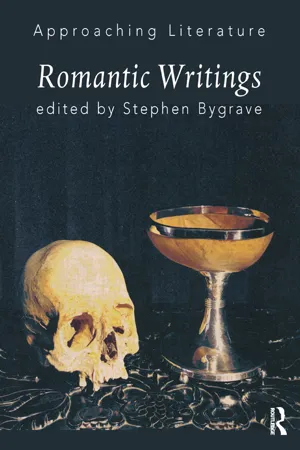
Romantic Writings is an ideal introduction to the cultural phenomenon of Romanticism - one of the most important European literary movements and the cradle of 'Modern' culture.
Here you will find an accessible introduction to the well-known male Romantic writers - Blake, Wordsworth, Coleridge, Byron, Shelley and Keats. Alongside are chapters dealing with poems by Charlotte Smith, Mary Robinson, Ann Barbauld, Elizabeth Barrett Browning which challenge the idea that these men are the only Romantic writers. As a further counterpoint the book also includes discussion of two German Romantic short stories by Kleist and Hoffman. Throughout, close-reading of texts is matched by an insistence on reading them in their historical context.
Romantic Writings offers invaluable discussions of issues such as the notion of the Romantic artist; colonialism and the exotic; and the particular situation of women writers and readers.
- 368 pages
- English
- ePUB (mobile friendly)
- Available on iOS & Android
eBook - ePub
Romantic Writings
About this book
Information
Part One
Chapter One
Romantic poems and contexts
This chapter has two aims. The first is to introduce you to a variety of Romantic writings, which will allow you to start building your own sense of their common tendencies. All these texts were produced in the last decades of the eighteenth century or in the first half of the nineteenth century, so the second aim is to begin explaining the context in which they were written. These texts were part of a historical period with its own particular habits, events, concerns, and so on. It has been common to label this the Romantic period’, and I hope in what follows to enable you to think about what that description means.
We will be looking at two main topics: (1) at what it might mean to read historically, the advantages of such a way of reading and how we might do it; and (2) at the novelty of Romantic writing, by looking at the figure of the child as it appears in Wordsworth and, in more detail, in Blake’s Songs of Innocence and Experience. (In this chapter, except where otherwise noted, page references refer to Duncan Wu, Romanticism, 1994.)
Writing in history
I want to begin by looking at two Romantic poems. First we will look at the poems individually, then see whether we can identify any features they have in common. The first is by William Wordsworth and was written in 1798. Please read it two or three times, thinking first about what kind of poem you think it is. Is it a lyric or a narrative? (That is to say, does it record the feelings of a particular moment or does it tell a story?)
She dwelt among th’ untrodden ways
Beside the springs of Dove,
A maid whom there were none to praise
And very few to love.
A violet by a mossy stone
Half-hidden from the eye!
Fair as a star when only one
Is shining in the sky!
She lived unknown, and few could know
When Lucy ceased to be;
But she is in her grave, and oh!
The difference to me.
(p.245)
The poem looks as though it is going to be a narrative – as though it is going to tell a story. We expect to find out what happens to this girl or woman, but all that we learn, from the last stanza, is her name and that she dies. So the poem is actually a lyric. Specifically, by the end it seems to be an elegy, or perhaps a love poem.
Now read the poem again, thinking about the following questions: (1) What is the point of the comparisons in the middle stanza? What do they suggest about the ‘she’ of the poem? (2) Who is the subject of this poem? Who is it actually about?
Discussion
1 Instead of giving a literal description of the girl or woman the middle stanza substitutes for her a violet and a star. These, we infer, stand for her being beautiful (‘fair’) but also obscure (‘half-hidden’). The violet and the star are symbols for her beauty and obscurity. We are not told her story, nor even what she looks like. She is represented by symbols drawn from the natural world rather than described as a person. The girl or woman is seen to be extraordinary – as extraordinary in her private way as a single star visible in the night sky.
2 ‘Me’ is the last word of the poem, and comes as something of a surprise. Finally, the focus is not upon the girl, now named as Lucy, but upon the speaker (or narrator), who has not appeared until this point. It seems that the poem is not about Lucy, but about the effect her absence has on the speaker. The poem comes to rest on a wholly individual feeling. As readers we are flattered to find ourselves amongst the ‘few’ who know about this and for whom it is significant. ■
The second poem is by John Clare and was written some time after 1842. This poem too changes course in its final stanza. Read the poem right through but concentrate here on the first two stanzas, noting any difficulties you have with them.
1
I am — yet what I am none cares or knows;
My friends forsake me like a memory lost: —
I am the self-consumer of my woes; —
They rise and vanish in oblivion’s host,
Like shadows in love’s frenzied stifled throes: —
And yet I am, and live — like vapours tost
2
Into the nothingness of scorn and noise, —
Into the living sea of waking dreams,
Where there is neither sense of life or joys,
But the vast shipwreck of my lifes esteems;
Even the dearest, that I love the best
Are strange — nay, rather stranger than the rest.
3
I long for scenes, where man hath never trod
A place where woman never smiled or wept
There to abide with my Creator, God;
And sleep as I in childhood, sweetly slept,
Untroubling, and untroubled where I lie,
The grass below — above the vaulted sky.
(p.1001)
Lines 3–5 are quite difficult here. If ‘woes’ have to be ‘self-consumed’ they have no outlet. In these stanzas, everything that might confirm the speaker’s identity – even his ‘woes’ – is strange and insubstantial like shadows, vapour or dreams. The poem begins strikingly: ‘I am’. At first this seems to be an assertion of identity as striking as the one which ended the Wordsworth poem. Yet this is at once seen to be impossible – just as to say simply ‘I am’ is grammatically impossible, or at least incomplete, since the verb ‘to be’ needs a complement. That is to say, nothing can just be; it has to be something. And what follows in the first two stanzas does not elaborate on an assertion of identity, but takes it away – together with all the people and things that might confirm it.
Now read the poem again, thinking about the following questions: (1) Do you notice anything about the punctuation? (2) How does the poem change course in the last stanza?
Discussion
1 There seems to be a possessive apostrophe missing from the word ‘life’ in line 10. You probably also noticed all the dashes, which are often added on to the other punctuation marks. Their effect is to break the poem up into a series of exclamations. All the same, these two stanzas constitute a single sentence, which continues across the break between the first two stanzas, a sentence which reads as ‘cost/Into the nothingness … Into the living sea …’, and so on.
2 In the final stanza the speaker (or narrator) does not describe his state as he has in the first two. Instead he ‘longs’ for a change of ‘scene’. Yet what he longs for is somewhere ‘man hath never trod/A place where woman never smiled or wept’. He yearns for what is impossible. The speaker longs to return to something like his childhood, to a lost paradise in which he was close to God. He wants to ‘abide’ in a ‘scene’ or ‘place’ which is natural, between ‘the grass … [and] the vaulted sky’, and in which he can be free and secure. There is a desire for escape – or even for death. He wants to be free not just from constraint but from human society. ■
Now read the two poems again and think about what, if anything, they have in common.
Discussion
Both poems are introspective – perhaps even self-pitying in the case of the Clare – and both look upon private experience as suitable material for poetry. Everything referred to in the Clare poem seems to be used as a way of finding an equivalent for the speaker’s psychological state. Ending as it does, the Wordsworth poem might be seen to be claiming that individual feeling is valid in itself. In the case of the Clare poem, to write about suffering is different from merely suffering. The poem was unpublished in his lifetime, but nevertheless Clare put private experience into words and into poetic form. In both poems then, private experience is made public. To publish something is to make it public. Publication after all means making public. It might be said also that both poems look upon private experience as it were from the outside. This assertion of the self and what it wishes, feels, fears, and so on, is a characteristic of Romantic
Both poems draw on natural objects as a source of comparisons. Nature provides Wordsworth with symbols for the ‘unknown’ beauty of Lucy. There are several references in the Clare poem to natural objects and phenomena: there are ‘vapours’ (line 6), the sea (line 8) and the grass and sky (line 18). However, in both cases this is succeeded, as we have seen, by longing for a state that does not exist. In neither poem is nature looked at from the outside and described. In both cases it is used to find an equivalent for a state of the self, so that the external is, as it were, internalized.
The Wordsworth poem at first stresses Lucy’s ordinariness before claiming her to be extraordinary. Her death makes a ‘difference’. And the difference Lucy’s death makes cannot be explained or rationalized but only stated. The Clare poem ends with a desire to be transfigured, or to have transcended the state in which it begins. In both poems the ‘real’ or material is succeeded by the ideal or, we might say, the natural by the supernatural. The two poems share a desire to transfigure or transcend the ordinary. This desire to transcend particular circumstances, or the claim to have done so, is a second characteristic of Romantic writing. ■
We have noted two tendencies that these poems share: an insistence that private experience (and private opinion) is publicly valid, and a desire for transcendence. We will see both these tendencies again and again in Romantic texts. These tendencies are to do with the content of poems which may not seem to have much in common formally.
If we find the poems difficult, the difficulties can mostly be resolved by attention to their language. That is to say, neither poem seems to rely heavily on references to people, things, or events outside itself. All the same, we might feel that additional information would be helpful. For instance, the punctuation of the Clare poem seemed to hamper our understanding at first. The punctuation is not Clare’s – the poem was transcribed by a warder in the Northampton madhouse in which he was kept. This information about Clare’s circumstances might also lead us to speculate about the references to the fantasy of release that the poem contains. In his ‘Note on the texts’ Duncan Wu explains why he has not regularized (that is, tidied up) the punctuation of the Clare texts for his edition (Romanticism, p.xxxi); nevertheless, he does alter the text, as do the editors of the standard edition of Clare’s works, by substituting the word ‘cost’ for the word ‘lost’, which is what actually appears in the transcript (Robinson and Powell, The Later Poems of John Clare, 1984, pp.396–7). Such a substitution would have been made because ‘cost’ made more sense to the editors, or was more in line with how they understood Clare’s intentions.
The Wordsworth poem, which is untitled, was sent with another, beginning ‘Strange fits of passion I have known’, in a joint letter from William Wordsworth and his sister Dorothy to Coleridge from Goslar in Germany in December 1798. It was published in Volume II of the second edition of the Lyrical Ballads collection in 1800. Lyrical Ballads was a collection of poems by Wordsworth and Coleridge which was first published in 1798. We will come back to Wordsworth’s Preface to an 1802 edition later in this chapter. This poem of Wordsworth’s is often seen as belonging to a group of four poems written around the same time, all of which refer to ‘Lucy’. We don’t know the identity of this ‘Lucy’, although Coleridge was first in attempting to identify her by speculating about another poem in this group, ‘Most probably in some gloomier moment he [Wordsworth] had fancied the moment in which his Sister might die’ (letter of 6 April, 1799; Griggs (ed.), Collected Letters of Coleridge, 1956, Vol. 1, p.479). Other critics have suggested that the absence with which the poem grapples is the absence of the poet from his homeland. It is not because of our inability to identify Lucy that the poem is enigmatic, but because of the feeling which it seems to express – a loss which is felt powerfully by the speaker, but only by him. It makes no general or public difference, but a difference to him which is made public by the poem.
We read these two poems first of all as words on the page, without reference to the context in which they were written. Once we had some additional information our perspective on the poems changed. The information I gave you may have prompted new questions and I hope that these were interesting questions. From the poems we were also able to describe two tendencies of Romantic poems. But that description was very general. It would not enable us to identify as ‘Romantic’ any other poem. It was so general it could apply to many other poems which might not generally be regarded as Romantic poems. Romantic writings share a broadly similar historical context and our reading gains from knowledge of this context. I hope I can demonstrate this by looking at a poem by Percy Bysshe Shelley. As you read it, I would like you to consider two questions. (1) Does there seem to be a dominant mood or feeling to the poem? (2) What part is played by form, especially grammar and rhyme, in the poem?
England in 1819
An old mad, blind, despised, and dying King;
Princes, the dregs of their dull race, who flow
Through public scorn – mud from a muddy spring;
Rulers who neither see, nor feel, nor know,
But leech-like to their fainting country cling
Till they drop, blind in blood, without a blow.
A people starved and stabbed in th’ unfilled field;
An army, whom liberticide and prey
Makes as a two-edged sword to all who wield;
Golden and sanguine laws which tempt and slay...
Table of contents
- Cover
- Title Page
- Copyright Page
- Table of Contents
- Preface
- Introduction
- Part One
- Part Two
- Acknowledgements
- Index
Trusted by 375,005 students
Access to over 1.5 million titles for a fair monthly price.
Study more efficiently using our study tools.
Frequently asked questions
Yes, you can cancel anytime from the Subscription tab in your account settings on the Perlego website. Your subscription will stay active until the end of your current billing period. Learn how to cancel your subscription
No, books cannot be downloaded as external files, such as PDFs, for use outside of Perlego. However, you can download books within the Perlego app for offline reading on mobile or tablet. Learn how to download books offline
Perlego offers two plans: Essential and Complete
- Essential is ideal for learners and professionals who enjoy exploring a wide range of subjects. Access the Essential Library with 800,000+ trusted titles and best-sellers across business, personal growth, and the humanities. Includes unlimited reading time and Standard Read Aloud voice.
- Complete: Perfect for advanced learners and researchers needing full, unrestricted access. Unlock 1.5M+ books across hundreds of subjects, including academic and specialized titles. The Complete Plan also includes advanced features like Premium Read Aloud and Research Assistant.
We are an online textbook subscription service, where you can get access to an entire online library for less than the price of a single book per month. With over 1.5 million books across 990+ topics, we’ve got you covered! Learn about our mission
Look out for the read-aloud symbol on your next book to see if you can listen to it. The read-aloud tool reads text aloud for you, highlighting the text as it is being read. You can pause it, speed it up and slow it down. Learn more about Read Aloud
Yes! You can use the Perlego app on both iOS and Android devices to read anytime, anywhere — even offline. Perfect for commutes or when you’re on the go.
Please note we cannot support devices running on iOS 13 and Android 7 or earlier. Learn more about using the app
Please note we cannot support devices running on iOS 13 and Android 7 or earlier. Learn more about using the app
Yes, you can access Romantic Writings by Stephen Bygrave in PDF and/or ePUB format, as well as other popular books in Literature & Literary Criticism. We have over 1.5 million books available in our catalogue for you to explore.