- 523 pages
- English
- ePUB (mobile friendly)
- Available on iOS & Android
eBook - ePub
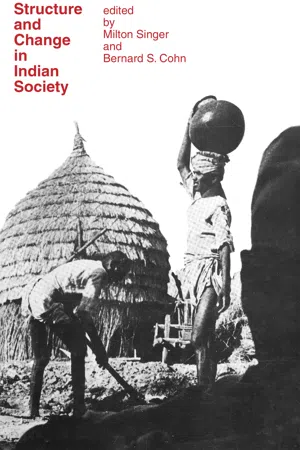
Structure and Change in Indian Society
About this book
Recent theoretical and methodological innovations in the anthropological analysis of South Asian societies have introduced distinctive modifications in the study of Indian social structure and social change. This book, reporting on twenty empirical studies of Indian society conducted by outstanding scholars, reflects these trends not only with reference to Indian society itself, but also in terms of the relevance of such trends to an understanding of social change more generally.The contributors demonstrate the adaptive changes experienced by the studied groups in particular villages, towns, cities, and regions. The authors view the basic social units of joint family, caste, and village not as structural isolates, but as intimately connected with one another and with other social units through social and cultural networks of various kinds that incorporate the social units into the complex structure of Indian civilization. Within this broadened conception of social structure, these studies trace the changing relations of politics, economics, law, and language to the caste system.Showing that the caste system is dynamic, with upward and downward mobility characterizing it from pre-British times to the present, the studies suggest that the modernizing forces which entered the system since independence--parliamentary democracy, universal suffrage, land reforms, modern education, urbanization, and industrial technology--provided new opportunities and paths to upward mobility, but did not radically alter the system. The chapters in this book show that the study of Indian society reveals novel forms of social structure change. They introduce methods and theories that may well encourage social scientists to extend the study of change in Indian society to the study of change in other areas.
Information
Part I
Caste and Social Structure
1
Notes on the History of the Study of Indian Society and Culture
Bernard S. Cohn
THE STUDY of social change and acculturation has become over the last 35 years one of the anthropologist’s major activities. Until quite recently the American Indians and African and Latin American societies and cultures have been the locus of most social change and acculturation studies.
The American Indian studies have tended to focus on the overwhelming effects that white American society has had on tribal groups. The African studies have tended to focus on the direct and indirect political effects of European incursions. The study of acculturation in Latin America has emphasized the initial effects of Hispanization, the destruction of indigenous Indian society, and the emergence of complicated new patterns of culture. These studies have taken a total system view of the societies in relation to overwhelming political, economic, and social power which were directly or indirectly applied to indigenous societies. The American Indian studies have illustrated how persistent indigenous patterns have been and to a large extent how effective American Indians have been in the face of often overwhelming pressure, in maintaining many of their indigenous patterns. In Africa by and large the studies indicate that in the political realm the Africans have adapted European institutions to their own political ends.
The societies of India offer a much different situation from that of the American Indian or the African to study long-term social change under colonial and post-colonial conditions. Indian society and political development were recognized by Europeans in the eighteenth century as being at relatively the same level as European society. In India there was settled agriculture and a variety of craft production on a large scale, political institutions of kingship, a legal system based partially on written law, taxation based on regular assessment, with record-keeping, and military forces roughly organized along lines similar to those of Europe. Many of the political and economic roles familiar to Europeans: clerks, judges, tax officials, generals, bankers, and traders, existed. In addition, there was a multiple cultural-religious system based on sacred texts, both Hindu and Muslim, with a wide range of ritual specialists and scholars.
Relatively speaking, British domination until the middle of the nineteenth century had little direct effect on Indian social, economic, and cultural life. As a result of British revenue arrangements, there was some circulation of personnel in the rural society as land became marketable and as new methods of acquisition of land through the use of British administrative procedures allowed nonmilitary groups access to control of land. New groups who tended to take advantage of the conditions established by the British fitted into the traditional structure or were placed on top of the existing structure and took over life styles well established by the eighteenth century.
The Study of Indian Society and the Caste System
There have been recorded observations on Indian society since the third century B.C. It is useful in considering more recent developments in the study of social change in India to sketch briefly the nature and content of the observations and assumptions which observers have made of the Indian social system.
Classical and Arab-Persian Accounts
For the period 327 B.C. to 1498, there are scattered accounts of Indian society written by foreigners. These travelers included Greeks, Romans, Byzantine Greeks, Jews, and Chinese, and, increasingly from A.D. 1,000 onward, Arabs, Turks, Afghans, and Persians. Most classical accounts of Indian society follow Megasthenes, who had the advantage of direct observation of parts of India. But as Lach comments:
Although he was an acute observer, Megasthenes was handicapped by his ignorance of the native languages. Like many Europeans since his time, he was unable to penetrate deeply into the thought, literature and history of the country simply by looking and listening, or by using interpreters (1945, I: 1, p. 10).
Megasthenes described Indian society as being divided into seven classes: (1) philosophers, who offer sacrifices and perform other sacred rites; (2) husbandmen, who form the bulk of the population; (3) shepherds and hunters; (4) those who work at trades and vend wares and are employed in bodily labor; (5) fighting men; (6) inspectors; and (7) counselors and assessors of the king (M’Crindle, 1901, pp. 47–53). Megasthenes also noted that each of these seven “classes” were endogamous and that one could not change his occupation or profession (M’Crindle, 1901, p. 53). From the context of his account it would appear, as with many subsequent observers, that Megasthenes’ data came mainly from observation of urban political centers. It is also interesting to note that, at least in the materials of Megasthenes which have survived, he makes no reference to the varna theory.
Although there was regular and extensive contact between Rome and India through direct trade contact, Roman accounts, although fuller on geographic information, add little in the form of sociological information to our knowledge of the stratification system in early India.
The earliest Arabic accounts follow the classical view of Indian society in reporting the division of Indian society into seven classes (Elliot and Dowson, 1867, vol. 1, pp. 16–17, 77). Al-Biruni (973-ca. 1030) appears to have been familiar with Sanskrit sources and does mention the four-varna theory of the caste system (al-Biruni, 1962, pp. 132–40). In the seventeenth century many translations were made from the Sanskrit literature into Persian by Indo-Muslim scholars (Rehatsek, 1880; Sabah Al-Din, 1961). Abu’l Fazl ’Allami, the author of the Ā’īn-i-Akbarī, a late sixteenth-century gazetteer and description of Akbar’s court, revenue, and administrative system, presents the view that the four varnas were produced from the body of Brahma at the creation of the world. He recognizes that there are internal divisions within the four varnas, but follows Brah-manic theory in attributing these divisions to the mixture of the original varnas through intermarriage (Abu’l Fazl ‘Allami, 1786, vol. 3, pp. 82–84).
Functionally, as can be seen in the lists of military and revenue obligations given in the Ā’īn-i-Akbarī, the Mughals clearly recognized that the operational level of the Hindu social system was not at the level of the varnas but at the level of kin-based social categories such as we are familiar with in twentieth-century literature on the Indian caste system. The split view of Indian society, which we will see is so typical of nineteenth-century European views of India, of a theoretical varna-based society which sees the four major ideological based categories of Brahman, Kshatriya, Vaishya, and Shudra as being the system, existed functionally along with the necessity on the part of the Mughals to operate with localized kin-based caste groups.
The View of the Caste System of the Early European Travelers
The earliest direct observers of the Indian caste system in modern times were Portuguese adventurers, administrators, merchants, and priests, who began primarily on the Malabar coast to have direct experience with Indian society. Malabar at one and the same time was a highly cosmopolitan society, with enclaves of Arabs (Moplahs), Syrian Christians, Jews, and other foreign peoples, and an area in which the hierarchic principles of the caste system had been worked out in one of its most extreme forms. The Europeans were also fascinated in confronting matrilineal and polyandrous groups.
Early Portuguese observers like Duarte Barbosa (1866, 1918, 1921) naively but accurately reported major cultural features of the caste system which continue to be recognized as central today: the high position of the Brahmans (1866, p. 121), the significance of pollution in relation to untouchability (1866, p. 129), the bars to commensality among endogamous groups (1866, p. 136), the relationship of occupation to caste (1866, pp. 135, 137), the application of sanctions within castes to maintain caste customs (1866, p. 133), and the relationship between caste and political organization (1866, pp. 103–106).
Striking in Barbosa’s description is his matter-of-fact and objective approach in trying to describe what he saw and what he was told; he presents his description of the caste system organized as a hierarchy with Brahmans on top and Untouchables on the bottom. There is no reference to the Hindu theory of the varnas and no moralizing about the benefits or evils of the system. In many respects European accounts for the next 250 years do not progress much beyond Barbosa’s reporting. Unlike many of the Europeans who followed him to India, for shorter or longer periods, Barbosa knew an Indian vernacular well and was recognized by his contemporaries for his linguistic abilities (1918, p. xxxvi).
Although there were others over the next 250 years who became fascinated with Indian society, most accounts by Europeans which circulated in Europe tended to focus on the Mughal courts and on political and commercial matters rather than on Indian society itself. Jean Baptiste Tavernier, a French merchant and traveler who made six voyages to the Middle East, India, and Southeast Asia between about 1631 and 1667, wrote accounts of his travels that are typical of the works of this period (1889). He describes in detail the various routes and points of interest historically and commercially in his travels in India, much like a forerunner of Murray’s guide to India (1889, vol. 1, pp. 1–318). He provides a history of the reign of Aurangzeb mainly based on oral evidence, and extensive discussions of commercial activities. Finally, Tavernier reports on various Hindu beliefs, rituals, and customs. This reporting is based on conversations with Brah-mans and on eyewitness reports. The caste system receives very brief notice. Tavernier bases his views on what he “ascertained from the most accomplished of their priests” (1889, vol. 2, p. 182); that is, that although there are believed to be 72 castes, “these may be reduced to four principal [castes], from which all others derive their origin” (p. 182). Tavernier and other European travelers appear to have had little difficulty in finding Brahmans to discuss Hinduism with them.
Abraham Roger, the first chaplain at the Dutch factory at Pulicat in Madras, studied Hinduism from a Dutch-speaking Brahman, Padmanubha, in the 1630’s. Roger’s account of Hinduism was published in 1670, twenty years after his death, and contains Padmanubha’s Dutch translation of Bhartrihari’s Satakas (Yule and Burnell, 1903, p. xliii).
Developments in the Later Eighteenth and Early Nineteenth Centuries
With the establishment of British suzerainty in the later eighteenth century, the rapid acquisition of knowledge of the classical languages of India by a few British officials, the need for administrative purposes of a knowledge of the structure of Indian society, and the intensification of missionary activities, systematic knowledge of Indian society began to develop very rapidly from 1760 onward. Three major traditions of approach to Indian society can be seen by the end of the eighteenth century: the orientalist, the administrative and the missionary. Each had a characteristic view, tied to the kinds of roles which foreign observers played in India and the assumptions which underlay their views of India.
The Orientalist
Although there was some knowledge of the learned traditions of India, both Hindu and Muslim, before the middle of the eighteenth century, it was not until the post-Plassey generation that a cumulative knowledge of Persian and Sanskrit and the vernacular languages began to develop which enabled the British to begin to comprehend the depth and range of texts and their contents through which the religion, philosophy, and history of India began to become known to Europeans. Alexander Dow, an officer in the East India Company’s army, was one of the first to publish a translation of one of the standard Persian histories of India, Tārīkh-i-Fīrīshtāhī, which was published as The History of Hindustan in 1768–1771. As was typical for the period, Dow prefaced his translations with a number of essays, one on the nature of Mughal government, one on the effects of British rule in Bengal, and “A Dissertation Concerning the Customs, Manners, Language, Religion and Philosophy of the Hindoos.” To Dow, customs and manners appear to have largely meant Brahmanic prescriptions derived from his study in Persian and “through the vulgar tongue of the Hindoos” of “some of the principal shasters.” This he did with the assistance of a pundit from Bañaras. Although Dow had tried to learn Sanskrit, apparently his official duties prevented him from mastering the language, but he was fully aware of the difficulties of understanding Hinduism through Persian translations. Matters which we would call sociological are treated in seven pages out of the fifty of his essay and cover the four varnas, which he sees as four great tribes, each of which is made up of a variety of castes; the tribes do not intermarry, eat, drink, or in any manner associate with each other. Dow presents the Brahmanical theory of the origin of the system as derived from parts of the body of Brahma. The caste system is treated in two pages. Other customs Dow thinks worth noting are astrological concerns at the birth of a child, early marriage, suttee, disposal of the dead, the privileged legal position of the Brahmans, the role of sannyasis as conveyers of Hinduism and types of penances which both sannyasis and the public sometimes perform.
The orientalists seem to have been convinced that the texts were indeed accurate guides to the culture and society of the Hindus. N. B. Halhead, who provided the first compilation and translation from the Dharmashastras under the title A Code of Gentoo Laws, or, Ordinations of the Pundits. From a Persian Translation, Made from the Original, Written in the Shanscrit Language, published in London in 1776, commented that from these translations “may be formed a precise idea of the customs and manners of these people” (Halhead, 1777, p. xi).
A view of Indian society which was derived from the study of texts and cooperation with pundits and sastris (scholars of Hindu scriptures) had several consequences. In the first instance, it led to a consistent view that the Brahmans were the dominant group in the society. This was the function of the view which came from the texts themselves—a view which sees the Brahman as the center of the social order, which prescribes differential punishments for crimes based on one’s varna status, which prohibits other varnas than Brahmans from learning certain texts, and which generally exalts the sacredness of the Brahman. The acceptance of this view is all the more odd in that it flew in the face of the evidence of the political structure of late eighteenth- and early nineteenth-century India, in which there were few Brahman dynasties, and political military power rested in the hands of other groups in the society.
The acceptance of a textual view of the society by the orientalists also led to a picture of Indian society as being static, timeless, and spaceless. Statements about customs which derived from third century A.D. texts and observations from the late eighteenth century were equally good evidence for determining the nature of society and culture in India. In this view of Indian society there was no regional variation and no questioning of the relationship between prescriptive normative statements derived from the texts and the actual behavior of individuals or groups. Indian society was seen as a set of rules which every Hindu followed.
The Missionary
The missionary view of India developed slightly later than the orientalist view. The first full expression of this view was contained in Charles Grant’s Observations on the State of Society among the Asiatic Subjects of Great Britain, Particularly with Respect to Morals, and on the Means of Improving It. Grant, who was one of the early evangelicals, and who served as a commercial official in Bengal from 1774 to 1790, wrote the tract in 1792 for Henry Dundas, president of the Parliamentary Board of Control, the body responsible for the supervision of the East India Company’s government.1 Grant’s view of Indian society and Indian character is summed up in the following quotation:
Upon the whole, then, we cannot avoid recognizing in the people of Hindostán, a race of men lamentably degenerate and base, retaining but a feeble sense of moral obligation, yet obstinate in their disregard of what they know to be right, governed by malevolent and licentious passions, strongly exemplifying the effects produced on society by great and general corruption of manners, and sunk in misery by their vices . . . (Great Britain, House of Commons, 1833, vol. 14, p. 41).
Grant felt that the caste system, the legal system, government, and above all the despotic role of the Brahmans who control the society are the cause of the degraded state of the Hindus. Since society and culture are based, directed, and maintained by the religious system, the only hope for the improvement of Hindus and Hindu society lies in the elimination of Hinduism. This can be accomplished by government support of a highly effective campaign by Christian missionaries to convert the Indian population to Christianity.
The early nineteenth century saw a considerable literature by missionaries and by the evangelicals on Indian society. Claudius Buchanan, Sir John Shore, William Carey, and William Ward all produced extensive works in much the same tenor as Grant’s Observations. In these later works, especially in William Ward’s Account of the Writings, Religion and Manners of the Hindoos, originally published at Serampore in 1811 in four volumes, but subsequently republished with some changes in content and title in 1815 and in 1820, the nature and type of “documentation” of the condemnation of Hindu society changed. There is much more of an attempt to condemn Hindu society and to hold up the religion to ridicule with translations from the Sanskrit texts. In addition, increasing attention was paid on the basis of eyewitness and hearsay accounts of what the missionaries took ...
Table of contents
- Cover Page
- Copyright
- Acknowledgments
- Preface
- Transcription of Indian Words
- Contents
- Part I Caste and Social Structure
- 1 Notes on the History of the Study of Indian Society and Culture
- 2 Family, Jāti, Village
- 3 A Comparative Analysis of Caste: The United States and India
- Part II The Structure of Intercaste Relations
- 4 Caste Regions of the North Indian Plain
- 5 Toward A Grammar of Defilement in Hindu Sacred Law
- 6 Caste Ranking and Food Transactions: A Matrix Analysis
- 7 Caste and World View: The Application of Survey Research Methods
- 8 Mobility in the Caste System
- 9 Mobility in the Nineteenth-Century Caste System
- 10 The Politics of Untouchability: A Case from Agra, India
- 11 Structures of Politics in the Villages of Southern Asia
- 12 Caste and Merchant Communities
- 13 Changing Legal Conceptions of Caste
- 14 Region, Caste, And Family Structure
- 15 Chitpavan Brahman Family Histories: Sources for a Study of Social Structure and Social Change in Maharashtra
- 16 Time-Dimension and Structural Change in an Indian Kinship System: A Problem of Conceptual Refinement
- 17 The Indian Joint Family In Modern Industry
- 18 Social Dialect and Semantic Structure in South Asia
- 19 The Structure of Variation: a Study in Caste Dialects
- 20 Occupation and Residence in Relation to Dharwar Dialects
- Index
Trusted by 375,005 students
Access to over 1.5 million titles for a fair monthly price.
Study more efficiently using our study tools.
Frequently asked questions
Yes, you can cancel anytime from the Subscription tab in your account settings on the Perlego website. Your subscription will stay active until the end of your current billing period. Learn how to cancel your subscription
No, books cannot be downloaded as external files, such as PDFs, for use outside of Perlego. However, you can download books within the Perlego app for offline reading on mobile or tablet. Learn how to download books offline
Perlego offers two plans: Essential and Complete
- Essential is ideal for learners and professionals who enjoy exploring a wide range of subjects. Access the Essential Library with 800,000+ trusted titles and best-sellers across business, personal growth, and the humanities. Includes unlimited reading time and Standard Read Aloud voice.
- Complete: Perfect for advanced learners and researchers needing full, unrestricted access. Unlock 1.5M+ books across hundreds of subjects, including academic and specialized titles. The Complete Plan also includes advanced features like Premium Read Aloud and Research Assistant.
We are an online textbook subscription service, where you can get access to an entire online library for less than the price of a single book per month. With over 1.5 million books across 990+ topics, we’ve got you covered! Learn about our mission
Look out for the read-aloud symbol on your next book to see if you can listen to it. The read-aloud tool reads text aloud for you, highlighting the text as it is being read. You can pause it, speed it up and slow it down. Learn more about Read Aloud
Yes! You can use the Perlego app on both iOS and Android devices to read anytime, anywhere — even offline. Perfect for commutes or when you’re on the go.
Please note we cannot support devices running on iOS 13 and Android 7 or earlier. Learn more about using the app
Please note we cannot support devices running on iOS 13 and Android 7 or earlier. Learn more about using the app
Yes, you can access Structure and Change in Indian Society by Bernard S. Cohn,John C. Hopkins in PDF and/or ePUB format, as well as other popular books in Social Sciences & Anthropology. We have over 1.5 million books available in our catalogue for you to explore.