- 136 pages
- English
- ePUB (mobile friendly)
- Available on iOS & Android
eBook - ePub
About this book
Solar energy will play an important role in our future energy supply, to the advantage of both the environment and the economy. This book focuses on water-based solar heating technology, presenting basic principles on solar radiation and the solar heating system, including details on orientation and output, sizing, the solar collector, the solar circuit, heat exchangers, heat stores and overall system technology. A range of practical applications are described, such as multi- and single-family dwellings, pools, camp sites, sports facilities, schools and industry. The potential and diversity of solar energy is made clear with additional sections on solar electricity, passive solar and solar air heating.
Information

1.1 Solar radiation
The energy radiated by the sun is a result of thermonuclear fusion, in which hydrogen is transformed into helium. This transformation involves a loss of mass, which is converted into energy. Box 1.1 lists some facts about the sun.
Box 1.1 Facts about the sun
The sun is our nearest star, and with its immense size governs the movements of the planets by its force of gravity. The sun is estimated to be 4.6 × 10⁹ years old. Its radius is 696,000 km, and it consists of 71% hydrogen (H), 27% helium (He) and 2% other elements. Its weight can be estimated as 1989 × 1030 metric tonnes (333,000 times as heavy as the earth).
The energy-producing process in the sun is the transformation of hydrogen atoms into helium atoms. The transformation involves a loss of mass, which is converted into large amounts of energy emitted in the form of electromagnetic radiation. The total radiation from the sun is 3.8× 1026 W. Of this amount about 1.7 × 10¹⁷ W reaches the earth, and this is (1990) 15,000 times the energy that is consumed on earth.
Solar irradiance outside the earth’s atmosphere has an average power of 1370 W/m2, measured on a surface perpendicular to the direction of the radiation when the earth is at its mean distance from the sun. This value is called the solar constant. Only part of the sun’s energy reaches the surface of the earth. Some is reflected back, and some is absorbed by water vapour, ozone and carbon dioxide in the atmosphere (Figure 1.1). The molecules in the atmosphere scatter some of the sun’s rays, dimming direct sunlight but creating the radiant blue sky. The maximum solar radiation that reaches the surface of the earth is about 1000 W/m2, including both direct and diffuse radiation.
The variation in global radiation is large, as can be seen by comparing the Mediterranean area, the pure desert areas, and the northern parts of Scandinavia (Kiruna in Sweden) (Table 1.1). The area around the equator receives more energy than northerly or southerly latitudes, because the angle of incidence is higher and the distance through the atmosphere is shorter. There is also less cloud at the equator than in Northern Europe, for example. In the desert areas of the earth the average figure for solar insolation is 2200 kW/m2 per year, whereas Sweden has an average solar insolation of slightly over 1000 kW/m2 per year.
Table 1.1 Global radiation
Place | kWh/m2 per year |
Kiruna | 870 |
Stockholm | 980 |
Malmö | 1000 |
Paris | 1000 |
Mediterranean area | 1400–1800 |
Sahara/Arizona | 2300–3400 |
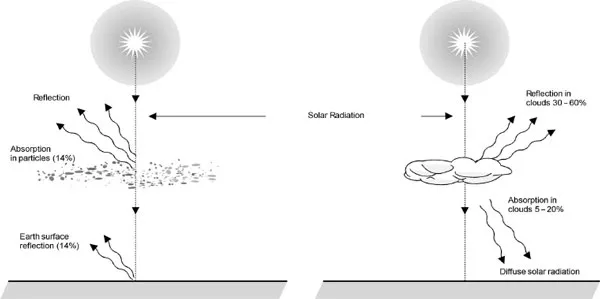
FIGURE 1.1 How the atmosphere affects solar radiation
Solar radiation that reaches the surface of the earth contains wavelengths from ultraviolet to infrared, but a significant part of the energy is in the infrared range. For good utilization of solar radiation it is necessary for all wavelengths to be able to be absorbed. Materials and surfaces with high absorptance and low emittance are preferable.
1.2 Available energy
The amount of energy that can be utilized is affected by supply, location, reduction in the atmosphere, reflection and absorption in the clouds, and the angle that the object used to absorb the energy makes with the horizontal. Solar radiation is normally classed as direct (beam) or diffuse. Direct sunlight causes strong shadows; indirect or diffuse sunlight is reflected from clouds or other objects. The sum of direct and diffuse solar radiation is the radiation we can make use of. It is called global radiation. The amount of radiation that reaches the earth’s surface is influenced largely by the local weather. The direct radiation can be reflected and absorbed in the clouds, so that on occasions it is practically non-existent.
For example, in the south of Sweden (areas near the coast, ar...
Table of contents
- Cover Page
- Title Page
- Copyright Page
- Contents
- Preface
- Acknowledgements
- 1 Introduction
- 2 The solar heating system
- 3 Solar heating applications
- 4 Solar heating for multi-family dwellings
- 5 Solar heating for single-family dwellings
- 6 Solar heating for outdoor pools
- 7 Large-scale solar heating technology
- 8 Economy and profitability analysis
- 9 Procurement
- 10 Other solar technologies
- 11 Summary and a look to the future
- References and further reading
- Glossary
- Index
Trusted by 375,005 students
Access to over 1.5 million titles for a fair monthly price.
Study more efficiently using our study tools.
Frequently asked questions
Yes, you can cancel anytime from the Subscription tab in your account settings on the Perlego website. Your subscription will stay active until the end of your current billing period. Learn how to cancel your subscription
No, books cannot be downloaded as external files, such as PDFs, for use outside of Perlego. However, you can download books within the Perlego app for offline reading on mobile or tablet. Learn how to download books offline
Perlego offers two plans: Essential and Complete
- Essential is ideal for learners and professionals who enjoy exploring a wide range of subjects. Access the Essential Library with 800,000+ trusted titles and best-sellers across business, personal growth, and the humanities. Includes unlimited reading time and Standard Read Aloud voice.
- Complete: Perfect for advanced learners and researchers needing full, unrestricted access. Unlock 1.5M+ books across hundreds of subjects, including academic and specialized titles. The Complete Plan also includes advanced features like Premium Read Aloud and Research Assistant.
We are an online textbook subscription service, where you can get access to an entire online library for less than the price of a single book per month. With over 1.5 million books across 990+ topics, we’ve got you covered! Learn about our mission
Look out for the read-aloud symbol on your next book to see if you can listen to it. The read-aloud tool reads text aloud for you, highlighting the text as it is being read. You can pause it, speed it up and slow it down. Learn more about Read Aloud
Yes! You can use the Perlego app on both iOS and Android devices to read anytime, anywhere — even offline. Perfect for commutes or when you’re on the go.
Please note we cannot support devices running on iOS 13 and Android 7 or earlier. Learn more about using the app
Please note we cannot support devices running on iOS 13 and Android 7 or earlier. Learn more about using the app
Yes, you can access Solar Installations by Lars Andren in PDF and/or ePUB format, as well as other popular books in Technology & Engineering & Architecture General. We have over 1.5 million books available in our catalogue for you to explore.