- 336 pages
- English
- ePUB (mobile friendly)
- Available on iOS & Android
eBook - ePub
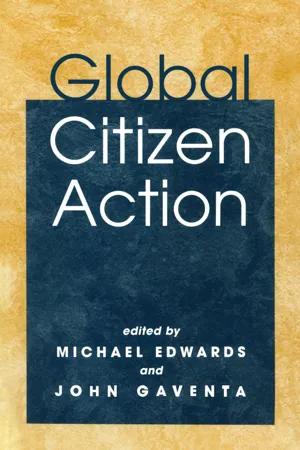
Global Citizen Action
About this book
Civil society, or citizen's groups, have taken centre stage in international policy debates and global problem solving. They hold out the promise of a global community and global governance. This volume, by leading scholars and participants, shows how to understand the changes that are occurring, particularly in relation to the international institutions involved. It includes case studies from all the major social movements of the 1990s.
Information
Subtopic
Ecology1

Introduction
Ten years ago, there was little talk of civil society in the corridors of power, but now the walls reverberate with at least the rhetoric of partnership, participation, and the role of citizens’ groups in promoting sustainable development. Though poorly understood and imperfectly applied in practice, concepts like the “new diplomacy,” “soft power,” and “complex multilateralism” place civil society at the center of international policy debates and global problemsolving (Edwards 1999). This radical change in international relations bodes well for our common future, but it is also a highly contested debate in which questions abound and answers are in short supply. In reality, civil society is an arena, not a thing, and although it is often seen as the key to future progressive politics, this arena contains different and conflicting interests and agendas (Scholte 1999). For their part, global institutions are still the prisoners of a state-based system of international negotiation and find it exceptionally difficult to open up to nonstate participation at any meaningful level. We may dream of a global community, but we don’t yet live in one, and too often, global governance means a system in which only the strong are represented and only the weak are punished. Resolving these deficiencies is the essential task of the twenty-first century. This volume brings together a diverse group of scholars and practitioners to reflect on the lessons of recent social movements and the challenges that lie ahead. This introduction provides a short analysis of the changing global context as well as a conceptual framework for the case studies that follow and an overview of their contents and conclusions.
The Rise and Rise of Civil Society
Civil society is a contentious term with no common or consensus definition. The contributors to this book use it to refer, in very broad terms, to the arena in which people come together to advance the interests they hold in common, not for profit or political power, but because they care enough about something to take collective action. Civil society organizations are all those bodies that act in this arena, comprising a huge variety of networks and associations, political parties, community groups, and NGOs but excluding firms that are organized to make a profit for their shareholders and that generate no public benefits. NGOs (nongovernmental organizations) are formally constituted nonprofits that often dominate discussions about global civil society, but they are only one part of a much bigger picture. Although our contributors recognize that civil society organizations have different and sometimes conflicting normative agendas, they focus their case studies on those groups that share a broad commitment to democracy, human rights, and protection of the environment.
During the past few years, and especially since the much-publicized demonstrations against the World Trade Organization in Seattle in 1999, the term global civil society has been much in vogue. Although some of the case studies in this book do use this term, they refer more often to elements of transnational civil society or international social movements to describe a spreading web of networks of organizations based in different countries, usually but not always led by NGOs. Such transnational networks abound, but there are few global citizens to constitute a global civil society in the deepest meaning of that term. Citizens from different countries are certainly speaking out on global issues, but the rights and responsibilities of citizenship at the global level are ill defined, especially in the absence of a global state or culture. Nevertheless, the place of civil society in international affairs has risen dramatically since the end of the Cold War. Why is this? There are at least three reasons:
Changing Ideas About International Development
In recent years, there has been a significant move away from what was known as the Washington consensus—the belief that market liberalization and Western-style democracy offered a universal blueprint for growth and poverty reduction across the world. Central to the emerging post-Washington consensus are a number of ideas that place civil society at the heart of the development policy debate. First, a strong social and institutional infrastructure is crucial to growth and development: Social capital—a rich weave of social networks, norms, and civic institutions—is just as important as other forms of capital to these ends. Second, more pluralistic forms of governance and decisionmaking are seen to be more effective in developing a social consensus about structural changes in the economy and other key reforms. That is, shared ownership of the development agenda is seen as the key to its sustainability. Third, public, private, and civic roles are being reconceptualized and reshaped, in both economics and social policy; the best route to problemsolving lies through partnerships among these different actors. Fourth, international institutions require stronger public and political constituencies to support them; otherwise they will continue to lose legitimacy. Civil society is central to all these ideas, and to their successful application. Although the empirical evidence backing some of the underlying assumptions about these ideas is incomplete, there is already a consensus among the donor community that a strong civil society is crucial to successful development performance.
New Conceptions of Governance
Beyond the domestic arena, the second major shift highlighting civil society concerns a quiet revolution in the theory of international relations. When Kofi Annan talks of the “new diplomacy,” he is echoing a common perception that the characteristics of global governance—the rules, norms, and institutions that govern public and private behavior across national boundaries—are changing in new and important ways (Annan 1998). As economic and cultural globalization proceed, the state’s monopoly over governance is challenged by the increasing influence of private actors, both for-profit and not-for-profit (Rosenau and Cziempel 1992; Archibugi and Held 1995). Corporations and private capital flows react very quickly to the opportunities provided by an increasingly integrated global market. By contrast, the response of states and civil society is necessarily slow, fragmented, and messy because of the demands of democracy and the need to negotiate among so many different interests. In theory, civil society can be a counter-weight to the expanding influence of markets and the declining power of states, but in practice there are few formal structures through which this countervailing authority might be expressed, especially at the global level. The result is a growing democratic deficit in the processes of global governance.
As Ann Florini puts it in Chapter 3, “the Westphalian system [of nation states] is neither divinely ordained nor easily swept away,” but it is changing, and one of the most important of these changes concerns the expanding role of transnational civil society. In the twenty-first century, global governance is unlikely to mean a single framework of international law applied through a unified global authority. More likely is a multilayered process of interaction among different forms of authority and different forms of regulation, working together to pursue common goals, resolve disputes, and negotiate new tradeoffs among conflicting interests. The early stages of this model of governance, described as “global public policy” by some (Kaul 1999; Reinicke 1998) and “multi-track diplomacy” by others (Smith et al. 1998; Waterman 1998), can already be discerned in global environmental regimes such as the Montreal protocol and in the campaign case studies provided later in this volume. Over 20,000 transnational civic networks are already active on the global stage, 90 percent of which have been formed since 1970 (O’Brien et al. 2000; Runyan 1999). This form of governance is messy and unpredictable, but ultimately it will be more effective—by giving ordinary citizens a bigger say in the questions that dominate world politics and a greater stake in the solutions. For citizens of nondemocratic regimes, transnational civil society may provide the only meaningful avenue for voice and participation in decisionmaking.
Currently, civil society involvement in global regimes tends to operate through networks of interest groups, especially NGOs, rather than through formal representative structures (Keck and Sikkink 1998; Higgott and Bieler 1999). This raises important questions about the future role of global citizen action, especially issues of structure, governance, and accountability that may erode the legitimacy of civic groups as social actors in the emerging global order. These questions are taken up below and throughout the rest of this book. However, the role of civil society is certain to grow as global governance becomes more pluralistic and less confined to state-based systems defined according to territorial sovereignty.
It’s Good for Business
In addition to the conceptual explanations, international agencies have become more interested in civil society, and more open to working with civic groups, for a simpler and more commercial reason—it is “good for business.” They have found that operational partnerships and a broader policy dialogue contribute to more efficient project implementation and a lower rate of failure; a better public image and more political support, especially among key shareholder governments in North America and Western Europe; and research and policy development more informed and less constrained by internal orthodoxy. Given these tangible benefits, it would be difficult for any international agency to retreat from the trend toward greater civic engagement; the practical and political costs would be too high.
This positive assessment is a comparatively recent phenomenon. Prior to 1980, there was little structured contact between civic groups and multi-lateral institutions and almost no formal nonstate involvement in global regimes. Toward the middle of the 1980s such contacts became more frequent and more organized, including the consolidation of NGO advisory or consultative bodies for the specialized agencies of the UN system, the formation of the NGO Working Group on the World Bank in 1984, and some early global campaigning efforts around debt, structural adjustment, and popular participation (Willetts 1996; Weiss and Gordenker 1996; Fox and Brown 1998). Global civic organizing increased at a much faster rate after the end of the Cold War, with NGO networks increasingly sharing the stage with other civic actors such as international labor union federations and networks of professional associations. Successive UN conferences on gender, population, the environment, social development, and habitat provided a vehicle for these emerging civic alliances to test out their skills. Both the UN and the World Bank began to form strategic partnerships with key NGOs in ventures such as the Global Alliance for Forest Conservation and Sustainable Use and the World Commission on Dams (Florini, Chapter 3). The assumption underlying these partnerships is that “global civil society” can broaden democratic practice by creating additional channels for popular participation, accountability, consultation, and debate, thus improving the quality of governance and promoting agreements that will last. The World Bank, the United Nations Development Programme (UNDP), and many bilateral aid agencies have embarked on a systematic effort to increase their understanding of civil society and its role in these contexts and to enhance their capacity to engage effectively with civic groups at both the national level—through planning processes such as the World Bank’s Comprehensive Development Framework—and the international level.
However, toward the end of the 1990s, critical questions about this phenomenon began to surface inside the international institutions, especially about the role of intermediary (advocacy) NGOs as a subset of civic actors. Because institutions such as the UN have in the past portrayed civil society as something of a magic bullet for state and market failure, it is not surprising that observers are now turning their attention to the failings (actual or perceived) of civil society itself. It is increasingly common to hear senior agency staff, academics, and journalists echo the complaints of some governments (especially in the South) that NGOs are self-selected, unaccountable, and poorly rooted in society, thereby questioning their legitimacy as participants in global debates. It is not that these commentators question the principle of civic engagement; they worry, rather, that the practice of civic engagement may be distorted in favor of organizations with greater resources and more access to decisionmakers in capital cities. At the start of a new century, there are forces acting both for and against the deepening of civil society involvement in global regimes.
From Rhetoric to Reality: The Dilemmas of Civil Society Involvement
As a result of the political openings of the last decade, civic groups increasingly feel that they have the right to participate in global governance. Much less attention has been paid to their obligations to pursue this role responsibly or to concrete ways in which to express these rights. This is sensitive and difficult ground for all concerned. There are at least four areas of tension:
Legitimacy, Accountability, and Representation
The first set of issues—and by far the most contentious—concern legitimacy and accountability: Who speaks for whom in a global network, and how are differences resolved when participants vary in strength and resources? Who enjoys the benefits and suffers the costs of what the movement achieves, especially at the grassroots level? Whose voice is heard, and which interests are ignored, when differences are filtered out in order to communicate a simple message in a global campaign? In particular, how are grassroots voices mediated by institutions of different kinds—networks and their members, Northern NGOs and Southern NGOs, Southern NGOs and community groups, and so on down the line?
In the mid-1990s, North American NGOs generally claimed to represent a Southern consensus against the replenishment of the International Development Association (IDA, the soft loan arm of the World Bank), on the grounds that social and environmental safeguards were too weak. In contrast, Southern NGOs (mainly from Africa) tended to insist that IDA go ahead regardless of the weakness of these safeguards, because foreign aid was desperately needed even if its terms were imperfect (Cleary 1995, Nelson 1996, Edwards et al. 1999). On some issues (like debt or land mines), there is a solid South-North consensus in favor of a unified lobbying position. However, in other areas (especially trade and labor rights and the environment), there is no such consensus, since people and their civic representatives may have conflicting short-term interests in different parts of the world. As globalization proceeds, these areas will become the centerpiece of the international system’s response, so it is vital that networks develop a more sophisticated way of addressing differences of opinion within civil society in different regions. However, very few networks have mechanisms in place to resolve such differences democratically (Covey 1995).
In cases like these, discussions often focus on the thorny issue of representation, though there are really two questions at hand: First, is representation the only route to civic legitimacy in global governance? Second, how representative must an organization be in order to qualify for a seat at the negotiating table? These questions are often conflated, with results that make sensible conversation about policy options impossible.
Legitimacy is generally understood as the right to be and do something in society—a sense that an organization is lawful, admissible, and justified in its chosen course of action. However, there are generally two ways to validate organizations: through representation (which usually confers the right to participate in decisionmaking) and through effectiveness (which only confers the right to be heard).
Legitimacy in membership bodies is claimed through the normal democratic processes of elections and formal sanctions that ensure that an agency is representative of, and accountable to, its constituents. Trade unions and some NGOs fall into this category, though whether these processes operate effectively and democratically is another matter. Agreement on some minimum standards in this regard remains an important part of the agenda for the future. By contrast, nonmembership NGOs define their legitimacy according to legal compliance, effective oversight by their trustees, and recognition by other legitimate bodies that they have valuable knowledge and skills to bring to the debate. No one expects Oxfam, for example, to represent third-world opinion perfectly, only that its proposals on debt and other issues should be solidly rooted in research and experience as well as sensitive to the views and aspirations of its third-world partners.
NGOs may have the right to a voice, but not necessarily to a vote in global fora. In this sense, the best representative of civil society is a democratically elected government, complemented by the checks and balances provided by nonstate membership bodies (such as labor unions) and pressure groups of different kinds. The resulting mix is very messy, but it mirrors standard practice in national politics and stands ready to shape the emergence of more democratic regimes at the global level too. As the case studies in this book make clear, transnational civil society is far from democratic, and few networks have democratic systems of governance and accountability. Nevertheless, the increasing voice of civil society groups on the world stage adds an essential layer of checks and balances into the international system, while helping to ensure that excluded views are heard. The challenge—which our authors take up—is how to structure global citizen voice in ways that combat, rather than accentuate, existing social, economic, and political inequalities.
It is no accident that questions about legitimacy are being raised at a time when NGOs have started to gain real influence on the international stage. In that sense they are victims of their own success. Neither is there any shortage of hypocrisy among the critics, especially when they appear to single out NGOs in contrast to businesses (and even many governments) that are even less accountable than they are. Nevertheless, the criticisms are real and must be addressed if NGOs are to exploit the political space that has opened up in the post–Cold War world. At the minimum, that means no more unsubstantiated claims to “represent the people” as well as an explicit recognition that voice and vote rest on different types of organizational legitimacy.
Global Citizen Action: Building fro...
Table of contents
- Cover Page
- Half Title page
- Title Page
- Copyright Page
- Contents
- 1 Introduction
- Part 1: Conceptual Frameworks
- Part 2: Global Civil Society and the International Financial Institutions
- Part 3: Global Campaigns
- Part 4: Lessons Learned
- Acronyms
- References
- The Contributors
- Index
- About the Book
Trusted by 375,005 students
Access to over 1.5 million titles for a fair monthly price.
Study more efficiently using our study tools.
Frequently asked questions
Yes, you can cancel anytime from the Subscription tab in your account settings on the Perlego website. Your subscription will stay active until the end of your current billing period. Learn how to cancel your subscription
No, books cannot be downloaded as external files, such as PDFs, for use outside of Perlego. However, you can download books within the Perlego app for offline reading on mobile or tablet. Learn how to download books offline
Perlego offers two plans: Essential and Complete
- Essential is ideal for learners and professionals who enjoy exploring a wide range of subjects. Access the Essential Library with 800,000+ trusted titles and best-sellers across business, personal growth, and the humanities. Includes unlimited reading time and Standard Read Aloud voice.
- Complete: Perfect for advanced learners and researchers needing full, unrestricted access. Unlock 1.5M+ books across hundreds of subjects, including academic and specialized titles. The Complete Plan also includes advanced features like Premium Read Aloud and Research Assistant.
We are an online textbook subscription service, where you can get access to an entire online library for less than the price of a single book per month. With over 1.5 million books across 990+ topics, we’ve got you covered! Learn about our mission
Look out for the read-aloud symbol on your next book to see if you can listen to it. The read-aloud tool reads text aloud for you, highlighting the text as it is being read. You can pause it, speed it up and slow it down. Learn more about Read Aloud
Yes! You can use the Perlego app on both iOS and Android devices to read anytime, anywhere — even offline. Perfect for commutes or when you’re on the go.
Please note we cannot support devices running on iOS 13 and Android 7 or earlier. Learn more about using the app
Please note we cannot support devices running on iOS 13 and Android 7 or earlier. Learn more about using the app
Yes, you can access Global Citizen Action by Michael Edwards,John Gaventa in PDF and/or ePUB format, as well as other popular books in Politics & International Relations & Ecology. We have over 1.5 million books available in our catalogue for you to explore.