Responding to a need for greater cultural competence in the preparation and development of teachers in diverse public school settings, this book investigates the critical developmental and social processes mediating students' academic identities in those settings posing the greatest challenges to their school achievement and personal development. It provides an accessible, practice-oriented culturally responsive framework for teachers in American schools.
Murrell proposes a situated-mediated identity theory that emphasizes examining not just the child, not just the school environment, but also the child in-context as the unit of analysis to understand how both mutually constitute each other in the social and cultural practices of schooling. He then develops this theory into an applied psychology of identity and agency development among children and youth as well as their teachers, striving together for academic achievement in diverse school settings.
For researchers, professionals, and students in multicultural education, educational and developmental psychology, social and cultural foundations of education, and teacher education, Murrell's cultural practices approach builds on current thinking about multicultural teacher preparation and provides the practice component underpinning theories about cultural competence.
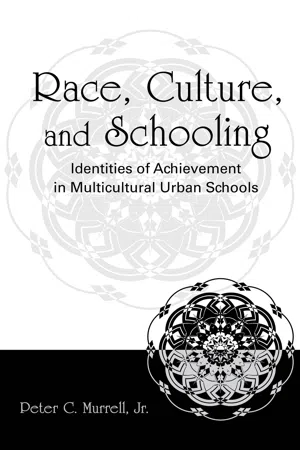
eBook - ePub
Race, Culture, and Schooling
Identities of Achievement in Multicultural Urban Schools
- 228 pages
- English
- ePUB (mobile friendly)
- Available on iOS & Android
eBook - ePub
Race, Culture, and Schooling
Identities of Achievement in Multicultural Urban Schools
About this book
Information
II
Application of the Framework
4
The Construction of Academic Identities
Situativity, Positionality, and Agency in Intellectual Life
People tell others who they are, but even more important they tell themselves and then try to act as though they are who they say they are.
—D. Holland et al. (1998, p. 31)
It is probably no mere historical accident that the word person, in its first meaning, is a mask. It is rather a recognition of the fact that everyone is always and everywhere, more or less consciously, playing a role … . It is in these roles that we know each other; it is in these roles that we know ourselves.
—Park (1950, p. 249)
In Goffman’s (1959) famous study The Presentation of Self in Everyday Life, he distinguished between ego identity and positionality in a way that introduced action and performance as determiners of the individual self. In that work, one’s personal identity (ego identity) existed behind a persona, a public and dramaturgical representation of self. The key idea is that one’s personal identity is always inferred based on what one does or says. It has no content or structure per se, as it is an organizational feature of one’s mentality. Personas, on the other hand, are public and shared. One’s persona is expressed or presented discursively, and its uniqueness is recognized by how well it conforms to the roles and person types recognized by the large collective of people. It is this important distinction between the personal self and the public self that I take up in this chapter. Of central concern here is the nature of the dynamics of identity expression in relation to young people’s performance and well-being in school settings.
Let me restate that the purpose of situated-mediated identity theory is to explain the relationship between young people’s achievement motivation on the one hand and the shifting, complex social worlds they experience in school settings on the other hand. As stated earlier, mediated identity theory should not be regarded as a grand theory, but rather a starting point for understanding the social construction of learning achievement and academic proficiency as a process of mediated identity formation. In chapters 2 and 3, the basic conceptual apparatus of mediated identity theory was presented and summarized in Table 2–2 and Table 3–3. In this chapter I focus on the three dimensions of identity in the theory constituting the first column of that table—situated identity, positionality, and agency—and explain how they constitute three critical developmental tasks young people face as they struggle to make sense of themselves as academic achievers, cultural beings, and worthy human beings.
The first column in Table 2–2 depicts the three kinds of identity that already seem to have a psychological reality to everyday people. Recall that these included (a) the self or personal identity—one’s sense of continuity and “me-ness” that has an integrity over time and through different contexts; (b) the selves that are publicly represented, in different ways at different times, as in the episodes of interpersonal interaction in the everyday world; and (c) the self of personal agency—in that one takes oneself as acting from a point of interest and intention located in or attached to the me-ness. These three types of selves—roughly speaking, ego identity, positionality, and agency—appear in various guises and forms in sociology, psychology, semiotics, and other disciplines. A thorough treatment of these three levels of identity as a formal integrated sociopsychological theoretical framework is available elsewhere (cf. Côté & Levine, 2002) and is not addressed here. Here I examine in greater detail those three elements—situated identity, positionality, and agency—to reveal school achievement as a social process of becoming a learner and an adult. What should become clear in this discussion is how identities of achievement are socially constructed across each of these levels of experience—the interpersonal level (micro), the institutional level (meso), and cultural level (macro).
Situated Identity
Situated identity is the first element. I realized just how tricky it is to define situated identity on an occasion at a recent academic conference where I was explaining my work to a colleague there. She had asked me for a one-sentence definition of situated identity, which, surprisingly to me, I could not easily come up with. My explanation was uncomfortably wordy, but I managed to be clear enough by using concepts my colleague was familiar with, which included the notions of situated learning, socio-cultural theory, ego identity, and an area of inquiry in sociology called role-identity theory. It troubled me, though, that my explanation seemed needlessly circuitous, and I forgot about this episode until later in the semester when I asked my students to do the same thing in my undergraduate course in learning and development. I asked students to define situated identity by telling me what their “take-away understanding” of the concept was from the course. Here is a sample of their written responses:
Student 1: | Situated identity means that our sense of self (our identity) is not “fixed,” rather, our identity is flowing and determined situationally by many factors. Our identity is formed through social practice. A person’s identity is mediated by what is going on situationally. (April 2005) |
Student 2: | Situated identity is a combination of personal identity and social identity. In a particular situation those two senses of identity combine and the person takes on a situated identity. Also, in a particular situation the person is declaring their role in that social interaction, such as a student in a classroom is declaring that they are there to learn. By encouraging that as a situated identity the teacher can use that identity to secure the student’s attention as a learner and encourage learning. (April 2005) |
Student 3: | Situated identity is an identity that is affected by where you are, whom you are with, and how they make you feel. Therefore teachers have a major influence on situated identity because it is their job to make a positive learning environment for their students. (April 2005) |
Student 4: | A person’s situated identity (sense of self) is both the person and the setting the person is in. Our sense of self or identity is ever changing and is determined by the situation. It is mediated by what is going on around the individual and it is continuous throughout life. Understanding the concept of situated identity can lead a teacher to be more effective in promoting academic achievement by connecting with the families, the neighborhood, and the different cultures. Students are affected by their social context and cultural practices. (April 2005) |
My students provided wonderful and accurate explanations, any one of which would have been more than adequate to satisfy my inquiring colleague at the conference a few weeks prior. Their definitions are all right on the money because of their semester-long intensive study using the concept as applied theory in children’s learning and development during their field work in urban after-school programs. Many of my students used the idea to interpret children’s motivation on a daily basis and saw how particular situations mediated children’s senses of self, and how this in turn mediated their effort and investment in the learning activity. The notion of situated identity provided them with a way of actually responding to the admonition of “know your students and where they are coming from” to promote effective and worthwhile learning. In short, the notion of situated identity made sense to my students because of the framework that informed their practice as they worked with school-aged children in their urban field experiences. It also made sense to them because it helped them make sense of their daily successes and failures working with children from backgrounds very different from their own. It made sense to them because it provided a way of interpreting the relationship between self and learning, and seeing the importance of identity in mediating the teaching and learning process, both for their students and for them personally.
What these two experiences revealed to me is that the nature of understanding the concept of situated identity is itself an act of situating identity. The meaning of ...
Table of contents
- Cover Page
- Title Page
- Copyright Page
- Contents
- Preface
- I Theoretical Framework
- II Application of the Framework
Trusted by 375,005 students
Access to over 1.5 million titles for a fair monthly price.
Study more efficiently using our study tools.
Frequently asked questions
Yes, you can cancel anytime from the Subscription tab in your account settings on the Perlego website. Your subscription will stay active until the end of your current billing period. Learn how to cancel your subscription
No, books cannot be downloaded as external files, such as PDFs, for use outside of Perlego. However, you can download books within the Perlego app for offline reading on mobile or tablet. Learn how to download books offline
Perlego offers two plans: Essential and Complete
- Essential is ideal for learners and professionals who enjoy exploring a wide range of subjects. Access the Essential Library with 800,000+ trusted titles and best-sellers across business, personal growth, and the humanities. Includes unlimited reading time and Standard Read Aloud voice.
- Complete: Perfect for advanced learners and researchers needing full, unrestricted access. Unlock 1.5M+ books across hundreds of subjects, including academic and specialized titles. The Complete Plan also includes advanced features like Premium Read Aloud and Research Assistant.
We are an online textbook subscription service, where you can get access to an entire online library for less than the price of a single book per month. With over 1.5 million books across 990+ topics, we’ve got you covered! Learn about our mission
Look out for the read-aloud symbol on your next book to see if you can listen to it. The read-aloud tool reads text aloud for you, highlighting the text as it is being read. You can pause it, speed it up and slow it down. Learn more about Read Aloud
Yes! You can use the Perlego app on both iOS and Android devices to read anytime, anywhere — even offline. Perfect for commutes or when you’re on the go.
Please note we cannot support devices running on iOS 13 and Android 7 or earlier. Learn more about using the app
Please note we cannot support devices running on iOS 13 and Android 7 or earlier. Learn more about using the app
Yes, you can access Race, Culture, and Schooling by Peter C. Murrell, Jr. in PDF and/or ePUB format, as well as other popular books in Education & Education General. We have over 1.5 million books available in our catalogue for you to explore.