eBook - ePub
Higher Education in Latin American
- 322 pages
- English
- ePUB (mobile friendly)
- Available on iOS & Android
eBook - ePub
Higher Education in Latin American
About this book
The purpose of this series is to bring together the main currents in today's higher education and examine such crucial issues as the changing nature of education in the U.S., the considerable adjustment demanded of institutions, administrators, the faculty; the role of Catholic education; the remarkable growth of higher education in Latin America, contemporary educational concerns in Europe, and more. Among the many specific questions examined in individual articles are: Is it true that women are subtly changing the academic profession? How is power concentrated in academic organizations? How successful are Latin America's private universities? What is the correlation between higher education and employment in Spain? Is minority graduate education in the U.S. producing the desired results?
Information
Higher Education 21: 63–81, 1991.
© 1991 Kluwer Academic Publishers. Printed in the Netherlands.
Issues and perspectives for higher education in Argentina in the 1990s*
Instituto de Economía y Finanzas, Facultad de Ciencias Económicas, Universidad Nacional de Córdoba, Ciudad Universitaria. 5000 Córdoba, Argentina
Abstract. In Argentina, inadequate financing of higher education is an old rather than a new issue. The paper takes a close look at the financing issues associated with the evolution of national universities in Argentina in 1960–1990. Accordingly, the first and second sections highlight the major trend of the last thirty years in student population, faculty staff and goverment spending. The third section explores the teaching and research labor market covered by the national universities. The fourth section includes a discussion of several proposals under debate to ease existing constraints to the financing of higher education. Finally, the feasibility of these proposals, as well as their limitations and possibilities in the light of the the long run trend in enrollment and expenditures reviewed in the previous sections are discussed.
Introduction
The decade of the eighties has not been propitious for the advancement of public institutions of higher education (OECD 1987). These institutions suffered severely from inconsistent government financing, currently associated with the global economic slowdown of the early eighties (Buiter 1986; Dornbush 1986; Tibi 1989). In Latin America, adjusting the nations to the new international economics resulted, first, in skyrocketing government expenditures designed to keep the old engine running (Corbo and De Melo 1987) only to be followed next by fiscal instability and resulting deficits in public accounts (Fisher 1986; Calvo 1986). Consequently, in the case of education, attempts to introduce institutional sector adjustment policies have meant the interruption of a long lasting upward trend at least two decades long, in government sustained financial support to public institutions of Higher Education.
During the eighties, government spending, the major source of financing for the sector, has not kept pace with growth in enrollment (Winkler 1988; Tedesco 1987). Decreasing expenditures per student, lower faculty salaries and generalized cuts in complementary supplies were the most immediate results found throughout the region. This has put universities under scrutiny and much stimulated the search for alternative approaches in the governance and financing of institutions of higher education.
In contrast to the situation described for Latin America as a whole, in Argentina, sluggish financing of higher education is an old rather than a new issue (Gertel 1977). Given this setting, the purpose of this paper is to take a close look at the financing issues associated with the evolution of national universities in Argentina. Accordingly, the paper is organized into four sections. The first and second sections highlight the major trend of the last thirty years in student population, faculty staff and goverment spending. The third section explores the teaching and research labor market covered by the national universities. The fourth section includes a discussion of several proposals under debate to ease existing constraints to the financing of higher education. Finally, the feasibility of these proposals, as well as their limitations and possibilities in the light of the long run trend in enrollment and expenditures reviewed in the previous sections are discussed.
1. Enrollment and expenditures in the National Universities. Trend and fluctuations: 1960–1990
This section analyses the trend and fluctuations in enrollment and expenditures in the national universities during the past thirty years. The beginning of this period is characterized by an organized official effort to upgrade the quality of national universities and academic activities. Some important landmarks at the time were the creation of the National Research Council (CONICET) in 1958, the incorporation of a significant number of full-time academic positions, and the support for research activities through a network of newly created research institutes affiliated either to universities or the CONICET (OECD 1968). These early efforts were not followed by a consistent policy of support during the following thirty years. This is reflected in the trends of financing analysed in this section as well as in the sustained migration of highly qualified professionals (Zucotti 1987), an aspect which won’t be dealt with specifically in this paper.
1.1. The trend
One of the most distressful features of higher education financing in Argentina is revealed by long term analysis of enrollment and public expenditures at the national universities: while total student population (as shown in Figure 1a) grew over the trend line 1960–90, at an average annual rate of 5.9%, public financing, during the same period, diminished, in constant US$ of 1987, at an average annual rate of 1.5% (Figure 1b). The combined result, shown in Figure 1c, was a sustained and substantial decline in per-student expenditures that has gone down from an annual average of US$ 1800, in 1963, to an all-time low of US$ 225 in 1989, averaging an annual rate of decline of 7.5%.
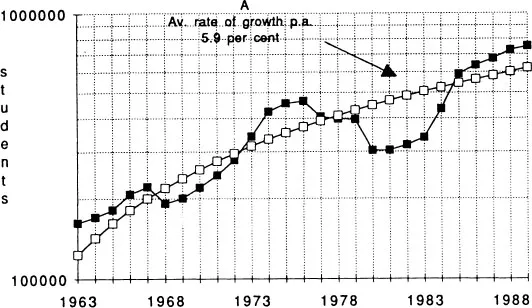
Fig. 1a. Actual and trend line of total student population in national universities 1963–1989.
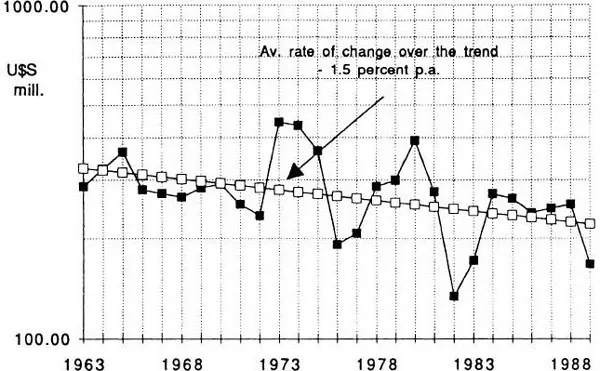
Fig. 1b. Actual and trend line of total current expenditures in national universities (in constant 1987 US$).
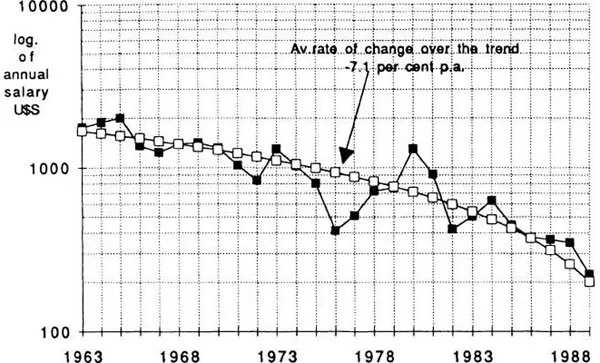
Fig. 1c. Actual and Trend Value of Per Student Expenditures National Universities 1963–1989.
1.2. Fluctuations in enrollment and expenditures
Enrollment, as shown in Figure 1a, presents two pronounced and lengthy downturns in the 1963–88 period, the first in 1967–72, and the second in 1976–84. Both correspond to unstable political periods, when elected governments were overturned and replaced by military regimes and new restrictive regulations were introduced at the national universities. The rapid recuperation in enrollment growth observed after the first downturn can be associated with a multiplication in the number of institutions across the country, the number of national universities changed from 11 in 1969 to 23 in 1974. Thus, the evolution in enrollment seems to be, in the first place, quite responsive to shifts in policy. For example, it was observed that as restrictions in access to public universities are lifted, enrollment tends to increase. This is the case of the 1967–72 period, when drastic restrictions in access introduced in 1967 were almost immediately followed by the creation of 12 new institutions in less than five years. At the same time, it was also observed that the longer the period in which restrictions to access apply, as in 1976–83, the sharper the aftermath tendency to expanding enrollment will result.
Public financing of national universities since 1963 has been characterized by instability. Accordingly, the analysis of derivatives associated with the curve of public financing indicate that improvements in budget allocations for higher education existed in 1963–65, 1972–73, 1976–80 and 1982–84; while budgets deteriorated in 1965–72, 1975–76, 1980–82 and 1988–89. Periods of relative stability (plateaux in the curve) were 1973–75 and 1984–88. As compared with enrollment, fiscal cycles were shorter and fluctuations sharper, depending more on the peculiar macroeconomic behavior prevalent in the country’s economy (Cavallo and Peña 1983; Diaz-Alejandro 1981) than on specific public policies towards higher education.
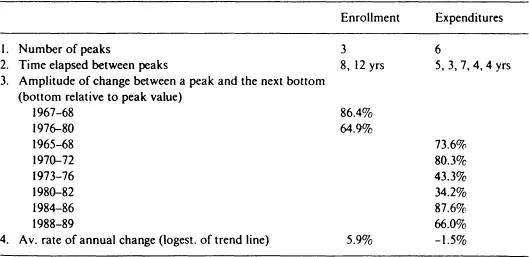
Fluctuations were smoother in per-student expenditures, and the steady decrease (an annual decrease of 7.1) observed in average expenditures was only disturbed in 1976–80, and 1980–86. The first, an increase, can be regarded as the result of a combination of economic factors (overvaluation of the national currency) and a tight enrollment policy adopted in those years, which resulted in a short but important upward shift in the US$ value of per-student expenditures. The second, a decrease, is associated with the severe social and economic crisis which affected the country then. Budget instability increased over time, decline from peak to bottom averaged 9% annually in 1965–68, 10% in 1970–72, 19% in 1973–76, 33% in 1980–82 and 34% in 1988–89.
The main features concerning fluctuations in the trends in enrollment and expenditures are summarized in Table 1, three peaks in enrollment figures and six peaks in expenditures were found. Thus, while the trend in enrollment seems predictable, fluctuations in budget allocations are almost impossible to adjust to any model. These fluctuations, when considered independently of a historic perspective, have obscured the overall decreasing tendency in the expenditures in national universities.
Table 1. Main features in enrollments and expenditures fluctuations: 1963–1989
Source: Own calculations.
1.3. Expenditures in higher vs secondary education
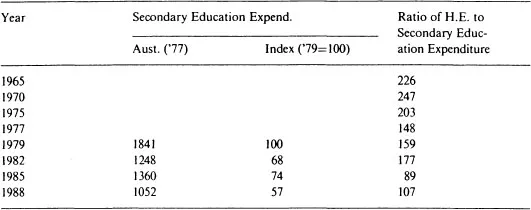
Expenditures in higher education have also declined relative to expenditures in secondary education. As shown in Table 2, in 1970 a typical student in higher education received more than 2 times (2,50) the amount spent on the average secondary school student, but even this slight difference disappeared after 1985. At the present, there is almost no difference in per-student expenditures between higher and secondary education. Thus, in universities, the conflicting result of increasing enrollment and decreasing budgets was a reduction in the relative cost of providing education. Unable to exert effective pressure to revert this situation, the response from the national university system has been to provide education of significantly decreasing quality.
Table 2. National Government: per-student expenditures in higher education relative to secondary education
Source: 1965–77, Carnoy et al. (1981), T.4, 1979–88, A. H. Petrei et al (1989), p. 144.
2. The quality aspect of university education and declining spending per-student
The average expenditure per-student, as shown in Figure 1c, has gone down in 1960–90 at an average annual rate of 7.1%. What are the implications of this decline on the quality of teaching?
Changes in per-student spending can be explained through variations in two components: the inverse of the student-teacher ratio (T/S), a technical relationship reflecting scale and organizational factors, and the changes in the average expenditure per teacher (E/T), a factor-productivity component:

Thus, the observed decline in the average per-student expenditures ratio over time may be due to an increased student-teacher ratio (T/S decreases), decreasing expenditures per teacher (a drop in Ex/T) or a combination of both. Changes in any one of these two components will have an effect on the quality of teaching and shall, then, be explored independently.
Economies of scale, that is, relative spending per student, are brought about when the student-teacher ratio increases (Psacharopoulos 1982). Let’s observe then the student-teacher ratio evolution in Argentina. A rather stable student-teacher ratio with a mean value of 22 and a standard deviation of 4.2 points was registered along the 1960–90 period; within the ± one standard deviation range, values above the mean were found to concentrate in the early years while most values below the mean corresponded to the last years. This can be explained as follows: the average annual growth rate of the teaching force, of 7.1% as estimated from actual data, and calculated in terms of full-time equivalent units, remained on average slightly above that of the growth of student population (6.1%). Stability of the student teacher ratio was a direct result of this. The few ‘outlayers’, identified through regression analysis corresponded to specific periods: 2 points were above the standard range in 1966–67. These are related to the fact that the rate of increase in the teaching force decelerated sharply after the military coup of 1966. This resulted in higher student-teacher ratios for 1966 and 1967. In 1968, as entrance examinations started to be required, enrollment decreased and the student-teacher ratio resumed values within the historical range of 22 to 25 student per faculty member. A second important deviation relative to the trend values was registered in 1980–82, in coincidence with a combination of social and economic events, including the Falkland war of 1982, and a drastic deterioration in the prevailing economic conditions that resulted in a heavy restraint in public finance. Tuition fees were introduced at the national universities and enrollments registered values well below those corresponding with the trend. This time, the student-teacher ratio dropped, to reach an all time low of 15–16 only to resume its historical trend value soon after the Alfonsin administration took power, in December 1983. The last figure registered, corresponding to 1988, indicates a ratio below the range of values. This time, it can be attributed to a new slackening in the growth of the teaching force associated now with the deteriorated conditions of the academic labor market.
The student-teacher ratio, which has remained relatively stable throughout the pas thirty years, would then have no significant bearing on the dec...
Table of contents
- Cover Page
- Half Title page
- Title page
- Copyright Page
- Contents
- Volume Introduction
- 1 Overview
- 2 Contemporary Issues and Themes
- 3 Illustrative Country Cases
- Acknowledgments
Trusted by 375,005 students
Access to over 1.5 million titles for a fair monthly price.
Study more efficiently using our study tools.
Frequently asked questions
Yes, you can cancel anytime from the Subscription tab in your account settings on the Perlego website. Your subscription will stay active until the end of your current billing period. Learn how to cancel your subscription
No, books cannot be downloaded as external files, such as PDFs, for use outside of Perlego. However, you can download books within the Perlego app for offline reading on mobile or tablet. Learn how to download books offline
Perlego offers two plans: Essential and Complete
- Essential is ideal for learners and professionals who enjoy exploring a wide range of subjects. Access the Essential Library with 800,000+ trusted titles and best-sellers across business, personal growth, and the humanities. Includes unlimited reading time and Standard Read Aloud voice.
- Complete: Perfect for advanced learners and researchers needing full, unrestricted access. Unlock 1.5M+ books across hundreds of subjects, including academic and specialized titles. The Complete Plan also includes advanced features like Premium Read Aloud and Research Assistant.
We are an online textbook subscription service, where you can get access to an entire online library for less than the price of a single book per month. With over 1.5 million books across 990+ topics, we’ve got you covered! Learn about our mission
Look out for the read-aloud symbol on your next book to see if you can listen to it. The read-aloud tool reads text aloud for you, highlighting the text as it is being read. You can pause it, speed it up and slow it down. Learn more about Read Aloud
Yes! You can use the Perlego app on both iOS and Android devices to read anytime, anywhere — even offline. Perfect for commutes or when you’re on the go.
Please note we cannot support devices running on iOS 13 and Android 7 or earlier. Learn more about using the app
Please note we cannot support devices running on iOS 13 and Android 7 or earlier. Learn more about using the app
Yes, you can access Higher Education in Latin American by Lewis Tyler, Maria Helenda De Magalhaes Castro, Hernan Courard Bull, Rollin Kent, Daniel C. Levy, Marcela Mollis, Juan Carlos Navarro, Philip G. Altbach, Lewis Tyler,Maria Helenda De Magalhaes Castro,Hernan Courard Bull,Rollin Kent,Daniel C. Levy,Marcela Mollis,Juan Carlos Navarro,Philip G. Altbach in PDF and/or ePUB format, as well as other popular books in Education & Education General. We have over 1.5 million books available in our catalogue for you to explore.