The place of native and non-native speakers in the role of English teachers has probably been an issue ever since English was taught internationally. Although ESL and EFL literature is awash, in fact dependent upon, the scrutiny of non-native learners, interest in non-native academics and teachers is fairly new. Until recently, the voices of non-native speakers articulating their own concerns have been even rarer.
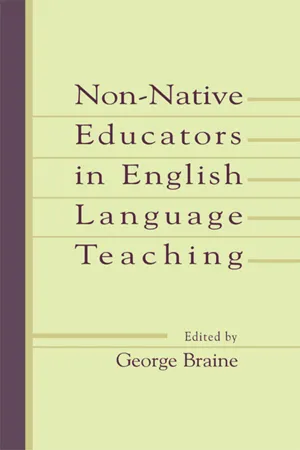
This book is a response to this notable vacuum in the ELT literature, providing a forum for language educators from diverse geographical origins and language backgrounds. In addition to presenting autobiographical narratives, these authors argue sociopolitical issues and discuss implications for teacher education, all relating to the theme of non-native educators in ETL. All of the authors are non-native speakers of English. Some are long established professionals, whereas others are more recent initiates to the field. All but one received part of the higher education in North America, and all except two of the chapters are at least partially contextualized in North America.
Particularly relevant for non-native speakers who aspire to enter the profession, graduate students in TESOL programs, and teacher educators, the unique nature of this book's contributors and its contents will interest researchers and professionals in applied linguistics generally and in ELT, and all those who are concerned with the role of non-native speakers in English-language teaching.
- 256 pages
- English
- ePUB (mobile friendly)
- Available on iOS & Android
eBook - ePub
Non-native Educators in English Language Teaching
About this book
Information
PART ONE
Who We Are
The NS-NNS dichotomy can be a highly personal issue for non-native teachers of English. Hence, every chapter in this book displays the personal touch of the author(s), albeit more explicitly in Part I than in others.
In the opening chapter, Jacinta Thomas explores the fundamental issue of credibility that confronts NNS professionals in ESL contexts. She examines the challenges to credibility in various contexts and perspectives—in hiring practices, from professional organizations, from students, and during graduate studies. She then explores the effects of these challenges to credibility by delving into her personal experiences and by frequently citing the experiences of her colleagues as well. Thomas claims that NNS teachers have to work twice as hard as their NS colleagues, proving themselves as effective users of the language before being accepted as professionals. This thoughtful and poignant narrative provides an insight to the struggles that many NNS teachers face in their professional development and provides a fitting opening to the volume.
By most accounts, there are at least four NNS to every NS of English. As the British Empire dwindles to a few obscure specks on the world map, the ownership of English is being shared with the former colonists and the brash newcomers to the field—the Americans. Although the flow of English language teaching expertise has been from the Center countries—where the dominant groups are NSs of English—to the Periphery, scholars from the Periphery have more recently begun to establish themselves in Center countries. In the second chapter, arguing that some NS professionals from the Center appear to be unaware of the backgrounds of their NNS colleagues from the Periphery, George Braine recounts his journey as a teacher at a village school in Sri Lanka to the Center, as a graduate student in the United States, as a teacher at international universities in the United States and in Asia, and as the coeditor of the Asian Journal of English Language Teaching. Braine recalls his acquisition of academic literacy and also describes how he first became aware of his non-nativeness. Drawing on his experiences and that of others, Braine describes how the challenges for NNS Periphery scholars continue even when they leave the Center, because the need to publish internationally continues in some parts of the Periphery. As he reflects upon his journey, Braine presents some scenes from the past as four vignettes, which help him to illustrate his reflections.
A literacy biography is an account of significant factors and events that have contributed to one's development as a reader and writer. In chapter 3, Ulla Connor traces her development as an established writer in English, beginning with concurrent Master's theses in English language and literature at the University of Helsinki in her native Finland and in English literature at the University of Florida. Recalling that she first wrote in English in the voice of her mentor, Connor describes how she began to master the orderly, coherent writing of research during her doctoral studies at the University of Wisconsin and gradually began to acquire her own voice and confidence as a writer in English. She also recounts the advantages of collaborative writing, noting that her co-authors also acted as mentors. At the conclusion of the chapter, Connor describes how, when attempting to write later in Finnish, she discovered that she had become a “completely Americanized” writer. She also offers a number of suggestions to other ESL writers. Connor's literacy autobiography typifies the journey of many NNS professionals in ELT in Center countries.
With the thawing of relations between the United States and China in the 1970s, Chinese graduate students and scholars began to trickle into the United States. The trickle later became a flood, and in the late 1990s, the largest number of international students in the United States is from China. How would a Chinese scholar who spent her teens as a Red Guard, thereby missing high school, survive the thrust into U.S. graduate school? In chapter 4, Xiao-ming Li, the author of “Good Writing” in Cross-Cultural Context (1996), describes her initiation into academic discourse under the tutelage of Donald Murray at the University of New Hampshire. Weaving in and out of her deeply instilled Chinese experiences, Li delightfully recalls her bewilderment at U.S. idioms, which in turn led to her first publication, in The Boston Globe. Li concludes with a description of how “Good Writing” almost destroyed her career and how the writing community rallied to her support. Li's chapter is a literacy autobiography recalled with clarity and the poignancy of an accomplished writer.
In the final chapter of Part One, Claire Kramsch and Eva Lam examine the role textuality plays in the native-nonnative relationship and the effect written language has on the development of a learner's social and cultural identity. Citing the experiences of two NNSs of English, Kramsch and Lam argue that, unlike everyday conversations, texts can be reproduced, reread, cited, and annotated by every user. It is therefore important that language teachers themselves cultivate both an insider's and an outsider's attitude toward English. Kramsch and Lam further argue that such a position implies a tension between the standardized, native norms of the English language and the ability of the non-native writer/reader to see through these norms and to test their limits. Rather than being used primarily for socializing non-natives into the ways of the natives, the written language can offer the opportunity to express human thoughts and feelings that NNSs have experienced particularly acutely.
References
Li, X. (1987, February 1). Trying to make sense out of nonsense. The Boston Sunday Globe, p. A26.
Li, X. (1996). “Good writing” in cross cultural context. Albany, New York: State University of New York Press.
CHAPTER 1
Voices from the Periphery: Non-Native Teachers and Issues of Credibility
It is the first day of class and I am nervous. This is going to be the first time that I teach a class of “native speakers of American English.” My recently acquired Ph.D. and my almost 7 years of teaching give me little confidence as I enter the classroom 10 minutes early to make sure that I have everything that I need for class, including a working overhead projector and chalk. A few minutes later, a young woman sticks her head in, stares at me in confusion, walks outside to check the room number, comes in again and asks: “Is this an English class?”
Experiences such as this are not really isolated incidents. It is one example of the type of challenges that many non-native teachers of American English are forced to face both from within and outside the profession. Like Okawa (1995), I have felt that “my initial credibility as a teacher (or lack thereof—was related to my race” (p. 1), and I would like to add to my language and accent as well. NNSs are not merely “strangers in academia,” a term used by Zamel (1995) to describe English as a Second or Other Language (ESOL) students and teachers in a university setting; we are sometimes strangers on the periphery. Although we may not always have to respond openly, “Yes, this IS an ENGLISH class and I AM the teacher,” we often find ourselves in situations where we have to establish our credibility as teachers of ESOL before we can proceed to be taken seriously as professionals. In the words of a colleague of mine, “I sometimes feel that I have to do twice as well to be accepted.”
From outside the TESOL profession, there is sometimes a little confusion and often amusement about us foreigners with our accents. A 95-year-old neighbor of mine, a dear sweet old lady, recently introduced me to her daughter as a college teacher and quickly added “Guess what she teaches?” “What?” her daughter asked. “English. Imagine someone coming from India to teach English here,” replied my neighbor with a slight chuckle.
This notion that one only has to be a “native speaker” of English to be able to teach it is one that I encounter as coordinator of an Academic English program in a community college. I receive telephone calls from people who want to teach in my program. When I ask them for their qualifications (we require at least a master's degree), I sometimes hear answers that range from “I am a native speaker of English, and I speak English well” to “I am sensitive to the needs of people from different cultures.” Although these are desirable qualities in teachers I hire, by themselves they are insufficient. Notions that they are sufficient undermine the training and knowledge necessary to be a good ESOL teacher. In fact, they are part of a much larger picture of false assumptions that challenge the credibility of NNSs of English.
Challenges to Credibility: Hiring Practices
The challenges that NNSs face, unfortunately, are not always merely uninformed or innocuous. Walelign's (1986) “Non-Native Speakers Need Not Apply” documented some of the prejudice that NNSs face in the hiring process abroad. This “birthright mentality” (p. 40) gives in to the fallacy that anyone who speaks a certain variety of English as the native language can teach it. More important, it is part of a “double standard” that ignores the routine hiring in many foreign language departments throughout Europe and America of NNSs to teach non-European languages (p. 41).
The uniform blanket exclusion of NNSs as potential teachers of English is nothing short of discrimination. Although stories of unintelligible foreign teaching assistants abound, the fact remains that there are good teachers and “not-so-good” teachers, and there are “not-so-good” teachers among the ranks of NSs of English as well. To say that “Non-Native Speakers Need Not Apply” is exclusionary, and any policy that blindly bars certain groups should be suspect.
It is very disturbing that even some professionals involved in TESOL believe that being a NS of English is a necessary condition to teach English (see Braine, Chap. 2, and Kamhi-Stein, Chap. 10, this volume). At the 1995 TESOL Convention, I attended an early morning discussion on Intensive English programs. The topic for discussion was recruitment. One person commented: “One thing that we do when we recruit, is that we tell students that they will only be taught by NSs. After all these students don't come so far to be taught by someone who doesn't speak English.” An obvious implication of such a statement is that anyone who is not a NS of English cannot speak the language; beyond this, such a statement begs the question of who a “native speaker” is and whether NS of various international varieties of English, such as Indian English, Singapore English, Nigerian English, or Englishes that Kachru (1985) characterized as belonging to the outer circle are to be counted as “native speakers,” and therefore eligible to teach English. The modification of the requirement of being a “native speaker” to having “near native proficiency” adds further confusion to this issue.
It is my suspicion that the professional who boasted that her program only hired “native speakers of English” would not hire NS of international varieties of English merely because they do not fit the profile of the “native speaker.” I say this because I have been frequently complimented on my good English even after I tell people I am a NS of Indian/Singapore English. Such compliments stem from the fallacy that there is only one kind of English, the right kind—the kind spoken by people belonging to the “inner circle” (Kachru, 1985). Furthermore, it undermines the competence of both NSs and those who have “near native proficiency” in international varieties of English.
Challenges to Credibility: Organizational Invisibility
The challenges that NNSs face are not limited to discriminatory hiring practices. At times, our place within the TESOL organization is not clearly defined. Although the membership of TESOL is diverse, our presence is sometimes ignored. Our invisibility as professionals is nowhere more evident than in a statement made by Denise Murray, a former President of TESOL, in a chapter discussing diversity in ESOL classrooms. She said: “In many cases, our student's life experiences have been so different from ours, their teachers, that we cannot assume that they bring the same background knowledge to the classroom as white, middle class children” (1996, p. 436). What Murray appears to assume in this statement is that all ESOL teachers can in fact identify with the background of “white, middle class children” because they are from white, middle class backgrounds themselves.
Perhaps this is just a single statement that may appear to be taken out of context. Yet it is just a part of a much larger picture of, perhaps, unconscious exclusion. Although our academic journals are supposed to represent the TESOL profession on the whole, they seem to be dominated by the voices of only some. As professionals, NNSs may be seen on the covers of our publications, but are they heard? To what degree are their real voices represented in our major journals? At one level, as Canagarajah (1996) suggested, the “nondiscursive” requirements of academic journals, such as the requirement of stamps, envelopes, multiple copies or a soft copy, serve to exclude the voices of scholars from the Third World. At another level, the Western rhetorical style of most “international” journals is “sometimes ethnocentrically considered the universal academic discourse” (Canagarajah, 1996, p. 436). In order to be published in those journals, NNSs often need to adhere to the standards set by their NS peers. As an international body, to what extent will TESOL tolerate different accents in writing or different varieties of English used in its international journals? Do we, or are we willing, to accommodate a pluralistic rhetoric in our journals? Although we are willing to publish the works of our ESOL students in their original voices, are we willing to do the same with our professionals?
At a TESOL Convention presentation in 1995, a panel of prominent writing specialists argued that ESOL writing teachers need to challenge prescriptive rules. A young woman stepped up to the microphone during the question session and said “You talk about challenging rules, and that is good if they don't have validity. But it is easier for you to do that: you are four white women. People will listen to you. Will they listen to me, an Asian with an accent?” There was no response to this question, only a period of rather uncomfortable silence.
Challenges to Credibility: From Students
The challenges that NNSs face stem not only from professionals in the field or from the organization as a whole but also from their non-native students (see Braine, Chap. 2, this volume, for a similar experience). This trickle-down effect is inevitable. We usually learn to value what we see valued and to undermine what we see undermined.
I remember one of the best writing classes I have taught. It was an intermediate writing class during which I got to know my students really well, and we often spent time talking as a class or after class. On one occasion, a topic arose related to race, language, and assumptions. One of my students said, “You know when I saw you enter the class on the first day, I was disappointed. I had spent a lot of money to come to the United States and I was hoping to get a NS to teach the class. When I first saw you, I felt certain that I wouldn't like your class.” I recently had the opportunity to talk to some former students of mine, including a couple who themselves aspire to be ESOL teachers, about their impressions of a NNS teaching them English. Several repeated that they felt a little disappointed when they first saw me, “a foreigner” with a different accent, as they put it (see Amin, 1997, for a discussion of the issue of race and linguistic identity of the non-native ESOL teacher). Although these students said that their initial reaction to me changed after I began to teach, I wonder about those students who perhaps may have never given me a second chance only because I was not a NS of American English.
Challenges to Credibility: As a Student
My struggles with credibility did not just begin when I became a teacher. I found myself and my abilities challenged when I was an aspiring teacher, a doctoral student in an applied linguistics program. Some students appear to share a perception of a separate grading system for foreign students—a “foreign-student A, B or C” given on compassionate grounds to these ...
Table of contents
- Cover
- Half Title
- Title Page
- Copyright Page
- Dedication
- Table of Contents
- Preface
- Introduction
- Part One Who We Are
- Part Two Sociopolitical Concerns
- Part Three Implications for Teacher Education
- Contributor Biostatements
- Author Index
- Subject Index
Trusted by 375,005 students
Access to over 1.5 million titles for a fair monthly price.
Study more efficiently using our study tools.
Frequently asked questions
Yes, you can cancel anytime from the Subscription tab in your account settings on the Perlego website. Your subscription will stay active until the end of your current billing period. Learn how to cancel your subscription
No, books cannot be downloaded as external files, such as PDFs, for use outside of Perlego. However, you can download books within the Perlego app for offline reading on mobile or tablet. Learn how to download books offline
Perlego offers two plans: Essential and Complete
- Essential is ideal for learners and professionals who enjoy exploring a wide range of subjects. Access the Essential Library with 800,000+ trusted titles and best-sellers across business, personal growth, and the humanities. Includes unlimited reading time and Standard Read Aloud voice.
- Complete: Perfect for advanced learners and researchers needing full, unrestricted access. Unlock 1.5M+ books across hundreds of subjects, including academic and specialized titles. The Complete Plan also includes advanced features like Premium Read Aloud and Research Assistant.
We are an online textbook subscription service, where you can get access to an entire online library for less than the price of a single book per month. With over 1.5 million books across 990+ topics, we’ve got you covered! Learn about our mission
Look out for the read-aloud symbol on your next book to see if you can listen to it. The read-aloud tool reads text aloud for you, highlighting the text as it is being read. You can pause it, speed it up and slow it down. Learn more about Read Aloud
Yes! You can use the Perlego app on both iOS and Android devices to read anytime, anywhere — even offline. Perfect for commutes or when you’re on the go.
Please note we cannot support devices running on iOS 13 and Android 7 or earlier. Learn more about using the app
Please note we cannot support devices running on iOS 13 and Android 7 or earlier. Learn more about using the app
Yes, you can access Non-native Educators in English Language Teaching by George Braine in PDF and/or ePUB format, as well as other popular books in Education & Education General. We have over 1.5 million books available in our catalogue for you to explore.