- 355 pages
- English
- ePUB (mobile friendly)
- Available on iOS & Android
eBook - ePub
About this book
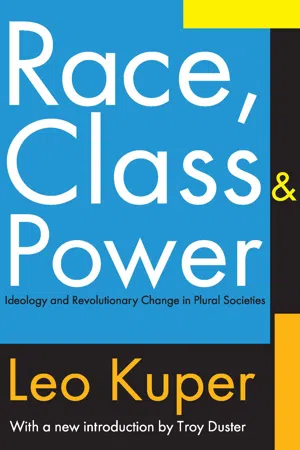
Examining in detail the apparently inexorable polarization of society in such countries as Rwanda, Algeria, and South Africa, the author questions whether current theories correctly explain the past or offer adequate guides for the future. In their place he puts forward an alternative neo-Durkheimian view of the possibility of non-violent revolutionary change, based on the development of such social and cultural continuities as already exist within each plural society. But he warns that -this is an age of passionate commitment to violence in which vicarious killers abound in search of a Vietnam of their own.- The aim of this groundbreaking and challenging book is to create theoretical perspectives in which to view the racial conflict of plural societies. Written in the turbulent early 1970s, the book demonstrates the inadequacy of then prevailing views such as Marxist interpretations of racial conflict as class struggle, and the Fanon a priori rejection of non-violent techniques of change, which Kuper holds responsible for the acceptance of what he calls -the platitudes of violence.- The book concludes with more personal sections focusing on the author's struggles with the then prevailing South African society, critiques of that, and censorship of his attempts to make these public. In the light of subsequent changes in South Africa many decades later, this book serves not only as an important work of political sociology but as a personal testament to the fight against racism in South Africa. Leo Kuper was professor of sociology and director of the African Studies Center at the University of California, Los Angeles. A South African by birth, he was one of the first writers on genocide as well as other aspects of African studies and urban sociology. His major book, Genocide (Penguin, 1981), remains in print. The Leo Kuper Foundation is a non-governmental organization dedicated to the eradication of genocide through research, advice, and education. It was created in Washington, DC in 1994 following the death of Leo Kuper, with the aim of improving measures to prevent genocide. The main area of work for the past five years has been in support of the creation of an International Criminal Court. Troy Duster is director at the Institute for the History of the Production of Knowledge, New York University.
Information
Table of contents
- Cover Page
- Title Page
- Copyright Page
- Table of Contents
- ALDINETRANSACTION INTRODUCTION
- Preface
- PART ONE: IDEOLOGIES
- PART TWO: REVOLUTIONARY CHANGE
- CONCLUSION
- APPENDIX I Review of Class and Colour in South Africa—1850-1950
- APPENDIX II A Matter of Surrogate Censorship
- Bibliography
- Index
Trusted by 375,005 students
Access to over 1.5 million titles for a fair monthly price.
Study more efficiently using our study tools.
Frequently asked questions
Yes, you can cancel anytime from the Subscription tab in your account settings on the Perlego website. Your subscription will stay active until the end of your current billing period. Learn how to cancel your subscription
No, books cannot be downloaded as external files, such as PDFs, for use outside of Perlego. However, you can download books within the Perlego app for offline reading on mobile or tablet. Learn how to download books offline
Perlego offers two plans: Essential and Complete
- Essential is ideal for learners and professionals who enjoy exploring a wide range of subjects. Access the Essential Library with 800,000+ trusted titles and best-sellers across business, personal growth, and the humanities. Includes unlimited reading time and Standard Read Aloud voice.
- Complete: Perfect for advanced learners and researchers needing full, unrestricted access. Unlock 1.5M+ books across hundreds of subjects, including academic and specialized titles. The Complete Plan also includes advanced features like Premium Read Aloud and Research Assistant.
We are an online textbook subscription service, where you can get access to an entire online library for less than the price of a single book per month. With over 1.5 million books across 990+ topics, we’ve got you covered! Learn about our mission
Look out for the read-aloud symbol on your next book to see if you can listen to it. The read-aloud tool reads text aloud for you, highlighting the text as it is being read. You can pause it, speed it up and slow it down. Learn more about Read Aloud
Yes! You can use the Perlego app on both iOS and Android devices to read anytime, anywhere — even offline. Perfect for commutes or when you’re on the go.
Please note we cannot support devices running on iOS 13 and Android 7 or earlier. Learn more about using the app
Please note we cannot support devices running on iOS 13 and Android 7 or earlier. Learn more about using the app
Yes, you can access Race, Class, and Power by Leo Kuper in PDF and/or ePUB format, as well as other popular books in Social Sciences & Ethnic Studies. We have over 1.5 million books available in our catalogue for you to explore.