- 160 pages
- English
- ePUB (mobile friendly)
- Available on iOS & Android
eBook - ePub
The Design and Production of Self-instructional Materials
About this book
Designed to help those who are planning to produce open or flexible learning materials, particularly trainers who must work on their own with little support or encouragement. All aspects of the design and production of materials is examined, including the role of audio and video cassettes.
Information
Chapter 1
Distinctive features of self-instructional material
The first paragraph in the Introduction above identifies several contexts in which self-instructional materials are used, whether in a financial/business, industrial/production or educational environment. Below I have reproduced the question, offered the example of individual learning and provided you with space in which to note those distinctive features you can identify.
- What are the distinctive features of self-instructional material?
- Individual learning - no need to wait until there are enough learners to form a group.
You may be able to list several of these immediately. If not you could either talk to colleagues who use such materials and get their ideas; you could also inspect examples of materials your company, department or division currently uses. Whichever route you decide to follow, it is likely that once you start one feature will help to identify another.
Figure 1.1 offers over a dozen features that many regard as distinctive features of self-instructional material; the figure summarizes the comments below. You can amend these to suit your situation.
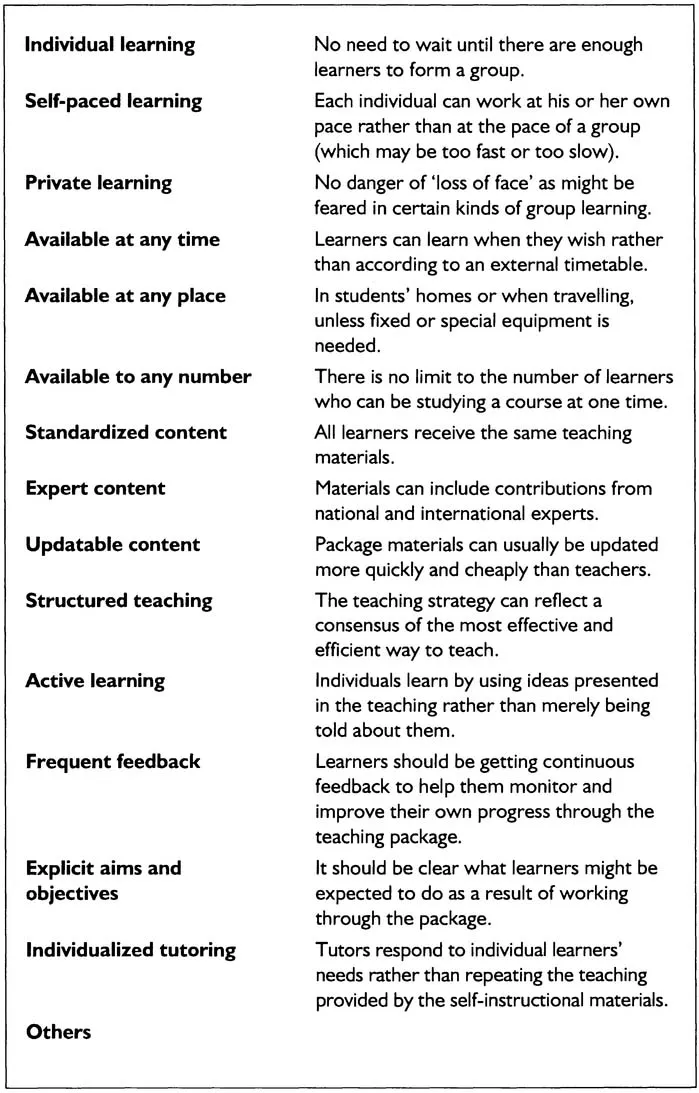
Figure 1.1 Distinctive features of self-instructional material
1.1 Individual learning
A major and obvious feature of self-instructional material is that there is no need to wait until there are enough learners to form a viable group. Indeed, it is possible within a single group to have several programmes of study being followed. Those learners requiring additional or remedial help can have it provided at the same time as those who want additional practice or who wish to pursue their own special interests in an area. Needless to say, the self-instructional packages do not have to be lengthy nor limited to printed media and a home or teaching/training context. Brief video sequences dealing with, for example, fault diagnosis on a motor car braking system are available for use in the service area of garages. Mechanics can view the video, perform the required checks on the system, complete the fault diagnosis and effect a repair.
1.2 Self-paced learning
Each individual can work at his or her own pace rather than at the pace of the group —or rather the pace the teacher or trainer believes is the optimum! People do not study at a regular speed. Depending on their interests, background, personal experiences and other demands, students will complete their study of some material quickly; at other times it will take them longer. For example, all new Open University undergraduates were given preparatory materials to study prior to the start of their course. (The material was circulated in November prior to their course starting in February.) An evaluation revealed that one person studied these materials in 20 minutes while another took 180 hours! Forcing learners to progress at a pace too slow for them would be both frustrating and patronizing. However, if learners are forced to study too quickly it could be equally counter-productive. Leaving students 'trailing in your wake' is not to be recommended.
1.3 Private learning
How often have you been in a learning situation where you didn't understand some part of the explanation, procedure or technique? How often did you immediately put your hand up and advertise your ignorance - or did you keep quiet, hoping it would become clear or decide to check with fellow learners later? Self-instructional learning is private learning. Certainly, there is no 'loss of face' possible because there is no one else around to witness your confusion. However, it does put great emphasis on the need for clear teaching, with every opportunity for learners to monitor their progress, check their learning and resolve their problems.
In case the above comments suggest that private learning is 'second best' it should be mentioned that many learners actually say that they prefer to study on their own. Many of the students following the Hotel and Catering Course provided by the Hong Kong Polytechnic did so because they held senior positions and had considerable experience, but no formal qualifications. To attend a class with junior members of the industry was unthinkable. (Similar reasons have been expressed by UK managers!)
1.4 Available at any time
One of the main attractions of self-instructional material is that it is available at any time - when a learner wishes to study rather than according to some fixed timetable. Students not only study at different speeds, they also prefer to study at times convenient to themselves. The assumption that learners will study according to a regular, fixed schedule is a myth. The belief that regular broadcast transmissions or tutorials would 'pace' a student have been replaced by the realization that only assignment deadlines are likely to prompt study to a timetable. Indeed, we now realize that between such assignment deadlines study is likely to be irregular for the majority of students. Students pace themselves according to their own schedule and competing demands.
Where a course follows a linear sequence it is common for students to 'fall behind' and then undertake a period of intensive study to 'catch up' or 'get ahead'. Where courses resemble a resource, with the ability to study in virtually any sequence, it is common for learners to focus on what they either find most interesting or what they need immediately. For example, an explanation of the appropriateness of different statistical procedures and how to conduct them may be needed now rather than in several weeks' time.
1.5 Available at any place
A distinctive feature of self-instructional material is that it is available at any place: in students' homes, when travelling, at the workplace or on holiday! The only limitation would be where some audio, video, practical work or computer-based materials are needed. However, at the present time and for the immediate future the majority of self-instructional materials are likely to be based on print and are thus portable, cheap and flexible. What is more, audio, video and other components are typically flagged in the text, allowing learners to arrange their study so that any necessary equipment or facilities are available when required.
Many learners describe how they fit their study around their lives — studying between breakfast and going to work, during the lunch break and on the bus home. Indeed, one student, a bus driver, described how he completed a degree while sitting in the cab of his bus prior to and at the end of his bus route journey. Furthermore, many teachers and trainers have acknowledged that simple 'kitchen sink experiments', using everyday items, can be used to illustrate the principles and relationships that have previously required laboratories, workshops or clinical settings. Portable cassette tape recorders, and more recently laptop microcomputers, allow multimedia self-instructional material to be studied virtually anywhere.
1.6 Available to any number
In principle there is no limit to the number of learners who can study a course at any one time. Above, I mentioned the problem often encountered by conventional institutions of requiring a viable sized group; sometimes the reverse is true! For example, when the British police force wished to inform its officers of changes to the British Road Traffic Act, 1991, it was faced with the problem of informing over 80,000 officers as soon as possible. It was considered impractical to provide conventional face-to-face training; it would simply take too long for small groups to attend particular training venues while maintaining adequate active staffing levels. The solution was to assemble a self-instructional booklet and make this instantly available to all officers.
Facilities for rapid duplication of printed material and audio and video tapes, plus economies of scale, make self-instructional material for large groups particularly attractive.
1.7 Standardized content
Learners deserve the best teaching and training materials that we can provide; materials that are not adversely affected by the particular preferences or idiosyncrasies of a teacher or trainer. A feature of self-instructional material is that it enables all learners to receive the same teaching material. Furthermore, since the materials are available for scrutiny by others it is likely that current thinking and the accepted arguments are likely to be central - rather than the personal views of the author.
In large institutions it is not unusual for a group of learners to be taught by two or more teachers/trainers — each following the same syllabus or scheme of work. However, often an independent observer would be excused if they judged that two completely different courses were being taught! Indeed, even when one person is responsible for the teaching, and conducts duplicate classes, the difference between the presentations is likely to be significant.
1.8 Expert content
You may, or may not, be the world expert in your field. However, a distinctive feature of self-instructional material is that you can include contributions in your teaching from colleagues as well as national and international experts. An obvious way is to include existing published material in your teaching - particular articles, extracts, pamphlets, technical reports, etc (ensuring you do not infringe copyright). These may represent a degree of detail and quality of writing that you are unable to improve upon. You may be able to persuade them to record an audio tape — perhaps a discussion with you or a debate with another colleague. Depending on the resources and technical expertise available you may even be able to take the learners to places they would find impossible to visit by recording such situations, events, techniques or whatever on videotape. Your learners may be able to take part in online discussion with an expert or other learners via a computer-mediated communication (CMC) link.
Of course, you do not have to automatically agree completely with the arguments, positions and theories of models put forward by these 'experts'. Indeed, you may wish to compare and contrast these views - presenting them to the learners and inviting them to make up their own minds.
1.9 Updatable content
The upgrading of teachers and trainers is typically a costly and time-consuming task, even when they acknowledge a need for retraining. Furthermore, while the initial impact of in-service training may be substantial, teachers and trainers often fail to implement all the previously acknowledged good practice. For example, at the end of a course designed to improve the teaching of literacy among schoolchildren the value of new methods was recognized. However, subsequent checks revealed that teachers gradually reverted to previously acknowledged inferior practices as time progressed.
In contrast, self-instructional materials are cheap and quick to update. The availability of desktop publishing techniques means that printed materials can be revised rapidly. Furthermore, on-demand printing means that documents can be reproduced in minutes. For example, high-speed laser photocopiers are able to print and bind a 48 page A4 booklet, including high-quality photographs, at a rate of one every two minutes. The integration of colour photocopies is also possible. This, together with high-speed audio and video copying, means that once the desired changes have been made to originals, copies can be generated overnight. World-Wide Web pages can be created virtually as fast as you can type.
1.10 Structured teaching
If you asked a dozen subject matter specialists, independently, to design a particular package to satisfy an agreed aim and series of objectives you would probably get a dozen different ways of doing it. Some would take longer than others to study, some would stress one element rather than another, and some would consume more resources than others. The structure of the packages and sequence of elements would undoubtedly vary. Of course, in reality many teachers and trainers are only required to provide the briefest of outlines for a particular programme of study. It is often merely a list of topics or lecture titles supplemented by two or three sentences. What is more, a detailed description or overview of the course, let alone individual modules or study sessions, is typically provided in a paragraph in course publicity material.
A distinctive feature of self-instructional material is that the teaching structure and sequence is made explicit. Preliminary documents, often an Introduction and Guide, provide the general structure of the course, while preliminary pages in each module indicate the structure and sequence of the teaching material — and alternative ways through it. If the material is assembled by two or more authors, or they have the advice and assistance of others, they can devise a teaching strategy that reflects a consensus of the most effective and efficient way to teach the topic.
1.11 Active learning
In higher education, and much of further education, the lecture is still widely held as an obvious method of conveying information. The problem is that the teacher does all the work - all the telling. The learner is reduced to the role of one who must merely comprehend, interpret and remember; often little opportunity is provided to ask questions, resolve misunderstandings or clarify ideas. Unfortunately, many learners still appear to believe that this method has merit until given the opportunity to experience an alternative way of studying.
A distinctive feature of self-instructional material is that individuals learn by using ideas presented in the teaching material rather than merely being told about them. The provision of exercises, activities or self-assessment questions is the mechanism by which the key objectives associated with a teaching text are realized and students allowed to practise them.
It is sobering to learn that when two modules of a course were compared by students, one containing activities and one in which none were present, the majority of students said the absence of activities hindere...
Table of contents
- Cover
- Half Title
- Title
- Copyright
- Contents
- Preface
- Ways of using the guidelines - for individual or group use
- Presentation of chapters - how the guidelines have been presented
- Introduction - characteristics of self-instructional material
- 1. Distinctive features of self-instructional material
- 2. Differences between textbooks and self-instructional material
- 3. Differences between open, distance and flexible learning
- 4. Resources and constraints
- 5. Target audience
- 6. Alternative methods of material production
- 7. Assembling a course proposal
- 8. Advance organizers
- 9. Student learning activities
- 10. Learner workload and readability
- Index
Trusted by 375,005 students
Access to over 1.5 million titles for a fair monthly price.
Study more efficiently using our study tools.
Frequently asked questions
Yes, you can cancel anytime from the Subscription tab in your account settings on the Perlego website. Your subscription will stay active until the end of your current billing period. Learn how to cancel your subscription
No, books cannot be downloaded as external files, such as PDFs, for use outside of Perlego. However, you can download books within the Perlego app for offline reading on mobile or tablet. Learn how to download books offline
Perlego offers two plans: Essential and Complete
- Essential is ideal for learners and professionals who enjoy exploring a wide range of subjects. Access the Essential Library with 800,000+ trusted titles and best-sellers across business, personal growth, and the humanities. Includes unlimited reading time and Standard Read Aloud voice.
- Complete: Perfect for advanced learners and researchers needing full, unrestricted access. Unlock 1.5M+ books across hundreds of subjects, including academic and specialized titles. The Complete Plan also includes advanced features like Premium Read Aloud and Research Assistant.
We are an online textbook subscription service, where you can get access to an entire online library for less than the price of a single book per month. With over 1.5 million books across 990+ topics, we’ve got you covered! Learn about our mission
Look out for the read-aloud symbol on your next book to see if you can listen to it. The read-aloud tool reads text aloud for you, highlighting the text as it is being read. You can pause it, speed it up and slow it down. Learn more about Read Aloud
Yes! You can use the Perlego app on both iOS and Android devices to read anytime, anywhere — even offline. Perfect for commutes or when you’re on the go.
Please note we cannot support devices running on iOS 13 and Android 7 or earlier. Learn more about using the app
Please note we cannot support devices running on iOS 13 and Android 7 or earlier. Learn more about using the app
Yes, you can access The Design and Production of Self-instructional Materials by Fred Lockwood in PDF and/or ePUB format, as well as other popular books in Education & Education General. We have over 1.5 million books available in our catalogue for you to explore.