Wendy Wasserstein: A Casebook contains in-depth discussions of the playwright's major works, including her recent play 1 An American Daughter. Wasserstein's plays and essays are explored within diverse traditions, including Jewish storytelling, women's writing, and classical comedy. Critical perspectives include feminist, Bakhtinian, and actor/director. Comparisons with other playwrights, such as Rachel Crothers, Caryl Churchill, and Anton Chekhov, provide context and understanding. An interview with the playwright and an annotated bibliography are included.
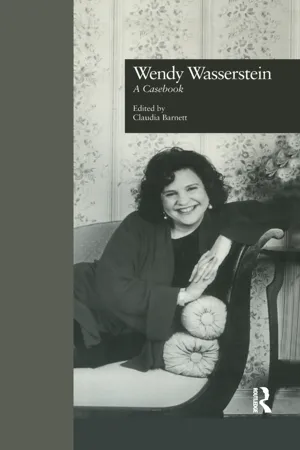
- 246 pages
- English
- ePUB (mobile friendly)
- Available on iOS & Android
eBook - ePub
About this book
Information
Chapter 1
Women's Movement
The Personal as Political in the Plays of Wendy Wasserstein
Bette Mandl
Wendy Wasserstein describes the genesis of Uncommon Women in a telling anecdote: "I made the decision to write a play with all women after seeing all that Jacobean drama, where a man kisses the poisoned lips of a woman's skull and drops dead" (Interview 1987, 425). In a line that could have been lifted from one of her plays, she humorously calls into question familiar images of gender from the classic tradition, undercutting the high seriousness that reinforces them. Here, as in her other exchanges with interviewers, as well as in her essays and talks, Wasserstein discusses her motivations as a playwright with candor and explains what her craft entails for her. Such openness, which is certainly an aspect of her general appeal, is more than merely engaging. Like the plays she writes, Wasserstein's demystification of the portrait of the artist and the creative process pushes against the boundaries that exclude what differs from "all that Jacobean drama."
Virginia Woolf, in A Room of One's Own, compares "fiction, imaginative work" with "a spider's web, attached ever so lightly perhaps, but still attached to life at all four corners" (43). Her approach to the aesthetic both de-idealizes the making of art and leads to new appreciation of the struggle art entails. Wasserstein (who owns two paintings by Woolf's sister, Vanessa Bell) extends our understanding of the connections between art and life by calling attention to the touch of the real in her comedies. As a playwright who makes frequent use of her own "story" as a paradigm in an era of rapid social change, she willingly provides the cues and clues that enable us to trace the beginnings of imaginative invention. A friend of hers has said that "many of her principal characters are 'very Wendy-based'" (Koch Bl). Wasserstein acknowledges the coincidence of her own concerns and those of her characters and contributes to the identification of the playwright and her plays. She admits, for example, feeling some apprehension about a recognizably autobiographical character in Uncommon Women. "Holly was the hardest to write because I thought, 'That's Wendy,' or people will think, 'THAT'S WENDY!'" (Interview 1987, 424). She places Holly in a setting like her own alma mater, Mount Holyoke, reminiscent of the red-brick colleges for women Woolf uses as a starting point for her reflections on women and literature. The play, which is punctuated by a neutral male voice-over that serves as a counterpoint to the generally animated conversations of the college students, opens a space for speaking "in a different voice," to use psychologist Carol Gilligan's phrase. Gilligan says that "Bringing the experience of women and girls to full light ... becomes a radical endeavor" (xxiv). Wasserstein's goal of an all-woman curtain call grows out of a similar vision of how social change might occur.
In a New Yorker profile, Nancy Franklin points out characteristic parallels between Wasserstein's own experience and that of her characters: "In her late twenties she turned down a marriage proposal from a nice Jewish lawyer; for further, roughly accurate details, see Isn't It Romantic, in which Janie Blumberg turns down a marriage proposal from a nice Jewish doctor" (64). Wasserstein readily acknowledges the correspondence between her own mother, Lola, and Janie's mother, Tasha, who wears tie-dyed exercise clothes, attends dance classes, and urges marriage. Like Janie, Wasserstein once reacted strongly when a friend married and connected her own feelings to what she was noticing around her: "When I was getting out of Mount Holyoke in 1971, there was this pressure to have a career.... But suddenly all my women friends were talking about getting married and having babies ... I started trying to figure it all out, and I decided it might be interesting to write a comedy about it" (quoted in Bosworth 142). Wasserstein's musings underscore a pattern that persists for her: linking a strong personal response to a larger social trend and making that the basis for her creative work. That self and art are coextensive in Wasserstein's oeuvre is central to what she accomplishes, as well as to how both are seen, as is evident in this comment about Wasserstein from the New York Times: "You like her instantly because she seems, well, just like her plays" (Miller 1).
Even when Wasserstein's characters are not as clearly Wendy-based as Holly and Janie, Wasserstein hints at self-disclosure in what we see on the stage, as she does in The Heidi Chronicles. When Heidi, for example, in an art history lecture, describes two female figures, both "slightly removed from the occasions at hand" (206), we suspect that she is telling us something about both playwright and character that is as accurate as it is indirect. Wasserstein does closely resemble the somewhat detached, "highly informed spectator" (206) Heidi recognizes herself to be. Heidi also sounds very Wendy-like when she describes a book of essays on art she has written: "Well, actually, it's sort of humorous. Well, sort of social observation. I mean, it's sort of a point of view" (198). Wasserstein sees herself and her work as "accommodating and entertaining" (Interview 1997, Winer 187), and tends to modulate both her self-presentation and her writing; gentle comedy rather than biting satire, "sadnesses" (Interview 1997, Balakian 82) rather than tragedy.
Wasserstein's diffidence and unpretentiousness are often noted by those describing her. A comment in Time is typical: "Her natural instinct is to charm, to disarm, to retreat from harm. The nervous giggles, the wispy, high-pitched voice, the ingratiating brown eyes and perhaps even the plump figure all seem protective camouflage" (Shapiro 90). Some who know her well insist on a fuller picture. Terrence McNally, for example, suggests that "what people often miss about Wendy is the thoughtful, passionate, mature womanly side of her. She is far more interesting as a mature artist than as this giggling, girlish, daughter-person that people want to take care of" (quoted in Shapiro 92). However, the "girlishness" and self-deprecating wit are intrinsic to the alternative picture of art and the artist that Wasserstein impresses on us. She describes herself working in a flannel nightgown, trying to resist distractions. In the diary entries she composed for Slate, an on-line magazine, she jots notes on her attempts to work toward deadlines, yielding to occasional lethargy, eating taboo french fries. She shapes a persona that is very different from that of the proud, aloof modern artist as hero, as well as that of the stereotypical woman-as-artist: "I remember when I was in college I always thought I couldn't grow up to be an artist or in the theatre because women in the theatre wore black and had Pre-Raphaelite hair, the silver earrings, the shawl, the cheekbones, and the Fred Braun sandals, and I was never one of those people (Interview 1995, 258.) Moreover she knows that what makes her "other" as a playwright is potentially liberating for the young Judith Shakespeares in the audiences she addresses. She imagines the students who listen to her thinking, "... this is an accessible person and this is her job; this is what she does. If she was able to express herself in this way, then I can do that, too." She adds, "I think that's great, really good, because Wendy never came to my school when I was in high school" (Interview 1995, 273).
Wasserstein's emphasis on the collaborative aspect of her work has a similarly deconstructive impact. Invariably, when she is asked about her own successes she speaks of how valuable she has found her association with her director, Daniel Sullivan, and her producer, Andre Bishop, and is generous in the praise and the credit she gives them. She also frequently mentions Christopher Durang, both as an important friend and as a cowriter, and speaks admiringly of his work, as well as that of other playwrights, such as Lanford Wilson, John Guare, August Wilson, and Tina Howe. While she acknowledges how much she appreciates the artistic control that being a playwright affords, she tends to deflect a focus on herself as the creative individualist, explaining without hesitation that she listens to suggestions and devotes herself to rewriting. She also takes in the response of critics, acknowledging that even painful bad reviews may be important: "If everybody says the same thing and these are intelligent people who have come to your play, then something's not getting across; so I think that's important" (Interview 1995, 270). Moreover, although her first devotion is to Playwrights Horizons as a supportive theater community, she works without modernist conflict and angst in other spheres. She unabashedly loves Broadway and works in television, journalism, and film, enduring such frustrations as the prolonged delay in the filming of her version of Stephen McCauley's The Object of My Affection. Concerned with ideas in her plays, she is nonetheless unapologetic about plying her trade at the margin of serious art and entertainment. As a contemporary woman playwright, she defies easy categorization. However, her own modus operandi is noteworthy for what it reveals about the nature of a commitment to a life in the theater today, as women move toward center stage.
That Wasserstein is as resilient as she is genial is apparent in her response to the controversy aroused by The Heidi Chronicles. She explains what originally motivated her: "I wrote this play because I had this image of a woman standing up at a women's meeting saying, 'I've never been so unhappy in my life.' ... Talking to friends, I knew there was this feeling around, in me and in others and I thought it should be expressed theatrically. But it wasn't" (quoted in Shapiro 90). In the play that emerged, Heidi moves through an episodic structure that takes her from a high school dance in 1965 through the social currents of the years that follow. After an initial euphoria about the women's movement, Heidi finds its promise of "sisterhood" illusory. In her "Women Where Are We Going Speech" at an alumnae luncheon, she describes her alienation from the women in her locker room. She denies that she means to blame them, or "any of us": "It's just that I feel stranded. And I thought the whole point was that we wouldn't feel stranded. I thought the point was that we were all in this together" (232). Some feminist critics found the speech particularly disturbing, and were understandably uncomfortable with a play that focuses on the failure of female friendship and solidarity. They pointed to Wasserstein's seeming complicity with the biases of mainstream theater and its compromises, and urged greater awareness of other voices, other theatrical spaces.1 That she was tapping into a current of feeling among some second-wave feminists is undeniable, however. Vivian Gornick, for example, describes a similar disillusionment in her volume of essays, Approaching Eye Level:
The feminists were my sword and my shield—my solace, my comfort, my excitement.... Then the unthinkable happened. Slowly, around 1980, feminist solidarity began to unravel. As the world had failed to change sufficiently to reflect our efforts, that which had separated all women before began to reassert itself now in us. The sense of connection began to erode ... One day I woke up to realize the excitement, the longing, the expectation of community was over. (66-67)
Like Gornick, Wasserstein has, in fact, remained committed to feminism, recently saying that it gave her "the perspective to see that there weren't enough women's voices being heard. It gave me the belief that my own voice was worth hearing. And that there could be many different women's voices, all that could and should be heard" ("Yes I Am a Feminist" 45). She tends to respond with equanimity to the criticism of Heidi's complaint. She has even jocularly pictured herself as a member of the audience reacting as some others did: "Some nights I would see The Heidi Chronicles and be very moved by it and think, 'I'm still that woman. I still feel stranded, too.' And then some nights, she'd say, 'Oh, I feel stranded,' and I'd think, 'Oh, just shut up and be happy. Stop whining'" (Interview 1995, 275). As for the anger that the final scene of Heidi and her newly adopted baby girl provoked, Wasserstein says she sometimes sides with those who are exasperated by it. She insists, however, that "there should be more plays by women, and in some plays the woman should adopt the baby, and in some she won't. One play can't stand for everything" (Interview 1996, 389). Ever the perceptive observer of the social scene, she also notes where her own work fits in to the larger scheme of things: "... from my point of view, what's political is that this play exists. What's political is that we can talk about this play that's about us—like it, don't like it; it's there, it exists, and that's the forward motion" (Interview 1995, 266).
Undeterred, Wasserstein continues to limn her own admittedly circumscribed territory, employing methods that have served her well. For The Sisters Rosensweig, she once more looked both inward and outward for inspiration. Acting on the discomfort she felt when someone remarked during her stay in London on a writing grant that she was "terribly Jewish" (Interview 1997, Winer 181), she wrote a play that grows out of the experience of her own assimilated American family, and has some resonance for a culture scrutinizing itself about issues of identity. Wasserstein's parents are immigrants from Poland, but the four siblings, including a brother, Bruce, who is a prominent investment banker, had to learn some of the colloquialisms of the "old country" from The Joys of Yiddish by Leo Rosten, a writer she looks back to fondly i...
Table of contents
- Cover
- Title
- Copyright
- Dedication
- Contents
- Acknowledgments
- Introduction
- Chronology
- Chapter 1: Women's Movement: The Personal as Political in the Plays of Wendy Wasserstein
- Chapter 2: Bachelor Machine: Postmodern Travels, Female Communities, Melancholy and the Market in Bachelor Girls
- Chapter 3: Generations ofNora: Self-Realization in the Comedies of Rachel Crothers and Wendy Wasserstein
- Chapter 4: "We've All Come a Long Way": The Role of Women in Uncommon Women, Top Girls, and My Mother Said I Never Should
- Chapter 5: Female Laughter and Comic Possibilities: Uncommon Women and Others
- Chapter 6: Building the Gift: Creating a Character in Wasserstein's The Sisters Rosensweig
- Chapter 7: Wendy Wasserstein's Three Sisters: Squandered Privilege
- Chapter 8: When Wendy Isn't Trendy: Wendy Wasserstein's The Heidi Chronicles and An American Daughter
- Chapter 9: Three American Daughters: Wendy Wasserstein Critiques Success
- Chapter 10: Interview with Wendy Wasserstein
- Bibliography
- Contributors
- Index
Trusted by 375,005 students
Access to over 1.5 million titles for a fair monthly price.
Study more efficiently using our study tools.
Frequently asked questions
Yes, you can cancel anytime from the Subscription tab in your account settings on the Perlego website. Your subscription will stay active until the end of your current billing period. Learn how to cancel your subscription
No, books cannot be downloaded as external files, such as PDFs, for use outside of Perlego. However, you can download books within the Perlego app for offline reading on mobile or tablet. Learn how to download books offline
Perlego offers two plans: Essential and Complete
- Essential is ideal for learners and professionals who enjoy exploring a wide range of subjects. Access the Essential Library with 800,000+ trusted titles and best-sellers across business, personal growth, and the humanities. Includes unlimited reading time and Standard Read Aloud voice.
- Complete: Perfect for advanced learners and researchers needing full, unrestricted access. Unlock 1.5M+ books across hundreds of subjects, including academic and specialized titles. The Complete Plan also includes advanced features like Premium Read Aloud and Research Assistant.
We are an online textbook subscription service, where you can get access to an entire online library for less than the price of a single book per month. With over 1.5 million books across 990+ topics, we’ve got you covered! Learn about our mission
Look out for the read-aloud symbol on your next book to see if you can listen to it. The read-aloud tool reads text aloud for you, highlighting the text as it is being read. You can pause it, speed it up and slow it down. Learn more about Read Aloud
Yes! You can use the Perlego app on both iOS and Android devices to read anytime, anywhere — even offline. Perfect for commutes or when you’re on the go.
Please note we cannot support devices running on iOS 13 and Android 7 or earlier. Learn more about using the app
Please note we cannot support devices running on iOS 13 and Android 7 or earlier. Learn more about using the app
Yes, you can access Wendy Wasserstein by Claudia Barnett in PDF and/or ePUB format, as well as other popular books in Literature & Feminist Literary Criticism. We have over 1.5 million books available in our catalogue for you to explore.