- 244 pages
- English
- ePUB (mobile friendly)
- Available on iOS & Android
eBook - ePub
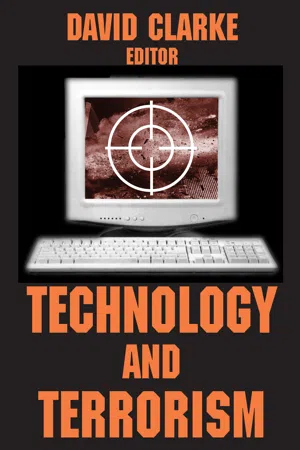
Technology and Terrorism
About this book
In this volume, thirteen authors from all points of the English-speaking world provide a tour of the entwined labyrinths of technology and terrorism. They describe terrorism as an epistemological contact sport. With espionage, one can often deduce from a few pieces of the puzzle a plan's goals and its roots, its sources. But the goals of terrorists are both vague and hopelessly specific, while their means are restrained by rational, institutional thought. Thus, terrorists can be equally expected to flail out without any thought at all, as a child might exhibit in a temper tantrum, and to be hyper-rational, probing at the edges of the target for any weakness. Therefore, how terrorists use technology may not be determined by any particular level of technology but in the probabilities for the target's expectation and defense regarding particular technologies. Fred Allen asks why Bin Laden and his organization were effective against the Russians but may have more trouble with free societies. Edward Tenner muses on the ironies of low-tech attacks and the dangers of over-reliance on high-tech sophistication. Such thoughts are tempered by direct and unreassuring reportage from the federal security front. Ann Larabee turns the telescope around, with a history showing that bomb-throwing is as American as apple pie. Toby Blyth takes us inside the theorists' backroom for a look at the ever-mutating ways, means, and motives of war. It used to be about power, money, land, resources, or the ever-popular Pamir Knot "Great Game." Now it seems that globalization has coughed up groups of people, with little in common except for simultaneous feelings of helplessness and cultural superiority. Modern technology, which once seemed to hold only promise, now seems to harbor the potential for danger and destruction. The contributors to this volume are interested in the broader culture, and how terrorism affects that culture--including how people go about researching terrorism.
Information
1
The New Warfare and Old Truths: How Our Technologies are Still Our Allies
In the early 1880s, a Maine-born inventor named Hiram Maxim, who had tried and failed to become a leading figure in the young electrical industry, met a fellow American in Vienna who told him, “Hang your chemistry and electricity! If you want to make a pile of money, invent something that will enable these Europeans to cut each other’s throats with greater facility.“ Maxim took the man’s advice. He invented the first truly automatic machine gun. By the turn of the century, it had killed thousands of colonial rebels in Africa, India, and Egypt, and it accounted for more than half of the Japanese casualties in the Russo-Japanese War. By the end of World War I, the Germans had 100,000 machine guns. Death was now mass-produced.
Maxim’s gun was one of an endless succession of breakthroughs in warfare that have gone on for millennia, escalating destruction by leaps. Some of those breakthroughs, the Maxim gun among them, have seemed to change the very nature of warfare. Earlier in the nineteenth century had come the development of the rifle and the birth of the ironclad, remaking war both on land and sea. Later came the military airplane and the aircraft carrier and, most epochally, the atom bomb.
On September 11, 2001, the technology of war took a leap in a wholly new direction. Now it was not a matter of bigger, more advanced machinery, of an increase in destructive capability. It was chillingly the opposite. The biggest, most advanced weapon used on September 11 may have been a box cutter. This was a breakthrough into war fought not with weapons at all but with the peaceful technology of modern life. Swords were put aside, and our plowshares were turned against us.
It was done with fearful sophistication. Whoever dreamed up the conspiracy had been thinking exactly the way the man who advised Hiram Maxim thought: He had been discovering how to make killing radically easier. The terrorists recognized that our technologies have become so huge and so mighty that they are engines of death in disguise, needing only to be turned to that use, and that the mass murderer no longer need acquire mass-murder weapons. Building on this insight, the terrorists became experts in the civil technologies involved, not only learning to pilot jetliners but also, evidently, studying how to make the combination of jetliners and skyscrapers as deadly as possible. They chose transcontinental flights carrying thousands of gallons of fuel. They flew into the World Trade Center precisely high enough to avoid surrounding buildings, but low enough so that when the searing heat of burning fuel destroyed the structures’ integrity, enough floors above would topple down to crush, floor by floor, all those below. And they chose buildings whose collapse would make them into bombs themselves, throwing out shock waves that would wreck other buildings in turn, ruining acres of the world’s most heavily populated and economically central real estate while eradicating thousands of lives.
How much of this was planned, and how much gruesome luck, is not yet known and may never be. But the shock waves to our colos-sally interdependent world flowed beyond those acres and lives—to the financial markets, closed for nearly a week; to the airlines, nearly bankrupted as all air travel nationwide stopped for days; to the country’s very tranquillity, shattered not only by the specter of further, unpredictable attacks but by the likelihood of a war in a place, Afghanistan, that had already been one superpower’s Vietnam.
Were we cursed by our own prowess? Had our very strength and versatility—in throwing up cities of skyscrapers, in building ships to transport us across the skies, in having so much wealth and power to concentrate in such a confined space—become a fatal curse? What positive lessons, what glimmers of hope, can be drawn from this turning of our mastery back upon ourselves? I think there are two very important ones.
First, there are crucial ways in which systems did not fail under the intense pressure of the attacks but rather showed remarkable resilience. Almost unremarked amid the chaos of the events of September 11 was the fact that more than 4,000 commercial airliners in the air scrambled to find places to land in an instant game of nationwide musical chairs. Hundreds, if not thousands, of them had to head for airports they had never been to before. This might be the sternest test possible of the nation’s strained air-traffic-control system. It was passed so easily that it was hardly noticed amid the day’s tragedies.
Likewise, the unprecedentedly massive mobilization of emergency services in New York was carried out with a dazzling efficiency. By the end of the day, the New York City Fire Department had lost almost half as many men and women as in its entire previous history, transportation was shut down, and the whole city had to be closed off two miles north of the World Trade Center; yet, while absorbing this body blow, the city reacted with lightning speed. Right after the first plane struck, a TV-studio lot at Chelsea Piers began to be turned into a huge emergency trauma unit with rows of gurneys and IV racks; a new city Emergency Command Center was established within hours after the original one was destroyed in the attack; TV and radio stations that broadcast from the top of the World Trade Center raced to find backup transmitters; telephone and cellphone networks, suddenly handling many times their normal volume of calls, accommodated them with surprisingly little strain.
Our freedom is why any enemy who hates us for the world we have built must ultimately work at an enormous disadvantage.
The list goes on. The heart of the response was, of course, people; it was people gathering and cooperating to throw all their energy into turning technology back to its proper uses: doctors and nurses and medical technicians knitting New York’s hospitals into a megahospital; engineers and planners setting the subway running again, preparing to rebuild the ruined pieces; electricians and plumbers and water engineers restoring crippled parts of the city’s infrastructure; construction engineers and workers shoring up standing buildings and safely disposing of fallen ones...and much more.
Which leads to the second and larger heartening lesson to be gained from the events of September 11. It is a stark truth, not a sentimental one, that the reason the response was so swiftly effective—the human response so commanding at turning our technologies back to our benefit—was our freedom. We wield our technologies with such authority and resilience, indeed we have our technologies in the first place, only because we have freedom: freedom to communicate, and connect, and build, and work together as we see fit. Our freedom is the raw material of our technical mastery. It gives us the command that shows itself in the world we have built.
And this is why any enemy who hates us for the world we have built must ultimately work at an enormous disadvantage.
Here is Osama bin Laden’s sense of history and destiny. He said in an interview in 1998: “Allah has granted the Muslim people and the Afghani mujahedeen, and those with them, the opportunity to fight the Russians and the Soviet Union.... They were defeated by Allah and were wiped out. There is a lesson here. The Soviet Union entered Afghanistan late in December of ’79. The flag of the Soviet Union was folded once and for all...just ten years later. It was thrown in the wastebasket.... We are certain that we shall—with the grace of Allah—prevail over the Americans and over the Jews....”
If he thinks the United States can go the way of the Soviet Union, he misses the essential difference between the two. Just as our freedom makes us strong, the Soviet Union’s lack of freedom made it weak. The Soviets tried to build an industrially powerful state without freedom and could not, though they appeared to outsiders for a long time to be succeeding. As the historian Loren Graham has observed, their approach included “the education of the largest army of engineers the world has ever seen—people who would come to rule the entire Soviet bureaucracy—in such a way that they knew almost nothing of modern economics and politics”; it included the “imperious demand for industrial expansion at a rate that was technically unfeasible and shockingly wasteful of human lives”; it included “into the 1980s...the Soviet insistence on maintaining inefficient state farms and giant state factories [as] an expression of willful dogmatism that flew in the face of a mountain of empirical data worldwide about economic structures that were more efficient and more just.”
That state had a closed mind; New York (and Washington, and America), in the days after the attacks, was an injured body with a healthy mind, reaching out, discovering its resources, bringing people together to heal and rebuild. This depended on a functioning nervous system—our networks of communication—and on plain muscle—our medical and industrial and transportation and logistical prowess—as well as on our heart, on the men and women, firefighters, police officers, relief workers, construction workers, engineers, and so many others who are our body’s lifeblood.
The Soviets were ultimately a crippled body. Their technological might, and ultimately their military strength, despite their nuclear arsenal, was a ghost. The give-and-take and flexibility and openness to new ideas that build both machines and societies were not there. Likewise, bin Laden and all his followers have their headquarters in a devastated land with barely a paved road or a telephone line, crushed by tyranny, and they operate by secrecy and evasiveness and smuggled communications and subterfuge. The experiences of September 11 demonstrated that such a system can, if cannily deployed, deliver a stunning blow to the world. But the experiences of the last century, like the experience of New York City and America on September 11, 2001, show that where there is freedom and openness, there will be strength.
Frederick Allen is a member of the KT&P Editorial Board and is the editor of American Heritage of Invention & Technology. He may be reached at <[email protected]>. Reprinted with kind permission from American Heritage.
2
The Shock of the Old
Our focus on new technology, as both the source of our vulnerabilities and the answer to our problems, can go too far.
On September 11, when terrorists forcibly diverted two airline flights into the Twin Towers of the World Trade Center and a third plowed into the Pentagon, stunned surprise and inconsolable grief could be our only initial response. Then came an apprehension that will long be with us: How many other terrorist cells are still out there, and will we be able to find them in time?
But to many of those who have followed the scientific and technical side of warfare and terrorism, there was yet another jolt. It was comparable to the horror of the military analysts in December 1941 who had been expecting a Japanese preemptive strike in the Philippines or elsewhere in Asia, but not at Pearl Harbor. Assumptions were fatally wrong. Things were not supposed to be this way. We faced an old nightmare, not the futuristic dystopia of information warfare and massive chemical or biological attack that we had dreaded.
In the 1990s, as advanced systems triumphed in the Gulf War and the Nasdaq index began to soar, conflict was supposed to be going high-tech. In December 1995, for example, a dozen Marine Corps generals and colonels, including the commandant, General CharlesKrulak, visited the World Trade Center. They were studying how to master information overload by observing some of the top traders of the New York Mercantile Exchange practicing simulated commodity activity. Later, they conducted simulated combat exercises with fifteen traders at advanced workstations on Governor’s Island off the southern tip of Manhattan. How could the images on those sixty-nine-centimeter monitors have warned them that less than six years later, the Twin Towers would become the battleground of a domestically launched air war?
Of course we feared attacks from the Middle East and elsewhere in the late 1990s. But the bad guys, we thought, were getting online, just like us. As the year 2000 approached, military and civilian authorities were on high alert, not only for accidental failures of vital systems but also for cyberattacks using the date change as a smoke screen. Yet the nation’s pipelines and electrical grids survived the new year without incident. Even the powerful anti-U.S. emotions of the Kosovo war produced no serious assault on the U.S. infrastructure. Only too late did we realize what a cataclysm had been in preparation.
Our tragic mistake was not that we pursued the new. It was that we neglected the old. And it is a pattern that could have troubling implications if we do not recognize its applicability to other key parts of our technological culture.
In the case of the September 11 attacks, as journalists soon realized, the terrorists‘ methods were surprisingly low-tech. In fact, the technologies involved had been established for a generation—thirty years, plus or minus five.
While the building design was tested to withstand a hit from a 707 jet, the Boeing 747, with its immense fuel loads, was already in service by 1969. The terrorists also apparently needed no sophisticated knowledge of automatic pilots and global positioning satellites. They had simply, and all too well, learned the classic principles of flying.
The immediate goal of the hijackers was also a 1970s concept: stunning the world with photogenic violence, as at the 1972 Munich Olympics. Thanks to satellite feeds, cheap color televisions and the Internet, these images could now have a more rapid and vivid impact, but the principle was old hat. So was the idea, dating at least from the time of the Ho Chi Minh sandal—carved by resourceful Viet Cong soldiers from rubber tire segments—that the improvised technologies of poor countries and peoples might humiliate the West.
The terrorists understood all too well this neglected feature of technology—with enough determination, practice and time, mature and even seemingly outdated tactics and devices can be reborn.
What can halt future attacks? The events showed the limits of communications monitoring and satellite surveillance. The question remains whether more ambitious programs like the FBI’s troubled Carnivore e-mail-sniffing technology or facial recognition software will unearth new data on terrorist activity, or simply compound the familiar problem of information overload and produce an illusion of control. The frequent false alarms from even the simplest home security systems are already a plague for the police.
We obviously need to think more about protection from both newer and older forms of attack. One common feature of both is reliance on personal networks. The terrorist cells‘ apparent methods of recruiting from the same regions, clans and families, and moving frequently from base to base, make them difficult to infiltrate conventionally—but they also reveal patterns to experienced analysts, making more targeted technical surveillance possible. We do not need another decimal place of accuracy from computational social-science studies but a better intuitive understanding of the terrorists and their civilian neighbors. At the same time, the tacit knowledge possessed by the most effective police officers and detectives deserves more respect. One of our great challenges will be to formalize and teach these elusive skills to security screeners at airports and elsewhere.
But the shock of the old is not limited to breaches of national security. The civil engineer and historian Henry Petroski, in his book Engineers of Dreams: Great Bridge Builders and the Spanning of America, points to a thirty-year cycle in which a new generation of professionals forgets the hard-won lessons of its predecessors‘ errors. Indeed, there are signs that many professions have started to lose their technological balance. Many U.S. medical residents, for example, are no longer highly skilled in using a stethoscope to interpret body sounds. The demands of training physicians for tomorrow’s biotechnology may be in conflict with the best preparation for hands-on contact with today’s patients. Doctors obviously need to know the latest science, but both educational trends and the pressures of managed care make it harder for them to read facial expressions alongside lab reports.
What makes a good lawyer, too, is not just access to databases of legisation and decisions but intuitive knowledge of clients and clients‘ environments. That is why most lawyers still avoid representing themselves despite all the new tools at their disposal. They are paying not for formal information but for tacit knowledge.
Librarians tell me that students often spend much more time finding certain information on the Web than they would have needed using standard printed reference books. Internet skills are indispens-able—in fact, they too are not taught enough—but so is the ability to access the vast body of essential knowledge that has not been and may never be available in an electronic format. The high cost of both electronic and paper information, not to mention terminals and printers, challenges librarians, but most of them recognize that each mode has irreplaceable advantages.
In fact, engineering itself is not just the application of mathematical equations but a subtle balance of aesthetics, economics, and science in which culture counts as much as calculation. Computer-assisted design can accelerate execution of ideas but can never replace the insight that comes from immersion in the traditions ...
Table of contents
- Cover Page
- Title Page
- Copyright Page
- Contents
- Foreword
- 1 The New Warfare and Old Truths: How Our Technologies are Still Our Allies
- 2 The Shock of the Old
- 3 WTC + 2 Update
- 4 A Brief History of Terrorism in the United States
- 5 Terrorism as Technology: A Discussion of the Theoretical Underpinnings
- 6 Securing Through Technology? "Smart Borders" after September 11 th
- 7 Hacktivism: Securing the National Infrastructure
- 8 Terrorism and the Internet: Resistance in the Information Age
- 9 Cyber Terror: Missing in Action
- 10 Risk, Terrorism, and the Internet
- 11 The Dark Side of Tinkering
- 12 Code Wars: Steganography, Signals Intelligence, and Terrorism
- 13 Morphing the Counter-Terrorist Response: Beating the Bombers in London's Financial Heart
- 14 Research after September 11: Security is Now the Sturdy Child of Terror 1
- 15 The Academy and Fourth Generation Warfare
- Index
Trusted by 375,005 students
Access to over 1.5 million titles for a fair monthly price.
Study more efficiently using our study tools.
Frequently asked questions
Yes, you can cancel anytime from the Subscription tab in your account settings on the Perlego website. Your subscription will stay active until the end of your current billing period. Learn how to cancel your subscription
No, books cannot be downloaded as external files, such as PDFs, for use outside of Perlego. However, you can download books within the Perlego app for offline reading on mobile or tablet. Learn how to download books offline
Perlego offers two plans: Essential and Complete
- Essential is ideal for learners and professionals who enjoy exploring a wide range of subjects. Access the Essential Library with 800,000+ trusted titles and best-sellers across business, personal growth, and the humanities. Includes unlimited reading time and Standard Read Aloud voice.
- Complete: Perfect for advanced learners and researchers needing full, unrestricted access. Unlock 1.5M+ books across hundreds of subjects, including academic and specialized titles. The Complete Plan also includes advanced features like Premium Read Aloud and Research Assistant.
We are an online textbook subscription service, where you can get access to an entire online library for less than the price of a single book per month. With over 1.5 million books across 990+ topics, we’ve got you covered! Learn about our mission
Look out for the read-aloud symbol on your next book to see if you can listen to it. The read-aloud tool reads text aloud for you, highlighting the text as it is being read. You can pause it, speed it up and slow it down. Learn more about Read Aloud
Yes! You can use the Perlego app on both iOS and Android devices to read anytime, anywhere — even offline. Perfect for commutes or when you’re on the go.
Please note we cannot support devices running on iOS 13 and Android 7 or earlier. Learn more about using the app
Please note we cannot support devices running on iOS 13 and Android 7 or earlier. Learn more about using the app
Yes, you can access Technology and Terrorism by David Clarke,Francis T. Cullen in PDF and/or ePUB format, as well as other popular books in Politik & Internationale Beziehungen & Informatik Allgemein. We have over 1.5 million books available in our catalogue for you to explore.