Based on two years of ethnographic fieldwork in an urban elementary school, this volume is an examination of how school division politics, regional economic policies, parental concerns, urban development efforts, popular cultures, gender ideologies, racial politics, and university and corporate agendas come together to produce educational effects. Unlike conventional school ethnographies, the focus of this work is less on classrooms than on the webs of social relations that embed schools in neighborhoods, cities, states, and regions. Utilizing a variety of narratives and analytical styles, this volume:
* explores how curriculum innovations are simultaneously made possible by and undermined by school district politics, neighborhood histories, and the spatial and temporal organizations of teachers' and parents' lives;
* situates the educational discourse of administrators and teachers in the changing economic and political climates of the city;
* analyzes the motivations behind an effort by school and business proponents to refashion classrooms within the school into business enterprises, and of children's efforts to make sense of the scheme;
* examines the role of the school as a neighborhood institution, situating it at the intersections of city planners' efforts to regulate city space and children's efforts to carve out live spaces through out-of-school routines;
* contemplates the meaning of school as a site for bodily experience, and looks at how patterns of space and control in the school shaped children's bodies, and at how they continued to use body-based languages to construct maturity, gender, and race; and
* investigates the school as a space for the deployment of symbolic resources where children learned and constructed identities through their engagements with television, comic books, movies, and sports.
Tangled Up In School raises questions about how we draw the boundaries of the school, about how schools fit into the lives of children and cities, and about what we mean when we talk about "school."
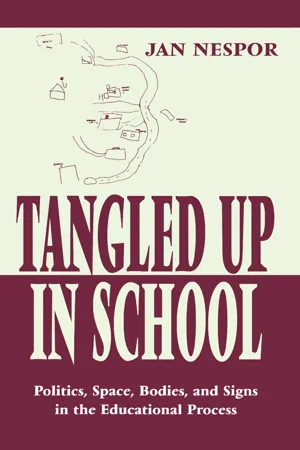
eBook - ePub
Tangled Up in School
Politics, Space, Bodies, and Signs in the Educational Process
- 280 pages
- English
- ePUB (mobile friendly)
- Available on iOS & Android
eBook - ePub
About this book
Information
1
Adults at Elementary School
During my two years at Thurber Elementary School, the principal, Mr. Watts, embraced, with varying levels of passion, a host of innovations: portfolio assessment, outcomes-based education, cognitive coaching, performance assessment, business-school partnerships, business-in-the-school programs, computer simulation curricula, volunteer mentoring programs, site-based management, whole language and writing process pedagogies, cross-age grouping, the integration of special education students into regular education classrooms, and nontraditional report cards. This barrage of innovations, unique among Roanoke schools, produced a good deal of opposition from the community.
The parents of children at the school were especially critical of the novel-based curriculum, the heterogeneous grouping of students, and the nontraditional grading scale. They often asked me, as an education professor, what I thought about such things and listened politely while I explained their value. But they remained skeptical; they conceded that such practices might work in an ideal world but not in the real world of the Roanoke city schools. By 1993-1994 their skepticism had developed into the organized protest described in this chapter. A breakdown in the usual silence between parents and teachers on matters of curriculum, the dispute forced both parties to articulate fundamental assumptions about the functions of schooling, in particular about the role of the school in representing, ranking, and categorizing students.
To understand the protest we have to unravel a historical-political-pedagogical knot in which subtle, complex, deeply layered flows of practice came together. First I examine how city and school system politics created a space for attempting innovations. Then I try to make sense of the Thurber innovations by looking at Mr. Watts’s educational ideas and the teachers’ struggles to understand and implement the innovations. Next I put the parents’ relations to the school in context by reconstructing the history of Thurber’s ties to the neighborhoods from which its students came—a history that had recently included a turnover of the school’s staff along with major changes in the boundaries of its attendence zone. Finally I turn to the protest itself and look at the perspectives that gave parents and educators their different understandings of the purposes of instruction and assessment.
Politics and Power Shape the Spaces of Curriculum
At the time of this study, many school boards in Virginia were still appointed rather than elected. In Roanoke a city council decided on board membership, and for decades prior to the 1980s their decisions had been influenced by a small elite of millionaire businessmen and corporate officers. When I asked an informant, who’d been politically active in the city for decades, how politicized the selection of the school board had been back in the 1960s, he replied:
It’s much more political now, I think. It used to be pretty cut and dried. [Laughs] A lot of people served forever on the school board.…They just used the same people over and over and over. It was just this group that served on everything. But it’s much more political now. Much more political.
In the old days, he explained: “People, like the group of millionaires, they’d say ‘I think so and so ought to be on the school board’ when a vacancy occured, and so and so would be put on the school board.”
This situation began to change around 1980, when political interests other than those of the dominant business class gained influence in city politics. In particular, middle-class White property owners, feeling pinched by the declining regional economy, began a “tax revolt.” My informant explained that, in 1980 and 1982 respectively, the city council (and through it, the school board) began to change with the elections of a couple of “populist” councilmen:
They rode the wave of “gettin’the people”—“We’re gonna serve the people”; “We need people on the council that’s gonna look after the citizens, lower taxes,” la-di-da.…It was a tax revolt kind of thing [Laughs]. That was funny.…They were the candidates of Concerned Taxpayers.…Pm very fond of both of them. But about their first two or three years on Council, they weren’t going to put a rubber stamp on anything, not on anything! Didn’t make any difference. And that was when the school board began to change. ‘Cause whatever the incumbents were for, they were against [Laughs].
Even before the city council shift, the school board was becoming increasingly antagonistic toward the entrenched administrative leadership of the school system. When mistakes were discovered in the district budget in 1980, the board made the first break with tradition by firing the superintendent (Pack: “Severed relations,” 1980). After a year-long search, the board made a second break by bringing in an outsider from New York, Frank Tota, to serve as the new superintendent. According to the school board chairman, Tota’s mandate was to provide “the highest quality of instruction for the least possible cost” (Chamberlin, 1982a, p. A14). According to my informant:
[Tota was] hired with that understanding, that he would clean house. And he did. And a lot of people blamed him. But it was understood before he came that he would do this. I mean, names were named. When he came he knew he had to get rid of certain people. [The school board had decided that? I asked. He nodded.]
So he had an uphill battle. A lot of people here absolutely hated him when he came and did what he did. Because it was not known for a number of years that when he came, he knew he had to do this.…You really couldn’t blame him directly for the things that happened. But I guess with him came the advent of the modem school system that we have today in Roanoke City.
In the first 6 months of his tenure, in a system with 2 high schools, 6 junior high schools, and 21 elementary schools, Tota changed the principals of 10 schools, moved 9 assistant principals from 6 other schools, and reassigned or demoted 16 central office administrators. He began this process his first week on the job, with a series of lateral transfers and promotions that moved 9 principals or assistant principals and 11 central office administrators. There was no great public reaction to these moves, but things were different 6 months later when Tota demoted 16 veteran principals, assistant principals, and central administrators to lower-paying, lower-status positions. Given no warning or opportunity to defend themselves before the decision, the demoted administrators received form letters that varied only in the reasons given for their demotion. One junior high principal was told: “You have failed to demonstrate sensitivity toward students from lower socio-economic groups and have not responded in a satisfactory manner to their educational and sociological needs” (Chamberlin, 1982b, p. Al). One principal of an elementary school was reassigned with this explanation: “You have not indicated superior knowledge of elementary curriculum and program development” (Chamberlin, 1982b, p. Al). Because the administrators were merely “reassigned” rather than fired, they had few due process rights in the matter. Their fates, however, triggered widespread criticism of Tota among educators. Tense relations between central office administrators and teachers persisted for years.
Reshaping School-Community Ties
Along with cutting costs and reducing the number of administrators, the reassignments signaled a break with past practice. A newspaper editorial of the period described Tota’s moves as a necessary shake-up of the system (“Upheaval,” 1982):
There is a rough consensus…on why Tota was hired. The city school system for years has limped along with deadwood in the ranks. The Peter Principle operated freely. A dozen or so administrators were elevated to their levels of incompetence and they stayed put.
The new superintendent was told to clean out the deadwood. In a series of moves, he has shaken up both the central administration and at least half of the system’s schools, (p. A8)
But if most people seemed to agree there was “deadwood” in the school system, others questioned some of the demotions. The elementary school principal mentioned earlier was a 30-year veteran of the system who had strong ties to the community served by his school and seemed to have been well liked and respected by teachers, parents, and pupils. When his demotion was announced, teachers and parents rallied to his support and submitted petitions to the school board asking that he not be reassigned; the parent teacher association’s petition contained the signatures of 80% of the school’s families (Chamberlin, 1982c). Nevertheless, the school board endorsed his demotion along with the others recommended by Tota.
My point is not to defend the principal or the Roanoke schools as they were before Tota’s arrival but to suggest that in addition to trimming “deadwood,” the reassignments fractured whatever collegial and communal ties might have existed between school personnel and the parents of the kids attending their schools. This kind of break in relations between parents and schools had begun to affect most of the city’s African American communities a decade or more earlier, as urban renewal and desegregation undercut neighborhood schooling and community involvement (see chapter 3). Tota merely extended the process to the European American communities. In contrast to previous regimes, his administration marked a period in which principals and teachers were frequently reassigned from one school to another. These transfers made it more difficult for educators to develop close relationships with the communities served by their schools, to define clear roles for community members in school activities, or to develop bases of support among parents. In some cases, this loosening of community ties might have made it possible to innovate, to change neighborhood schools into magnet schools, for example. But, as well see was the case at Thurber, the weakening of community attachments could also make it difficult to implement and maintain support for innovations over the long term.
Centralizing Control
Within Tota’s new administration, schools and teachers were placed under increased scrutiny from the central office. Teachers were pressured to adopt routinized, textbook-driven teaching methods—a kind of technical control (Edwards, 1979) buttressed by frequent administrator observations. Elementary teachers, for example, were expected to use an “instructional management systems” approach involving weekly, chapter by chapter, pre- and post-test measures of student achievement. At the high schools teachers were drilled in “effective teaching” methods. A year after the demotions, a feature article in the local newspaper, based on more than 50 interviews with teachers and administrators, painted a dismal scene (Chamberlin, 1983):
Few of those interviewed were willing to speak up and be identified. … Several teachers and administrators said they have been told at staff meetings or individually that teachers and administrators who don’t conform to prescribed methods and who don’t measure up to the new standards can be replaced. They said they have been told that public criticism of the system will not be tolerated. “Tota said, You play on my team or you don’t,’” an administrator said [paragraphing suppressed], (p. A12)
Not surprisingly, morale plummeted and remained low for years. Teachers reported increased stress and illness and a vastly diminished sense of control over their practice (Chamberlin, 1983; Jones, 1985). High school teachers were warned that they would be expected to do better, regardless of how well they’d done in the past:
An assistant principal at [one of the high schools] sent this memo to his teachers in November regarding their evaluations: “If you are doing no more than you have done in previous years, your progress will certainly be considered wanting, and the assessments will reflect a need for improvement” [paragraphing surpressed]. (Chamberlin, 1983, p. A12)
These policies suggest a change strategy designed to produce quick and highly visible results. Instead of, say, bringing together groups of teachers, parents, and students to talk about the state of the schools, to study or analyze the system, and then to systematically experiment with different reforms, reform was accomplished through the adoption of visible markers of innovation (e.g., effective teaching strategies), and intrusive evaluations were used to enforce at least token compliance. Internally, the routinized teacher evaluations strengthened central administration power by translating pedagogy into stable, standardized, mobile representations that could be accumulated at the central office and there used to compare, rank, reward, and punish (cf. Latour, 1987). Externally, the high visiblity of the control strategies seemed designed to address the concerns of an increasingly conservative public audience being told by media and government reports that the nation was “at risk” because of its inadequate schools.
Standardized testing became a major emphasis in the schools for similar reasons. Testing reduced students to scores, numbers on paper that could be collected and combined to produce comparisons across schools and judgments about the performances of particular schools. Although Superintendent Tota insisted he did not want teachers “teaching to the test,” teachers consistently complained that they were being directed to do so (e.g., Jones, 1985). Even at the time of my fieldwork, more than a decade after these events, the district was still known for its preoccupation with testing. When I talked to my Virginia Tech colleagues who supervised student teachers in Roanoke city elementary schools, they told stories like the following:
I have one student teacher that I’m very—the placement I had her, I don’t know that I got to see her do hardly any teaching at all, because of the fact that every time I would go, they were preparing for a standardized test. And this was a fourth-grade classroom. And it was constant.…There was a lot of emphasis on preparing for the tests. Iowa Test of Basic Skills (ITBS). … They were doing a lot of worksheet type things. They were doing some pre-tests; they were doing situations set up as testing situations. And actually then—it was a format; some of it was standardized it looked like, that they were using. And this was for about 3 or 4 weeks out of a placement. It was every time I would go.
A preoccupation with test scores might be common in U.S. schools, but it had a special resonance and political meaning in Roanoke. As I’ll explain further in the next chapter, Roanoke City had been in economic decline since the mid-1970s and grew progressively poorer than surrounding Roanoke County. Quality of life issues—education, for example—were important to city leaders’ attempts to keep affluent residents from leaving and to make the city more attractive to county residents. Yet standardized test scores, one of the most obvious ways to compare schools and school districts, consistently favored the County over the City by a wide margin. Thus, in addition to its use as a control mechanism, the stress on raising scores stemmed in part from a need to improve the public image of the city’s schools.
The result within the district, however, was a kind of punctuated curriculum in which elementary schools interrupted their teaching for weeks at a time to coach students for the tests. Outside of this test preparation, there was little consistency in curriculum from one elementary school to another. One of my colleagues at the university, who had worked with both Roanoke city and suburban Roanoke County schools, remarked on how different city schools were from one another, in part because of the relatively short tenures principals spent at particular schools:
I’ve been struck by the differences among the buildings [in the city], and that would really hit somebody who’s spent a lot of time in Roanoke County schools, because those [county] schools are more notable for their similarities than their differences. But the differences in the city schools—and I have a feeling that they’re centered around the principal quite a bit—that they have a lot of authority. Which ...
Table of contents
- Cover
- Title
- Copyright
- Dedication
- Contents
- Preface
- Introduction
- 1 Adults at Elementary School
- 2 A Tangle of Cities, Corporations, and Kids
- 3 Neighborhood Intersections
- 4 Intersections of Bodies and Spaces at School
- 5 Intersections of Kids, Signs, and Popular Culture
- 6 Loose Ends
- 7 Fieldwork as an Intersection
- References
- Author Index
- Subject Index
Trusted by 375,005 students
Access to over 1.5 million titles for a fair monthly price.
Study more efficiently using our study tools.
Frequently asked questions
Yes, you can cancel anytime from the Subscription tab in your account settings on the Perlego website. Your subscription will stay active until the end of your current billing period. Learn how to cancel your subscription
No, books cannot be downloaded as external files, such as PDFs, for use outside of Perlego. However, you can download books within the Perlego app for offline reading on mobile or tablet. Learn how to download books offline
Perlego offers two plans: Essential and Complete
- Essential is ideal for learners and professionals who enjoy exploring a wide range of subjects. Access the Essential Library with 800,000+ trusted titles and best-sellers across business, personal growth, and the humanities. Includes unlimited reading time and Standard Read Aloud voice.
- Complete: Perfect for advanced learners and researchers needing full, unrestricted access. Unlock 1.5M+ books across hundreds of subjects, including academic and specialized titles. The Complete Plan also includes advanced features like Premium Read Aloud and Research Assistant.
We are an online textbook subscription service, where you can get access to an entire online library for less than the price of a single book per month. With over 1.5 million books across 990+ topics, we’ve got you covered! Learn about our mission
Look out for the read-aloud symbol on your next book to see if you can listen to it. The read-aloud tool reads text aloud for you, highlighting the text as it is being read. You can pause it, speed it up and slow it down. Learn more about Read Aloud
Yes! You can use the Perlego app on both iOS and Android devices to read anytime, anywhere — even offline. Perfect for commutes or when you’re on the go.
Please note we cannot support devices running on iOS 13 and Android 7 or earlier. Learn more about using the app
Please note we cannot support devices running on iOS 13 and Android 7 or earlier. Learn more about using the app
Yes, you can access Tangled Up in School by Jan Nespor in PDF and/or ePUB format, as well as other popular books in Education & Education General. We have over 1.5 million books available in our catalogue for you to explore.