- 218 pages
- English
- ePUB (mobile friendly)
- Available on iOS & Android
eBook - ePub
About this book
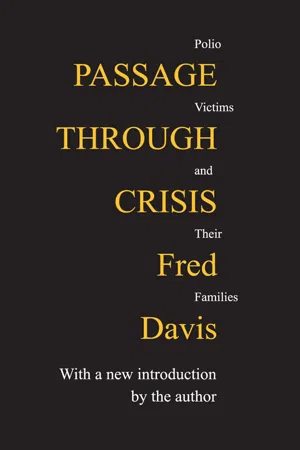
Based on a study of fourteen families in which a child had contracted paralytic poliomyelitis. Passage Through Crisis: Polio Victims and Their Families, first published in 1963, was widely praised for its penetrating--and, for its time, innovative--analyses of doctor-patient communications, and for its interpreta-tion of the meaning of physical disability in American society. In his new opening essay, Davis reflects on the enduring sources of this profound problem in human relations as well as on those changes in the culture of American health care that are helping to restructure doctor-patient relations along more open, less authoritarian lines. The emergence of patient self-help groups, the political militancy of the Gay community in regard to AIDS, and the fading of the early post-World War II naive faith in the humanitarian efficacy of science are some of the developments dealt with. A parallel discussion of the importation into medical sociology of such concepts as the reality-structuring power of professional discourse and of the meta-phoric significance of different diseases for different historical eras seeks to relate developments in the culture of health care to sociology's study. Passage Through Crisis retains for today's readers that essential quality that most engaged readers of a quarter century ago: its vivid and probing ethno-graphic account of the impact of serious illness on the family, the difficult processes of adjustment that ensue and, in these connections, the role played (and toll exacted) by American values.
Information
Chapter 1. Introduction
THIS book is an account of the social-psychological impact of a serious illness on fourteen children and their families. The illness is spinal paralytic poliomyelitis; the subjects are the members of fourteen urban families in which a child contracted the disease, was hospitalized for an extended period, and returned home—nearly always—with a physical handicap. The families were first seen during 1954-55, immediately prior to the full-scale introduction of the Salk anti-polio vaccine, when many facts and rumors were being circulated about the vaccine but when parents could not as yet procure it for their children.
At time of onset of the disease, the eight boys and six girls ranged in age from four to twelve. The primary site of paralytic involvement for all was the lower extremities, although with some, other portions of the body (e.g., abdomen, forearm, fingers) were also affected. Upon admission to the hospital, all the children but one had been diagnosed as either moderately or severely paralyzed. The children came from predominantly working class families, there being only four in which the parents could be classified as either lower-middle or middle class. All the families were white and native-born; the ethnic backgrounds of a majority of them were what is loosely termed Protestant Anglo-Saxon. Of the remaining families, two were Jewish, two Catholic, and two of mixed Protestant-Catholic affiliation.1
The research design of the study was longitudinal; that is, the same families were seen at regular intervals, beginning within a week of the child's admission to a general hospital and terminating some fifteen months after his discharge from a convalescent hospital. In general, this encompassed an 18- to 24-month span in which the research team maintained repeated contact with the child, his parents, and the hospital personnel charged with his treatment and care.
A variety of medical, psychological, and sociological methods and techniques was utilized in studying the families.2 From the data gathered it was possible to chart and compare reactions, to note changes over periods of time, and, in general, to trace in developmental terms the adjustments of the families to the altered life circumstances occasioned by the child's illness and its aftermath.
POLIO: DISEASE AND POPULAR SYMBOL
Until the first successful mass administration of the Salk anti-polio vaccine, in 1955, poliomyelitis enjoyed the infamous distinction of being the only remaining serious epidemic disease in the Western world. Its over-all incidence had never been especially high compared, for example, to that of such nonepidemic diseases as tuberculosis, heart disease, and cancer, but, as an epidemic disease, it tended to strike a whole community suddenly and unpredictably, leaving in its wake much malaise, crippling, and death, particularly among children and youth.3 Thus, whereas the mean annual incidence of the disease for the whole of the United States in 1940-47 was but 10 per 100,000 population, in Minnesota during this same period it was 22. In such notorious epidemics as those in New York in 1931 and Berlin in 1947 the rates were 59 and 76, respectively. But even these figures fail to convey the peculiar notoriety that the disease had acquired prior to the recent discovery of effective preventive measures. For, since polio is a disease affecting children primarily, the age-specific incidence rates always ran markedly higher in the younger age groups than in the population at large. Thus, in the New York and Berlin epidemics, the specific rates for the highly susceptible five-to-nine-year-old group were 226 and 360, respectively.4 Even in an “average” pre-1955 year, the incidence rate among children in this age group living in metropolitan areas of the United States was approximately 50.
Epidemiological statistics alone, however, cannot account for the awe and dread with which polio had come to be regarded or for the very special consideration and mass sympathy extended to its victims.5 Certainly, in a child-centered culture such as ours, some of this feeling can be attributed to the fact that polio is so predominantly a disease of childhood and early adolescence. The crippling it often caused would also seem to be an important factor, although it should be noted that, even in fairly serious polio epidemics, nonparalytic cases generally outnumbered paralytic cases ten to twenty-five times.6 In ways difficult to ascertain, the apparent (by no means well-documented) tendency of the disease prior to 1955 to exact a disproportionately great toll among children in the middle and upper socioeconomic classes may also have influenced public apprehension.7
What most distinguished poliomyelitis from other equally severe and prevalent diseases, however, is that it had been made the object of one of the largest and most highly organized voluntary movements in American history. Since the early thirties, the National Foundation for Infantile Paralysis, with its many fund-raising, educational, welfare, research, and promotional activities, had touched and penetrated in one fashion or another almost every community and social grouping in the nation.8 It served as the model for a host of other national voluntary associations dedicated to the prevention, treatment, and cure of such diseases as mental illness, cancer, epilepsy, heart disease, and muscular dystrophy. A major factor in the growth and accomplishments of the National Foundation—culminating in Enders’ laboratory isolation of the polio virus and Salk's development of the anti-polio vaccine—was the figure of Franklin D. Roosevelt, whose service to his country despite his long and arduous experience with paralytic polio not only inspired his fellow sufferers but also publicized the work and aims of the foundation to the nation.
It is not surprising, therefore, that of the many critical diseases which afflict man, polio had come to occupy a pre-eminent—and, according to some, an exaggerated—place in the awareness, sympathy, and philanthropy of the American people.9 By the time of the development of the Salk vaccine it had emerged in popular thought as more than a sometimes crippling disease of children; it was regarded as a powerful symbol of blind, devastating, and uncontrollable misfortune whose victims were specially entitled to the support and good will of the community.
POLIO AS AN OBJECT OF SOCIOLOGICAL STUDY
I cite this background for two reasons: first, for what it may convey to the reader of the “polio Zeitgeist” surrounding the crisis reaction of the 14 families to be described here; and second, as a means of intro ducing, and attempting to answer, certain basic questions regarding the study that the reader may, quite properly, feel impelled to raise. Of what value is it, one might ask, to report on the experiences of families with a disease that appears to be well on its way toward becoming extinct? Moreover, is not the train of medical and social events set in motion by this disease so unique as to offer no basis for increasing our understanding of what happens in families stricken by other serious illnesses, much less by nonmedical crises of an equally disruptive kind? Finally, even assuming that certain meaningful parallels can be adduced in these connections, what broader theoretical purposes, if any, does such a study serve? I shall briefly consider each of these questions.
As regards the first question, it should be noted that although polio may well be “on its way” toward becoming an extinct disease, at least in the medically advanced parts of the world, this millenium has not yet arrived. Despite a markedly reduced incidence since 1955,10 a sizable number of persons, mostly children, still contracts the paralytic variety of the disease. Much of the remaining incidence can no doubt be explained by the failure of these persons to avail themselves of the number of Salk-vaccine inoculations necessary to ensure a high degree of protection, but a significant residual proportion of it—recently estimated at 29 percent—can be attributed to the less than total effectiveness of the vaccine itself.11 (Whether other newly developed preventive measures, such as the Sabin oral vaccine, will prove more effective has yet to be definitely demonstrated.) In any event, it is probable that for some years to come a considerable number of children will continue to contract the disease and be handicapped as a result. From a practical standpoint, therefore, a systematic account of some of the numerous problems experienced by families in which this happens would seem to be of value.
Does the study have relevance beyond the specific patterning of events comprising paralytic polio as such? I believe that it does. In analyzing the relatively long-term involvement of 14 families in the social vicissitudes caused by this particular disruptive experience, we are perforce inquiring into such generalized matters as the perception of sudden crises by families, the effects on the family unit of prolonged hospitalization (or other separation from the home) of family members, problems in doctor-patient communication, and the identity stresses arising from alterations in the bodily self. Although it is true that the precise manifestations of these events and problems will vary with the nature of the crisis or family situation, there are enough structural and processual similarities to contribute to our knowledge of general conditions, provided that the generic properties of these various crises are so delineated as to make comparisons possible.
Finally, as regards the theoretical relevance of the study, we might mention the continuing need in sociology for concrete empirical analyses of what Talcott Parsons has termed the exchanges between major social subsystems in our society. Among these subsystems would certainly be numbered the family and the hospital. Not only are these engaged in frequent and highly salient exchanges, but each, as we shall see, is also greatly implicated in the stability, the decision-making, and the problem-solving of the other.12 Regardless, then, of the nature of the illness or which family member is afflicted, a study of the complex social relations brought into being by hospitalization can shed light on such theoretically relevant issues as the boundary-defining and maintaining properties of the two subsystems; the points at which their respective needs, normative orientations, and values support and conflict with each other; and the accommodations that each, following its own distinctive organizational bent, can and cannot make to the other. No single study so limited in scope as this one can presume to provide exhaustive answers to such questions; but it can call attention to a range of considerations that need to be taken into account if fruitful theory is to develop in this area.
SCOPE AND EMPHASES OF THE STUDY
I regard this as a naturalistic study. It neither focuses on a single aspect of the family's experience with the child's illness and its after-math nor does it try, as does much present-day sociological research, to test a series of preformulated hypotheses on highly delimited and analytically refined facets of the experience. Finally, because of the small number of subjects involved, this study cannot be viewed as a sample survey of the ways in which families in general react when one of their children is struck by polio.
A much more descriptive and inductive tendency characterizes this work. I have attempted to describe and analyze certain experiences common to the families studied as they moved from one set of conditions to the next—the onset of the child's illness, its diagnosis as polio, the child's hospitalization, the course of his treatment, his discharge from the hospital, and his reincorporation into the family setting. Both in time and in depth, this sequence encompassed a very broad and varied range of life experience for the families that could not possibly be fully described in so small a volume as this. In the six chapters that follow, therefore, I shall deal mainly with the natural history of the unfolding of the polio crisis experience in the family (Chapter 2); the families’ conceptions of the disease and the recovery process; alterations in these conceptions as a result of the hospital experience and interaction with treatment personnel; and the strains, communication problems, and clashes of perspectives to which this experience and interaction gave rise (Chapter 3); the perspectives on recovery developed by different families following the child's return home and the relationship of these to the severity of the child's residual handicap (Chapter 4); the effects of the child's illness and hospitalization on family functioning, both during the period of his separation from the family setting and during his subsequent reincorporation into it (Chapter 5); the problems in identity posed for child and family by his newly acquired status as a handicapped person and the major adjustive stratagems they employed (Chapter 6); and a summary discussion of certain of the broader implications of the study for continuing and emerging issues in sociology (Chapter 7).
Throughout the book, three major themes recur. For the moment these may be designated as emergence, continuity of identity, and clash of interests between hospital and home.
Emergence
Emergence has to do mainly with the pacing, quality, and development of the families’ reactions over a period of time to the many novel conditions and events occasioned by the child's illness. The summary concept of emergence is used here in opposition to the more familiar sociological notion of inherence. That is to say, the reactions displayed by the families were not in any strict sense “determined” by the objective events themselves; nor, on the other hand, can it be said that they issued mainly from any personality characteristics, attitudes, or interpersonal configurations pre-existent and latent in the makeup of each family. Instead, the reactions of the families can best be described in terms of an ongoing developmental process—an improvisatory “building up,” as it were, in which each new event posed new problems that in turn generated a trial-and-error search for new interpretations and definitions of the situation. This search resulted not only in perceptual modifications of the existent situation, but in unwitting re-evaluations of relevant past and impending sit...
Table of contents
- Cover
- Half Title
- Title Page
- Copyright Page
- Table of Contents
- Introduction to The Transaction Edition
- Acknowledgment
- Chapter 1. Introduction
- Chapter 2. The Crisis Experience
- Chapter 3. Perspectives on Recovery: TheChildin theHospital
- Chapter 4. Perspectives on Recovery: The Child at Home
- Chapter 5. The Family: Role Performances and Relationships
- Chapter 6. The Family: Some Problems of Identity
- Chapter 7. Implications
- Appendix A: Study Background, Population, and Methods
- Appendix B: Social Characteristics of the Fourteen Families
- Index
Trusted by 375,005 students
Access to over 1.5 million titles for a fair monthly price.
Study more efficiently using our study tools.
Frequently asked questions
Yes, you can cancel anytime from the Subscription tab in your account settings on the Perlego website. Your subscription will stay active until the end of your current billing period. Learn how to cancel your subscription
No, books cannot be downloaded as external files, such as PDFs, for use outside of Perlego. However, you can download books within the Perlego app for offline reading on mobile or tablet. Learn how to download books offline
Perlego offers two plans: Essential and Complete
- Essential is ideal for learners and professionals who enjoy exploring a wide range of subjects. Access the Essential Library with 800,000+ trusted titles and best-sellers across business, personal growth, and the humanities. Includes unlimited reading time and Standard Read Aloud voice.
- Complete: Perfect for advanced learners and researchers needing full, unrestricted access. Unlock 1.5M+ books across hundreds of subjects, including academic and specialized titles. The Complete Plan also includes advanced features like Premium Read Aloud and Research Assistant.
We are an online textbook subscription service, where you can get access to an entire online library for less than the price of a single book per month. With over 1.5 million books across 990+ topics, we’ve got you covered! Learn about our mission
Look out for the read-aloud symbol on your next book to see if you can listen to it. The read-aloud tool reads text aloud for you, highlighting the text as it is being read. You can pause it, speed it up and slow it down. Learn more about Read Aloud
Yes! You can use the Perlego app on both iOS and Android devices to read anytime, anywhere — even offline. Perfect for commutes or when you’re on the go.
Please note we cannot support devices running on iOS 13 and Android 7 or earlier. Learn more about using the app
Please note we cannot support devices running on iOS 13 and Android 7 or earlier. Learn more about using the app
Yes, you can access Passage Through Crisis by Fred Davis in PDF and/or ePUB format, as well as other popular books in Social Sciences & Global Development Studies. We have over 1.5 million books available in our catalogue for you to explore.