Written for teachers, nursery nurses, students and parents by experienced nursery staff, this is an essential guide to organizing, resourcing and teaching in pre-school settings.
eBook - ePub
Planning the Pre-5 Setting
Practical Ideas and Activities for the Nursery
- 120 pages
- English
- ePUB (mobile friendly)
- Available on iOS & Android
eBook - ePub
Planning the Pre-5 Setting
Practical Ideas and Activities for the Nursery
About this book
Information
1 Settling in
Attending a playgroup or nursery for the first time is an important milestone in the lives of many children and their parents. It may be the first time parents have entrusted their children to ‘strangers’ and the first time that these children have had to cope without their parents at their side. Some will anticipate the new venture confidently while others will need more reassurance that good things lie ahead. So that everyone can relax and enjoy this new stage in the children’s lives, it is vitally important that right from the start, a relationship of trust between parents and nursery staff is established. This chapter shows how that may be done.
What do the children need to know?
While many children come into nursery ready to hang their coat on their peg and ‘have a go’, others need lots of reassurance to help them settle in. This may be the first time they have experienced:
• being ‘left’ with people they do not know;
• being among so many children, all busily employed;
• having so much space and so many toys;
• not being sure that Mum will come back.
They need to know that they are welcome to join in, that they can settle at their own pace with Mum beside them, that they can choose what they want to do and that they will soon make friends.
To prevent the children, especially the three-year-olds, becoming overwhelmed by all that goes on in the nursery, it is a good idea to make the first visit a short one of an hour or so. It is best if the child goes home before story time as sitting closely within a group could prove too much for the first day. Even although Mum is there in the background, it is better for the children to leave after a short, happy spell – then they will be anxious to come back tomorrow! Visits can gradually be lengthened, with mums absent for increasingly longer spells once the children have understood the layout of the nursery, the routine of the day and when they have recognised that they will be safe and supported in this new environment.
What do parents need to know?
Parents who do not know the nursery or the staff are likely to require plenty of reassurance too. They need to know that:
• the nursery is a safe place for their children;
• their children will be valued as individuals and well cared for;
• the staff are qualified to teach very young children;
• their children will be supported and encouraged to learn;
• if any difficulty arises (e.g. the child not settling in or feeling ill), they will be contacted immediately.
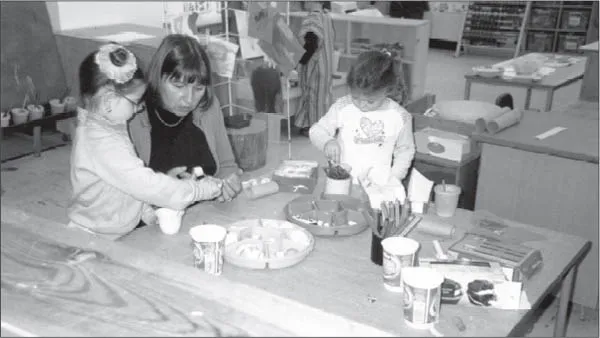
Kiera and Hannah are supported as they learn
Practical details
Parents need to be sure of:
• the start and end times of their child’s session;
• the number to call if they have a problem, e.g. their child is unwell or they are going to be late collecting their child;
• how to advise the nursery staff if any other person has their permission to collect their child – this is essential for security.
What does the nursery need to know?
Parents need to provide essential information before any child can be left at the nursery.
Personal details
The nursery will need to have:
The child’s name and date of birth.
Parents’ names, home addresses and telephone numbers.
Any workplace telephone numbers (for emergencies only).
Details of a second reliable contact (name, telephone number, distance from the nursery).
Details of anyone else authorised to collect the child from nursery.
The name and telephone number of the child’s doctor and/or health visitor.
Any dietary information, e.g. food that must not be offered at snack time.
Details of any allergies, e.g. asthma triggers such as dust or animal fur, or eczema that might be aggravated by the use of soap.
Information about previous or ongoing contact with a hospital, a speech and language therapist, a psychologist or social work agencies.
Details of the first symptoms of any recurring illness, particularly if a GP has to be contacted quickly (e.g. asthma, diabetes).
Details of any medication. If this has to be given during nursery, written instructions of the dose and how and when to administer it are required.
(Note: a medical form provided by the school has to be completed. This gives staff the authority to follow the instructions that have been given.)
If special resources are required, e.g. a handrail in the toilets and in the garden, the more notice the school has the better (see also Ch. 7, ‘Transitions’, p. 105).
Planning a first meeting between staff, parents and children
Although there is a great deal of administration to get through at a first meeting, some quality time must be scheduled for parents to ask questions and for the staff to share their plans and hopes for the coming session. The date of the first meeting needs to be carefully planned to give staff time to talk – ideally once the nursery is up and running and when the returning children have re-established their routines and their relationships with the staff.
It is a good idea to make special arrangements for parents coming into the nursery with their children for the first visit, depending on whether a home visit has already taken place (perhaps at the end of the previous term). All parents are offered such a visit but some families, for a number of reasons, may not have been able to participate and so some ‘new starts’ will be unknown.
Home visits
Two staff together arrange to visit the children’s homes, leaving precise details of the times and places of their visits (and their mobile phone numbers) with the remaining nursery staff. This preliminary meeting ensures that staff and parents are acquainted with each other before the first day at nursery. It allows the staff to see the children interacting with their parents, to understand a little of the home background and to begin to consider how much and what kind of support that particular child will require during the first days at nursery.
From these meetings the staff can decide the order of the children coming for their first visit. If they anticipate that one particular child will need special support, that child can come in as a ‘single’ whereas another two children with their parents could attend the same session – one at 9.30am and another at 10.00am.
It is important for all parents to feel that the staff have had the opportunity to talk with them individually and establish the first all-important, friendly link. This time allows the parents to see the nursery in action and gives the staff advance notice of strategies which might help their child settle down. If, for example, a particular child is keen on cars, the staff can set out some toy cars for his first visit to the nursery. A ‘staggered start’ or ‘gradual entry’ also prevents the nursery being swamped by adults! Organisational considerations such as these will help the staff to understand each child and provide the most appropriate support.
At a first meeting, there is no need to bombard parents with too many questions, for as the relationship between the nursery and the family develops, understandings will be built up which will make sharing information easier. From the start however, parents should be made aware of the importance of sharing details of everyday happenings in their child’s life. Even small snippets of information, e.g. that the goldfish has just died, can explain why the child is upset and enable the staff to give the most appropriate kind of comfort or if a child has refused breakfast, staff can ensure that an early snack is made available. In the latter case, staff could then check whether the child was willing/able to eat and if they find a problem this can be related back to the parents. The parents have to appreciate why this kind of personal information is needed or they could resent giving it!
Sharing personal information
Useful information which could be passed on at this first meeting (or subsequently shared at arriving and leaving times) might concern any parental worries. Parents might have suspicions that ‘something’ is wrong with their child; perhaps, in their eyes, he or she is not progressing as fast as a sibling or other children of the same age and they would like the staff to confirm/deny this or initiate requests for specialist support. Maybe another child is showing signs of temporary difficulties due to changing circumstances or the arrival of a baby in the family, and the staff need to understand why the child’s behaviour is affected.
Understandably, some parents may find it difficult to share personal information or concerns about their child, suspecting perhaps that they might be considered bad or inadequate parents. In these instances, do not rush them but allow a little more time to discuss what both parties can do to help the children settle in – perhaps over a cup of tea. This will smooth the path of future communications!
Parents might also wish to explain:
• that their child needs to be reminded to go to the toilet;
• that their child’s speech is slow or that they have difficulty making themselves understood;
• that they suspect their child has a hearing difficulty;
• that they have recently moved to the area, the child is missing his or her old home and has not yet had the opportunity to make friends with the local children.
Getting to know the child’s world
At nursery, children are encouraged to talk to the staff; they expect the staff to know their cat’s name, that Auntie Sharon lives next door and that they have a big brother – often in that order of importance. Conversations can break down if the staff have insufficient background information to reply appropriately.
Helpful insights might concern:
• the number of other children in the family and their names;
• whether the child attending the nursery is the oldest or youngest;
• which schools any siblings attend;
• whether one or both parents are at home when the child is at nursery;
• whether one or both parents speak English fluently;
• what religion the family observes;
• whether the child has had any previous nursery experience;
• the names of people in daily contact with the children;
• any pets and their names.
Staff who do not live close to the nursery could also carry out some research. Their first conversations will be more relevant if they know something of the local area and the people who live there. While no one should make any assumptions, understanding the children’s homes, their family arrangements and possibly what amenities are available to them, e.g. local shops, a library or a garden, can help interactions to be correctly pitched and will avoid the possibility of causing hurt or embarrassment to anyone.
As can be seen from the above, a great deal of forward planning is needed to ensure that the children, their parents and the staff get off to a good start. This comes through understanding and trusting each other’s position and working together to achieve the same goals.
Confidentiality
The first meeting is a time for trust and partnership to be established. Although staff must collect personal information, the parents must be reassured that this will be held in the strictest confidence and that no information will be passed on to any outside agency without their permission.
Permission slips
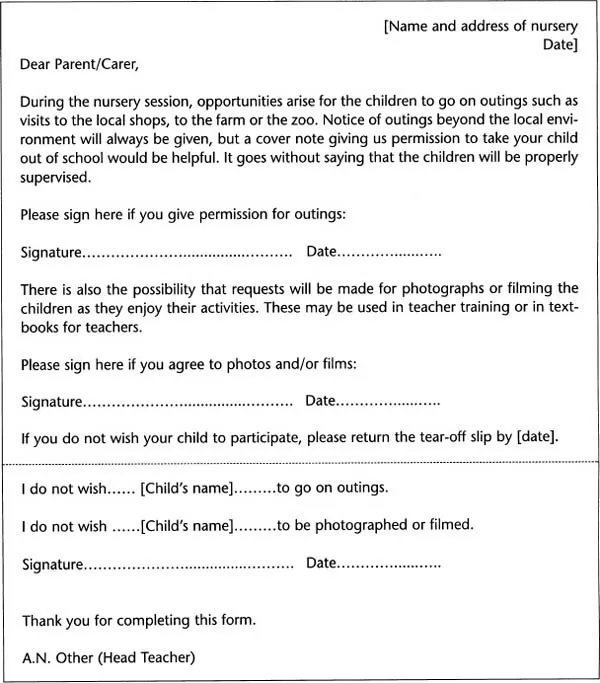
Figure 1.1 Permission slip
At an early meeting, it is useful to ask parents to sign a permission slip which covers ‘films, photos and local outings’. This prevents the need for repeated requests, but parents should also be made aware that they can cancel their permission if circumstances change. Similarly, if the nursery is expecting a visit from ‘outsiders’ (perhaps for a ‘People who help us’ session), parents need to know that they have been approved by the school.
Inform parents that details of any ‘event’ will be posted on the parents’ notice board well in advance so that they can react to it as appropriate.
Preparing a ‘Welcome’ booklet for parents
Different parents will need different amounts of information. Some nurseries provide lists of their aims for a session and give detailed plans of how these are to be achieved, but some parents will find a smaller booklet more manageable and appropriate. It is up to the staff to gauge what is most suitable for their particular parents. A smaller booklet ...
Table of contents
- Cover
- Title Page
- Copyright Page
- Dedication
- Contents
- Acknowledgements
- Introduction
- Chapter 1 Settling in
- Chapter 2 Explaining the child-centred ethos of the nursery
- Chapter 3 Planning and organising in the nursery
- Chapter 4 Provision and organisation of resources
- Chapter 5 Enhancing early learning and practical ideas for activities
- Chapter 6 Observation/assessment/recording, intervention and identifying/supporting children with difficulties
- Chapter 7 Transitions
- Catalogues
- Books for preschool children
- Bibliography
Trusted by 375,005 students
Access to over 1.5 million titles for a fair monthly price.
Study more efficiently using our study tools.
Frequently asked questions
Yes, you can cancel anytime from the Subscription tab in your account settings on the Perlego website. Your subscription will stay active until the end of your current billing period. Learn how to cancel your subscription
No, books cannot be downloaded as external files, such as PDFs, for use outside of Perlego. However, you can download books within the Perlego app for offline reading on mobile or tablet. Learn how to download books offline
We are an online textbook subscription service, where you can get access to an entire online library for less than the price of a single book per month. With over 1.5 million books across 990+ topics, we’ve got you covered! Learn about our mission
Look out for the read-aloud symbol on your next book to see if you can listen to it. The read-aloud tool reads text aloud for you, highlighting the text as it is being read. You can pause it, speed it up and slow it down. Learn more about Read Aloud
Yes! You can use the Perlego app on both iOS and Android devices to read anytime, anywhere — even offline. Perfect for commutes or when you’re on the go.
Please note we cannot support devices running on iOS 13 and Android 7 or earlier. Learn more about using the app
Please note we cannot support devices running on iOS 13 and Android 7 or earlier. Learn more about using the app
Yes, you can access Planning the Pre-5 Setting by Christine Macintyre,Kim McVitty in PDF and/or ePUB format, as well as other popular books in Education & Early Childhood Education. We have over 1.5 million books available in our catalogue for you to explore.