![]()
1 The rise of multiliteracies: Global trends and practices that change literacy
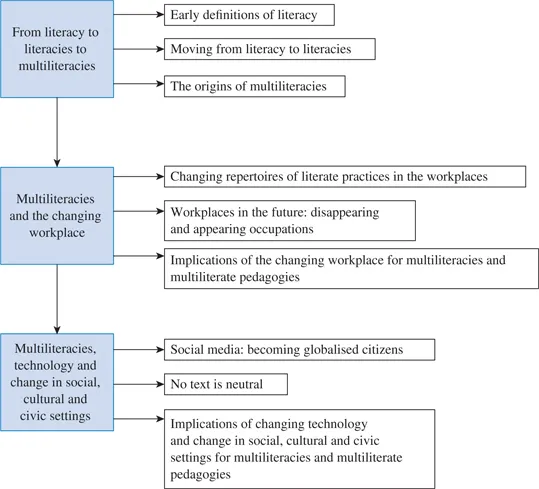
This chapter provides the historical, sociocultural and educational basis for using the term multiliteracies to describe literacy. It commences with a section in which the reasons for continuously evolving definitions of the term literacy are explored, concluding with the emergence of the term multiliteracies. The implications for education and pedagogy will be discussed in relation to the evolving definitions of literacy, literacies and multiliteracies.
The remainder of the chapter will establish the relevance of, and necessity for, using the term multiliteracies and its associated pedagogies in current and future educational settings. This will be addressed through the concept of continuous change as the new constant of societies across the world, focussing on increasing globalisation, social and cultural diversity, and use of developing technologies. The impact of continuous change on the literacy and the literate practices of workplace, leisure, social, cultural and civic environments, together with the implications for literacy pedagogy, will be discussed.
Reflection Strategy 1.1
- The purpose of this Reflection Strategy is to identify your current understandings about the concepts of literacy, literacies and multiliteracies.
- Before you commence reading the next section of this chapter, think about your current perceptions of literacy, literacies and multiliteracies.
- Using your reflections, write your own definition of each term: literacy, literacies, multiliteracies.
- You can express these definitions in whatever way you feel best conveys your ideas, for example, a series of dot points, complete sentences, a flow chart, table or diagram.
- As you read this chapter and come across ideas that are new to you or cause you to change or modify your definitions, go back and revise your original definitions.
- Write your revisions into a new definition each time, separate to the previous one, rather than modifying the original.
- The reason it is suggested that a separate and new definition be written each time is because this will provide a way for you to reread all your iterations of the definition, tracing your developing understanding of the terms. It will also provide a good source for reviewing your knowledge and understandings of this chapter when you finish it.
From literacy to literacies to multiliteracies
In the educational context, definitions of literacy have been used to shape curriculum, specifying the desired outcomes of literacy education and the knowledge, skills and understandings that need to be taught. Definitions of literacy can also be found in civic documents at the local, state, national and international level to explain and justify social, economic and education policy or provide benchmarks for the measurement of literacy.
Logically, when definitions are used to shape the content of curriculum it would be assumed that they would also shape the teaching and learning of literacy, that is, the pedagogy. However, as Gardner (2017) pointed out in a comparative analysis of the current primary English curricula in the U.K. and Australia, this is not always the case. As will be discussed later in this chapter, one of the reasons the concept of multiliteracies was originally proposed was to address the gap between evolving definitions of literacy and literacy pedagogy. Therefore in this chapter, and the whole book, there will be a focus on the implications of evolving definitions of literacy, literacies and multiliteracies for literacy pedagogy.
Early definitions of literacy
It is useful to look at definitions of literacy over time, as they provide insights into how and why perceptions of literacy and being literate have changed. Kalantzis et al. (2016, p. 6), suggest that education is about creating ‘kinds of people’ and therefore definitions of literacy and literacy education are about the knowledge, skills and understandings that have been identified as necessary to participate in the work, public and community life of a society. Therefore, such definitions implicitly (and sometimes explicitly) tell us about the current views of society and the desirable characteristics of people in that society. Because of the relationship between literacy and all aspects of society it is understandable that definitions of literacy will change as societies change.
The following definition from a UNESCO document in 1957 provides a good example of how analyses of a definition can provide such insights into society at that time and what literacy skills were perceived as important. It also helps to reflect upon whether such a definition would be adequate today.
[L]iteracy is a characteristic acquired by individuals in varying degrees from just above none to an indeterminate upper level. Some individuals are more or less literate than others, but it is really not possible to speak of literate and illiterate persons as two distinct categories.
UNESCO (1957, p. 18)
This statement about literacy does not suggest what skills, knowledge and practices constitute literacy but it does assert that it is acquired at various levels and some individuals might be less literate than others. What these levels are and what constitutes achievement at these levels is not stated. It tells us little about what global documents in society at that time specified as literacy, but it does recognise degrees of literacy and it infers that defining literacy and illiteracy is difficult – '…not possible to speak of literate and illiterate persons as two distinct categories.’
Just a few years later, in recognition of the impact of illiteracy on human rights and discrimination, UNESCO launched an Experimental World Literacy Program (EWLP). A 1962 UNESCO document cited by Oxenham (1980, p. 87) provided a definition with a more detailed picture of how literacy and literate practices were viewed in this period.
A person is literate when he has acquired the essential knowledge and skills which enable him to engage in all those activities in which literacy is required for effective functioning in his group and community, and whose attainments in reading, writing and arithmetic make it possible for him to continue to use those skills toward his own and the community’s development.
Examination of the italicised sections of this definition indicate a belief that there is a finite set of skills and knowledge that are unique to a group or community and that acquisition of them is a prerequisite to being able to function and develop oneself and one’s community. The apparent gendered nature of the definition (use of him) reflects the language of the times and does not necessarily preclude other genders.
Most of us cannot picture the world in 1957 or 1962; our perceptions and experience are mediated by old movies, film or TV shows from those times, or those made more recently to depict the period. Therefore, it is difficult to picture a society in which these definitions would function. At the time in Western English-speaking countries such as the U.K., U.S.A., Canada and Australia, the skills and knowledge necessary were language dominated as communication in work, public and community life was largely transacted through words on paper, and oral communication in person or by phone Phones were fixed and had to be used in an office, home or telephone box. As publishing in colour or reproducing photos and images was very expensive, images in print-based material were minimal. Television was in its infancy; colour was only just beginning to become widely available. In some countries owning a television was still the province of the rich. Therefore, the movie theatre was the main source of entertainment through film or moving images. It was also a source of world news in documentary style newsreels that were played before the main film, for example, Movietone News. If you wish to get a picture of life and news in the 1950s, the following QR codes give access to Movietone News archives and lists of movies that are set in the 1950s. However, as you access them and view them, remember that these depict one group’s perceptions of life at this time. The third QR code is a link to the trailer for the film Hidden Figures, which was released in December 2016 and is set in the early 1960s. This link is included because it gives insight into the technologies of the period, as well as the social values the producers of the movie chose to highlight. It depicts NASA and the early space launches and the use of human computers. The job of the human computers was to do the mathematical computations necessary to predict things like the orbit of space capsules, prior to the introduction of the technology that became non-human computers. These calculations were done using pencil and paper or chalk and a blackboard, slide rules and basic adding machines.
QR Code 1.1 Movietone news archives on YouTube (https://www.youtube.com/channel/UCHq777_waKMJw6SZdABmyaA)
QR Code 1.2 A list of movies set in the 1950s (https://en.wikipedia.org/wiki/Category:Films_setJn_the_1950s)
QR Code 1.3 Trailer for Hidden Figures (https://www.youtube.com/watch?v=RK8xHq6dfAo)
Most people left school and stayed in one job for life and, while a few might move towns, it was rare to move states or countries for work. Travel by plane for work or leisure was expensive and therefore limited to those who had the means to pay for it. Education often encouraged the early filtering of students into occupations through academic and manual streaming and exit points that encouraged early identification of career into manual labour, apprenticeships, office work, professionals or university. For example, in England the Tripartite System was used from 1944 to 1976 and the 11 Plus exam at the end of primary school determined whether students should attend a grammar school, a secondary modern or a technical school. The idea was that students’ performance in the test indicated their ability to enter particular careers and these three different types of schools provided the skills and knowledge appropriate for entering those careers. In Australia in the 1960s Scholarship, Junior and Senior exams screened students firstly for entry to secondary school, secondly for entry into apprenticeships or trades and finally entry to university. Very few attended university, firstly because of the school filtering process and entry requirements and secondly because it required the ability to pay fees and the funds to move and live away from home. Literature of the dominant society was most valued and there was an accepted canon of ‘good quality’ literature reflecting writers identified as the ‘great writers’ of previous generations. Knowledge of such literature was seen as prestigious, an indicator of a fine mind and education.
What are the implications for literacy education in such a period? If communication is language dominated then understanding the rudiments of grammar, spelling and punctuation and comprehension are essential requirements for both reading and writing. If jobs are for life, then the set of communication skills and knowledge necessary for those jobs is finite and identifiable. If you do not travel then the groups and cultures you encounter will be those of your own society and community, so there is no need to know about how to communicate with people who may not share your beliefs, culture or ways of communicating or who may challenge yours. As access to media such as television or film was limited and largely for leisure there was no need to understand how to make meaning of film or how to make it.
The education and literacy of this period has been characterised as old basics (Luke 1995), (Luke and Freebody 1997), traditional (Anstey and Bull, 2004, 2006), and heritage-based (Kalantzis et al. 2016). That is, at this time the goal of education generally was to pass on and maintain one’s heritage and the literacy skills needed to maintain it. Literacy was language dominant, as language was the most powerful tool for use with the available communication technology (paper and phone). Therefore, the teaching practices or pedagogy of this period were content and rule based (grammar, phonics, punctuation and spelling), test oriented (to check mastery), and encouraged passive learning where the teacher was the holder of all knowledge. A society of hierarchical workplaces where jobs were held for life required well-disciplined people and these teaching practices encouraged such behaviour Luke (1995) referred to this as providing a basic toolkit, which is an appropriate analogy given the social context and technologies of the tim...