eBook - ePub
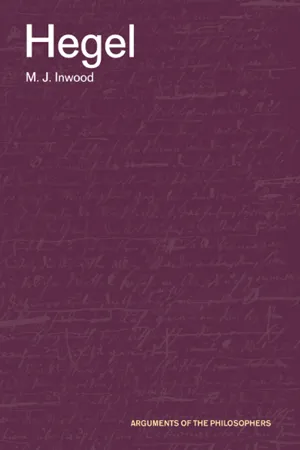
Hegel
About this book
In this clear, critical examination of the ideas of one of the greatest and most influential of modern philosophers, M.J. Inwood makes Hegel's arguments fully accessible. He considers Hegel's system as a whole and examines the wide range of problems that it was designed to solve - metaphysical, epistemological theological and political. He concentrates especially on the logical and metaphysical ideas which underpin the system and which supply the key to understanding much of what is obscure in Hegel's thought. Throughout the book, M.J Inwood reconstructs Hegel's thought by arguing with him. He examines Hegel's arguments and restates his views precisely and clearly. He also conveys the impressive unity of Hegel's system and its links with the thought of such philosophers as Aristotle, Spinoza and Kant.
Information
PART ONE
Prelude
I
Perception, Conception and Thought
‘Thinking’ and ‘thought’ are among the most important words in Hegel’s vocabulary. Philosophy, for example, is the ‘thinking consideration of objects’ (Enz. I. 2) and, in so far as Hegel’s system has a foundation, it lies in some relatively simple features of thinking.1 This chapter will be concerned with Hegel’s distinction between thinking, or more properly thoughts, and some other elements of our cognitive equipment.
1 The sensuous
A dog, like a person, may be able to see a telephone, but it cannot presumably think about a telephone in its absence or about telephones in general. To do this it would need to have the concept of a telephone and other concepts which this one presupposes.2 What is it that is missing when I merely think about telephones and do not see or hear any or, to put it another way, what is it that is common to me and a dog when we both see (or hear) a telephone? It is our sensory intake or, as Hegel generally calls it, the ‘sensuous’ (das Sinnliche, Enz. I. 20). The sensuous is the object of perception or, at least, it is what makes the difference between perceiving something and merely thinking about it. Hegel is aware that our perceptual experience is organized and articulated in terms of our concepts and beliefs. A dog cannot, as we can, recognize or see a telephone as a telephone and does not, therefore, have the same perceptual experience as ourselves. He sometimes marks this distinction by a contrast between perception, which is concerned with our raw sensory intake, and experience (Erfahrung), which is this sensory material moulded by thought.3 This is a difficult distinction and one on which Hegel sometimes casts doubt, but it does not concern us here.4
The sensuous is characterized by individuality and by asunderness (das Aussereinander, Enz. I. 20). What we perceive are individuals. When I see a bowl or a red patch, I see not bowls in general or bowlhood or redness, but some definite, individual bowl or some definite, individual red patch. Again, the things that we perceive are asunder, spread out, in space and time. I see, feel or hear one thing after another and I see or feel one thing next to another. The parts of the bowl are next to each other in space and the parts of it that I see at any one time occupy different positions in my visual field. Moreover, no bowl stands in isolation. There are other individual things next to it, above and below it. Unless I am so close to it that it takes up the whole of my visual field, I shall see other things spatially related to it and these things, or the parts of them that I see, occupy different places in my field of vision. (This account of asunderness has been conducted in terms both of our sensations and of the material things which produce them, since this is not a distinction which Hegel clearly draws when he speaks of the ‘sensuous’.)5
We can, of course, think about a definite individual bowl, but we can also think about bowls in general or about a bowl, but no particular bowl. What enables us to do this is the concept of a bowl. In contrast to the individuality and asunderness of the sensuous, concepts are characterized by universality and by simple ‘self-relatedness’ (Beziehung-auf-sich, Enz. I. 20). The concept of a bowl applies not just to some particular bowl, but to any bowl whatsoever of the indefinite number that there are. Any particular bowl will have definite features and will stand in definite spatial and temporal relationships to other things, features and relationships which differentiate it from other bowls. If the concept is to apply to any bowl, it must omit or abstract from these particular features and relationships; it must be, in one sense of that elusive word, ‘abstract’.6 Concepts, moreover, are not spread out or asunder; they and their components do not stand in spatio-temporal relationships to each other in the way that items in our visual field do, nor do the universal features, redness, for example, or bowlhood, for which they can perhaps be said to stand, except in so far as they are embodied in particular individuals.
2 Concepts and conceptions
This distinction between the sensuous and concepts is no doubt difficult in detail, but its general drift is clear enough. Matters become more complicated when Hegel comes to distinguish between two types of concept. Indeed the concept of a bowl or of redness is not, in his terminology, a concept (Begriff) at all, but rather a conception (Vorstellung). The distinction is one between empirical or, at least, non-formal concepts such as those of a bowl, a horse or of God (Vorstellungen) and abstract or formal concepts such as those of being, of causality or of a thing (‘thoughts’, Gedanken). It is an important distinction. The Logic, the first part of Hegel’s triadic system, is, among other things, an examination of (pure) thoughts, and when he says such things as that philosophy is the ‘thinking consideration of objects’, it is thinking in terms of pure thoughts that he primarily has in mind.
Conceptions are themselves of two types. There are empirical ones such as that of a horse and non-empirical ones such as those of God or of duty (Enz. I. 20). Difficulties arise even in the attempt to distinguish empirical conceptions from pure thoughts. Pure thoughts are non-empirical, but Hegel interprets this in more than one way. In the first place, pure thoughts are not given in ‘immediate sensation’ (Enz. I. 42Z. 3. Cf. 39). A lump of sugar, a particular thing, is hard, white, sweet and cubical, and we can detect these qualities by our various sense-organs. But the unity of the lump of sugar, the fact that these qualities all belong to a single thing, is not given in our sensory intake and is not, therefore, strictly perceived (Enz. I. 42Z. 3. Cf. PG pp. 89 ff., M. pp. 67 ff.). Similarly, when I watch a piece of wax melting under the application of a flame, all that is strictly given in perception is ‘the individual events following one another in time’, not the fact that there is a causal connection between the events, that the application of the flame causes the wax to melt (Enz. I. 42Z. 3). Some pure thoughts, that of a force for example, refer to entities which we do not ordinarily regard as perceptible. We can see the flash of lightning, but not the force of which it is the expression (Enz. I. 21Z. Cf. PG pp. 102 ff., M. pp. 79 ff.). These are some of the ways in which thoughts, or the features to which they refer, are imperceptible.7
These examples do not, however, immediately enable us to discriminate between thoughts and conceptions. For if I cannot strictly perceive things, then I cannot strictly perceive lumps of sugar or bowls. If I cannot perceive causal relations, then I cannot perceive melting, pushing, or pulling. But presumably the concepts of a lump of sugar, of melting, and so on are conceptions rather than thoughts. Hegel sometimes obscures the distinction still further by interpreting the imperceptibility of thoughts in a quite different way. For he gives as an example of a thought rather than a conception the concept of an animal, for the reason, amongst others, that we cannot perceive or point to an animal as such, an animal which is no particular sort of animal (Enz. I. 24Z. 1). This point applies, however, to any determinable general term. I cannot see a poodle which is just a poodle and has no further features of its own; I cannot see a red patch which is just red and no specific shade of red. I may indeed see that something is a poodle or red and yet fail to notice what sort of poodle or red it is, whereas I could hardly see that something was an animal while failing to notice anything about what sort of animal it was. But Hegel has not said enough to license the attribution of this idea to him. The point would fail to apply, then, only to maximally determinate terms, a term, for example, for a specific shade of red which did not contain, or within which we could not sensorily discriminate, a range of different shades. But Hegel does not want to restrict the class of conceptions to such concepts as these.
His main point, however, is a better one than this. He can concede that bowls and sugar-lumps as well as things, melting as well as causing, and electricity as well as force, are not given in sensation. But we can distinguish within any conception a sensory element and an element of thought. A lump of sugar, for example, is a unified thing with properties. That is the element of thought which the conception of it contains and this is not given in our perception of it. But it is not simply a thing; it is also a particular sort of thing different in kind from a lump of salt. This element, which distinguishes a thing of one sort from those of another, is what is given in sensation. Similarly, while causal relations are not given in sensation, what is so given enables us to distinguish between a flame melting a piece of wax and a block of ice solidifying it. Forces, again, are not perceptible, but the empirical element enables us to distinguish between electricity and gravity.
This is perhaps what Hegel means, but it involves at least three difficulties. Firstly it still gives us no ground for drawing a sharp line between thoughts and conceptions. For granted that empirical data are required for us to tell whether something is melting something else rather than solidifying it, perceptual experience is also needed if we are to know whether one of two events causes the other and, if so, which causes which. This will be so, even if the concept of causality is regarded as universally applicable to our experience, as long as it is not randomly applicable to it. And most of the concepts which Hegel classifies as pure thoughts are of neither random nor universal application. Some of them, that of being for example, are applicable to everything and are involved in any significant utterance.8 But many of them, though they are widely applicable, are not universally so. The concept of causality is one example of this. Hegel does not believe that this concept is properly applicable to organic nature or to human life. We should not say, for example, that damp causes fever or that Caesar’s ambition caused the downfall of the Roman Republic, not because such statements are empirically false, but because causality is not the right category to employ in such cases.9 Another example is the concept of a whole consisting of parts. This too can be applied to a wide range of entities, but not to living organisms, minds or societies.10 There are presumably empirical procedures for deciding whether or not any given entity can be appropriately conceived in terms of causality or as a whole consisting of parts — one might, for example, attempt to dismantle and reassemble it — and, if that is so, it is hard to deny that the concept has some empirical content. As far as this goes, then, all that Hegel can claim to have shown is that there are degrees of generality in our concepts, that of causality being, for example, of greater generality than that of a horse, and that the more general a concept is, the less its applicability depends on the precise character of our sensory data.
A second difficulty is that Hegel seems to be conflating two quite different distinctions, the distinction between more general and less general concepts and that between concepts the instances of which are perceptible and concepts the instances of which are not. His treatment of the concept of an animal provides a bridge between these two distinctions but it is, as we have seen, an insecure one. For it is not true of all the concepts which he regards as pure thoughts that they are not given in sensation. The concepts with which the Logic begins, those of being, of becoming and of determinate being (Dasein) are not of this kind, though they are also of unrestrictedly universal application. The concept of being is taken by Hegel both in a predicative sense (as in This leaf is green’, Enz. I. 3) and in an existential one (as in ‘God is’, Enz. I. 51), but its primary use seems to be when one simply gestures towards or focuses upon some item in one’s experience by saying or thinking ‘That is!’ or There it is!’ (PG pp. 79 ff., M. pp. 58 ff.).11 It may be true that the fact that a creature has sensations does not guarantee that it has this concept, and that the concept cannot be acquired by abstraction from one’s sensory experience. But neither of these points is sufficient to establish that being is not given in our sensations in the way that causality or forces supposedly are not. The question is not whether, if one has the requisite sensations, one will automatically have or acquire the concept, but whether, given that one has the concept and that one has the requisite sensations, the sensations alone can guarantee the applicability of the concept to them. In the case of the concept of being, there is no room for a sceptic to drive a wedge between our bare sensory intake and the claim that it is. That is, no doubt, little consolation, for the claim is a singularly empty one. However, the same is true of the richer claims that come under the heading of determinate being. Here we do not confine ourselves to saying that things are, but ascribe definite qualities to our experience, particular colours for example. There is, however, no assumption at this stage that one and the same individual has more than one quality or that it can have different qualities at different times, nor is it assumed that the qualified items are objective rather than subjective or, for that matter, subjective rather than objective (Enz. I. 89 ff.; WL I. pp. 115 ff., M. pp. 109 ff.). The claims are of the type ‘This is green’, ‘That is red’, and so on. In this case, too, it is not obvious that there is an epistemic gulf between our sensory intake and the application of these concepts, once it is granted that we have them. The pure thought is not, however, the concept of redness; that is, if anything, a conception. Rather it is the concept of determinate being itself. But again, granted that we have this concept, there can be no question that our sensory intake is determinate. Indeed the statement that something is red presumably entails that it is of some determinate quality. Hegel’s claim that thoughts are not given in sensation cannot, then, provide him with the distinction he requires between thoughts and conceptions.
A third difficulty is suggested by one of Hegel’s own arguments in the Phenomenology of Mind. There he argues that there is no way in which I can capture or express my experience without employing thoughts. Even if, as I do in the ‘form of consciousness ‘which he entitles ‘sense-certainty’ (sinnlicbe Gewissheit), I confine myself to focusing upon or picking out particular items in my experience, I am committed to the use of token-reflexive terms such as ‘this’, ‘here’, and ‘now’ and these terms express or involve thoughts (PG pp. 79 ff., M. pp. 58 ff.).12 If I go further and ascribe qualities to my experience, then the terms I employ involve the concept of determinate being. As we have seen, Hegel does not speak, in this context, of one’s subjective sensory intake as opposed to objective items in the world, and this is perhaps because he feels that the distinction between what is objective and what is merely subjective is a sophisticated one, the drawing of which presupposes a richer conceptual arsenal than is available to the simple forms of consciousness which he is considering here. The point would apply, however, to our sensory intake considered as such, namely that no thought-free description, or even indication, of it can be given. But to give substance to the thesis that thoughts generally are not, or that some particular thought is not, given in our sensory intake, we should be able to suggest some way of describing our sensations such that the description does not imply or entail statements which involve thoughts or, at least, the particular thought with which we are concerned. If Hegel’s argument is sound, however, then we cannot claim that no thought is given in sensory experience, since we cannot provide an entirely thought-free description of it. The thoughts of being, of negation, and of determinate being are implicit in any description of our sensory experience. The most we can hope to do along these lines is to show that certain thoughts are not involved in it when it is described in minimally thought-ridden terms. The claim, for example, that the unity and persistence of objects is not given in sensation will mean that no ...
Table of contents
- Cover
- Half Title
- Title Page
- Copyright Page
- Dedication
- Table of Contents
- Abbreviations
- Chronological Table
- Preface
- Introduction
- Part One PRELUDE
- Part Two PROBLEMS
- Part Three THE SYSTEM
- Conclusion
- Notes
- Bibliography
- Index
Trusted by 375,005 students
Access to over 1.5 million titles for a fair monthly price.
Study more efficiently using our study tools.
Frequently asked questions
Yes, you can cancel anytime from the Subscription tab in your account settings on the Perlego website. Your subscription will stay active until the end of your current billing period. Learn how to cancel your subscription
No, books cannot be downloaded as external files, such as PDFs, for use outside of Perlego. However, you can download books within the Perlego app for offline reading on mobile or tablet. Learn how to download books offline
Perlego offers two plans: Essential and Complete
- Essential is ideal for learners and professionals who enjoy exploring a wide range of subjects. Access the Essential Library with 800,000+ trusted titles and best-sellers across business, personal growth, and the humanities. Includes unlimited reading time and Standard Read Aloud voice.
- Complete: Perfect for advanced learners and researchers needing full, unrestricted access. Unlock 1.5M+ books across hundreds of subjects, including academic and specialized titles. The Complete Plan also includes advanced features like Premium Read Aloud and Research Assistant.
We are an online textbook subscription service, where you can get access to an entire online library for less than the price of a single book per month. With over 1.5 million books across 990+ topics, we’ve got you covered! Learn about our mission
Look out for the read-aloud symbol on your next book to see if you can listen to it. The read-aloud tool reads text aloud for you, highlighting the text as it is being read. You can pause it, speed it up and slow it down. Learn more about Read Aloud
Yes! You can use the Perlego app on both iOS and Android devices to read anytime, anywhere — even offline. Perfect for commutes or when you’re on the go.
Please note we cannot support devices running on iOS 13 and Android 7 or earlier. Learn more about using the app
Please note we cannot support devices running on iOS 13 and Android 7 or earlier. Learn more about using the app
Yes, you can access Hegel by Michael Inwood in PDF and/or ePUB format, as well as other popular books in Philosophy & Philosophy History & Theory. We have over 1.5 million books available in our catalogue for you to explore.