eBook - ePub
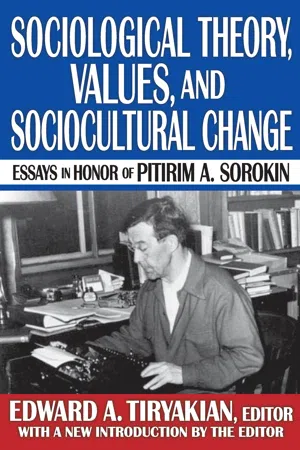
Sociological Theory, Values, and Sociocultural Change
Essays in Honor of Pitirim A. Sorokin
- 340 pages
- English
- ePUB (mobile friendly)
- Available on iOS & Android
eBook - ePub
Sociological Theory, Values, and Sociocultural Change
Essays in Honor of Pitirim A. Sorokin
About this book
This volume brings together some of the biggest names in the field of sociology to celebrate the work of Pitirim A. Sorokin, professor and founder of the department of sociology at Harvard University. Sorokin, a past president of the American Sociological Association, was a pioneer in many fields of research, including sociological theory, social philosophy, methodology, and sociology of science, law, art, and knowledge. Edward A. Tiryakian's updated introduction examines major factors, inside and outside sociology, that have led to new appreciation of Sorokin's contributions and scholarship, and demonstrates their continued relevance. This new edition also includes an updated bibliography of works by and about Sorokin.The volume includes Arthur K. Davis, who describes Sorokin's importance as a teacher in the Socratic tradition. Talcott Parsons examines internal differentiation in Christianity in its historical Western development. Thomas O'Dea deals with the institutionalization of religious values. Walter Firey examines how actors relate their conception of a distant future to their present behavior. Florence Kluckhohn focuses upon the problem of cultural variations within a social system. Robert K. Merton and Elinor Barber examine the sociological aspect of ambivalence. Bernard Barber considers the American business's efforts to institutionalize professionalism.Other contributors include Charles P. Loomis, Wilbert E. Moore, Georges Gurvitch, Marion J. Levy, Jr., Nicholas S. Timasheff, Carle Zimmerman, and Logan Wilson. This volume is an essential collection of essays concerning the work of one of the most prominent thinkers in twentieth-century sociology.
Information
Lessons from Sorokin
MORE than twenty years ago I enrolled as an undergraduate in Professor Sorokin’s best-known course, Principles of Sociology, officially catalogued as Sociology A, but commonly called Sorokin A by the irreverent Harvard Crimson’s Confidential Guide. My Saturday section man was R. K. Merton, who taught me a thing or two one day when he dispassionately atomized a juvenile term paper of mine. When in the course of events I became an instructor, one of my assignments would be to act as a section assistant in this same course. That association with Sorokin and Sociology A would last for several years, just before and just after the second world war. All that lay ahead, however.
Another well-known course I took that first year was Social Dynamics. Here the professor gave a preview of his magnum opus, Social and Cultural Dynamics, the first three volumes of which were to be published the following year (1937). In later years there were other Sorokin courses, and then graduate seminars, notably in social theory and social mobility. The professor had already published standard works in both of these fields.
These three or four courses, I think, carried the essence of Sorokin’s formal teaching. In any case, they are the ones I best remember.
Now a time has come to consider, reflectively, just what were the lessons we learned from Sorokin. On such a matter each of us must speak for himself. My own feeling is that the majority of my graduate-school generation did not learn much from Sorokin, and that because of this fact North American sociology is the poorer.
In this age of deep and chronic crisis, formal education is likely to become somewhat divorced from contemporary realities. This seems to be especially true in American society. A stiff dose of academic training, such as we unquestionably got at Harvard, is likely to require an inordinate amount of sifting and seasoning over the years before it can be satisfactorily adjusted to the realities of a fast-changing world. One gets his education, and then, as it were, one must get over it.
Too many of us in my university generation have not yet gotten over our academic educations.
If we had, certain key elements of Sorokin’s teaching would be considerably more prominent in North American sociology than is now the case. Five of those elements are: an emphasis upon social change as the primary frame of reference; the corollary that change is inherent or immanent in social systems; the premise that social conflict and social problems are basically organic aspects of a society rather than external accidents; the revolutionary nature of our time; and the necessity of taking a universal view of social life and social thought, both ancient and modern, rather than a perspective limited to modern Western societies.
These ideas did not, of course, originate with Sorokin, nor do they include all the facets of his thought. Some awareness of most of them can doubtless be found in most contemporary social scientists. But these propositions are central elements of Sorokin’s system, whereas they tend to be relatively peripheral with many other writers. Only brief comment on each of the five points seems desirable here.
Elsewhere1 I have discussed the high degree of unrealism that naturally results from attempting to analyze a dynamic society like our own in terms of an essentially static social theory. A conspicuous example of this is the theory of action. We must freely acknowledge the significance of Professor Parsons’ work for systematic interdisciplinary theory, analytical sophistication, small-group and family studies, and for many brilliant insights into special situations too numerous to mention. Yet when all is said and done, this approach remains basically static and a priori, logical rather than empirical, transhistorical rather than historical, structural rather than dynamic. It owes much to the concept of “normal equilibrium,” borrowed mainly from neoclassical economic theory.2
Similar comments can be made about the closely related but more general and more widely known structural-functional approach in sociology and anthropology. The development of func-tionalism has doubtless been one of the major phases of social science in the last twenty-five years. But its implicitly static frame of reference more or less obscures our awareness of concrete historical processes operating in specific social and geographic settings.3 With some exceptions, this seems particularly true of community studies in both literate and nonliterate societies.
Developing a functional type of social analysis has been a notable achievement, notwithstanding its shortcomings in certain areas. As a matter of record, Sorokin has made significant contributions to this chapter of modern social science. Some of his early works, first published in Russia, place him in the vanguard of this movement. But the main drift of his thought has not been in that direction.
The second key premise of Sorokin’s sociology is that social change is inherent in social systems. In the equilibrium frame of reference characteristic of much theorizing in economics and sociology, change necessarily appears as external or accidental force. Sorokin’s emphasis on the immanence of change is most clearly set forth in his Social and Cultural Dynamics.
The third premise views social problems primarily as organic aspects of society, and only secondarily as external factors or accidents. The prevailing emphasis in North American social science has tended to reverse the relative position of these two points of view. No doubt this oversimplifies the general picture, but hardly to the point of serious distortion. For example, Sorokin sees war, crime, and rising divorce rates as phenomena inherent in an excessively sensate and materialistic culture. One may debate Sorokin’s application of this premise. I would say that concrete material institutions, especially those centering around economy, class, and property, are usually the key elements of social life and social evolution. But concerning the validity of the basic premise itself, serious doubts can scarcely be entertained, for the alternative is confusion in social science and social policy. Explaining depressions by “accidents” like wars, or wars by depressions, or juvenile delinquency by slums or broken families, is neither scientifically accurate nor conducive to realistic remedial policy. It seems likely that juvenile delinquency and slums are both more or less directly linked to the social-class system. Modern war probably stems in considerable part from the institutional complex of capitalism and absolute nationalism, and from the movement of hitherto dependent nations toward socialism and independence. If these propositions are true, the conventional remedial measures we now rely upon for relief from delinquency and war are bound to be inadequate. Effective policies can be based only on insightful knowledge. Minor repairs will hardly suffice where major surgery is called for.
Another key teaching of Sorokin is the revolutionary nature of our time. This view has become accepted—more or less—even in North America as a result of the impact of assorted wars, revolutions, and depressions during the past generation. But general acceptance of this disturbing prospect has come reluctantly, especially among those governments and social classes having vested interests in the old order. As yet the depth and pervasiveness of the revolutionary currents are incompletely realized in the relatively prosperous sections of the Western world. For twenty-five years Sorokin has been one of the few voices to warn us of the true situation. If his analysis has underestimated some of the specific historical factors and overestimated the role of ideas, at least he has consistently recognized that we are passing painfully over one of the great watersheds of world history.
The last major lesson is the importance of a universal view of social life, Oriental as well as Western, ancient as well as modern. Modern Western social thought has naturally tended to concentrate upon the institutions and internal problems of Western societies. An unfortunate feature of this emphasis has been a relative neglect of the social evolution and thought of Near- and Far-Eastern civilizations. For several decades the outlook of Western scholarship and education has been little short of provincial in this respect. History, for example, is still taught in American schools and colleges in terms of the narrow categories ancient, medieval, and modern. Much the same is true of philosophy.
This preoccupation with the West European peninsula and its cultural extensions in North America and elsewhere means that the greater part of the world and its peoples has either been arbitrarily relegated to the background or else ignored. Yet most of the human race has always lived in Asia, and still does. The first urban civilizations emerged in India and Southwest Asia. China represents perhaps the longest span of social evolution. Although Western Europe was the first to reach the urban-industrial stage, thereby attaining a worldwide technical and political supremacy, other regions of the world with larger populations and potentially greater resources are now becoming industrialized. Already it seems possible to distinguish two partly overlapping subphases of urban-industrial development— Atlantic capitalism and Eurasian socialism. In the long-run view, the political and cultural hegemony of Western Europe and North America appears to be a temporary and receding tide.
No doubt the reasons for these deficiencies in Western-world outlooks are numerous and complex. But one practical result is that we of the West find ourselves confronting a major crisis without the intellectual concepts needed to understand it. American social science and education suffer from a relative unawareness of the deep historical currents of the times. In Sorokin’s works, however, we are continually reminded of the importance of studying Eastern history and social thought.
Thus far we have mentioned only a few aspects of Sorokin’s thought. These surely belong among the basic premises of a mature and realistic social science. Had we learned these lessons from Sorokin better than we did, North American sociology might be considerably more advanced than it is. With certain other features of his approach, to be sure, I would differ profoundly. Nonetheless, in recent years it has become clear to me that there are more fundamentals of sociology to be learned from Sorokin than from almost any other academic social scientist today.
Why is this? Chiefly because Sorokin has usually—with now and then a lapse—addressed himself to the basic problems of the age without being sidetracked by the current cult of “objectivity.” According to the latter view, which seems to prevail among sociologists of some leading North American universities, a social scientist should religiously avoid making value judgments in his scientific work—as if this were really possible! May not such antisepsis in science invite sterility rather than progress?
Writers who do not adhere to the canon of objectivity are likely to be looked upon by orthodox social scientists as “philosophers” rather than “scientists”—and in this context, “philosopher” is hardly a complimentary term. The orthodox are inclined somewhat to look askance at these deviant characters, among whom are commonly included Sorokin, Toynbee, the Marxians, Charles Beard, Veblen, and others. A distinguished list of sinners, indeed!
The great social thinkers of all times have dealt with the leading social and ethical issues of their day. In so doing they have necessarily made value judgments. Perhaps facing up to the leading ethical questions of the day is by itself not a sufficient condition of greatness—one must come up with some relevant answers, too. But it is surely a necessary condition of greatness.
One more point remains to be made, concerning the scholar’s integrity in his public role. At a time when the great majority of American scholars were climbing onto the cold-war bandwagon and accepting uncritically the official Washington line, Sorokin was one of a few who now and then spoke out for peace. The members of the Harvard faculty who took this risky and unpopular stand probably numbered less than half a dozen, if my memory is correct.
Is not the scholar, like any other citizen, duty-bound to speak out on public issues wherein he has both special insight and deep convictions? Then where were our academics during the cold-war buildup, the heats of the loyalty-security purges, the insanities of the Truman-Eisenhower Far Eastern policy? In an age of spreading conformity, Sorokin was one of the exceptions who continued to exemplify the best tradition of the independent scholar. A man of extraordinarily wide interests and long views, he remained relatively unmoved by passing political tempests, just as he has been generally unaffected by most of the short-term enthusiasms in social science.4
Once, during my college days, I volunteered with some other students to hand out organizing leaflets for an embattled CIO union in a Boston suburb. This trifling incident brought some of us before a local magistrate for allegedly infringing a long-forgotten local ordinance. The Court in his wisdom sent us back to our studies unscathed. Afterward, one of my professors warned me that the affair might jeopardize my scholarship. But when the matter (so I was told) came up in a Department meeting, Sorokin—then Chairman—turned the question aside with the humorous comment that he himself had been arrested six times—three times by the Czar of Russia and three times by the Bolsheviks.
In small things as well as in great ones, Sorokin is a teacher to remember. Of what he offered us, and what he stood for, we learned too little.
Notes
1 “Social Theory and Social Problems,” Philosophy and Phenomenological Research, XVIII (December 1957), 190-208.
2 Neoclassical economic theory, it must be noted, has developed its abstract and analytical apparatus at the cost of losing contact, to a considerable extent, with concrete historical processes. And “normal equilibrium” has become one of the major frames of reference in North American social science. A generation ago Charles Beard wrote: “What schemes of organization and valuation have generally prevailed among American scholars in the social sciences? In the main the system of British Manchesterism has prevailed, with modifications in detail.” Zeitschrift für Sozialforschung, IV (1935), 63-65.
3 Another example of the inherent incapacity of academic social science to deal effectively with problems of social change can be found in the introductory texts in sociology and anthropology. Usually the topic of change is reserved for the last section, and a pretty lame treatment it ordinarily is.
4 Sorokin’s recent volume, Fads and Foibles in Contemporary Sociology and Related Social Sciences (Chicago: Henry Regnery, 1956), is too cutting to be a popular book, but it deserves more attention than it has received. One may say of this work that it is erroneous in many of its details but accurate in most of its basic propositions.
Some Problems for a Unified Theory of Human Nature
I Distinctions on the Most General Methodological Level
However elementary it may seem, a few remarks must be made on the most general level of methodological analysis for our purposes; they will provide a statement in terms of which agreement and disagreement may be specified. For these purposes I wish to distinguish among concepts (and conceptual schemes), theories (and theoretical systems or systems of theory), and systems of analysis and to state a few propositions about their use in scientific systems.
A Concepts And Conceptual Schemes
The term concept may be defined as the name for the members of a given class of any sort, or the name of the class itself. A conceptual scheme may be defined as a group of concepts (two or more) used in conjunction with one another for any particular purpose. To the extent that the purpose is clearly stated and the concepts selected with a view to their relevance to that purpose and their relations to one another, the conceptual scheme may be termed a (more or less) systematic conceptual scheme.
For use in scientific work concepts—and by extension, conceptual ...
Table of contents
- Cover Page
- Title Page
- Copyright Page
- Table of Contents
- Sociological Theory, Values, and Sociocultural Change
- Introduction to the Transaction Edition Updating Sorokin
- Preface
- 1 Lessons from Sorokin
- 2 Some Problems for a Unified Theory of Human Nature
- 3 Christianity and Modern Industrial Society
- 4 Sociological Dilemmas: Five Paradoxes of Institutionalization
- 5 Sociological Ambivalence
- 6 Is American Business Becoming Professionalized? Analysis of a Social Ideology*
- 7 Conditions for the Realization of Values Remote in Time
- 8 The Temporal Structure of Organizations*
- 9 Social Structure and the Multiplicity of Times *
- 10 Social Change and Social Systems *
- 11 Some Reflections on the Nature of Cultural Integration and Change
- 12 Convergence of the Major Human Family Systems During the Space Age
- 13 Don Luigi Sturzo’s Sociological Theory*
- 14 Disjunctive Processes in an Academic Milieu
- Bibliography of Pitirim A. Sorokin*
- Supplementary Select Bibliography of Works by and on Pitirim A. Sorokin
- Contributors
Trusted by 375,005 students
Access to over 1.5 million titles for a fair monthly price.
Study more efficiently using our study tools.
Frequently asked questions
Yes, you can cancel anytime from the Subscription tab in your account settings on the Perlego website. Your subscription will stay active until the end of your current billing period. Learn how to cancel your subscription
No, books cannot be downloaded as external files, such as PDFs, for use outside of Perlego. However, you can download books within the Perlego app for offline reading on mobile or tablet. Learn how to download books offline
Perlego offers two plans: Essential and Complete
- Essential is ideal for learners and professionals who enjoy exploring a wide range of subjects. Access the Essential Library with 800,000+ trusted titles and best-sellers across business, personal growth, and the humanities. Includes unlimited reading time and Standard Read Aloud voice.
- Complete: Perfect for advanced learners and researchers needing full, unrestricted access. Unlock 1.5M+ books across hundreds of subjects, including academic and specialized titles. The Complete Plan also includes advanced features like Premium Read Aloud and Research Assistant.
We are an online textbook subscription service, where you can get access to an entire online library for less than the price of a single book per month. With over 1.5 million books across 990+ topics, we’ve got you covered! Learn about our mission
Look out for the read-aloud symbol on your next book to see if you can listen to it. The read-aloud tool reads text aloud for you, highlighting the text as it is being read. You can pause it, speed it up and slow it down. Learn more about Read Aloud
Yes! You can use the Perlego app on both iOS and Android devices to read anytime, anywhere — even offline. Perfect for commutes or when you’re on the go.
Please note we cannot support devices running on iOS 13 and Android 7 or earlier. Learn more about using the app
Please note we cannot support devices running on iOS 13 and Android 7 or earlier. Learn more about using the app
Yes, you can access Sociological Theory, Values, and Sociocultural Change by Edward A. Tiryakian,Harriet Martineau in PDF and/or ePUB format, as well as other popular books in Social Sciences & Social Science Research & Methodology. We have over 1.5 million books available in our catalogue for you to explore.