![]()
p.11
PART I
Transnational spaces
Histories and memories of the sixties have centered around the dramatic political protests, cultural contestations, and social upheavals of those tumultuous years. Events, like May ’68 in France, and images like the iconic, globally circulated photo of Che, take center stage. Much less attention has been paid to the spaces that incubated and encouraged, received and modified, rejected and repressed new social movements, ideologies, lifestyles, identities, and repertoires of action. Cities such as Berlin, Berkeley, and Paris have been studied endlessly, but not Second and Third World centers of organization, activism, and countercultural effervescence such as Belgrade and Tashkent, Dar es Salaam, and Dakar. Historians have reconstructed some of the transnational networks through which sixties activists, political ideas, cultural products, and possible lifestyles traveled among Western European countries and across the North Atlantic. We know much less about how flows and networks created transnational spaces of a distinctly sixties sort elsewhere. Some of these linked Africa, Asia, and Latin America to Europe or the U.S.; many more of them created dense South-South connections or forged ties between Communist countries and the Third World. Decolonization and postcolonial economic and political development, superpower Cold War interventions, and nonaligned responses shaped these transnational spaces, but so too did the organizations, political and cultural choices, and actions of local students and workers. There was not one kind of transnational space in the sixties, but rather a variety of such spaces, in which the local, the national, and the global mixed in complex ways; in which political protest and countercultural enthusiasm sometimes reinforced one another and sometimes competed and conflicted; in which ideologies like Maoism traveled widely but took on distinctive hybrid forms. There were transnational connections and solidarities of all sorts, some real, others desired, and still others imagined and feared.
The chapters in this opening Part offer varied perspectives on the character of particular transnational spaces, as well as on the complex meaning of the transnational in relation to space. Although each article focuses on a particular space, they share similar questions. Who and what created new transnational connections and exchanges? Who participated in transnational networks or led transnational lives, and who was excluded by necessity or choice? What political projects and cultural experimentation did transnational spaces promote? Did various transnational networks cooperate or compete with one another and with visions of internationalism?
Victoria Langland both provides an assessment of how Brazilian activists viewed the sixties elsewhere and offers a suggestive typology of transnational connections. Brazilian leftists were preoccupied with combatting a military dictatorship, but the primacy of domestic politics did not mean that no attention was paid to events in Europe and the United States. The local and the transnational coexisted, but Brazil did not simply imitate First World models. As will be seen, this relationship recurs in many of the cases studied in this collection. In Brazil and elsewhere, Langland argues, there were three kinds of connections: literal, involving the movement of ideas, people, and cultural forms across borders; aspirational or imagined and desired solidarities and similarities; and conspiratorial, referring to those that were fantasized by media and governments opposed to protest. After the sixties, commemorative connections emerged as well.
p.12
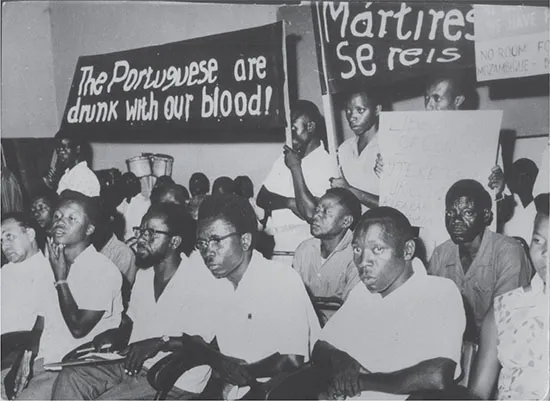
The chapters by Andrew Ivaska, Dan Hodgkinson, and Masha Kirasirova examine particular locales—Dar es Salaam, the University College of Rhodesia and Nyasaland, and Tashkent—reconstructing the complex networks that were created from above by Communist officials, in the case of Soviet Central Asia, or below by activists, as was the case in Tanzania and Rhodesia. Ivaska focuses on Dar es Salaam as a node that bundled together multiple transnational networks of political actors from Southern Africa, Cuba, the Soviet Union, China, the United States, and elsewhere. He illustrates the complexity of these connections and the provisional solidarities they fostered through the transnational trajectories of Eduardo Mondlane, the leader of the Mozambican liberation movement Frelimo, based in Dar, and Che Guevara, who twice visited the city. Ivaska’s chapter shows that class, material concerns, affective ties, and ideology fostered solidarities but also tensions and ruptures among activists in Dar. They also generated multiple and sometimes conflicting stances—between African activists and Che, for instance—on matters such as proletarian internationalism, inequality, and the sort of support that liberation movements in Africa needed.
p.13
Hodgkinson examines a quite different transnational space and set of actors in white-ruled Rhodesia from 1965 to 1973. Focusing on the University College of Rhodesia and Nyasaland, he contrasts the different situations and forms of protest of black and white students, looking particularly at the high-profile student activist Arthur Chadzingwa. While many white students were attracted to countercultural forms and norms, black activists shunned alternative lifestyles and did not challenge academic hierarchies and traditions. Rather they aimed their protests against the Unilateral Declaration of Independence, using the older languages and practices of liberal multiracialism and African nationalism.
Kirasirova presents a case of a transnational space created from above as part of the Soviet Union’s effort to present itself as a champion of decolonization and promoter of the “friendship of peoples.” Borrowing David Harvey’s typology of absolute, relative, and relational space, she assesses how Tashkent, a site of Cold War competition, was Sovietized and Europeanized. But officials in Tashkent, the largest city in the Soviet East, also represented the city as a transnational, multicultural model and a beacon for tourists from the developing world. Her assessment of the 1967 International Afro-Asian Film Festival illustrates the contradictory character of the transnational Soviet modernity that the films and Tashkent itself presented.
p.14
Rather than concentrating on one space, Quinn Slobodian traces the complex travels and transformations of Maoism as it moved from the global South into a variety of First World countries and movements. He teases out three main strands in the historiography of mobile Maoism: the first is what he calls the mea culpa Maoism of disillusioned former believers and of critical historians. Younger scholars, distant from the sixties, trace a multidirectional Maoism, one strand of which was adopted by activists critical of the Soviet Union; another of which, Dada Maoism, was opposed to all authority and hierarchy and cultivated an ironic and provocative style. A final strand of historiography focuses on Third World Maoism. Slobodian’s chapter illuminates the complex role of distant objects of identification to sixties politics not only at the time, but in the subsequent dismissal of such identifications as escapist and ill informed. Reassessing the political importance of such imagined transnational connections, he concludes, may contribute to finding alternative internationalisms to the dominant neoliberal variety.
![]()
p.15
1
TRANSNATIONAL CONNECTIONS OF THE GLOBAL SIXTIES AS SEEN BY A HISTORIAN OF BRAZIL
Victoria Langland
—Time, May 3, 19681
—Amir Haddad, former Brazilian student activist, 19882
I sus...