- 358 pages
- English
- ePUB (mobile friendly)
- Available on iOS & Android
eBook - ePub
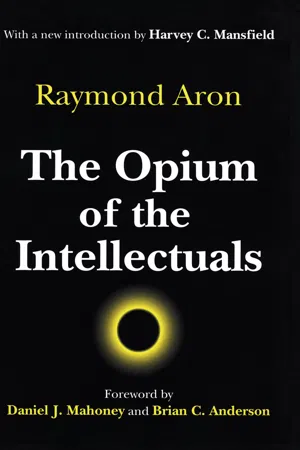
The Opium of the Intellectuals
About this book
Raymond Aron's 1955 masterpiece The Opium of the Intellectuals, is one of the great works of twentieth- century political reflection. Aron shows how noble ideas can slide into the tyranny of "secular religion" and emphasizes how political thought has the profound responsibility of telling the truth about social and political reality-in all its mundane imperfections and tragic complexities.Aron explodes the three "myths" of radical thought: the Left, the Revolution, and the Proletariat. Each of these ideas, Aron shows, are ideological, mystifying rather than illuminating. He also provides a fascinating sociology of intellectual life and a powerful critique of historical determinism in the classically restrained prose for which he is justly famous.For this new edition, prepared by Daniel J. Mahoney and Brian C. Anderson as part of Transaction's ongoing "Aron Project," political scientist Harvey Mansfield provides a luminous introduction that underscores the permanent relevance of Aron's work. The new edition also includes as an appendix "Fanaticism, Prudence, and Faith," a remarkable essay that Aron wrote to defend Opium from its critics and to explain further his view of the proper role of political thinking. The book will be of interest to all students of political theory, history, and sociology.
Information
PART ONE
POLITICAL MYTHS
CHAPTER I
THE MYTH OF THE LEFT
DOES the antithesis of Right and Left still have any meaning? The man who asks this question is immediately suspect. “When I am asked”, Alain once wrote, “if the cleavage between right-wing and left-wing parties, between men of the Right and men of the Left, still has a meaning, the first idea that comes to me is that the questioner is certainly not a man of the Left.” This verdict need not inhibit us, for it betrays an attachment to a prejudice rather than a conviction founded on reason.
The Left, according to Littré, is “the opposition party in French parliaments, the party which sits on the left of the President”. But the word Left has quite a different connotation from the word opposition. Parties alternate in power; the left-wing party stays left-wing, even if it forms the government.
In stressing the significance of the two terms, Right and Left, people do not restrict themselves to the mere statement that the machinery of political forces tends to divide itself into two blocs separated by a centre which is continually being encroached upon. Rather do they infer the existence of two types of men whose attitudes are fundamentally opposed, or two sets of conceptions between which the interminable and unchanging dialogue continues through every vicissitude of institution or terminology, or else two camps engaged in a never-ending struggle. Do these two kinds of men, of ideas, of parties, exist elsewhere than in the imagination of historians deluded by the example of the Dreyfus affair and by a questionable interpretation of electoral sociology?
The different groups which consider themselves left-wing have never in any profound sense been united. From one generation to the next the slogans and programmes change. Has the Left of yesterday, which fought for constitutional government, anything in common with the Left which today asserts its authority in the ‘People’s Democracies’?
The Retrospective Myth
France is generally considered to be the ancestral home of the antagonism between Right and Left. Whereas these terms scarcely figured at all in the political language of England before, the ‘thirties, in France they were naturalised long ago. The Left has such prestige in France that even the conservative and middle-of-the-road parties are at pains to disguise themselves with pseudonyms borrowed from the vocabulary of their enemies. French parties vie with one another in ‘republican’, ‘democratic’ and ‘socialist’ convictions.
Two circumstances, according to the current view, make this antagonism between Right and Left exceptionally grave in France. The first is the religious question. The conception of the world to which the rulers of the Ancien Régime adhered was inspired by the teachings of the Catholic Church. The new outlook which paved the way for the Revolution focused its attack on the principle of absolute authority, including in its condemnation the Church as well as the Monarchy. The party of progress, at the end of the eighteenth century and during the best part of the nineteenth, fought against both throne and altar, inclining to anticlericalism because the ecclesiastical hierachy favoured, or seemed to favour, the party of reaction. In England, where religious freedom was both the occasion and the apparent reward of the Revolution of 1688, the progressive parties bore the stamp of Nonconformist religious fervour rather than of atheistic rationalism.
The transition from the Ancien Régime to modern society was accomplished with unprecedented brutality and suddenness in France. On the other side of the Channel, constitutional government was introduced by stages, representative institutions being developed from the English Parliament whose origins could be traced back to mediaeval custom. In the course of the eighteenth and nineteenth centuries democratic legitimacy took the place of monarchical legitimacy without completely eliminating the latter, and the equality of the citizen before the law eventually blunted the distinctions between the Estates: the ideas which the French Revolution flung tempestuously across Europe—the sovereignty of the people, constitutional government, elected and sovereign assemblies, equality of rights—were realised in England, sometimes even sooner than in France, without any need for the people to rise, with a Promethean gesture, and shake off their chains. The process of ‘democratisation’ in England was the joint achievement of rival parties.
Whether one regards it as grandiose or horrific, as a catastrophe or an epic, the Revolution cuts French history in two. It seems to raise up two Frances, one against the other, the first of which refuses to resign itself to oblivion while the other carries on a relentless crusade against the past. Each of them regards itself as the embodiment of a perennial human type. The one invokes family, authority, religion, the other equality, reason, liberty; on the one side we have respect for order slowly evolving through the centuries; on the other a passionate belief in man’s capacity to reconstruct society according to the data of science: the Right, the party of tradition and of privilege, versus the Left, the party of progress and intellect.
This classic interpretation is not a false one, but it represents exactly half the truth. At every level, the two types of men exist (though not all Frenchmen can be fitted into either category): M. Homais versus M. le Curé, Alain and Jaurès versus Taine and Maurras, Clemenceau versus Foch. In certain circumstances, when the conflict assumes a mainly ideological character—over the education laws, for example, or the Dreyfus affair, or the separation of Church and State—the disparate elements tend to form themselves into two blocs each basing itself on a single orthodoxy. But it has rarely been pointed out that this apparent homogeneity is essentially retrospective and that it does no more than camouflage the inexpiable quarrels and divisions within the alleged blocs. The history of France since 1789 is characterised by the consistent inability of right-wing or left-wing coalitions to stick together and govern. The myth of a single unified Left is an imaginary compensation for the successive revolutionary failures from 1789 to 1848.
Until the consolidation of the Third Republic—apart from the few months between the February Revolution and the street fighting of June 1848—the Left in France in the nineteenth century was in permanent opposition (whence the confusion between Left and Opposition). The Left opposed the Restoration, because it considered itself the heir of the Revolution, which was the source and justification of all its historic claims, its dreams of past glory and its hopes for the future. But this nostalgic, backward-moving Left was actually as complex and equivocal as the tremendous events from which it claimed descent. Its unity was purely mythical. It had never been united between 1789 and 1815 and it was no more so in 1848 when the Republic seized the opportunity of filling the constitutional void left by the collapse of the Orleanist monarchy. The Right, of course, was no more united than the Left. In 1815 the monarchist party was divided between the Ultras, who dreamed of a return to the Ancien Régime, and the Moderates, who were prepared to accept things as they were. The arrival of Louis-Philippe flung the Legitimists into discontented isolation, and even the triumph of Louis-Napoleon failed to bring about a reconciliation between Orleanists and Legitimists in spite of their common hostility to the usurper.
The civil discords of the nineteenth century followed the same pattern as the dramatic events of the revolutionary period. The failure of the constitutional monarchy led to a semi-parliamentary monarchy, the failure of this led to a republic which eventually gave way to a plebiscitary empire. In the same way, Constituants, Feuillants, Girondins and Jacobins had fought each other relentlessly only to give way in the end to a crowned military dictator. These various left-wing groups were not only rivals for the possession of power, they were agreed neither on the form to be given to the government of France, nor on the means to be employed to this end, nor on the extent of the reforms to be introduced. The Monarchists, who wanted to give France a constitution similar to that of England, were in agreement with the egalitarian republicans only in the degree of their hostility to the Ancien Régime.
It is not my intention here to examine the reasons why the Revolution took such a fatal course. Guglielmo Ferrero, in his later years, was fond of pointing out the distinction between the two revolutions—the constructive revolution which aimed at extending the franchise and establishing certain liberties, and the destructive revolution brought about by the collapse of one principle of legitimacy and the absence of a new legitimacy to replace it. The distinction is satisfying to the mind. The constructive revolution corresponds more or less with the changes which we can regard with favour: representative government, social equality, personal and intellectual liberties; while the destructive revolution can be blamed for all the evil consequences: terror, wars, dictatorship and tyranny. One might well imagine the monarchy itself gradually introducing the essentials of what appears to us, looking back, to have been the Revolution’s achievement. But the ideas which inspired the Revolution, without being strictly incompatible with monarchy, shook to its foundations the system of thought on which the French monarchy was based, thus instigating the crisis of legitimacy which brought about the Terror. The fact is, at all events, that the Ancien Régime collapsed at one blow, almost without resistance, and that it took France nearly a century to find another regime acceptable to the majority of the nation.
The social consequences of the Revolution seem obvious and irrevocable from the beginning of the nineteenth century. There could be no question of restoring old privileges, or of going back on the new civil code and the equality of the individual before the law. But the choice between republic and monarchy was still in abeyance. Democratic aspirations were by no means exclusively tied to parliamentary institutions; the Bonapartists suppressed political liberties in the name of democratic ideas. No serious French writer of the time recognised a single Left with a united will, representing all the heirs of the Revolution in opposition to the defenders of the Ancien Régime. The party of progress is an oppositionist myth, which did not even correspond to any electoral reality.
When the Republic was assured of survival, Clemenceau, against all the historical evidence, decreed that “the Revolution is a bloc”. This proposition marked the end of the former quarrels between the various groups of the Left. Democracy was reconciled with parliamentarianism, the principle was finally established that all authority derives from the people, and, this time, universal suffrage encouraged the safeguarding of liberties and not the accession of a tyrant. Liberals and egalitarians, moderates and extremists, no longer had any motive for exterminating one another; the aims which the various parties had assigned themselves were all, at last, simultaneously achieved. The Third Republic, a regime at once constitutional and popular, which guaranteed the legal equality of its citizens by universal suffrage, gave itself a glorious and fictitious ancestor, the ‘bloc’ of the Revolution.
But at the very moment when the consolidation of the Third Republic was putting an end to the internal quarrels of the bourgeois Left, a new schism, which had been latent ever since the Babœuf conspiracy and perhaps since the beginnings of democratic thought, suddenly came to light. The anti-capitalist Left took over from the anti-monarchist Left. Can it be said that this new Left, which demanded public ownership of the means of production and State control of economic activity, was inspired by the same philosophy, or was even aiming at the same objectives, as the old Left which had risen up against absolutism, the privileged orders and the corporate guilds?
Marxism provided the formula which both ensured the continuity and marked the break between the old Left and the new. The Fourth Estate succeeded the Third, the proletariat took over from the bourgeoisie. The latter had thrown off the chains of feudalism, freed the people from the bonds of enforced allegiances, communal, personal or religious. The individual, freed from his former shackles and deprived at the same time of his traditional security, found himself the defenceless victim of the blind mechanism of the market and the whims of the all-powerful capitalists. It was for the new Left, the proletariat, to complete the process of liberation, to restore a human order in the place of laissez-faire economy.
The emphasis on the liberal or on the authoritarian aspects of socialism varied according to different countries, different schools and different circumstances. Some insisted on a total break with the bourgeoisie, others stressed the need for continuity with the Great Revolution. The Social Democrats in pre-1914 Germany displayed a marked indifference towards the strictly political values of democracy and did not disguise their somewhat contemptuous disapproval of the attitude adopted by the French Socialists, who were firm defenders of universal suffrage and parliamentary democracy.
The conflict between bourgeois democracy and socialism in France presents the same antithesis as the former conflicts between the various groups of the bourgeois Left: the more violent it is in reality, the more vehemently it is denied. Up to a fairly recent date, probably up to the Second World War. left-wing intellectuals rarely interpreted Marxism literally to the extent of admitting a radical division between the proletariat on the one hand and all past holders of power, bourgeois democrats included, on the other. The philosophy to which they were naturally inclined to subscribe was that of Jaurès, which combined Marxist elements with an idealistic meta-physic and a preference for reform. The Communist Party made more headway in its Popular Front or Resistance phases than when the class war was in the ascendant. Many Communist voters still persist in regarding the Party as the heir of the Enlightenment—the party which is pursuing the same task as the other left-wing groups, only with more success.
The social history of no other European country is scarred by such tragic episodes as those of June 1848 or the Commune. In 1924 and 1936 Socialists and Radicals triumphed together at the elections, but were incapable of governing together. From the day when the Socialists first joined a governmental coalition, the Communists became the principal working-class party. The periods of left-wing unity such as the alliance of anti-clericals and Socialists at the time of the Dreyfus affair and the fight for the separation of Church and State—crises which decisively influenced the thought of Alain—are less typical than the split between the bourgeoisie and the working class revealed by the outbreaks of 1848, 1871, 1936 and 1945. The ‘unity of the Left’ is less a reflection than a distortion of the reality of French politics.
Because it was incapable of attaining its objectives without twenty-five years of chaos and bloodshed, the party of progress conceived, after the event, a new and over-simplified dichotomy—between good and evil, the future and the past. Because it failed to integrate the working class with the rest of the nation, the bourgeois intelligentsia dreamed of a Left which would include the representatives both of the Third and of the Fourth Estates. This Left was not entirely mythical. Sometimes it presented a united front to the electorate. But just as the revolutionaries of 1789 became united only retrospectively, when the Restoration had thrown Girondins, Jacobins and Bonapartists together into opposition, so the Radicals and the Socialists were genuinely agreed only in their hatred of a vague, impersonal enemy—’reaction’—and in out-of-date battles against clericalism.
Dissociation of Values
Today, especially since the crisis of the ‘thirties, the predominant idea of the Left, the idea which African and Asian students take back home with them from the universities of Europe and the United States, is a kind of watered-down Marxism. Its ideology combines, in a muddled synthesis, public ownership of the means of production, hostility towards the concentrations of economic power known as ‘trusts’, and a profound suspicion of the mechanism of the market. The watchword ‘Keep Left’ means progress, via nationalisation and controls, towards eventual equality of incomes.
In Great Britain this slogan has acquired a certain popularity over the past twenty years or so. Perhaps Marxism, which crystallised some of the aims of anti-capitalism, helped to foster the historic vision of a Left which would embody the cause of the future and eventually take over from capitalism. Perhaps Labour’s victory in 1945 was an expression of the cumulative resentment of a fraction of the underprivileged against the ruling class. The coincidence between the wish for social reform and revolt against a ruling minority creates the situation where the myth of the Left is born and prospers.
On the Continent, the decisive ideological event of the century has been the double schism, splitting the Right as well as the Left, produced by Fascism or National Socialism on the one hand and Communism on the other. In the rest of the world, the decisive event has been the dissociation between the political and the social values of the Left. The appearance of ideological chaos arises from the clash and the confusion between a strictly European schism and the dissociation of European values in societies outside the Western sphere of civilisation.
It is always dangerous to apply terms borrowed from the political vocabulary of the West to the internal conflicts of nations belonging to other spheres of civilisation, even and perhaps especially when the political parties concerned arc at pains to identify themselves with Western ideologies. Removed from their original settings ideologies are liable to develop in a manner diametrically opposed to their original aims and meanings. The same parliamentary institutions can exercise either a progressive or a conservative function according to the social class which introduces and directs them.
When a group of well-meaning officers with a lower middle-class background dissolves a parliament manipulated by Pashas and speeds up the development of national resources, where is the Left and where the Right? Officers who suspend constitutional liberties (in other words, the dictatorship of the sword) cannot in any circumstances be described as left-wing. But the plutocrats who made use of democratic institutions to maintain their privileges are no more worthy of that noble epithet.
In the countries of South America and Eastern Europe, the same combination of authoritarian means and socially progressive ends has often shown itself. In imitation of Europe, parliaments have been created and the vote has been introduced, but the masses have remained illiterate and the middle classes weak: the new liberal institutions have inevitably been monopolised by the ‘feudalists’ or the ‘plutocrats’—the big landowners and their allies in the State machine. Should the dictatorship of Peron, supported by the descamisados and despised by the upper classes, attached both to their privileges and to the parliament they created and controlled, have been regarded as right-wing or left-wing? The political values and the social and economic values of the Left, which are on the way to being finally reconciled in Europe, are still radically dissociated elsewhere.
Moreover, this dissociation is far from having been ignored by political theorists. The Greek philosophers have described the two typical situations...
Table of contents
- Cover Page
- Halftitle Page
- Title Page
- Copyright
- Foreword to the Transaction Edition
- Introduction to the Transaction Edition
- Foreword
- Part One: Political Myths
- Part II: The Idolatry of History
- Part Three: The Alienation of the Intellectuals
- Conclusion: The End of the Ideological Age?
- Appendix
- Index
Trusted by 375,005 students
Access to over 1.5 million titles for a fair monthly price.
Study more efficiently using our study tools.
Frequently asked questions
Yes, you can cancel anytime from the Subscription tab in your account settings on the Perlego website. Your subscription will stay active until the end of your current billing period. Learn how to cancel your subscription
No, books cannot be downloaded as external files, such as PDFs, for use outside of Perlego. However, you can download books within the Perlego app for offline reading on mobile or tablet. Learn how to download books offline
Perlego offers two plans: Essential and Complete
- Essential is ideal for learners and professionals who enjoy exploring a wide range of subjects. Access the Essential Library with 800,000+ trusted titles and best-sellers across business, personal growth, and the humanities. Includes unlimited reading time and Standard Read Aloud voice.
- Complete: Perfect for advanced learners and researchers needing full, unrestricted access. Unlock 1.5M+ books across hundreds of subjects, including academic and specialized titles. The Complete Plan also includes advanced features like Premium Read Aloud and Research Assistant.
We are an online textbook subscription service, where you can get access to an entire online library for less than the price of a single book per month. With over 1.5 million books across 990+ topics, we’ve got you covered! Learn about our mission
Look out for the read-aloud symbol on your next book to see if you can listen to it. The read-aloud tool reads text aloud for you, highlighting the text as it is being read. You can pause it, speed it up and slow it down. Learn more about Read Aloud
Yes! You can use the Perlego app on both iOS and Android devices to read anytime, anywhere — even offline. Perfect for commutes or when you’re on the go.
Please note we cannot support devices running on iOS 13 and Android 7 or earlier. Learn more about using the app
Please note we cannot support devices running on iOS 13 and Android 7 or earlier. Learn more about using the app
Yes, you can access The Opium of the Intellectuals by Raymond Aron in PDF and/or ePUB format, as well as other popular books in Politics & International Relations & Communism, Post-Communism & Socialism. We have over 1.5 million books available in our catalogue for you to explore.