eBook - ePub
Sharing the World
Sustainable Living and Global Equity in the 21st Century
- 224 pages
- English
- ePUB (mobile friendly)
- Available on iOS & Android
eBook - ePub
Sharing the World
Sustainable Living and Global Equity in the 21st Century
About this book
This work proposes a framework based on the concept of a fair distribution of environmental space to include the diverse needs of North and South. Drawing on research in 38 countries, it aims to give an equitable basis for global development in order to achieve sustainable consumption by the year 2050. The environmental space approach seeks to explain the limitations of the global market economy as a tool of development and to give us the means to alter it in order to achieve a genuine quality of life, rather than simple economic growth. In addition, this book seeks to urge all countries and peoples to consider and evaluate the environmental space approach and to join in a movement towards sustainable production and consumption for the 21st century.
CHAPTER 1
A New Approach to Global Development
Introduction
Looking to the new century, and the world we bequeath to our children and grandchildren, there are causes for optimism but also major challenges. On the positive side, globalisation is bringing to the fore a common agenda for sustainable development, balancing economic progress with social and environmental concerns. Exciting partnerships and networks are linking North and South, and innovation is reflected in local action on Agenda 21 and fledgling political commitment at the international level. Action networks are enabled by the communications revolution which breaks down isolation and allows rapid exchanges of information and views. For example, indigenous tribes in the South American rainforest are linked via satellite to health centres and support groups all over the world. They can now campaign for their own, and the global, future. New means of communication could also support the spread of opportunities for lifelong education which can foster, in turn, a trend towards more widespread democratic freedom and personal liberty. Another positive development is triggered by the end of the Cold War -giving relief from polarised political thinking and global alliances. This creates the opportunity to rethink development processes and embed the global market economy in a social context, so that we can secure its positive benefits without so many of the negative impacts.
On the other side of the coin, the challenges include the long-term damage to the planet caused by pollution; the ecological and cultural dislocations caused by an infatuation with material goods in wealthy countries and enclaves; and the impacts of poverty and unemployment, which flow through generations.
The challenges are complicated by a number of factors. Firstly, the production and consumption processes which underpin the highly attractive global consumer lifestyle are unsustainable. They are taking us past critical thresholds in the planet’s ability to absorb waste and pollution, and in the use of scarce resources, including the air itself. Secondly, there is an unequal distribution of the benefits of industrialisation compared to the costs. Most of the benefits accrue to a small number of wealthy nations, which are vastly overconsuming the planet’s resources when assessed on a per capita basis. Conversely, a disproportionate amount of the costs are borne by people and countries which do not share the benefits. This serious imbalance, roughly along North-South lines, is foreclosing future development opportunities for Southern countries. It also means that current favoured models of national development fail to provide realistic guidance for the next century.
Although the inequality caused by overconsumption is glaring and morally unjustifiable, the intent of the overconsumers is hardly malicious. The short-term benefits of consumerism are many, and its lure is powerful and seductive. Many people in lower income countries would like nothing better than to emulate the lifestyles common in the advanced industrial economies. Overconsumption is part of a process of modernisation in which most of humankind would willingly participate. Progress towards sustainability is also hampered by the tendency of governments and political and business leaders to take a short-term, rather than a much needed long-term view of the relationship between people and the planet. And our approach to managing the human-environment interaction is also short-term, being mainly too little, too late.
The underlying problem is that, however much we talk about sustainable development, the sheer volumes of resource consumption and pollution embodied in our ever-expanding consumer lifestyles means that these problems are out of control. They cannot be resolved without major changes in the efficiency of production and consumption systems to reduce their material intensiveness, coupled to fundamental changes in the values that underpin consumerism. Because these challenges affect the prospect of everyone on Earth and their descendants, they cannot be resolved except by a common global effort linking North and South, East and West.
In spite of the magnitude of the challenge, this book argues that it is well within human competence to achieve harmonious, sustainable development by the year 2050. We propose a practical, gradual approach to fundamentally alter industrial processes and the values that drive consumption, so that the world shifts to clean, sustainable and satisfying modes of living within the boundaries of what we call environmental space. The rest of this introductory chapter examines the challenges of development to be overcome and introduces the concept of environmental space.
The Poisonous Legacy of Our Industrial Age
A first challenge is the restoration of ecological balance, globally and locally. This has been disturbed by industrial pollution, and by a dramatic rise in consumption of global resources, such as the decimation of the world’s fish stocks, the cutting of one fifth of the world’s forests and the exhaustion of underground freshwater supplies. About 40 per cent of natural ecosystems are biologically degraded. The atmosphere itself is under threat from global warming, which can no longer be denied or ignored. Coastal regions, polar ice and island states may disappear, as could their ecosystems, plants and animals, such as the polar bear, walrus and the narwhal. Ozone holes in both hemispheres continue to grow, making it increasingly dangerous for humans to venture into the sunshine without protection in countries such as Canada, the USA, Australia and Argentina.
Concern for climate change extends to global change, which means that pollution and resource consumption, such as deforestation, are negatively affecting fundamental interactions between the earth’s atmosphere, biosphere and oceans. There is also disturbing evidence of the endemic effects of the more than 50,000 industrial chemicals in everyday use – for example, organochlorines which disrupt human hormone systems and damage human fertility. Urban air pollution has a growing impact on health in the huge city regions emerging around the world, and even retards agricultural production in rural areas. Dangerous chemicals and pollutants are now found in every part of the planet, including in the peoples and landscape of the Arctic at high concentrations. In each case, safe thresholds are being exceeded which define the planet’s and our bodies’ abilities to absorb pollution.
Figure 1.1
Yo! Amigo!!
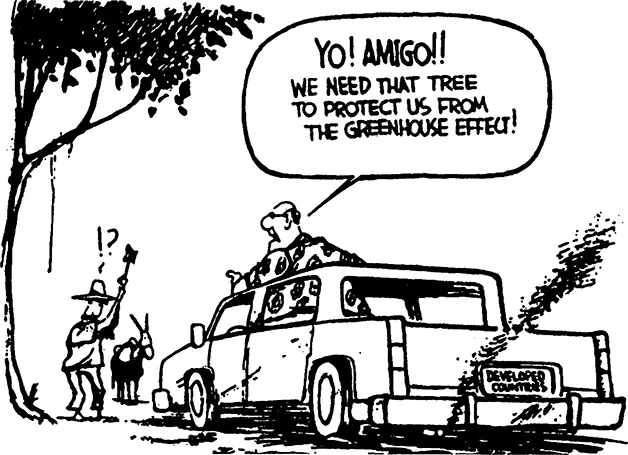
The Challenge of Too Much in the Wealthy Countries
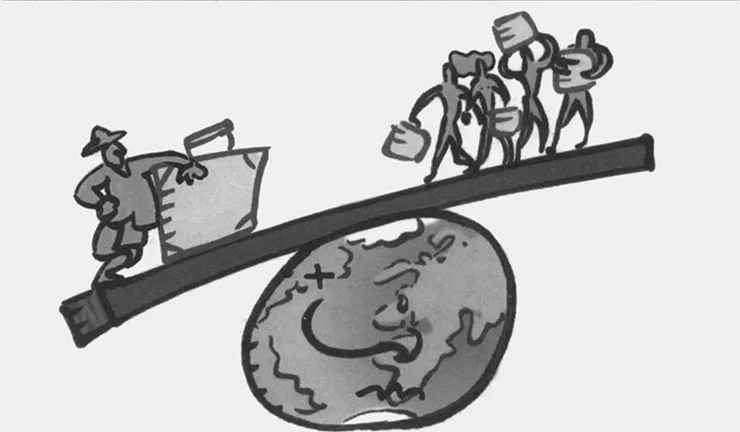
The related challenge is the overconsumption which characterises the Western consumer lifestyle. This way of life has caused consumption since 1950 to equal that of all previous human history. This causes two problems. Firstly, much of the damage to the planet’s global commons is the result of consumption by the consumer societies of the developed countries. For example, the 20 per cent of the world’s population which lives in the richest countries have generated almost three-quarters of the cumulative carbon dioxide emissions which are a primary cause of global warming. Many other global resources, from metals to timber, are consumed in about the same proportion, with a fifth of the world’s population consuming four-fifths of all resources consumed annually, many of which are non-renewable. On a global basis, overconsumption by some countries means a reduced resource base for the development of others. The gap between the world’s rich and poor is constantly widening with the richest one fifth now having 85 per cent of the world’s income. This is the result of a development model which overvalues economic growth without considering the social and environmental impacts. It is no longer obvious that the benefits of high consumption outweigh the costs – not even to the high consumers themselves who are fouling their own nests. These high rates of unsustainable consumption are overwhelming the modest ecoefficiency savings being achieved by methods such as recycling.
Figure 1.2
Current patterns of global resource consumption are unsustainable – ecologically and socially
Secondly, within these consumer societies many people feel they are locked into a dispiriting and stressful cycle of work and spend, to ‘keep up with the Joneses’. This emphasis on material goods to give meaning to life diminishes the quality of family and community life and erodes traditional cultural values. An incipient movement against overconsumption has been started in the USA, called ‘downshifting’ to a saner, less materialistic lifestyle. However, overconsumption in the wealthy countries is taking place even while around 100 million people in those countries are marginalised by poverty, unemployment and low pay. Poverty damages family life and the prospects of children and can destabilise communities by fostering crime and violence. An emphasis in industry on substituting technology for people, making unemployment endemic, means that much economic growth has become jobless growth. During the 1980s, 35 million people in the wealthy countries suffered unemployment, but even this enormous sum is small compared with the problems of lack of employment and household income in the poor countries of the world. Even where employment appears to be created by economic growth, the quality of the employment is changing. In advanced economies there is less opportunity for full-time, permanent work and increasing emphasis on short-term, part-time work to reduce employers’ wage bills. This insecurity of income contributes to family stress, and the result can be an underclass of working poor.
The Challenge of the World’s Poor
A third vital challenge is to alleviate poverty in the low-income countries, as well as in the industrialised countries. In 2010 there will still be more than 800 million chronically undernourished people in the developing world while, perversely, obesity causing ill-health is becoming endemic in the wealthy countries. Poverty is both a cause and effect of environmental degradation. It is indicated by lack of basic needs such as food, water, shelter and access to primary education and health services. Absolute poverty is incompatible with sustainable development, which seeks to balance economic, social and environmental goals. As Svend Auken, the Danish Minister for Environment and Energy, says: ‘Wealth creates overconsumption, but poverty also destroys nature due to the fact that too many have too little to share.’ The grinding effects of poverty extend even to many people in work in the developing world, such as child labourers in Asian factories earning ten cents an hour making sporting goods, or in the maquiladoras in Mexico – foreign-owned factories where workers assemble consumer goods for Northern markets for poverty level wages. On a global scale, the problems of insufficient income extend to about one fifth of the world’s population, a growing number of which are concentrated in the exploding megacities of ten million persons or more in the developing world.
It is essential to avoid a two-track global economy in which only industrialised countries and a small number of newly industrialising countries sustain widespread technological and economic progress. This could marginalise the development potential of the majority of countries in Africa, Asia and Latin America by making it difficult for them to access the resources needed for development.
The Challenge of a Development Leapfrog by the NICs
Following dramatic economic growth in Asia’s export-led tiger economies, we are now likely to see the emergence of another round of newly industrialised economies, or NICs, in key countries in Asia and South America. In countries such as China and India, growth can be based on the vast size of the internal market. Including China and India, these NICs will encompass more than a third of the world’s population. Economic growth in these countries is obviously a key to the vital amelioration of poverty and to a broader opportunity to enjoy the fruits of the global economy.
Nevertheless, the major challenge is for the NICs to realise their legitimate aspirations for development in a way which does not cause yet more ecological destruction. As in the North, many material benefits will flow from industrialisation, including the meeting of basic needs and the provision of necessary infrastructure. But careful management of the process is important to avoid ecological damage, and the social and cultural dislocations of overconsumption. If the NICs go down the same highly polluting route to industrialisation as the Northern countries, ecological imbalances will pass critical thresholds even more quickly. The massive forest fires and air pollution over South East Asia in 1997 may be an example. The rainforest was being cleared for the planting of wood pulp, palm oil and rubber plantations – much of this for Northern consumption. In spite of this, NICs are suspicious of the agenda of sustainable development, which they fear is a ploy to protect Northern markets by slowing their well-earned rush to industrialisation. Given that Northern lifestyles caused many of the world’s environmental problems, the NICs feel that the North has no moral authority to deny them the opportunity to make full use of their natural resource base, just as the North does.
Similar opportunities and risks beckon in the transition economies of Central and Eastern Europe, including Russia. On the one hand, they use resources inefficiently and are heavily polluted; on the other they are among the world’s richest sources of biodiversity. In their cities, they have excellent public transport systems and low levels of car use. But they are being encouraged to rush into the unsustainable Western development model, in part because the ideal of democracy has been confused with an unleashed and unregulated winner-take-all market economy.
Figure 1.3
Equi...
Table of contents
- Cover Page
- Title Page
- Copyright Page
- Contents
- List of Figures, Tables, Boxes and Guest Essays
- List of Acronyms and Abbreviations
- Preface
- 1 A New Approach to Global Development
- 2 The Global Commons: Wild Frontier to Full World
- 3 Managing the Global Commons – North and South, One World?
- 4 Fair Shares in Environmental Space – Basic Principles
- 5 Assessing a Fair Share in Environmental Space
- 6 Eco-Innovation: More from Less
- 7 Sufficiency: Rethinking the Consumer Society
- 8 Sustainable Production and Consumption – Towards a Global Framework
- Appendix A: List of National Studies and Other Publications of the Sustainable Europe Campaign
- Appendix B: Contact Points for Sustainable Europe Campaign and the North-South Project Participating Organisations
- Index
Trusted by 375,005 students
Access to over 1.5 million titles for a fair monthly price.
Study more efficiently using our study tools.
Frequently asked questions
Yes, you can cancel anytime from the Subscription tab in your account settings on the Perlego website. Your subscription will stay active until the end of your current billing period. Learn how to cancel your subscription
No, books cannot be downloaded as external files, such as PDFs, for use outside of Perlego. However, you can download books within the Perlego app for offline reading on mobile or tablet. Learn how to download books offline
Perlego offers two plans: Essential and Complete
- Essential is ideal for learners and professionals who enjoy exploring a wide range of subjects. Access the Essential Library with 800,000+ trusted titles and best-sellers across business, personal growth, and the humanities. Includes unlimited reading time and Standard Read Aloud voice.
- Complete: Perfect for advanced learners and researchers needing full, unrestricted access. Unlock 1.5M+ books across hundreds of subjects, including academic and specialized titles. The Complete Plan also includes advanced features like Premium Read Aloud and Research Assistant.
We are an online textbook subscription service, where you can get access to an entire online library for less than the price of a single book per month. With over 1.5 million books across 990+ topics, we’ve got you covered! Learn about our mission
Look out for the read-aloud symbol on your next book to see if you can listen to it. The read-aloud tool reads text aloud for you, highlighting the text as it is being read. You can pause it, speed it up and slow it down. Learn more about Read Aloud
Yes! You can use the Perlego app on both iOS and Android devices to read anytime, anywhere — even offline. Perfect for commutes or when you’re on the go.
Please note we cannot support devices running on iOS 13 and Android 7 or earlier. Learn more about using the app
Please note we cannot support devices running on iOS 13 and Android 7 or earlier. Learn more about using the app
Yes, you can access Sharing the World by Michael Carley,Phillipe Spapens in PDF and/or ePUB format, as well as other popular books in Economics & Development Economics. We have over 1.5 million books available in our catalogue for you to explore.