- 368 pages
- English
- ePUB (mobile friendly)
- Available on iOS & Android
eBook - ePub
About this book
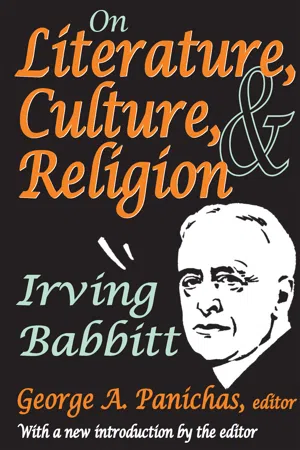
Irving Babbitt was a giant of American criticism. His writings from the 1890s to the 1930s helped advance American criticism and scholarship to international esteem. More than seventy years after his death his intellectual staying power remains undiminished. On Literature, Culture, and Religion is an ideal introduction to this seminal American thinker.Babbitt's opinions were uncompromising, and his vocal allies and opponents included almost every name in American literature and scholarship: T. S. Eliot, Edmund Wilson, Paul Elmer More, H. L. Mencken, and Sinclair Lewis. A founder of New Humanism, Babbitt was best known for his indictment of Romanticism and his insistence that the modern age had gone wrong. Babbitt argued for a renewal of humanistic values and standards--which he found best articulated in classical Greece, Hinduism, and Buddhism. The selections cover topics central to Babbitt: criticism, Romanti-cism, classical literature, French literature, education, democracy, and Buddhism. They typify Babbitt's method: recondite allusion, penetrating insight and analysis, impeccable scholarship, and unrelenting pursuit of the furthest ramification and the profoundest implication. The original annotation is retained. Brief introductions to the essays place them in the Babbitt canon.A major introductory essay by George A. Panichas surveys Babbitt's career and critical reception and summarizes the concepts that inform Babbitt's writing. Panichas raises again controversial issues that were not really resolved in Babbitt's time. The essay will challenge those long familiar with Babbitt and New Humanism and those newly introduced thereto.
Information
Part I
Outlook and Overview
What I Believe
In this creedal statement Babbitt summarizes the principles of the New Humanism. He sets the tone of his indictment of the two main forms of naturalism: the scientific and utilitarian and the emotional. He also reveals his critical style and vision. In Baconian and Rous-seauistic ideas he sees the radical sources, the errors, of a modern humanitarianism exalting the materialistic, especially in the assumption that man is naturally good. This assumption, Babbitt claims, undermines the humanistic tradition going back to ancient Greece. Standards that create human significance and a principle of unity that measures manifoldness and change surrender to vital impulse (élan vital). The elimination of the will to refrain (frein vital), that is, the “veto power” or “inner check,” leads to “free temperamental overflow “ and denies the higher will, by which man is a moral agent. Babbitt insists upon moderation, common sense, and common decency, which he associates with a positive, critical humanism and, hence, with the spirit of the gentleman and the spirit of religion. In opposing the modern movement, Babbitt singles out Rousseau: “To debate Rousseau is really to debate the main issues of our contemporary life in literature, politics, education, and, above all, religion. “ (From Spanish Character and Other Essays, ed. Frederick Manchester, Rachel Giese, and William F. Giese [Boston and New York: Houghton Mifflin Co., 1940], pp. 225-47, under title “What I Believe: Rousseau and Religion”; originally printed in the Forum 83 [1930]:80-87, as “What I Believe. “)
I
Rousseau is commonly accounted the most influential writer of the past two hundred years. Lord Acton, indeed, is reported to have said, with a touch of exaggeration, that “Rousseau produced more effect with his pen than Aristotle or Cicero or Saint Augustine or Saint Thomas Aquinas or any other man who ever lived.” At all events this saying needs to be interpreted in the light of the saying of Madame de Staël that “Rousseau invented nothing but set everything on fire.” His leading ideas were abundantly anticipated, especially in England. These ideas made their chief appeal to a middle class which, in the eighteenth century, was gaining rapidly in power and prestige, and has been dominant ever since.
The Rousseauistic outlook on life has also persisted, with many surface modifications, to be sure, but without any serious questioning on the part of most men of its underlying assumptions. To debate Rousseau is really to debate the main issues of our contemporary life in literature, politics, education, and, above all, religion. It is not surprising, therefore, that his reputation and writings have from the outset to the present day been a sort of international battleground. One cannot afford to be merely partisan in this strife, to be blind to Rousseau’s numerous merits—for example, to all he did to quicken man’s sense of the beauties of nature, especially wild nature. Neither should one forget that there is involved in all the strife a central issue toward which one must finally assume a clear-cut attitude.
Regarding this central issue—the source of the fundamental clash between Rousseauist and anti-Rousseauist— there has been and continues to be much confusion. A chief source of this confusion has been the fact that in Rousseau as in other great writers, and more than in most, there are elements that run counter to the main tendency. Rousseau has, for example, his rationalistic side. On the basis of this fact one professor of French has just set out to prove that, instead of being the arch-sentimentalist he has usually been taken to be, “the real Rousseau is at bottom a rationalist in his ethics, politics, and theology.”
Again, there are utterances in Rousseau quite in line with traditional morality. Another American scholar has therefore set out to show that it is a mistake to make Rousseau responsible for a revolution in ethics. Still another of our scholars has managed to convince himself on similar lines that Rousseau is not primarily a primitivist in his Discourse on Inequality.
Most remarkable of all is a book that has just appeared, the author of which covers with contumely practically all his predecessors in this field on the ground that they have been blinded by partisanship, and promises to give us at last the true meaning of Rousseau. Yet this writer does not even cite the passage that, as Rousseau himself correctly tells us, gives the key to his major writings. It is to this passage that every interpreter of Rousseau who is not academic in the bad sense will give prominence: for the thesis it sums up has actually wrought mightily upon the world. It has thus wrought because it has behind it an imaginative and emotional drive not found behind other passages of Rousseau that might in themselves have served to correct it.
The passage to which I refer is one that occurs in Rousseau’s account of the sudden vision that came to him by the roadside on a hot summer day in 1749 in the course of a walk from Paris to Vincennes. This vision has an importance for the main modern movement comparable to that of Saint Paul’s vision on the road to Damascus for the future development of Christianity. Among the multitude of “truths” that flashed upon Rousseau in the sort of trance into which he was rapt at this moment, the truth of overshadowing importance was, in his own words, that “man is naturally good and that it is by our institutions alone that men become wicked.”
The consequences that have flowed from this new “myth” of man’s natural goodness have been almost incalculable. Its first effect was to discredit the theological view of human nature, with its insistence that man has fallen, not from Nature as Rousseau asserts, but from God, and that the chief virtue it behooves man to cultivate in this fallen state is humility. According to the Christian, the true opposition between good and evil is in the heart of the individual: the law of the spirit can scarcely prevail, he holds, over the law of the members without a greater or lesser degree of succor in the form of divine grace. The new dualism which Rousseau sets up—that between man naturally good and his institutions—has tended not only to substitute sociology for theology, but to discredit the older dualism in any form whatsoever.
Practically, the warfare of the Rousseauistic crusader has been even less against institutions than against those who control and administer them—kings and priests in the earlier stages of the movement, capitalists in our own day. “We are approaching,” Rousseau declared, “the era of crises, and the age of revolutions.” He not only made the prophecy but did more than any other one man to insure its fulfillment. There are conservative and even timid elements in his writings; but as a result of the superior imaginative appeal of the new dualism based on the myth of man’s natural goodness, the rôle he has actually played has been that of arch-radical. In one of the best-balanced estimates that have appeared, the French critic Gustave Lanson, after doing justice to the various minor trends in Rousseau’s work, sums up accurately its major influence: “It exasperates and inspires revolt and fires enthusiasms and irritates hatreds; it is the mother of violence, the source of all that is uncompromising; it launches the simple souls who give themselves up to its strange virtue upon the desperate quest of the absolute, an absolute to be realized now by anarchy and now by social despotism.”
I have said that there has been in connection with this Rousseauistic influence a steady yielding of the theological to the sociological or, as it may also be termed, the humanitarian view of life. One should add that there enters into the total philosophy of humanitarianism an ingredient that antedates Rousseau and that may be defined as utilitarian. Utilitarianism already had its prophet in Francis Bacon. Very diverse elements enter into the writings of Bacon as into those of Rousseau, but, like those of Rousseau, they have a central drive: they always have encouraged and, one may safely say, always will encourage the substitution of a kingdom of man for the traditional Kingdom of God—the exaltation of material over spiritual “comfort,” the glorification of man’s increasing control over the forces of nature under the name of progress.
Rousseauist and Baconian, though often superficially at odds with one another, have co-operated in undermining, not merely religious tradition, but another tradition which in the Occident goes back finally, not to Judea, but to ancient Greece. This older tradition may be defined as humanistic. The goal of the humanist is poised and proportionate living. This he hopes to accomplish by observing the law of measure. Anyone who has bridged successfully the gap between this general precept and some specific emergency has to that extent achieved the fitting and the decorous. Decorum is supreme for the humanist even as humility takes precedence over all other virtues in the eyes of the Christian. Traditionally the idea of decorum has been associated, often with a considerable admixture of mere formalism, with the idea of the gentleman. Humanism and religion in their various forms have at times conflicted, but have more often been in alliance with one another. As Burke says in a well-known passage: “Nothing is more certain than that our manners, our civilization, and all the good things that are connected with manners and with civilization, have, in this European world of ours, depended for ages upon two principles; and were indeed the result of both combined; I mean the spirit of a gentleman and the spirit of religion.”
II
All the points of view I have been distinguishing—Baconian, Rousseauist, Christian, humanistic—often mingle confusedly. From all the confusion, however, there finally emerges a clear-cut issue—namely, whether humanitarianism, or, if one prefers, the utilitarian-sentimental movement, has supplied any effective equivalent for Burke’s two principles. As for the “spirit of a gentleman,” its decline is so obvious as scarcely to admit of argument. It has even been maintained that in America, the country in which the collapse of traditional standards has been most complete, the gentleman is at a positive disadvantage in the world of practical affairs; he is likely to get on more quickly if he assumes the “mucker pose.” According to William James, usually taken to be the representative American philosopher, the very idea of the gentleman has about it something slightly satanic. “The prince of darkness,” says James, “may be a gentleman, as we are told he is, but, whatever the God of earth and heaven is, he can surely be no gentleman.”
As to the spirit of religion, though its decline has in my opinion been at least as great as that of the spirit of a gentleman, it is far from being so obvious. In any case, everything in our modern substitutes for religion—whether Baconian or Rousseauistic—will be found to converge upon the idea of service. The crucial question is whether one is safe in assuming that the immense machinery of power that has resulted from activity of the utilitarian type can be made, on anything like present lines, to serve disinterested ends; whether it will not rather minister to the egoistic aims either of national groups or of individuals.
One’s answer to this question will depend on one’s view of the Rousseauistic theory of brotherhood. It is at this point, if anywhere, that the whole movement is pseudo-religious. I can give only in barest outline the reasons for my own conviction that it is pseudo-religious. It can be shown that the nature from which man has fallen, according to Rousseau, does not correspond to anything real, but is a projection of the idyllic imagination. To assert that man in a state of nature, or some similar state thus projected, is good, is to discredit the traditional controls in the actual world. Humility, conversion, decorum—all go by the board in favor of free temperamental overflow. Does man thus emancipated exude spontaneously an affection for his fellows that will be an effective counterpoise to the sheer expansion of his egoistic impulses? If so, one may safely side with all the altruists from the Third Earl of Shaftesbury to John Dewey. One may then assume that there has been no vital omission in the passage from the service of God to the service of man, from salvation by divine grace to salvation by the grace of nature.
Unfortunately, the facts have persistently refused to conform to humanitarian theory. There has been an ever-growing body of evidence from the eighteenth century to the Great War that in the natural man, as he exists in the real world and not in some romantic dreamland, the will to power is, on the whole, more than a match for the will to service. To be sure, many remain unconvinced by this evidence. Stubborn facts, it has been rightly remarked, are as nothing compared with a stubborn theory. Altruistic theory is likely to prove peculiarly stubborn, because, probably more than any other theory ever conceived, it is flattering: it holds out the hope of the highest spiritual benefits—for example, peace and fraternal union— without any corresponding spiritual effort.
If we conclude that humanitarian service cannot take the place of the spirit of religion and that of a gentleman—Burke’s “two principles”—what then? One should at least be able to understand the point of view of those who simply reject the modern movement and revert to a more or less purely traditionalist attitude. Dogmatic and revealed Christianity, they hold, has in it a supernatural element for which altruism is no equivalent. Religion of this type, they argue, alone availed to save the ancient world from a decadent naturalism; it alone can cope with a similar situation that confronts the world today.
But does it follow, because one’s choice between the religious-humanistic and the utilitarian-sentimental view of life should, as I have said, be clear-cut, one is therefore forced to choose between being a pure traditionalist or a mere modernist? At bottom the issue involved is that of individualism. The Roman Catholic, the typical traditionalist, has in matters religious simply repudiated individualism. In this domain at least, he submits to an authority that is “anterior, superior, and exterior” to the individual. The opposite case is that of the man who has emancipated himself from outer authority in the name of the critical spirit (which will be found to be identical with the modern spirit), but has made use of his emancipation, not to work out standards, but to fall into sheer spiritual anarchy. Anyone, on the other hand, who worked out standards critically would be a sound individualist and at the same time a thoroughgoing modern. He would run the risk, to be sure, of antagonizing both traditionalists and modernists; of suffering, in short, the fate of Mr. Pickwick when he intervened between the two angry combatants. This hostility, at least so far as the traditionalist is concerned, would seem to be ill-advised. The true modern, as I am seeking to define him, is prepared to go no small distance with him in the defense of tradition.
At all events, anyone who seeks to deal in modern fashion—in other words, critically—with the religious problem, will be brought back at once to Rousseau. He will have to make his clear-cut choice, not between dogmatic and revealed religion, on the one hand, and mere modernism, on the other, but between a dualism that affirms a struggle between good and evil in the heart of the individual and a dualism which, like that of Rousseau, transfers the struggle to society.
Let us ask ourselves what it is the modern man has tended to lose with the decline of the older dualism. According to Mr. Walter Lippmann, the belief the modern man has lost is “that there is an immortal essence presiding like a king over his appetites.” This immortal essence of which Mr. Lippmann speaks is, judged experimentally and by its fruits, a higher will. But why leave the affirmation of such a will to the pure traditionalist? Why not affirm it first of all as a psychological fact, one of the immediate data of consciousness, a perception so primordial that, compared with it, the denial of man’s moral freedom by the determinist is only a metaphysical dream? The way would thus be open for a swift flanking movement on the behaviorists and other naturalistic psychologists, who are to be accounted at present among the chief enemies of human nature.
This transcendent quality of will—which is the source of humility and is, at the same time, immediate and intuitive— has often been associated traditionally with the operation of God’s will in the form of grace. For this higher immediacy, Rousseau—at least the Rousseau who has influenced the world—tended to substitute the lower immediacy of feeling, thus setting up a sort of sub-rational parody of grace. In order to make this substitution plausible, he—and, in his wake, the sentimentalists—have resorted to the usual arts of the sophist, chief among which are a juggling with half-truths and a tampering with general terms. For example, in their use of words like “virtue” and “conscience,” they have eliminated more or less completely, in favor of vital impulse (élan vital), the equally vital principle of control (frein vital)—in short, the dualistic element that both religion and humanism require.
The half-truth that has been used to compromise religion in particular is that, though religion is in itself something quite distinct from emotion, it is in its ordinary manifestations very much mixed up with emotion. I give an example of this error in its latest and fashionable form. In a very learned and, in some respects, able book, the Reverend N. P. Williams seeks to show that Saint Augustine’s experience of grace or, what amounts to the same thing, his love of God, was only a “sublimation” of his “lust.” Saint Augustine was a very passionate man and his passionateness no doubt entered into his love of God. But if it could be shown that the love of God was in Saint Augustine or any other of the major saints merely emotion, sublimated or unsublimated, religion would be only the “illusion” that Freud himself has declared it to be. The psychoanalytical divine, who is, I am told, a fairly frequent type in England, is about the worst mélange des genres that has appeared even in the present age of confusion.
Another example of prevailing misapprehensions in this field, and that not merely from the point of view of dogma but of keen psychological observation, is the standard treatment of Rousseau’s religion by P. M. Masson, a work which has been almost universally acclaimed by scholars and which has, as a matter of fact, distinguished merits as a historical investigation. M. Masson admits that this religion is “without redemption or repentance or sense of sin,” and then proceeds to speak of Rousseau’s “profound Christianity”!
Religion has suffered not only from the Rousseauist but also from the pseudo-scientist. If the Rousseauist gives to emotion a primacy that does not belong to it, the pseudo-scientist claims for physical science a hegemony to which it is not entitled. A science that has thus aspired out of its due place runs the risk of becoming not only a “wild Pallas from the brain” but, in connection with its use in war, “procuress to the Lords of Hell.” Mr. Walter Lippmann seeks to persuade us in his Preface to Morals that if one becomes “disinterested” after the fashion of the scientific investigator, one will have the equivalent not only of “humanism” but of “high religion.” Certain scientific investigators are busy in their laboratories at this very moment devising poison gases of formidable potency. What proof is there that, so far as the scientific type of “disinterestedness” is concerned, these gases will not be pressed into the service of the will to power? In seeking to base ethics on monistic postulates, Mr. Lippmann has simply revived the error of Spinoza, who himself revived the error of the Stoics. This error becomes not less but more dangerous when associated with the methods of science. The question involved is at all events that of the will and finally of dualism. One cannot insist too often that “the immortal essence presiding like a king over man’s appetites” is transcendent—in other words, set above “nature,” not only in Rousseau’s sense, but also in the sense that is given to the term by the man of science.
This higher will is felt in its relation to the impressions and impulses and expansive desires of the natural man as a will to refrain. In the great traditional religions, notably in Christianity and Buddhism, the will to refrain has been pushed to the point of renunciation. The modern movement, on the other hand, has been marked since the eighteenth century and in some respects since the Renaissance by a growing discredit of the will to refrain. The very word ‘’renunciation’’ has been rarely pronounced by those who have entered into the movement. The chief exception that occurs to one is Goethe (echoed at times by Carlyle). Anyone who thinks of the series of Goethe’s love affairs prolonged into the seventies is scarcely likely to maintain that his Entsagung was of a very austere character even for the man of the world, not to speak of the saint.
III
One must admit that genuine renunciation was none too common even in the ages of faith. As for the typical modern, he...
Table of contents
- Cover Page
- Title Page
- Copyright Page
- Contents
- Introduction to the Transaction Edition
- Introduction
- Part I Outlook and Overview
- Part II The Life of Literature
- Part III Ideas and the World
- Reference Notes
- Bibliography
- Acknowledgments
- Index
Trusted by 375,005 students
Access to over 1.5 million titles for a fair monthly price.
Study more efficiently using our study tools.
Frequently asked questions
Yes, you can cancel anytime from the Subscription tab in your account settings on the Perlego website. Your subscription will stay active until the end of your current billing period. Learn how to cancel your subscription
No, books cannot be downloaded as external files, such as PDFs, for use outside of Perlego. However, you can download books within the Perlego app for offline reading on mobile or tablet. Learn how to download books offline
Perlego offers two plans: Essential and Complete
- Essential is ideal for learners and professionals who enjoy exploring a wide range of subjects. Access the Essential Library with 800,000+ trusted titles and best-sellers across business, personal growth, and the humanities. Includes unlimited reading time and Standard Read Aloud voice.
- Complete: Perfect for advanced learners and researchers needing full, unrestricted access. Unlock 1.5M+ books across hundreds of subjects, including academic and specialized titles. The Complete Plan also includes advanced features like Premium Read Aloud and Research Assistant.
We are an online textbook subscription service, where you can get access to an entire online library for less than the price of a single book per month. With over 1.5 million books across 990+ topics, we’ve got you covered! Learn about our mission
Look out for the read-aloud symbol on your next book to see if you can listen to it. The read-aloud tool reads text aloud for you, highlighting the text as it is being read. You can pause it, speed it up and slow it down. Learn more about Read Aloud
Yes! You can use the Perlego app on both iOS and Android devices to read anytime, anywhere — even offline. Perfect for commutes or when you’re on the go.
Please note we cannot support devices running on iOS 13 and Android 7 or earlier. Learn more about using the app
Please note we cannot support devices running on iOS 13 and Android 7 or earlier. Learn more about using the app
Yes, you can access On Literature, Culture, and Religion by Irving Babbitt in PDF and/or ePUB format, as well as other popular books in Literature & Literary Criticism for Comparative Literature. We have over 1.5 million books available in our catalogue for you to explore.