![]()
Introduction
The transport of radioactive materials is totally safe. At least that is the view of the nuclear industry and the government. According to the International Atomic Energy Agency (IAEA) “In more than 40 years of experience, there have been no known deaths or injuries due to the radioactive nature of (the) material being transported…”.1 Another reassurance, from an advisory committee set up by the Department of Transport, goes even further: “…there has been no known damage to the health of anyone due to the transport of radioactive materials…”.2
And yet despite this record of apparent perfection, the movement of various kinds of radioactive material – from nuclear warheads to nuclear waste – has generated anxiety, criticism and outright opposition, including demonstrations against various targets:
| • 1984 | French protestors try to prevent a consignment of plutonium sailing to Japan. |
| • 1985 | Uranium exports sailing from Darwin, Australia, are held up by anti-nuclear activists. |
| • 1988 | Liverpool dockers refuse to handle cylinders of uranium hexafluoride (a uranium compound from which nuclear fuel is made) on their way to the United States. |
| • 1989 | CND groups on south Humberside demonstrate at the offices of Exxtor, a shipping company which transported nuclear fuel materials across the North Sea. |
| • 1990 | Swiss demonstrators chain themselves to railway lines at Goesgen nuclear power station, to prevent a flask of irradiated nuclear fuel departing for Sellafield. |
To those in the nuclear industry, it must sometimes seem that the mere sight of a radiation symbol on the move is guaranteed to provoke hostility from the public and from environmental groups, local authorities and the press. Travelling around on our roads and railways, in the air and over the sea, are nuclear materials of the sort that vaporised Hiroshima and Nagasaki or fuelled the fated reactors at Chernobyl and Three Mile Island. As other aspects of the industry have proved controversial, it would be surprising indeed if the movement of its raw materials had not also attracted criticism.
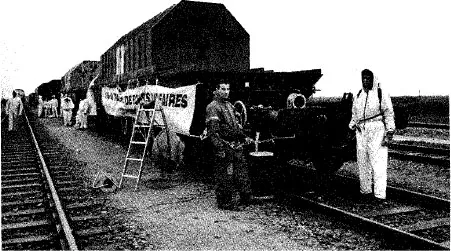
Demonstrators in Dunkerque protest against spent fuel deliveries to Sellafield. These Castor flasks were transporting spent fuel from Germany.
Yet the transport side of the industry is one area where there has not – as far as is publicly known – been a major disaster. The industry will point to the various regulations which control the transport of radioactive materials. The International Atomic Energy Agency (IAEA) provides model regulations, adopted by national governments including Britain, which, for example, recommend approval tests to verify the integrity of the various packages, containers and flasks and specify limits for radiation emissions in transit. Containers used for the most dangerous materials, such as spent fuel, must survive drop tests from a height of 9 metres and an 800°C fire for at least half an hour. In the industry’s view, the regulatory framework and its own good practice have ensured an exemplary record.
But if that is the case, why do shipments of materials like uranium and plutonium attract such a fuss? Is it a gut reaction against all things nuclear, or do movements of radioactive materials pose more of a threat than the industry is prepared to admit? Alternatively, are protests against such movements simply a tactical ploy by anti-nuclear campaigners to hinder the activities of the industry in an area where it is vulnerable to disruption?
Undoubtedly, public anxiety about radiation provides one explanation. All radioactive substances are potentially hazardous and must be transported in flasks, containers or some other type of package designed to prevent their contents escaping to the environment: not without reason must they be labelled with radiation warning symbols (with the exception of some items with extremely low levels of radioactivity). Questions of health and safety are inevitable: will radioactivity leak in transit? What would be the consequences of an accident? Look at the history of any other part of the nuclear industry and something has always gone wrong – from the cancers and contamination that have followed uranium mining; to accidents involving every type of reactor; to leaking storage tanks of radioactive waste. Is the transport of radioactive materials immune to error, or do accidents simply never happen?
Unfortunately they do, and over the years most types of radioactive material – from uranium ore imports to nuclear warheads – have been involved in transport accidents. So far, most have not been too serious and few have led to a release of radioactive material. From the industry’s point of view, the worst damage has probably been the unwanted publicity that tends to ensue. Thus the 1984 sinking in the Channel of the French ship the Mont Louis, which had been transporting uranium hexafluoride to the Soviet Union, gave added weight to protests against the shipment from France, just a few weeks later, of a consignment of plutonium, exported to Japan by sea.
Three years later the crash, near the Dean Hill Royal Ordnance Depot in Wiltshire, of a Ministry of Defence lorry used for carrying British nuclear warheads drew public attention to the fact that Britain’s nuclear deterrent is not confined to military bases. Nuclear warheads move around the world by road, air and sea and in the event of a major accident their contents could be potentially fatal even without being used in war.
Given the volume of radioactive material moving around, it would be unusual if accidents did not happen occasionally. Some ten million packages containing radioactive materials are transported worldwide every year3 – with about half a million of those in Britain. Despite reassurances of safety, such statistics suggest other reasons for concern: ten million packages of what, for example? Unfortunately, attempts to find out exactly what is moving around show that health and safety issues are not the only concern. In common with many other aspects of the nuclear industry, the transport of radioactive materials is bedevilled by secrecy. Movements are unannounced, local authorities are not informed, and certainly individual citizens, concerned about something passing through their neighbourhood, stand little chance of finding out. The movement of most radioactive materials is unknown to the public at large and the industry is happy to keep it that way.
As with other nuclear activities, it sometimes seems that information is released only when something goes publicly wrong. The Mont Louis incident, for example, drew much attention to Europe’s nuclear trade with the USSR, including Soviet contracts to process nuclear materials for Britain, a sensitive subject in the Cold War era. Such incidents, like the demonstrations above, often reveal hidden corners of the industry’s operations – places like Liverpool and Humberside are not usually found on maps of nuclear Britain.
As the statistics suggest, the use – and therefore the transport – of radioactive materials is a lot more extensive than often realised. They are not only used for the production of nuclear electricity and warheads: most movements of radioactive material consist of radioisotopes, widely employed in industry, research and medicine. Although there are some dangerous exceptions, many contain relatively low amounts of radioactivity.
Within the nuclear industry itself, transport operations are also extensive; the image of the solitary lorry making a rare delivery of fuel to a nuclear power station is but a small part of the picture. Nuclear power stations such as Sizewell and Sellafield and military sites like Aldermaston do not exist in isolation. They require a back-up network of nuclear facilities to process the materials that keep the industry going. The radioactive ingredients of a nuclear power station, or a Trident warhead, or a nuclear submarine reactor, will typically have passed not only through several different factories in Britain but also through others around the world.
At the same time, Britain’s nuclear industry has an important international role: while many countries have nuclear reactors, Britain is one of relatively few places where nuclear fuel materials can be manufactured and processed. As a result, radioactive materials are imported and exported for overseas customers as well as for domestic use. Britain has become a major link in the international nuclear chain, although the extent of this trade is not always fully appreciated.
Secrecy provides one reason why. The reluctance to divulge information which afflicts Britain’s own nuclear programme extends to the processing work carried out in this country for overseas customers; the prerogative of national security is replaced by “commercial confidentiality”. Britain’s nuclear trade with the rest of the world adds an extra dimension to the transport of radioactive materials. By increasing the quantity of material moving around, it increases any associated risks. Commercial confidentiality makes it harder to obtain basic information about the quantities involved or the transport arrangements. Legitimate questions about, for example, how local authorities might respond to an accident involving imported radioactive material are difficult to answer. Moreover, the industry’s overseas trade, especially with countries like South Africa has given the movement of radioactive materials a broader political dimension.
Clearly, the transport of radioactive materials is not just a health and safety issue. As the following chapters explain, military connections, secrecy and politics – domestic and international – all impinge on what the industry views as an otherwise commonplace activity.
![]()
2 Radiation, regulations and container design
Radioactivity is defined as the transformation of one chemical element into another as a result of atomic disintegration. It occurs in a few naturally occurring elements, such as radium and uranium, whose atoms are unstable. Over a period of time their atoms change into atoms of other elements which may also be radioactive and disintegrate. This process of decay is accompanied by the emission of ionising radiation from the disintegrating atoms and continues until a stable, non-radioactive element is eventually formed. All radioactive materials emit varying amounts of one or more of the following four types of radiation:
1 Alpha particles. These travel only a few centimetres in air. They are easily stopped and will penetrate neither a sheet of paper nor the thickness of human skin. They are, however, a hazard if they enter the human body through a wound, by ingestion, or especially by inhalation.
2 Beta particles. These are more penetrating than alpha particles but can be stopped by relatively thin layers of water, glass or metals like aluminium. They can penetrate a centimetre or so of human tissue and are therefore a relatively superficial external hazard; internal organs are more vulnerable to beta particles absorbed into the body internally.
3 Gamma radiation. Unlike alpha and beta particles, these are highly penetrating electromagnetic waves which will pass through the human body. Gamma radiation is therefore dangerous whether the source of emission is inside or outside the body. However, intensity decreases with distance from source. Alternatively, the intensity can be reduced by a substantial thickness of solid material. A ten-fold reduction in gamma radiation can be achieved by approximately:1
• 1.75 inches (4.45 cms) of lead
• 3.5 inches (8.89 cms) of steel
• 13 inches (33.02 cms) of ordinary concrete
• 20 inches (50.8 cms) of brickwork
4 Neutrons (sub-atomic particles). These are produced spontaneously by the decay of certain fissile materials. Like gamma radiation, neutrons are highly penetrating and radiologically equally dangerous.
IAEA regulations
Radioactive materials are transported in accordance with national and international regulations. These are mostly derived from the International Atomic Energy Agency’s (IAEA) “Regulations for the Safe Transport of Radioactive Material” (Safety Series No. 6). The most recent edition appeared in 1985. Their objective is to: “… protect the public, transport workers, and property from both the direct and indirect effects of radiation during transport”. The potential radiation dangers identified by the Agency are:
1 the dispersion of radioactive material and its possible uptake by people nearby during normal transport or in the event of an accident;
2 the hazard due to radiation emitted from the package; and/or
3 the possibility that a chain reaction (criticality) may be initiated in the material contained in the package.
Protection against these dangers is achieved by “… limiting the nature and activity of the radioactive material which may be transported in a package of a given design, specifying design criteria for each type of package, and recommending simple rules for handling and stowage during transport”.2 At the heart of the Agency’s regulations are broad specifications for four general types of transport package which between them accommodate the vast range of radioactive materials transported. The regulations also set limits on the amount of radiation that may be emitted from a package and the amount of radioactive material that may be released in normal and accident conditions. To demonstrate the ability of packages to transport radioactive material safely – especially in the event of an accident – the Agency recommends design standards and tests for each type of package. The regulations prescribe four basic types of package. In increasing order of robustness they are:
Excepted packages
These contain quantities of radioactive material sufficiently small to allow exemption from most design and use requirements. Radiation dose rates at the surface must be below 0.005 mSv per hour. There are, however, certain requirements to ensure that they are safely handled and transported.
Industrial packages
These are used for transporting materials defined either as low specific activity (LSA), such as yellowcake and low-level radioactive waste which have low levels of radioactivity per unit mass, or surface contaminated objects (SCO) – non-radioactive objects with low levels of surface contamination. Both types of materials are considered safe because the radioactivity is low or because the material is in a form which cannot easily be dispersed. Conventional metal drums used for yellowcake shipments and ordinary freight containers fall into this category. There are three types of industrial package, graded according to integrity: IP-1, IP-2, and IP-3. IP-1 packages must meet certain temperature and pressure requirements; IP-2 packages must be subjected to drop and stacking tests; and IP-3 packages must satisfy additional water spray and penetration test requirements.
Type A packages
These packages provide an economical method of transporting relatively small quantities of radio...