- 256 pages
- English
- ePUB (mobile friendly)
- Available on iOS & Android
eBook - ePub
About this book
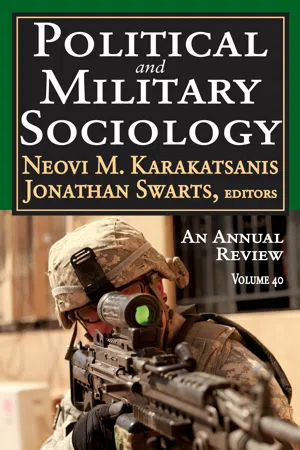
Several contributions in this volume focus on the modern Middle East, with other articles examining justifications for war, the return of war veterans, white nationalists, and the activities of the Moral Majority.Maria Markantonatou addresses the blurring of distinctions between civilians and combatants. Udi Lebel investigates how the IDF is being changed by the increasing number of religious-Zionists recruited. Orlee Hauser argues that the experiences of women in the IDF vary depending on their positions and assignments. Bruce McDonald compares the performance of the Feder-Ram and augmented Solow models in accounting for economic growth in Iran. Neema Noori examines the interrelationship of war, the state, and mobilization in Iran. Molly Clever examines the justifications for war employed by both state and non-state actors. Christina Knopf uses relational dialectics to examine US veteran transitions. David Bugg and Dianne Dentice analyze attitudes and perceptions of white nationalists. Finally, Aaron Davis considers the rise of the Illinois state chapter of the Moral Majority in the 1980s.This volume in the Political and Military Sociology series also includes reviews of important new books in civil-military relations, political science, and military sociology.
Information
Postmodern or Conservative? Competing Security Communities over Military Doctrine: Israeli National-Religious Soldiers as Counter [Strategic] Culture Agents
Udi Lebel
Ariel University Center
Samaria and Jordan Rift R&D Center
Political and Military Sociology: An Annual Review, 2012, Vol. 40: 23–57.
In this article, I refer to “strategic culture” as a conceptual locus and describe the implications of the increasing number of religious-Zionist youth recruited into the Israeli military. Against the background of a postmodern versus traditional army, I argue that the motivating force for the nostalgic return to the martial values of Israel’s early wars is rooted in a conservative backlash against liberal and “humane” considerations, rather than in religious ideology. The war against terror requires the same attitudes that more traditional battlefield confrontations do.
In recent years, public attention has been growing with regard to two demographic trends in the Israeli Defense Force (IDF):
- Members of the middle class—western, secular, and left wing—have ceased to regard the military as an arena for integration, investment, and service (Peri 2007:128). The social elites, to which the majority of the military commanders belong, experienced a “crisis of motivation” in the final years of the millennium, and their sons “ceased to regard the military path as the dominant way to advance their personal careers” (Peri 2007:125).
- At the same time, we are witnessing a growing trend for integration of the sons of religious Zionists in the IDF as officers, commanders, and fighters in elite and combat units, where their numbers as a percentage of the total are much higher relative to those of the general population (Cohen 2005). This was achieved through educational institutions that imparted religious, normative, and civic values which were pertinent to their integration in commanding positions in the military.
These two processes transformed the Israeli military command, which originally tended to be secular and identified with the socialist parties of the past and, still later, with the upper-middle classes, allowing it to be increasingly dominated by more peripheral elements—new immigrants, minorities, and, above all, by religious soldiers whom Peri (2007) identified as the “new military elite.”
This change in the military’s demographic characteristics has already been addressed in several contexts:
- First to be addressed is the effect of the army’s social composition on civilian criticism and protests related to security issues. The argument here has been that the more that fighters and casualties belong to ethno-republican groups, the less critical and more friendly the atmosphere in which the military operates will be (Levy 2010). This is especially the case with regard to public reactions to casualties (Lebel 2010, 2011).
- The process by which religious groups are joining the military reflects a change in religious social thinking. Here, we are dealing with a society that, for years, has educated and encouraged its youth to acquire intellectual religious skills and has regarded the military profession as extraneous. However, since the 1990s, such groups were subjected to processes of militarization and began to regard war as a part of the normative Jewish experience (Cohen 2005).
- As more and more religious groups were recruited to join the army, increased research on the issue of diversity management in the IDF emerged (Lumsky-Feder and Ben-Ari 2003), identifying an inherent conflict, especially between religion and gender.
- Research also focused on the dilemmas faced by the religious soldier, involving a conflict of loyalties—one between obedience to military commanders and the instructions of his rabbinical educators (Cohen 1993; Rosman-Stollman 2008). This led to research on how such a religious soldier would react to orders contrary to his ideology, such as settlements evacuation, for example (Bick 2007; Lebel 2008; Levy 2007a).
It should be mentioned that both among the public and in the media discourse on this topic, the growing numbers of religious soldiers in the armed forces caused considerable moral panic, focusing on three issues:
- The implication of this integration on the status of women in military service;
- Possible future reactions of religious officers to orders related to the removal of settlements in the West Bank; and
- The future work of military rabbis, who might strive to shape the entire military rather than just the religious soldiers according to Jewish norms and values.
The Research Approach, Its Aims, and Uniqueness
This article does not intend to analyze the integration of the new groups—particularly the religious groups—in the IDF from the point of view of secularism and religiosity but, rather, on a continuum of conservatism–postmodernism. Namely, it aims at examining the effect of demographic changes in the IDF on military doctrine and conduct. In doing so, the article will not focus on extreme cases that are not a part of everyday military life (such as the removal of settlements) or on the cultural implications (the status of women, for example), but rather on the implications of the demographic change on the military’s daily conduct—its decisions, its theory of warfare, its fight against terrorism, and the way it frames threats and challenges. I argue that after years in which the IDF had become a postmodern army, the integration of religious Zionists into the army constitutes a counterculture and is an attempt to render the military as conservative as it was before having undergone the postmodern revolution. In other words, it has been an attempt to revive its activist ethos and initiative so as to prevail in war without being encumbered by ethical–legal–civilian considerations and ideologies, which have prevented it from crushing terrorism. Here, I refer to a nostalgic practice—an aim to “restore the army” to what it was at its founding—one required to lead conventional warfare, rather than fighting a guerilla and terrorist war.
The IDF in the Postmodern Condition
From the beginning of the 1990s, Israeli society has become increasingly exposed to what has been termed “the postmodern situation.” This term refers to processes that affected the generation following the “founding elite” of the State. The latter were, for the most part, individuals with an upper-middle class, secular, western background with center-to-left political orientations. The second generation acquired values that were characterized by individuation, pragmatism, and privatization, accompanied by a discourse of rights containing sentiments of victimization. The second generation’s ethos was only slightly imbued with the founding national ideology, and its adoption of a postnationalist outlook tended to regard the national-Zionist undertaking as aggressive, colonialist, and militaristic. These processes were a part of an attempt to formulate a liberal–secular–global civil society that would compete with the ethno-republican-local civil society which began to gather force among groups outside the ruling elite, with the religious Zionists being among them (Shafir and Peled 2002).
From the time these post-national processes began to influence the Israeli elite, the senior ranks of the IDF also began to exhibit characteristics associated with what has been termed a “postmodern army,” a process in which armies reformulate their values, organization, and operations in a manner reflecting the culture of the social elite (Ingelhart 2000). This led to a civil-military gap, in turn, in which the cultural values of civil society do not match those required of an army geared to defend its civilian population. The gap is also reflected in the differing social profile of army personnel vis-à-vis the dominant class as well as the ethnic and religious composition of the civilian establishment. The postmodern army, thus, adapts itself to the outlook of the civilian elite it serves, while at the same time engaging in a process that diminishes its concern for issues of national security, in general, and the valorous military experience in particular. By undertaking missions in alternative arenas (economic, academic, media, and legal) and adopting organizational values associated with these missions, the army becomes thoroughly postmodern (Morgan 2001). These processes characterize the upper-middle class, the first to experience the processes of globalization, individuation, and post-nationalism, to be more sensitive to the costs of war in terms of money and casualties, and which attaches lesser honor to heroism (Higley and Pakulski 2007). This class also rejects the legitimacy of resorting to violence and prefers resolving conflicts through diplomacy and compromise. The military leadership, whose senior officers and high command come from the dominant social strata in society, reflects this postmodern Weltanschauung and manages to overcome the “cognitive dissonance” (Simionato 1991) by means of a strategic and tactical military policy, attempting to minimize losses through defensive and preventive approaches to war. Moreover, senior military echelons express support for the civilian-directed military policy and lobby only half-heartedly against budget cuts, conceding that there is no need to swell the ranks of the military and agreeing to a reduction of training maneuvers for ground troops.
Characteristics of the Postmodern Army
Legalization
The incorporation of human and civil rights discourse by the liberal elite led to the internalization of codes of behavior that were influenced by international laws of war and upheld by international courts of law (Singer 2004). The IDF also yielded to these legal orientations, a fact that affected tactical decisions in battlefield operations. This has resulted in increased legal supervision of military operations by civilians (Meydani 2007), especially by military attorneys who now play an important role in policy formulation regarding the deployment of forces (Chouchane 2009).
Operations Other than War
Since the main arena of combat has shifted to the West Bank, the IDF turned into an army that trains its forces to fight terror as well as to employ a variety of policing strategies pertaining to the maintenance of order—ones which characterize a humanitarian army (Weiss and Campbell 1991). These elements suit an army operating in civilian areas prepared to undertake additional roles, such as the promotion of democracy, the maintenance of peace, and the like (Burk 1997).
Civil Society, Civilian Discourse, and Communication
Similar to other postmodern armies, the IDF has become an army whose policies are influenced not only by civil society (Kaldir 2003), particularly human rights organizations and social movements (Helman 2001; Peri 2001), but also by an increased sensitivity to media coverage (Peri 2007).
Post-Heroism, Absence of Decisive Outcomes and Casualty Panic
As a part of its tendency to display casualty phobia and casualty panic, Israeli military policy now exhibits an anti-combatant orientation, preferring this to the allocation of time for military maneuvers (Avidor 2008). With regard to doctrine, the tendency involves relying on the air force, long-range artillery, and special forces because of the fear of political backlash over endangering soldiers’ lives in land campaigns (Bracken and Alcala 1994; Gordon 1998). “Post-heroic” combat, as defined by Luttwak (1995), has led the IDF to conduct or even to cancel missions on the basis of the degree to which solders will be endangered (Lebel 2010). As a part of this tendency, it distanced itself from the notion of “a decisive campaign outcome,” conveyed through the term Revolution in Military Affairs (RMA)1 (Everts and Isernia 2005), and replaced decisive conclusion by the “management of confrontation” concept (Merom 2003:15).
It should be noted, here, that the concept of a postmodern army refers not only to military operations but also to ideology (Moskos 2000a). In this regard, after the Oslo Accords, a part of the Israeli liberal elite wished that the IDF would become an army of peace, whose soldiers would engage in non-aggressive missions (Kasher 2001). It should be noted that this conception is foreign to Israeli military doctrine. From the very inception of the IDF, its values have been based on notions such as commitment to mission, transferring the war to enemy territory, a swift conclusion of military operations, achieving deterrence and recognition, attributing importance to control of territory, and a readiness for sacrifice (Kober 1996; Merom 1999; Lebel 2010).
Research Argument
Culture is, by definition, a process of negotiation between ethos, myths, and values. The postmodern situation is a state of conflict between the dominant and counter cultures (Bauman 1987). Familiar examples might include conflicts between the local and global, men and women, as well as between heroic and victim cultures. Our millennium is one in which, according to Inglehart (1990), culture shifts have occurred. These affect not only consumerism but also national and security issues.
According to the argument presented here, the Israeli military is an arena in which cultural negotiations are conducted, and the religious-Zionist group is a cultural agent, leading and promoting what I will call, “the conservative security culture,” acting as a counterculture to the idea of a postmodern military. I argue that this is likely to affect military doctrine in the future.
According to Ben-Eliezer (2001:62), “if society enters the post-modernist mode and promulgates peace—its army will follow suit.” The presence of religious Zionists in the IDF serves as an avant-guard for the advancement of a conservative counterculture opposed to the culture that has turned the IDF into a postmodern army. This vanguard has been termed “an oppositionary security community” (Adler and Barnett 1998), promoting an anti-hegemonic counter-discourse (Desmond, McDonagh, and O’Donohoe 2000; Teridman 1985). It reflects a venue shifting “from counter-culture to subculture to (strategic) culture” (Walter 1981). In our case, a quasi-romantic aura infuses this military counterculture. The religious Zionists envisage a nostalgic return to authentic martial values and are motivated by opposition to a hegemony that they believe has betrayed the basic founding ideals of the IDF. One of their central goals is to upgrade military performance to its optimal level to enable it to fulfill its primary public objective, namely guaranteeing security to all residents of the Jewish state and the state’s survival through the elimination of terrorism.
On a continuum ranging from conservatism to postmodernism, this may be viewed as an effort to nudge the army toward the conservative end of the spectrum in all matters connected to its functioning—its combat doctrine, its missions, its organized values, and particularly its readiness to combat terror. With regard to the fight against terror, the conservative elements regard current efforts as limited confron...
Table of contents
- Cover Page
- Title Page
- Copyright Page
- Contents
- Potestas and Violentia Power in the Doctrine of “Military Operations in Urban Terrain” (MOUT): State Sovereignty and Biopolitics in 2000–2011 Urban Warfare
- Postmodern or Conservative? Competing Security Communities over Military Doctrine: Israeli National-Religious Soldiers as Counter [Strategic] Culture Agents
- Doing Army or Feeling Army? What Makes Women Feel Organizational Belonging in the Israeli Defence Forces?
- Reconsidering the Defense–Growth Relationship: Evidence from the Islamic Republic of Iran
- Rethinking the Legacies of the Iran–Iraq War: Veterans, the Basij, and Social Resistance in Iran
- Justifying War in PostíCold War Conflicts
- Relational Dialectics in the Civil–Military Relationship: Lessons from Veterans’ Transition Narratives
- American White Nationalism: The Ongoing Significance of Group Position and Race
- The Illinois State Chapter of the Moral Majority: A Study of a Religious Right Organization at the State Level and the Perception of Power, 1980–1988
- Book Reviews
- In This Issue
Trusted by 375,005 students
Access to over 1.5 million titles for a fair monthly price.
Study more efficiently using our study tools.
Frequently asked questions
Yes, you can cancel anytime from the Subscription tab in your account settings on the Perlego website. Your subscription will stay active until the end of your current billing period. Learn how to cancel your subscription
No, books cannot be downloaded as external files, such as PDFs, for use outside of Perlego. However, you can download books within the Perlego app for offline reading on mobile or tablet. Learn how to download books offline
Perlego offers two plans: Essential and Complete
- Essential is ideal for learners and professionals who enjoy exploring a wide range of subjects. Access the Essential Library with 800,000+ trusted titles and best-sellers across business, personal growth, and the humanities. Includes unlimited reading time and Standard Read Aloud voice.
- Complete: Perfect for advanced learners and researchers needing full, unrestricted access. Unlock 1.5M+ books across hundreds of subjects, including academic and specialized titles. The Complete Plan also includes advanced features like Premium Read Aloud and Research Assistant.
We are an online textbook subscription service, where you can get access to an entire online library for less than the price of a single book per month. With over 1.5 million books across 990+ topics, we’ve got you covered! Learn about our mission
Look out for the read-aloud symbol on your next book to see if you can listen to it. The read-aloud tool reads text aloud for you, highlighting the text as it is being read. You can pause it, speed it up and slow it down. Learn more about Read Aloud
Yes! You can use the Perlego app on both iOS and Android devices to read anytime, anywhere — even offline. Perfect for commutes or when you’re on the go.
Please note we cannot support devices running on iOS 13 and Android 7 or earlier. Learn more about using the app
Please note we cannot support devices running on iOS 13 and Android 7 or earlier. Learn more about using the app
Yes, you can access Political and Military Sociology by Neovi M. Karakatsanis in PDF and/or ePUB format, as well as other popular books in Politics & International Relations & National Security. We have over 1.5 million books available in our catalogue for you to explore.