eBook - ePub
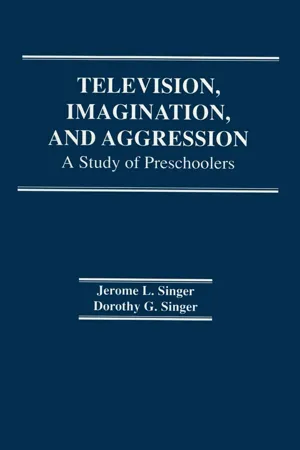
Television, Imagination, and Aggression
A Study of Preschoolers
- 224 pages
- English
- ePUB (mobile friendly)
- Available on iOS & Android
eBook - ePub
About this book
First Published in 1981. This book presents a detailed account of a two-year study relating preschool children's home television-viewing patterns to their spontaneous behavior, play, aggression, and language use in nursery school settings. It also describes an attempt to modify children's viewing patterns and behavior through interventions with parents and special training procedures. This book will be of special interest to behavioral scientists and graduate students in the fields of child development and communication research.
Information
| 1 | Television: Its Potential Role in the Cognitive and Emotional Development of the Child |
INTRODUCTION
It is possible that the television set now established in 99% of homes in the United States may actually be changing human consciousness and the nature of our cognitive development? We put the proposition in its boldest form because we think behavioral scientists (along with many intellectuals in the humanities) have preferred to ignore the “idiot box” that sits in the living rooms, bedrooms, or kitchens of millions of homes, peered at for at least three hours daily by milions of children and adults. We are now into the second generation of regular TV-viewers in this country; the fans of “Howdy-Doody” and “Miss Frances,” the “Mouseketeers,” the kids who bought coonskin hats in the millions after watching “Davey Crockett” are now many of them parents and their children are growing up watching even more television, much of it in vivid color. Behavioral scientists have occasionally decried the amount of violence represented on the 19 in. screen and have in the past decade begun studying the effects of such material on overt behavior, especially in children. They have paid less attention, on the whole, to other issues concerning the impact of the medium…its cognitive implications, its role in forming constructive social attitudes, its potential for educational use, not just providing information but in enhancing the emergence of cognitive skills that the growing child can draw on independent of the TV medium for effective adaptation and learning.
Children are growing up today in an environment that includes an element of daily visual stimulation never before a part of human experience. Three-and four-year-olds get up at 6:30 a.m. and go over to a little box on which they watch cartoon figures bouncing around or pounding each other into pieces, soon magically revived; by 8:30 a.m., when bundled off to day care center or nursery school, they have already watched for at least an hour. At noon if they attended school only for a half-day, they are in time for the “Gong Show” in which miniature adults on the screen also dress in absurd costumes, leap about frenetically, or are dragged screaming from a stage in the midst of a caterwauling song. Often well into 9:00 or 10:00 p.m. they continue to watch the movements on the box, usually only vaguely grasping the plots or the meaning of words used or distinguishing between commercials and program content. But the moving figures hold their attention!
In other generations of human history when three- or four-year-olds awoke they perhaps followed their parents around, performed some household chores, and tagged after the adults out into the fields. Or else they read or played Even with the advent of movies in this century, visits by very young children were occasional, took place with parents or other adults present to some degree, involved a large screen and a very special setting. The radio offered little to hold the attention of the very young child and, for the five- or six-year-old and up, called for an active effort to transform the auditory material into some private visual representation to sustain interest in the plot or characters.
Television is really different. It's there in the home all the time, it's small in size, its figures move and talk and sing, and the segments flash by with a rapidity different from the ordinary sequences of real life interactions. A recent book, The Plug-In Drug, by Marie Winn (1977), a professional writer, has provocatively examined the potentially addictive qualities of TV-viewing and has implied that many of our current ills from juvenile violence, the drop in national reading scores or SAT levels, through the increase in drug abuse are attributable to the medium. Ms. Winn may not be technically correct in some of her discussions of cognitive issues or in her hypothesis that the presumed heavier right-brain arousal of television may be weakening the verbal skills associated with left-brain activities. Still we think she is on the right track in emphasizing the fact that television can encourage a certain kind of cognitive passivity which leads to a “show me or entertain me” orientation by school children or college students and also in her emphasis on the fact that the time spent watching TV means less time spent reading or writing or actively exploring one's environment. We would emphasize even more than she does that the spontaneous play of children involving a mixture of games of mastery, games with rules, exploration and make-believe, or symbolic play are all critical phases of how a child learns about itself and its environment, practices verbal skills, tries out various emotions and cognitive discriminations or behaviors, and prepares itself for later social roles through sociodramatic pretending. Children sitting in front of TV sets are obviously playing or reading less than they might have done before the medium was available on so wide a scale.
We have begun with a challenge about some powerful implications of the television-viewing habit for the nature of consciousness. We would like to examine first of all some of the major developmental tasks that confront the growing child and then to suggest that play (and we are here emphasizing symbolic games, pretending, and make-believe) represents a major method by which children can develop the skills required for those tasks. We can look at television, which in a sense represents a form of vicarious play or fantasy, and examine some of the special cognitive properties of that medium. We next confront the question of how television-viewing and play are competitive for the child's time and whether there may be ways in which the two forms of experience may complement each other as part of the child's development. What are some of the dangers and limitations in development posed by even moderate TV-viewing (three hours a day for the child)? Ought we to abolish TV entirely as Winn wishfully suggests, or can we find ways of using the medium to good effect? What research still needs to be done to help us to move beyond “top-of-the-head” assertions by “authorities” toward a more systematic comprehension of the way television influences normal cognitive or social development?
THE TASK-DEMANDS OF GROWING-UP: THE SPECIAL ROLE OF IMAGINATIVE PLAY
In looking at the complexity of the developmental process, we think it may be helpful to think of cognitive and emotional growth somewhat in the way an industrial psychologist would look at a personnel selection process. In effect we need a job analysis first. What does it take to grow up into normal adolescence in a given culture or subgroup of a particular society or, in general, in the human species? Clearly a child by a certain age has to master certain motor skills, turning over first, creeping, crawling, pulling itself upright, and then standing alone before walking. Some of these performances. depend on maturation of musculature and physiology more generally but others are greatly abetted by environmental circumstances. Or, at least, the emergence of the behavior is accelerated by adult aid and encouragement.
For our purposes we focus primarily on the task demands of developing the cognitive and affective systems of the child. For example, the child must be prepared with expectations and motor or cognitive “plans” (Miller, Galanter, ' Pribram, 1960) to deal with each new setting or demand. In order to do this it must find a means of transforming externally derived information into a miniaturized private representational system, rapidly encoded and decoded as situations demand. We have increasing reason to believe that language encoding and the imagery storage processes are separately organized and processed by the brain (Paivio, 1971; Witelson, 1976), but that both systems ultimately may interact to produce optimal storage (Rohwer, 1970). In imitating language the child gradually miniaturizes sounds, words, and eventually phrases into a form suitable for efficient storage and retrieval in the long-term system. The same process presumably occurs with the more global material of visual, auditory, or other sensory-modality information, and to the extent that the child rehearses images and verbal labels together, the chances of highly efficient voluntary retrieval of this material is greatly enhanced.
Piaget (1962), in his emphasis on assimilation, and Tomkins (1970), in the theory of miniaturization through repetition, are proposing that effective internal representation does depend on some kind of continuing private rehearsal process. We have elsewhere elaborated on these suggestions to propose that make-believe play and pretending in early childhood develop naturally as part of this very process of the child's gaining control over an internal or symbolic representation system (Singer, 1973). Pretending and the profound dimension of “as if” in human experience are intrinsic to the establishment of an efficient set of anticipatory guiding images, verbal labels, and plans with easily spun-out subroutines. Pretending itself depends on the level of the child's cognitive maturation and also the complexity or “realism” of the structures with which the child is dealing, as Fein (1975) has indicated in her experimental analysis of 18-month- to 2-year-olds simulating drinking from an empty cup or feeding a plastic “horsey” with invisible milk.
Although almost all children show some degree of make-believe or fantasy play, the persistence and elaboration of such play in the 3- to 6-year-old period appears to depend on considerable support and encouragement from adults as well as on opportunities for practice in privacy (Singer, 1973; Singer ' Singer, 1976a). Obviously children whose play is more limited to games with rules or to mastery experiences such as climbing, ball-playing, or forms of motor exploration also master new schema and set up coding systems. But there is increasing reason to believe that those children whose play repertory in the preschool period includes a good deal of make-believe and fantasy play have a distinct edge in certain important cognitive areas (Smilansky, 1968). A study by Lewis (1973), for example, found that kindergarteners who played more elaborate and extensive sociodramatic or fantasy games showed better performance in picture interpretation tasks, in the amount of language employed, and in organization of language during picture interpretations. In free association tasks high fantasy-play children produced more responses, provided more associations remote from self or the home environment, and showed more use of categorization and associative linkage than of random naming. Lewis found her clearest differences in cognitive organization between the children of high IQ-high sociodramatic play and those with correspondingly high IQ and low levels of fantasy play thus ruling out sheer intelligence as a factor in the differences. Similar results have been reported recently by Dansky (1976) and in a series of studies summarized by Singer (1977).
Our own current research on 3- and 4-year-olds as well as several earlier studies using observation of free play have consistently found correlations between levels of make-believe and the use of more extended vocabulary or the introduction of more complex syntactic structures such as predicate nominatives into spontaneous language. A report by the late Corrine Hutt in England (1979) also suggests that working-class children whose spontaneous language is characterized by little variation and complexity show an increase in measures such as mean length of utterance and richness of vocabulary when encouraged to engage in make-believe games. The studies directed by Saltz (1976) on urban disadvantaged children trained in thematic play are also corroborative here.
We are suggesting, then, that growing up requires an increasing complexity of vocabulary, an ability to categorize materials, to retrieve words or images readily, and to generate sets of more remote associations or to recall details of verbally presented situations accurately (Tucker, 1975). Imaginative play provides an arena for rehearsing material and assimilating it to a greater variety of preestablished schema. By the very process of scaling the trucks or large environmental features down in the form of toys or small objects standing for large ones (as in blocks for buildings or pencils for airplanes), the child provides itself with manageable schema for effective later retrieval.
Let us briefly talk of the task demands for the growing child in the affective area. There is an increasing reason to believe that human beings grow up with a relatively differentiated but circumscribed affect system closely tied to facial representation and to the complexity of and rate of assimilability of information processing demands (Izard, 1977; Tomkins, 1962, 1963). An important feature of pretend play is that it again provides opportunities for expression and control of affect and the representation in miniaturized form of conflictual or frightening scenes or encounters. The child engaged in pretend play of adventurous or hostile encounters gains some sense of competence and power (Sutton-Smith, 1976) or empathy (Gould, 1972; Saltz ' Johnson, 1974) and may in effect be establishing better organized schema or plans and subroutines for observing others' emotions and expressing or controlling its own. In our own research we have regularly observed that children engaged in make-believe play are also “happier” children. That is, when observers rate them for the positive affects of interest and curiosity or joy and the smiling response we find positive consistent correlations between imaginativeness of play, positive affect, concentration, elation, and cooperation with peers (Singer ' Singer, 1976a).
Important task demands of socialization and moral growth also confront the child. Differentiating aggression or violence from adaptive assertiveness, impulsivity from means-end action, egocentricism from sharing, dependent demanding from sharing or helping, infantile sexuality from interpersonal intimacy…all these are demands we all must confront in the growth process. Make-believe play as child psychotherapists have long stressed is an important arena in which children can express and differentiate issues of this kind. Again, in a sense the play situation permits the child to examine an array of probabilities or possibilities with impunity and to store these miniaturized new schema more effectively.
Gould (1972), on the basis of her observations of free play in preschoolers, concluded that children who played more imaginatively also took roles other than self in play and thus developed an empathy for the victims of aggression. They were thus less likely to be directly aggressive toward others. There is a body of evidence that suggests that by elementary school age children who show imaginativeness in spontaneous play or in projective test performance are less likely to be overtly aggressive or impulsive and are better able to tolerate delays or are more socially cooperative (Singer & Singer, 1976b). In our current research as well as in earlier studies (Nahme-Huang, Singer, Singer, ' Wheaton, 1977; Tower, Singer, Singer, ' Biggs, 1979) we have generally found that imaginative play is also associated with peer group sharing or cooperation and with somewhat less demandingness or dependency on adults. Rubin, Maioni, and Hornung (1976) also report data suggesting a greater level of social maturity identified with sociodramatic play.
In summary, then, imaginative play can be viewed as a major resource by which children can cope immediately with the cognitive, affective, and social demands of growing up. It is more than a reactive behavior, however, for it provides a practice ground for organizing new schema and for transforming and storing material for more effective later expression in plans, action, or verbalization. Our own research and the increasing body of studies in this area suggest that play is an active process and one that depends to some degree on reinforcement, modeling, and general encouragement by parental figures (Dennis, 1976; Gershowitz, 1974; Shmukler, 1978; Singer, 1977).
INFLUENCES ON IMAGINATIVE DEVELOPMENT
A critical question that remains before us is to identify even more precisely those factors that are particularly conducive to encouraging imaginative play in early childhood so that such play can be effective in helping the child develop further its cognitive, affective, and social skills. Gershowitz (1974) demonstrated that well-trained or empathic adults who offered direction initially to a child and then pulled back were more likely to foster rich imaginative play in the youngsters. Shmukler (1978) has been carrying out an elaborate study of mother-child interaction patterns in relation to make-believe play and imagination with middle-class white parents in South Africa. In a sophisticated Boolean analysis of relevant variables she finds evidence that a variable reflecting a mother who tells stories to a child, is accepting of the child's uniqueness, and who shows leadership in stimulating play, but then withdraws, are the best predicators of imaginativeness.
A recent example of maternal input and its impact on a child's developing imagination can be cited. In an article on new developments in philosophy, Branch (1977) describes the childhood of Sol Kripke, an outstanding young American logician. Kripke's mother used to recite Gilbert and Sullivan passages to him when he was a preschooler. Subsequently intrigued by the word play of that delightful material the boy developed a whole world of gremlins, and abolute monarchy whose king was both the tallest and the shortest character in the realm. He used to delight his younger sisters with running episodes of this fantasy. The progression toward analytic philosophy and the complex word-play and mathematics of Kripke's modern examination of “truth” seems less surprising with such beginnings.
THE SPECIAL QUALITIES OF THE TELEVISION MEDIUM
Let us return now to examine the role of television in our job analysis of the child's cognitive and affective development. If play is as important as we have suggested it may be, then where does watching television fit into the child's repertory? It might be argued that television represents an important, easily accessible alternative to parental storytelling and subsequent spontaneous play. Indeed for many poor children whose parents are overworked, inaccessible, or lack cultural orientation to engage in story telling or reading to children it is possible that television affords a remarkable opportunity to come in contact with magic, fantasy, a richer vocabulary, and much information about other countries or about history and culture not ordinarily available to them. If one accepts some form of the psychoanalytic catharsis theory in which vicarious experience in the form of fairy tales or myths involving symbolic representation of crises of early childhood, for example, incest, parent-directed violence, or sibling hatred, can alleviate conflicts over sexuality and aggression (Bettleheim, 1975), then television may be serving as good or better a function for the broader society than bedtime stories ever could.
The fact is we do no yet know enough to assert the positive or negative evidence for the proposition that television may be providing a major form of alternative consciousness or that it may be serving much the same role as play in child development. The research described in this book, tracking 3- and 4-year-olds over a year or more and looking at relations between how much and what they watch on TV and their spontaneous play activities during the nursery school day is just a beginning in this direction. It is certainly clear from recording their make-believe play or from identifying their imaginary companions that a large percentage of their fantasy figures are drawn from TV characters, especially Batman, Superman, Bionic Man, Wonder Woman, and Bionic Woman. The pull of the powe...
Table of contents
- Cover
- Half Title
- Title Page
- Copyright Page
- Table of Contents
- Preface
- 1. Television: Its Potential Role in the Cognitive and Emotional Development of the Child
- 2. The Developmental Study: Participants, Variables, and Procedures
- 3. A Year to Grow: Patterns of TV-Viewing, Behavior, and Language
- 4. Dimensions of Spontaneous Play
- 5. Imaginary Playmates
- 6. Television-Viewing and Aggression: Play Observations
- 7. Family Interviews: Home Life Style, TV-Viewing, and Aggression
- 8. Parent-Intervention Study: Rationale, Method, Results
- 9. Television and Imagination: What We Have Learned and What Still Lies Ahead
- References
- Appendix 1: Behavioral Variables
- Appendix 2: Sample Observation Protocol
- Appendix 3: Imagination Interview
- Appendix 4: Imaginary Playmate
- Appendix 5: Language Variables and Sample Definitions Code Book Language Analysis Television Research Project–1976 (Developed by Mrs. Rhoda Brownstein)
- Appendix 6: How to Keep Your Television Log
- Appendix 7: Play Protocol Analysis Chart
- Appendix 8: Family Interview Schedule
- Appendix 9: Television Character Recognition Test
- Author Index
- Subject Index
Trusted by 375,005 students
Access to over 1.5 million titles for a fair monthly price.
Study more efficiently using our study tools.
Frequently asked questions
Yes, you can cancel anytime from the Subscription tab in your account settings on the Perlego website. Your subscription will stay active until the end of your current billing period. Learn how to cancel your subscription
No, books cannot be downloaded as external files, such as PDFs, for use outside of Perlego. However, you can download books within the Perlego app for offline reading on mobile or tablet. Learn how to download books offline
We are an online textbook subscription service, where you can get access to an entire online library for less than the price of a single book per month. With over 1.5 million books across 990+ topics, we’ve got you covered! Learn about our mission
Look out for the read-aloud symbol on your next book to see if you can listen to it. The read-aloud tool reads text aloud for you, highlighting the text as it is being read. You can pause it, speed it up and slow it down. Learn more about Read Aloud
Yes! You can use the Perlego app on both iOS and Android devices to read anytime, anywhere — even offline. Perfect for commutes or when you’re on the go.
Please note we cannot support devices running on iOS 13 and Android 7 or earlier. Learn more about using the app
Please note we cannot support devices running on iOS 13 and Android 7 or earlier. Learn more about using the app
Yes, you can access Television, Imagination, and Aggression by D. G. Singer, Jerome L. Singer in PDF and/or ePUB format, as well as other popular books in Languages & Linguistics & Communication Studies. We have over 1.5 million books available in our catalogue for you to explore.