eBook - ePub
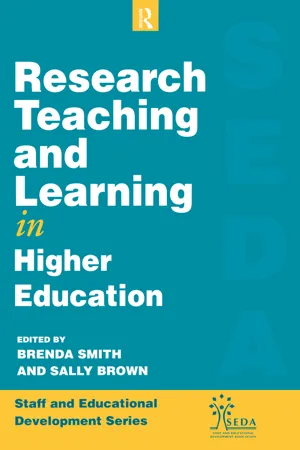
Research, Teaching and Learning in Higher Education
- 194 pages
- English
- ePUB (mobile friendly)
- Available on iOS & Android
eBook - ePub
Research, Teaching and Learning in Higher Education
About this book
Exploring the issue of how educational staff can balance successfully their research and teaching activities, this volume argues that the entire system governing the relationship amongst research, teaching and learning should be dismantled and rebuilt, focusing on symbiosis rather than conflict.
Information
SECTION TWO
IDEAS IN PRACTICE
Chapter 8
Competent Research – Running Brook or Stagnant Pool?
INTRODUCTION
For far too long there have been tensions between ‘academic research’ and ‘student-centred teaching and learning’. These tensions have been exacerbated by the apparent conflicts between research and teaching, for example the emphasis on research publications both in selection procedures for new appointments and in promotion criteria for existing staff.
The aim of the workshop upon which this chapter is based was to attempt to tease out the broad competences which underpin good-quality research. With non-completion rates in PhD research at around 50 per cent in some disciplines, it is timely to identify the competences that really count in research. These competences may fall into various categories of differing ‘worth’, including those relating to:

The comparative metaphor ‘running brook versus stagnant pool’ has been used to compare those active in research from those who concentrate on teaching – but it can be argued that the real ‘running brook’ should be associated with those who actively develop the quality of their students’ learning, rather than those pushing forward the frontiers ever so slightly in some tiny area of subject specialism. It is increasingly argued (Ramsden, 1992) that however competent higher education teachers may be in their subject area, they need to aspire to being distinguished teachers as well. Perhaps the most productive way towards such a position is to encourage teachers to become competent educational researchers, and help them to ensure that their research is recognized and valued.
CAN WE IDENTIFY RESEARCH COMPETENCES?
In many disciplines, NVQ competence-based frameworks have already been drawn up, attempting in their own way to identify and explain the competences which are intended to be developed in training programmes, and the evidence which should be brought forward to claim accreditation for such competences. Can we look forward to a NVQ framework describing competences relating to research? If we are to try to produce a blueprint for such a framework, it will mean working out the details of three parameters along the following lines:
Or is research something quite special, something beyond the scope of competence descriptors and evidence specifications? It may be tempting to say one or more of the following of research:
Several ‘research competence’ agendas
In one way or another, attempts have been made to judge research competence for many years. Whenever an application for funding of a research proposal is considered, and whenever a proposal for a new research studentship is drawn up, those processing the applications apply performance criteria of one sort or another to the evidence laid before them. One such criterion is bound to be along the lines of ‘has already delivered high quality research’. However, even that criterion is likely to be inextricably linked with evidence, and probably also with ‘range statements’ of a form. But what is ‘successful research’? There are several overlapping possibilities:
THE RELATIONSHIPS BETWEEN TEACHING AND RESEARCH
In higher education, many – or most – new lecturers are appointed largely on the basis of their expertise in their subject disciplines. A major contributing factor may be their records of research publications in their fields. At more senior levels, subject-related expertise is seen as even more important. When it comes to applying for promotion, or for senior appointments at another institution, a track record of successful research publications is a vital component of the sort of curriculum vitae that gets one onto interview shortlists.
It is often said that involvement in current state-of-the-art research is a valuable contributory factor towards good teaching. After all, someone who spends at least some time pushing back the frontiers of knowledge and understanding in a discipline will be a formative influence on the next generation of people who will carry on the good work. Or could this be looked on rather less kindly as a view whereby the main product of good teaching should be to engender the skills and attitudes needed by future researchers? How many of our students will make their careers out of research? (I recently advertised for a research assistant; the advertisement attracted some 121 applications from a wide range of hopeful candidates. My sympathies go to the 120 who were unsuccessful.)
It can, however, be argued that the most effective teachers are researchers, but not usually in the conventional sense. Effective teachers are usually researchers into teaching and learning processes. They are usually skilled observers of such processes. They are often experimenters, trying out new techniques and ideas. They seek feedback proactively to give themselves data on which to base new approaches and experiments. Sadly perhaps, such researching teachers may often not play that vital part of the research game – being seen to have researched successfully.
Despite the amount of published educational research, there are many excellent innovators and discoverers whose work is known only to those students whose learning experiences are enhanced by the effects of the research effort going into the teaching they encounter. Furthermore, even when researching teachers successfully publish their work in the educational literature, there are always those who say, ‘Well, under what subject exactly can we classify these publications; is it endocrinology, or research into teaching endocrinology, or research into how people learn about endocrinology?’
A FUNDAMENTAL RESEARCH AGENDA
Research of any kind is essentially the systematic and informed search for the answers to a mere six basic questions, and making sense of data gathered to explain the findings to other people. The most useful questions are usually the most basic – those that have underpinned the quest for human knowledge since the dawn of recorded history:
RESEARCH METHODOLOGY
There are numerous courses in ‘research methods’. Students undertaking Masters programmes may be required to follow such courses. PhD students may be encouraged to participate, or even required to attend. But what are the basic ingredients of the methodology of successful research? Most such ‘menus’ I have seen seem to be a rather arbitrary mixture of bits from other disciplines. ‘Statistics’ always features somewhere, yet how often do we see scientific statistical analysis techniques applied wildly beyond the scope where they may be valid or useful? While it is possible to compute standard deviations from quite small data samples...
Table of contents
- Cover
- Title Page
- Copyright Page
- Table of Contents
- Notes on contributors
- Foreword
- Section One: Theoretical Perspectives
- Section Two: Ideas In Practice
- Afterword: A Manifesto for Research, Teaching and Learning
- Index
Trusted by 375,005 students
Access to over 1.5 million titles for a fair monthly price.
Study more efficiently using our study tools.
Frequently asked questions
Yes, you can cancel anytime from the Subscription tab in your account settings on the Perlego website. Your subscription will stay active until the end of your current billing period. Learn how to cancel your subscription
No, books cannot be downloaded as external files, such as PDFs, for use outside of Perlego. However, you can download books within the Perlego app for offline reading on mobile or tablet. Learn how to download books offline
Perlego offers two plans: Essential and Complete
- Essential is ideal for learners and professionals who enjoy exploring a wide range of subjects. Access the Essential Library with 800,000+ trusted titles and best-sellers across business, personal growth, and the humanities. Includes unlimited reading time and Standard Read Aloud voice.
- Complete: Perfect for advanced learners and researchers needing full, unrestricted access. Unlock 1.5M+ books across hundreds of subjects, including academic and specialized titles. The Complete Plan also includes advanced features like Premium Read Aloud and Research Assistant.
We are an online textbook subscription service, where you can get access to an entire online library for less than the price of a single book per month. With over 1.5 million books across 990+ topics, we’ve got you covered! Learn about our mission
Look out for the read-aloud symbol on your next book to see if you can listen to it. The read-aloud tool reads text aloud for you, highlighting the text as it is being read. You can pause it, speed it up and slow it down. Learn more about Read Aloud
Yes! You can use the Perlego app on both iOS and Android devices to read anytime, anywhere — even offline. Perfect for commutes or when you’re on the go.
Please note we cannot support devices running on iOS 13 and Android 7 or earlier. Learn more about using the app
Please note we cannot support devices running on iOS 13 and Android 7 or earlier. Learn more about using the app
Yes, you can access Research, Teaching and Learning in Higher Education by Sally Brown,Brenda Smith,Brown, Sally,Smith, Brenda in PDF and/or ePUB format, as well as other popular books in Education & Education General. We have over 1.5 million books available in our catalogue for you to explore.