- 288 pages
- English
- ePUB (mobile friendly)
- Available on iOS & Android
eBook - ePub
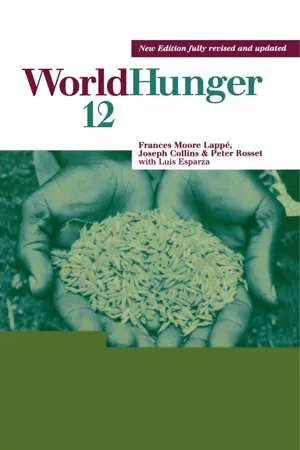
World Hunger
About this book
The revised edition of this text includes substantial new material on hunger in the aftermath of the Cold War; global food productioin versus population growth; changing demographics and falling birth rates around the world; the shifting focus of foreign assistance in the new world order; structural adjustment and other budget-slashing policies; trade liberalization and free trade agreements; famine and humanitarian interventions; and the thrid worldization of developed nations.
CHAPTER 1
Myth 1:
There’s Simply Not Enough Food
MYTH: With food-producing resources in so much of the world stretched to the limit, there’s simply not enough food to go around. Unfortunately, some people will just have to go hungry.
OUR RESPONSE: The world today produces enough grain alone to provide every human being on the planet with thirty-five hundred calories a day.1 That’s enough to make most people fat! And this estimate does not even count many other commonly eaten foods—vegetables, beans, nuts, root crops, fruits, grass-fed meats, and fish. In fact, if all foods are considered together, enough is available to provide at least 4.3 pounds of food per person a day. That includes two and a half pounds of grain, beans, and nuts; about a pound of fruits and vegetables; and nearly another pound of meat, milk, and eggs.2
Abundance, not scarcity, best describes the supply of food in the world today. Increases in food production during the past thirty-five years have outstripped the world’s unprecedented population growth by about 16 percent.3 Indeed, mountains of unsold grain on world markets have pushed prices strongly downward over the past three and a half decades.4 Grain prices rose briefly during the early 1990s, as bad weather coincided with policies geared toward reducing overproduction, but remained well below the highs observed in the early sixties and mid-seventies.5
All well and good for the global picture, you might be thinking, but doesn’t such a broad stroke tell us little? Aren’t most of the world’s hungry living in countries with food shortages—countries in Latin America, in Asia, and especially in Africa?
Hunger in the face of ample food is all the more shocking in the third world. According to the Food and Agriculture Organization (FAO) of the United Nations, gains in food production since 1950 have kept ahead of population growth in every region except Africa.6 The American Association for the Advancement of Science (AAAS) found in a 1997 study that 78 percent of all malnourished children under five in the developing world live in countries with food surpluses,7
Thus, even most “hungry countries” have enough food for all their people right now. This finding is based on official statistics even though experts warn us that newly modernizing societies invariably underestimate farm production—just as a century ago at least a third of the U.S. wheat crop went uncounted.8 Moreover, many nations can’t realize their full food production potential because of the gross inefficiencies caused by inequitable ownership of resources. We will discuss this in chapters 4 and 6.
Finally, many of the countries in which hunger is rampant export much more in agricultural goods than they import. Northern countries are the main food importers, their purchases representing 71.2 percent of the total value of food items imported in the world in 1992.9 Imports by the thirty lowest-income countries, on the other hand, accounted for only 5.2 percent of all international commerce in food and farm commodities.10
Looking more closely at some of the world’s hunger-ravaged countries and regions confirms that scarcity is clearly not the cause of hunger.
India. India ranks near the top among third world agricultural exporters. While at least 200 million Indians go hungry,11 in 1995 India exported $625 million worth of wheat and flour and $1.3 billion worth of rice (5 million metric tons), the two staples of the Indian diet.12
Bangladesh. Beginning with its famine of the early 1970s, Bangladesh came to symbolize the frightening consequences of people overrunning food resources. Yet Bangladesh’s official yearly rice output alone—which some experts say is seriously underreported13—could provide each person with about a pound of grain per day, or two thousand calories.14 Adding to that small amounts of vegetables, fruits, and legumes could prevent hunger for everyone. Yet the poorest third of the people in Bangladesh eat at most only fifteen hundred calories a day, dangerously below what is needed for a healthy life.15
With more than 120 million people living in an area the size of Wisconsin, Bangladesh may be judged overcrowded by any number of standards, but its population density is not a viable excuse for its widespread hunger. Bangladesh is blessed with exceptional agricultural endowments, yet its 1995 rice yields fell significantly below the all-Asia average.16 The extraordinary potential of Bangladesh’s rich alluvial soils and plentiful water has hardly been unleashed. If the country’s irrigation potential were realized, experts predict its rice yields could double or even triple.17 Since the total calorie supply in Bangladesh falls only 6 percent short of needs,18 nutritional adequacy seems an achievable goal.
Brazil. While Brazil exported more than $13 billion worth of food in 1994 (second among developing countries), 70 million Brazilians cannot afford enough to eat.19
Africa. It comes as a surprise for many of us to learn that the countries of sub-Saharan Africa, home to some 213 million chronically malnourished people (about 25 percent of the total in developing countries),20 continue to export food. Throughout the 1980s exports from sub-Saharan Africa grew more rapidly than imports,21 and in 1994, eleven countries of the region remained net exporters of food.22
The Sahelian countries of West Africa, known for recurrent famines, have been net exporters of food even during the most severe droughts. During one of the worst droughts on record, in the late 1960s and early 1970s, the value of the region’s agricultural exports—$1.25 billion—remained three times greater than the value of grain imported,23 and such figures did not even take into account significant unreported exports.24 Once again, during the 1982–85 drought food was exported from these countries.25
Nevertheless, by 1990, food production per person had apparently been declining for almost two decades,26 despite the productive capacity suggested by Africa’s agricultural exports, and in 1995 over one-third of the continent’s grain consumption depended on imports.27 We use the word “apparently” because official statistics notoriously underreport, or ignore all together, food grown for home consumption, especially by poor women, as well as food informally exchanged within family and friendship networks, making a truly accurate assessment impossible.28 In fact, the author of the AAAS report referred to earlier argues that hunger is actually less severe in sub-Saharan Africa than in South Asia.29
Repeated reports about Africa’s failing agriculture and growing dependence on imports have led many to assume that simply too many people are vying for limited resources. Africa’s food crisis is real, as evidenced by moderately high rates of childhood malnutrition, but how accurate is this assumption as to why the crisis exists?
Africa has enormous, still unexploited, potential to grow food, with potential grain yields 25 to 35 percent higher than maximum potential yields in Europe and North America.30 Beyond yield potential, ample arable land awaits use. In Chad, for example, only 10 percent of the farmland rated as having no serious production constraints is actually farmed. In countries notorious for famines—Ethiopia, Sudan, Somalia, and Mali, for example—the area of unused good-quality farmland is many times greater than the area actually farmed,31 casting doubt on the notion that there are simply too many people for scarce resources.
Many long-time observers of Africa’s agricultural development tell us that the real reasons for Africa’s food problems are no mystery.32 Africa’s food potential has been distorted and thwarted as follows:
• The colonial land grab that continued into the modern era displaced peoples and the production of foodstuffs from good lands toward marginal ones, giving rise to a pattern by which good land is mostly dedicated to the production of cash crops for export or is even unused by its owners.33 Furthermore, colonizers and, subsequently, national and international agencies have discredited peasant producers’ often sophisticated knowledge of ecologically appropriate farming systems. Promoting “modern,” often imported, and ecologically destructive technologies,34 they have cut Africa’s food producers out of economic decisions most affecting their very survival.
• Public resources, including research and agricultural credit, have been channeled to export crops to the virtual exclusion of peasant-produced food crops such as millet, sorghum, and root crops. In the 1980s increased pressure to export to pay interest on foreign debt further reinforced this imb...
Table of contents
- Cover
- Half Title
- Title Page
- Copyright Page
- Dedication
- Table of Contents
- Preface and Acknowledgments to the Second Edition
- Beyond Guilt and Fear
- Chapter 1 Myth 1: There's Simply Not Enough Food
- Chapter 2 Myth 2: Nature's to Blame
- Chapter 3 Myth 3: Too Many Mouths to Feed
- Chapter 4 Myth 4: Food vs. Our Environment
- Chapter 5 Myth 5: The Green Revolution Is the Answer
- Chapter 6 Myth 6: Justice vs. Production
- Chapter 7 Myth 7: The Free Market Can End Hunger
- Chapter 8 Myth 8: Free Trade Is the Answer
- Chapter 9 Myth 9: Too Hungry to Revolt
- Chapter 10 Myth 10: More U.S. Aid Will Help the Hungry
- Chapter 11 Myth 11: We Benefit from Their Hunger with Fuyuki Kurasawa
- Chapter 12 Myth 12: Food vs. Freedom
- Beyond the Myths of Hunger: What We Can Do
- Notes
- What We Can Do: A Resource Guide
- About Food First
- About the Authors
- Index
Trusted by 375,005 students
Access to over 1.5 million titles for a fair monthly price.
Study more efficiently using our study tools.
Frequently asked questions
Yes, you can cancel anytime from the Subscription tab in your account settings on the Perlego website. Your subscription will stay active until the end of your current billing period. Learn how to cancel your subscription
No, books cannot be downloaded as external files, such as PDFs, for use outside of Perlego. However, you can download books within the Perlego app for offline reading on mobile or tablet. Learn how to download books offline
Perlego offers two plans: Essential and Complete
- Essential is ideal for learners and professionals who enjoy exploring a wide range of subjects. Access the Essential Library with 800,000+ trusted titles and best-sellers across business, personal growth, and the humanities. Includes unlimited reading time and Standard Read Aloud voice.
- Complete: Perfect for advanced learners and researchers needing full, unrestricted access. Unlock 1.5M+ books across hundreds of subjects, including academic and specialized titles. The Complete Plan also includes advanced features like Premium Read Aloud and Research Assistant.
We are an online textbook subscription service, where you can get access to an entire online library for less than the price of a single book per month. With over 1.5 million books across 990+ topics, we’ve got you covered! Learn about our mission
Look out for the read-aloud symbol on your next book to see if you can listen to it. The read-aloud tool reads text aloud for you, highlighting the text as it is being read. You can pause it, speed it up and slow it down. Learn more about Read Aloud
Yes! You can use the Perlego app on both iOS and Android devices to read anytime, anywhere — even offline. Perfect for commutes or when you’re on the go.
Please note we cannot support devices running on iOS 13 and Android 7 or earlier. Learn more about using the app
Please note we cannot support devices running on iOS 13 and Android 7 or earlier. Learn more about using the app
Yes, you can access World Hunger by Joseph Collins in PDF and/or ePUB format, as well as other popular books in Economics & Ecology. We have over 1.5 million books available in our catalogue for you to explore.