- 256 pages
- English
- ePUB (mobile friendly)
- Available on iOS & Android
eBook - ePub
Strategic Air Power in Desert Storm
About this book
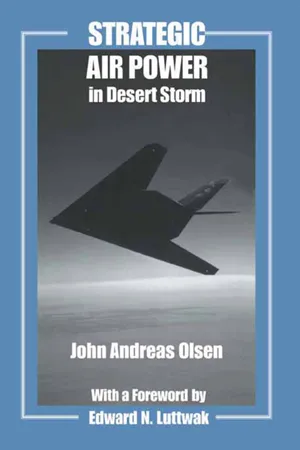
In response to the Iraqi invasion of Kuwait on the second of August 1990, a small group of air power advocates in the Pentagon proposed a strategic air campaign - "Operation Desert Storm" designed to drive the Iraqi army from Kuwait by a sustained effort against the major sources of Iraqi national power. John Andreas Olsen provides a coherent and comprehensive examination of the origins, evolution and implementation of this campaign. His findings derive from official military and political documentation, interviews with United States Air Force officers who were closely involved with the planning of the campaign and Iraqis with detailed knowledge and experience of the inner workings of the Iraqi regime.
1
The Politicomilitary Context of Operation Desert Storm
Throughout the Cold War successive US administrations consistently sought to pursue a two-strand policy in the Middle East: to exclude or minimise Soviet presence and influence in the area and to ensure the free flow of oil to Western countries. The process was complicated by the creation of the state of Israel, which in turn led to several Arab states embracing increasingly hard-line radical and nationalist agendas. These agendas, combined as they were with regional militarisation and polarisation through arms sales, further hardened support among national leaders for violent means to realise political objectives. Consequently, the Middle East area ensured that diplomatic solutions to both domestic and regional problems were undermined. As the level of inter-communal violence in the region increased, so did state security measures, and the result was that key regimes became extremely strong at the expense of their populations. These regional developments produced highly authoritarian and deeply entrenched regimes that were not always in harmony with US objectives. In the Iraqi case unprecedented problems followed in the wake of the war with Iran, and this at a time when the hitherto relatively close relationship with Washington was deteriorating. The Iraqi predicament, which culminated in the invasion of Kuwait, came at a period when the increased US defence budget of the Reagan years materialised and the United States found itself as the sole superpower. This chapter will examine these various developments and thereby establish the political and military framework for the analysis of the first phase of Operation Desert Storm – the strategic air campaign directed against Iraq and the Saddam Hussein regime.
US PREPONDERANCE IN THE MIDDLE EAST
The first contact between the United States and the Arab world, in the early part of the nineteenth century, can hardly be said to have been auspicious, even if ‘the Shores of Tripoli’ are remembered to this day in the Marine Corps’ hymn.1 The second was somewhat more fortunate, establishing as it did diplomatic relations between the United States and the Sultan of Muscat in September 1833.2 Throughout the remainder of the century, however, the US interest and involvement in matters Middle Eastern was minor even though the area experienced great changes and instability at the time.3 From the early 1880s onward the region, specifically Egypt and the fertile areas of the Arabian Peninsula, increasingly fell under British sway. After 1919 and the elimination of the Ottoman Empire, Britain and France were without rivals in the area though in this inter-war period the United States, on account of its oil interests, became increasingly involved in the Persian Gulf. It was the Second World War, however, that gave expression to direct US commitments, initially because it provided via Iran the only undeviating overland line of communication with the Soviet Union, but in the longer term because in the course of this war the end of US self-sufficiency in oil came into view. The US entry into the Second World War redefined the importance of the Middle East, according to Daniel Yergin, as oil became the critical commodity for the conduct of the war itself, for national power and international predominance.4
Another matter was the weakening of the British position throughout the Middle East.5 For most of the Second World War, albeit not without certain problems, Britain was able to retain control of the Middle East: the two main threats to its position were in 1941 in Iraq, which witnessed military intervention to forestall either a coup or an Axis challenge, and the following year in Egypt, when the tide of Axis conquest reached El Alamein. The defeat of Axis power in North Africa and the subsequent elimination of the Axis threat throughout the eastern Mediterranean was critically important in loosening the ties that bound various Middle East states and communities to Britain. In this respect, such matters, as well as the Atlantic Charter in 1941 and the formation of the United Nations four years later, served notice of the aspirations of national self-determination felt by various societies under British domination.6
Up to late 1941 President Franklin D. Roosevelt had shown little interest in Saudi Arabia, which was ‘a little far afield’, but on 18 February 1943 he authorised land-lease assistance, and diplomatic relations improved.7 The deepening US interest in the region promoted an immediate confrontation with Britain. According to Douglas Little, ‘To forestall British encroachments in Saudi Arabia, the United States wooed King Ibn Saud with military assistance.’8 The British Prime Minister, Winston Churchill, virtually accused the United States of seeking to undermine Britain’s rights, whereupon Roosevelt replied that the British wished to ‘horn in on Saudi Arabia’s oil-reserves’.9 To resolve wartime differences an Anglo-American oil agreement was negotiated in late 1943, and two years later, en route from the Yalta conference, Roosevelt met King Abdul Aziz Ibn Saud in the US heavy cruiser Quincy in the Suez Canal and affirmed that the United States had lasting interests in the security of the kingdom. In the event this dispute was quickly overshadowed by the Soviet Union’s refusal to consider an evacuation of northern Iran with the end of the war in Europe, the series of demands made on Turkey and the civil war in Greece.10 The free flow of oil in the Gulf grew in importance, the perception of a Soviet threat to the region seemed evident, and as the British and French were unable to retain their positions in the Middle East the United States found itself obliged to assume a higher profile in the area.11 Consequently they were no longer prepared to play the role of the ‘No. 2 Englishmen’.12
These various matters came together in the immediate post-war period as the victorious allied powers confronted one profound truism: allies are not necessarily friends, a fact never more evident than when the common threat that ensured their previous solidarity was gone. The Bolshevik Revolution of 1917 introduced communism as a formidable political force, and by the end of the Second World War the United States and capitalist European countries viewed the Soviet Union as a direct threat to their own ideology. Although the Soviet forces were exhausted after three traumatic decades, the Red Army, which had pushed German forces from the outskirts of Moscow to Berlin, was impressive. As the Cold War took shape and substance, Washington sought to build a security system in the region that would serve as a check upon perceived Soviet expansionism.
The policy adopted was one of containment, formulated by George F. Kennan at the American Embassy in Moscow in early 1946.13 Although Kennan argued that the policy was designed primarily for Europe, a point he continued to make well into the 1970s, Paul H. Nitze universalised containment through the National Security Council (NSC-68) four years later.14 It was, nevertheless, for all practical purposes, applied to the Middle East in March 1946 when the Soviet Union opposed withdrawing troops from the Iranian province of Azerbaijan.15 In this event, Marshal Josef Stalin chose to pull back when faced by a resolute response from Teheran, London and Washington – as anticipated by Kennan in his famous ‘Long Telegram’ of 22 February 1946. Although Iran had been the diplomatic focus of the first Cold War crisis, the United States was also concerned about Greece and Turkey, which the British were no longer capable of subsidising. The US support for these two countries, the articulation of the Truman Doctrine of 1947 and the implementation of the Marshall Plan the same year, formed the first part of a policy of containment, by which the United States sought to prevent the spread of communism, forestall Soviet aggrandisement, and in effect defeat the Soviet Union in a confrontation that would involve the use of all resources short of war itself.16 According to Scott Lucas, this was the first time the United States Joint Chiefs of Staff (JCS) and National Security Council recognised Middle Eastern security as ‘Vital’ to US defence.17 The nature of Soviet intentions in the region has sparked much scholarly debate: while Bruce R. Kuniholm argues that Washington managed to thwart a very real Soviet threat through military aid and hard-line diplomacy, Melvyn P. Leffler contends that US officials exaggerated the Kremlin menace in order to legitimise their own desire for strategic bases in the Middle East.18
Whether the Soviet threat was real or imagined, in terms of the Middle East the new thrust of US policy took the best part of a decade to fully manifest itself, but at the same time Washington set out the two markers that were to last for more than 40 years and which were to impose themselves on successive administrations: containing the Soviet Union and ensuring the free flow of oil to the West at reasonable prices.19 Within that framework, different policies and strategies were applied as international, regional and domestic circumstances in the area changed. Admittedly a US naval presence in the Gulf was established after 1947, but with Soviet forces obliged to withdraw from northern Iran in 1946 there was no immediate challenge in the Middle East to the United States’ policy of containment.20 Washington’s concern for the security of western Europe was ensured with the formation of the North Atlantic Treaty Organisation (NATO) in April 1949, an alliance to which Greece and Turkey subscribed in 1952, while the more immediate concern came in the Far East with the communist victory in the Chinese civil war (1948–49) and the outbreak of the Korean war in June 1950. With President Harry Truman’s new hard-line approach towards the Soviet Union, the United States assumed preponderance in the Middle East and the Western world as a whole.21
Although the Truman Doctrine was most welcome in London, another focal point of tension during the transition from British to US dominance in the region was the formation of a separate Jewish state in Palestine. While President Truman suggested that some 100,000 displaced European Jews should be settled in Palestine, the British opposed such a massive immigration. Truman continued to favour the Jewish pledge, and despite opposition from the British and prominent members in his own administration – including Secretary of State George Marshall, Under Secretary of State Dean Acheson and head of Policy and Planning Staff George Kennan – Truman declared, in agreement with the United Nations, the de facto recognition of Israeli independence on 14 May 1948.22 The new state was immediately attacked by over 30,000 troops from the neighbouring Arab countries, but the new state prevailed.23 By the time the United Nations managed to achieve an armistice in July 1949, Israel had expanded beyond the area it had originally been designated – although it remained without strategic depth. The conception of an Israeli state completely rearranged the political landscape as it polarised the region and led the United States into a more active role in the Middle East.24 While Truman reaffirmed his predecessor’s commitment to Saudi Arabia,25 Washington’s approach to the Middle East would increasingly be related to what Acheson termed the ‘Puzzle of Palestine’.26
The weakening of the British position in the region and the perceived Soviet threat led the Eisenhower administration in July 1953 to define US interests in terms of having access to the region’s resources and strategic positions while denying them to the Soviet Union.27 With the US primacy in Iran, established when Muhammad Reza Shah Pahlavi replaced Muhammad Mosaddiq in the American-supported coup of 1953, the Turkish–Iraqi alliance of 1955 became the basis of the Baghdad Pact, formed when Britain, Iran and Pakistan adhered to the already established bilateral agreement.28 Although not a member, it was the Eisenhower administration that orchestrated these arrangements. John Foster Dulles, the Secretary of State, together with Nuri al-Said, the Iraqi Prime Minister, were the real founders of the Northern Tier concept of area defence against perceived Soviet aggression.29 As reliance on military power increasingly became part of US policy, President Dwight D. Eisenhower came to regard Iraq as ‘a bulwark of stability and progress in the region’.30 However, Iran was defined as the most reliable new partner in the area, and after the 1953 coup the Shah of Iran received political, economic and military support for as long as he remained in power.31
Iraq was ironically the only Arab state in the Baghdad Pact, but in the period of the Hashemite Kingdom it was one of the United States’ closest associates in the Arab Middle East. However, when King Faisal II and Nuri al-Said were overthrown in 1958, Iraq left the alliance and joined Egypt and Syria in the proclamation of revolution, both domestically and throughout the Arab world. The growing nationalism that arose in the Middle East during the Eisenhower years manifested itself in particular in the person of Gamal Abdul Nasser. Although Iranian nationalisation of oil in 1951 and the forced abdication of King Farouk of Egypt in July 1952 had proved worrying, it was the emerging authority of Nasser in 1954 that was perceived as the biggest threat to Western interests. The Egyptian leader took advantage of the bitterness and humiliation that developed as a result of the 1949 defeat and he became the symbol of the pan-Arab movement. In the process Soviet–Arab relations improved at the expense of the United States. The Western withdrawal from the funding of the Aswan Dam project, Nasser’s nationalisation of the Suez Canal and the abortive Anglo-Franco-Israeli intervention in Egypt in October–November 1956 provided the Soviet Union with its first tentative foothold in the Arab Middle East.32 The Israeli government believed that a major show of force at the time would coerce Arab governments into acknowledging Israel’s existence, but rather than being defeated – in large parts a result of US negotiations – Nasser emerged from the Suez debacle as an Arab hero. Moreover, the crisis was a fatal undermining of the British and French position in the Middle East.33
The Eisenhower administration went beyond the terms of reference supplied by its predecessor by actually encouraging a regional security system.34 The Eisenhower Doctrine of 1957 widened US involvement in the region by stat...
Table of contents
- Cover
- Title
- Copyright
- Contents
- List of Illustrations
- List of Figures and Tables
- Series Editor’s Preface
- Foreword by Edward N. Luttwak
- Acknowledgements
- Introduction
- 1. The Politicomilitary Context of Operation Desert Storm
- 2. The Genesis of the Strategic Air Campaign Plan
- 3. The Evolution of the Strategic Air Campaign Plan
- 4. The Target State: The Iraqi Regime’s Political Power Structure
- 5. An Examination of the Strategic Air Campaign
- Conclusions
- Appendix I: Transcripts of The Desert Story Collection
- Appendix II: BBC Frontline: The Gulf War
- Note on Sources
- Bibliography
- Index
Trusted by 375,005 students
Access to over 1.5 million titles for a fair monthly price.
Study more efficiently using our study tools.
Frequently asked questions
Yes, you can cancel anytime from the Subscription tab in your account settings on the Perlego website. Your subscription will stay active until the end of your current billing period. Learn how to cancel your subscription
No, books cannot be downloaded as external files, such as PDFs, for use outside of Perlego. However, you can download books within the Perlego app for offline reading on mobile or tablet. Learn how to download books offline
Perlego offers two plans: Essential and Complete
- Essential is ideal for learners and professionals who enjoy exploring a wide range of subjects. Access the Essential Library with 800,000+ trusted titles and best-sellers across business, personal growth, and the humanities. Includes unlimited reading time and Standard Read Aloud voice.
- Complete: Perfect for advanced learners and researchers needing full, unrestricted access. Unlock 1.5M+ books across hundreds of subjects, including academic and specialized titles. The Complete Plan also includes advanced features like Premium Read Aloud and Research Assistant.
We are an online textbook subscription service, where you can get access to an entire online library for less than the price of a single book per month. With over 1.5 million books across 990+ topics, we’ve got you covered! Learn about our mission
Look out for the read-aloud symbol on your next book to see if you can listen to it. The read-aloud tool reads text aloud for you, highlighting the text as it is being read. You can pause it, speed it up and slow it down. Learn more about Read Aloud
Yes! You can use the Perlego app on both iOS and Android devices to read anytime, anywhere — even offline. Perfect for commutes or when you’re on the go.
Please note we cannot support devices running on iOS 13 and Android 7 or earlier. Learn more about using the app
Please note we cannot support devices running on iOS 13 and Android 7 or earlier. Learn more about using the app
Yes, you can access Strategic Air Power in Desert Storm by John Andreas Olsen in PDF and/or ePUB format, as well as other popular books in History & Military & Maritime History. We have over 1.5 million books available in our catalogue for you to explore.