- 260 pages
- English
- ePUB (mobile friendly)
- Available on iOS & Android
eBook - ePub
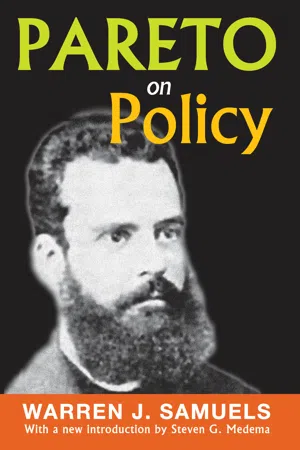
Pareto on Policy
About this book
Warren Samuels interprets Vilfredo Pareto's Treatise on General Sociology in terms of a general equilibrium model of policy. Three themes and one conviction run throughout the study. The first is a model of policy making involving three sets of variables: power, knowledge, and psychology. The second is a general equilibrium approach to the study of these variables emphasizing their fundamental interdependence. The third is the importance of Pareto's work.Pareto is one of the few individuals whose work has had enormous influence in at least three social sciences in the twentieth century: economics, sociology, and political science. Despite Pareto's attempt in the Treatise to produce a general sociology encompassing all of these sciences (as well as psychology), his work has been treated almost completely from the perspectives of the individual disciplines. This volume's interpretation is consonant with Pareto's intention in the Treatise, namely, to provide a general equilibrium model of the total socio-politico-economic decision-making or policy process.The book is directed at those who comprehend these as processes whose structure, conduct, and performance are a function of complex decision making. Social scientists and policy analysts have moved beyond models that solve problems in the abstract, without working them out through policy making in the real world. The approach outlined here is important to those who are interested in pursuing the working rules of law and morals that govern the distribution and exercise of power as well as the exercise of power that governs the development of these rules.
Chapter 1
Introduction
1. Objectives
Vilfredo Pareto has a secure albeit controversial place in the history of social thought. He was a seminal figure who influenced the direction of both economic and sociological theory. His contributions to economic analysis consisted primarily of his treatment of general economic equilibrium, including its extension to non-competitive conditions and variable coefficients of production; his ordinal-utility and indifference approach to the theory of demand; and his notion of welfare-economic optimality (or, more accurately, ophelimity). Sociologists have been primarily interested in his analysis of society as a system; his attempt at a positivist logico-experimental science of society; his theories of non-logical conduct, the residues, and derivations; and the circulation of the elite. As political sociologist, Pareto is one of the leading theoreticians and exponents of the theory of a ruling class. In addition, economists have shared with sociologists an interest in Pareto’s “law” of income distribution. In almost every aspect of his work Pareto has been penetratingly criticized, from his major substantive theorems to his concept and practice of science. On a different but not unrelated plane, many critics have been disturbed by Pareto’s relation to Mussolini and to the theory and genesis of fascism in general.
Interest in Pareto among social scientists, however, has been essentially dichotomized. In particular, there has been a substantial neglect of Pareto’s sociological analyses among economists. This neglect is regrettable, especially in light of the historical hiatus between orthodox neoclassicist and heterodox institutionalist economists. Pareto considered that market forces were part of a larger process and that the economic man was only a convenient, although important and necessary methodological, and to some extent substantively justified, abstraction. To Pareto, economics — particularly pure economic theory — was part of a larger general sociology; economic equilibrium was one facet of a more complex general social equilibrium; and economic ophelimity was one facet of generalized utility. Pareto, then, was not satisfied with analyzing the market as a self-contained process. He examined the operation of the forces and institutions of the market and the interaction between them and other social forces, institutions, and processes without making either artificially rigid. He attempted in his sociology to do for the larger matrix of forces what he had done earlier with respect to the economic. The larger general sociology, the general social equilibrium, and the itiodel of generalized utility were developed by Pareto in the major work he produced after leaving economic theory for sociology, his Treatise on General Sociology*1 Yet there is also the complaint by several sociologists, perhaps most recently Lopreato, (1965, p. 2 and passim), that Pareto’s central analytical system — as distinct from the particular theories — has been neglected and/or misunderstood among sociologists themselves.
What strikes me as being of great significance is that the general social equilibrium analysis of the Treatise may be interpreted as a particular theory of socio-economic policy and thereby is at least suggestive of the outline of a general model of socio-economic policy. The application of the Walras-Pareto general equilibrium model to micro-economics is a representation of the forces through which the economic decision-making process allocates resources through a market. Pareto’s model of the social process can be interpreted as a broader general model of policy encompassing both nominally market and socio-political forces, with greater attention given in the Treatise to the sociological than to the economic forces. Pareto’s general social system in the Treatise is an equilibrium model with an admixture of elements of both organic and mechanistic theories. But his model, generally functionalist in character, is readily restated in terms of the central problems of a general model of policy. Such a restatement is the rationale of this volume.
The objectives of this study, then, are, first and most immediately, to identify and restate the main themes of Pareto’s Treatise on General Sociology as a particular theory of socio-economic policy, and second and of broader significance, to derive insight into the fundamentals of a general model of policy. With respect to the former objective, one by-product should be a more thorough and systematic statement of Pareto’s system than is generally to be found in the sociological literature, however much the distinctive feature of the statement will lie in its interpretation as a model of policy. With respect to the latter objective, broader insight should be gained concerning the elements of a more complete general model of the economic decision-making process, and of the scope oí both policy and policy participation. Incidentally with respect to the latter objective, additional insight should be gained, first, about the artificiality of a strict market-plus-framework dichotomy for policy analysis and, second, about the relation of neoclassical to institutional analysis generally.
2. Theory of Economic Policy
The concept, theory of economic policy, emphasizes that policy is essentially choice and that the economy may be interpreted as a policy or decision-making, that is, a choosing process. Choices may be envisioned as emanating from businesses, families, universities, churches, and governments, or from particular individuals or subgroups therein. Decisions may also be envisioned as society’s effective or composite choices produced through the interaction of those institutions. Society’s economic policy issues from the total economic decision-making process. The economy, like the larger society itself, is a process through which effective decisions are reached or worked out in a continuing manner.
The scope of economic policy includes the three conventionally recognized basic economic problems of resource allocation, income distribution, and the determination of the aggregate level of income, output, employment, and prices. The economy may be functionally defined, pro tanto, in terms of the forces and institutions participating in the decision-making resolution of those problems. But the scope of economic policy also encompasses the fourth and more fundamental problem of the structuring of the economic decision-making process itself. In this and other connections the following arguments may be made: the market, considered separately, is itself a policy or decision-making process; policy encompasses more than government policy; the economic decision-making process — more extensive than the market and government — includes all forms of non-market and institutional participation; and the structuring of the economic decision-making process is a matter of policy. This latter is indeed, the fundamental level of policy.
With the scope of policy including the structuring of the decision-making process itself, the scope of policy participation encompasses nominally private-market, legal, and non-legal forces. Although traditional economic theory has been limited generally to the analysis of market forces, other bodies of thought, including institutional economics, have been attentive to the participation of both market and non-market institutions and forces in the resolution of the basic economic problems.
The problem of structuring the decision-making process is one facet of the more pervasive problem of order, which may be functionally defined as the continuing resolution of the dual basic social problems of freedom (or autonomy) and control and of continuity and change (Spengler, 1948). Indeed, in the economic realm, the problem of freedom and control takes the form of structuring the economic decision-making process, and the problem of continuity and change often reduces to the problem of restructuring the decisional process. In this and in other respects, economic policy analysis thus necessarily encompasses a theory of social control and a theory of social change. That analysis is made even more complicated inasmuch as the process frequently must at legist tend to involve both a theory of society and a theory of history (that is, of social change).
Consequently, the deepest issues of economic policy are inevitably concerned with such elemental questions of policy as whose interests, whose freedom, whose capacity to coerce, who may injure whom, whose rights, and who decides? Moreover, there is the question of specific content: the problem of applying general propositions, rules, or categories to specific instances.
One fundamental dimension pervading the nature of policy, the scope of policy and of policy participation, and the elemental questions of policy is power. The problem of structuring and restructuring the economic decision-making process — the problem of the organization and control of economic activity — is essentially a problem of the distribution of power in society. A corollary of that proposition is that the economy is essentially a system of power play, mutual coercion, or jockeying for position. Effective social choice ultimately governs the distribution of power both in society as a whole and in the institutions and relationships that comprise it.
But power is but one of three dimensions of policy. A second is knowledge. Policy is a partial function of knowledge of both reality and of values. A theory of economic policy must necessarily include a theory of the organization and application of knowledge in society and a theory of both the determination and the role of knowledge in respect to social or economic policy.
A third dimension of policy is psychology. It may be asserted simply that the participation of individuals and groups in the decision-making process is a partial function of complex individual and collective psychic states and motivations and that the effective policies that issue from the decision-making process are, pro tanto, a function of the interplay of those psychic states or postures. These conditions hold whether in the context of a corporation, a corporate board of directors, a church, a university, a university department, a family, or, mutatis mutandis, a single individual.
Policy (or decision-making), it may be said, is a function of power, knowledge, and psychology. The economist who is concerned with both the evolving structure of the economic system and the allocative and distributional consequences of the economic process must be concerned with policy as to the structure of the economic system and its operational consequences investigated in terms of power, knowledge, and psychology.
It is the premise of this study that the social equilibrium analysis of Pareto’s Treatise on General Sociology may be interpreted as a theory of economic policy. Accordingly, the nature of policy is choice, the socio-economic system is essentially a decision-making process, the choices are effective choices (as well as incrementally contributing individual choices), the scope of policy includes the structuring of the decisional process itself,.and the scope of policy participation includes both market and social forces. Moreover, Pareto’s analysis may be interpreted in terms of the dual basic social problems of freedom and control and of continuity and change as they relate to the economic decisional process. In addition, the elemental questions of policy also will be seen to emerge in the context of the foregoing. Finally, and with appropriate credit to the genius of Pareto, it will be seen that his social equilibrium system, interpreted as a theory of economic policy, postulates policy as a function of power, knowledge, and psychology. There are, therefore, in Pareto’s Treatise the basic problems, elemental questions, and general dimensions of a theory or model of economic policy.
In the remaining section of this chapter, Pareto’s general system in the Treatise will be characterized and outlined. Part One (chapters two through four) will attempt to identify the three dimensions of policy as derived from Pareto’s system. Chapter five of Part Two will attempt to chart the making of policy through the interaction of power, knowledge, and psychology as developed in the Treatise. Chapters six and seven, also in Part Two, will survey the problems of freedom and control and of continuity and change as they are manifest in the Treatise and in the foregoing analysis. Chapter eight will present a partial summary and conclusions.
Before proceeding, a brief digression will be taken. It is one which is highly appropriate in view of the marginalist and equilibrium character of Pareto’s economic and social analysis.
The making of policy, including society’s economic policy, is a complex process. Policy questions are not generally solved either in toto or once and for all time. One does not solve the farm problem, poverty, or air pollution, at one fell swoop; nor does one establish “freedom,” “justice,” or “security” in one blow. The latter are, for example, problems of policy on an abstract level. Although they are frequently discussed and argued in absolutist and universalist language, in the real world they are multifaceted and are worked out or resolved only incrementally, gradually, and contingently. Economic policy making thus may be characterized as a multivariable system of interdependent variables with magnitudes of possible marginal adjustments (both intensive and extensive) and equilibrium positions theoretically approaching infinity. As Lindblom (1958) has pointed out definitively, policy making is in fact incremental, and policy analysis accordingly should be in-crementalist.
The present author is in definite accord with this view. The opinion that there are certain abstract problems (freedom and control and continuity and change), certain elemental problems, and certain dimensions of policy generic to policy qua policy is supplementary not contradictory to the view of Lindblom. The incrementalist analysis of policy can be, and should be, conducted in terms of the problems, elemental questions, and dimensions of a general model of policy; that is, analysis along the lines of such a general model of policy usually must be incrementalist or as incrementalist as the situation warrants or allows. Incremental analysis in the context of such a general model of policy will be seen below to be highly appropriate to the social equilibrium theory of Pareto’s Treatise.
In addition, it should be pointed out that Pareto attempted in his Treatise to create what appears to be a rather grandiose general schema. It is a general social equilibrium model of rather delusive grandeur. In economics, the Walrasian and Paretian general equilibrium model provided an integrating vehicle for many hitherto divergent strands of microeconomic theory. It also provided an heuristic organon for the exploration of new fields and new aspects of old fields. Insofar as traditional economic theory is itself a general model for policy analysis, those roles of general equilibrium theory are even more significant (Lindblom, 1958, p. 299). Another and particularly instructive example, found in sociology, is the effort of Talcott Parsons (among others) to construct a general theory of action. It is particularly instructive because Parson’s (1937) initial effort in this cause involved an integration of the work of several forerunners, including Pareto (the others being Alfred Marshall, Emile Durkheim, and Max Weber). Such general models, far from necessarily precluding or hindering, enhance the development of what Merton calls middle-range theories through provision of integrative and interpretive insight (Merton, 1949). Moreover, they are important on their own level of generality.
Still, a sense of perspective and proportion must be retained. In studying any particular theory of economic policy it must be recognized that very real difficulties exist for at least two reasons. First, the construction and interpretation, if not the application, of a theory of policy strongly tends to involve both a theory of society and a theory of history. Second, no theory of policy can be fully specified (Samuels, 1966, pp. 215ff, 286ff). The world is comprised of more specifics than any general theory or model of policy can incorporate, and policy ultimately is s matter of specific content (Samuels, 1966, pp. 129-135, 146, 171-172, 209-223, 263-264, 285-286). That content is worked out in the real world of decision-making, which is to say, in the interrelations of power, knowledge, and psychology.
3. Pareto’s General System
Pareto’s general aim in the Treatise was in principle rather ambitious. His objective was to identify the “forms” that society takes (that is, the basic organization and structure of society), how those forms are determined, and the manner in which variations in the form of society take place (Sees. 15,145,1770). The Treatise was an attempt to develop a general theory of society and a general theory of social change and to integrate them so as to throw in relief the major variables operating upon the organization of society over time. According to Pareto, earlier sociologists and other writers ignored or neglected these fundamental subjects, and their systems and theories, accordingly, are deficient, incomplete, and superficial. It will be seen below that Pareto sketched a general model of the forces or variables involved in the organization and reorganization of society and then concentrated on the several variables which he considered most important to the sociologist.
In Pareto’s view, sociology was a general, that is abstract (Sec. 144; cf. Lopreato, 1965, p. 28), synthesis of all the disciplines studying human society: law, political economy, political history, the history of religions, etc. Pareto thought it would be impossible and perhaps even undesirable to specify any very strict definition. Nomenclature and compartmentalization are matters of convenience and, therefore, arbitrary, and change over time (Sec. 1). But the basic objective of Paretian sociology is clear. General sociology would have its own distinctive problem and heuristic function: to construct a general model of social organization and change which was important in its own regard and level of abstraction and which would function as a framework within which the more specialized disciplines could be developed.
Pareto never denigrated economics; he stressed its importance as a separate science (Pareto, in Hamilton, 1962, p. 49). Economics concer...
Table of contents
- Cover Page
- Title Page
- Copyright
- Contents
- Introduction to the Transaction Edition
- Preface
- 1. Introduction
- Part One: The Three Dimensions of Policy
- Part Two: The Making of Policy
- Notes
- References
- Name index
- Subject index
Trusted by 375,005 students
Access to over 1.5 million titles for a fair monthly price.
Study more efficiently using our study tools.
Frequently asked questions
Yes, you can cancel anytime from the Subscription tab in your account settings on the Perlego website. Your subscription will stay active until the end of your current billing period. Learn how to cancel your subscription
No, books cannot be downloaded as external files, such as PDFs, for use outside of Perlego. However, you can download books within the Perlego app for offline reading on mobile or tablet. Learn how to download books offline
Perlego offers two plans: Essential and Complete
- Essential is ideal for learners and professionals who enjoy exploring a wide range of subjects. Access the Essential Library with 800,000+ trusted titles and best-sellers across business, personal growth, and the humanities. Includes unlimited reading time and Standard Read Aloud voice.
- Complete: Perfect for advanced learners and researchers needing full, unrestricted access. Unlock 1.5M+ books across hundreds of subjects, including academic and specialized titles. The Complete Plan also includes advanced features like Premium Read Aloud and Research Assistant.
We are an online textbook subscription service, where you can get access to an entire online library for less than the price of a single book per month. With over 1.5 million books across 990+ topics, we’ve got you covered! Learn about our mission
Look out for the read-aloud symbol on your next book to see if you can listen to it. The read-aloud tool reads text aloud for you, highlighting the text as it is being read. You can pause it, speed it up and slow it down. Learn more about Read Aloud
Yes! You can use the Perlego app on both iOS and Android devices to read anytime, anywhere — even offline. Perfect for commutes or when you’re on the go.
Please note we cannot support devices running on iOS 13 and Android 7 or earlier. Learn more about using the app
Please note we cannot support devices running on iOS 13 and Android 7 or earlier. Learn more about using the app
Yes, you can access Pareto on Policy by Warren Samuels in PDF and/or ePUB format, as well as other popular books in Economics & Economic Theory. We have over 1.5 million books available in our catalogue for you to explore.