- 209 pages
- English
- ePUB (mobile friendly)
- Available on iOS & Android
eBook - ePub
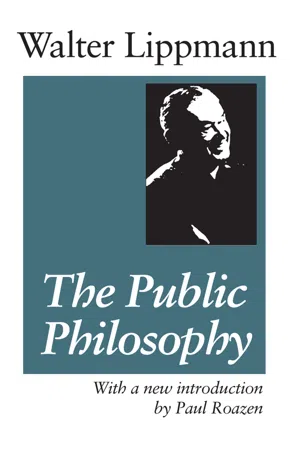
The Public Philosophy
About this book
Begun in 1938 and completed only in 1955, The Public Philosophy offers as much a glimpse into the private philosophy of America's premier journalist of the twentieth century as it does a public philosophy.The basis of Lippmann's effort is ""that there is a deep disorder in our society which comes not from the machinations of our enemies and from the adversaries of the human condition but from within ourselves."" He also provides a special sort of legacy to liberalism in its broadest sense - as the root approach to human existence that could provide civility and accommodation against incivilities and extremism, and that uniquely stood against the totalitarian counter-revolutions from Jacobism to Leninism. This work is a masterful defense of the public philosophy as a constitutional tradition, and can be easily read as such today.Paul Roazen, long identified with the analysis of Lippmann's work, points out that no matter how trenchantly Lippmann dissected democracy, and the populist faith in the people's wisdom, he still sought to study the world in order to help govern it. His constant flow of journalistic writing had the educative intent of raising the level of the public's knowledge. His rationalist conviction that clearheadedness on public matters can be effectively relayed to people is nowhere more evident than in The Public Philosophy. In this sense it is an argument for the democratic ideal that people can be rallied in defense of the public interest.
Information
CHAPTER I
The Obscure Revolution
1. My Reason for Writing This Book
DURING the fateful summer of 1938 I began writing a book in an effort to come to terms in my own mind and heart with the mounting disorder in our Western society. I was living in Paris at the time, and I had learned that the decision had been taken which was soon to lead Mr. Chamberlain and Monsieur Daladier to Munich. Little hope remained that another world war could be averted except by abject surrender, and yet there was no sure prospect that France and Great Britain would be able to withstand the onslaught that was coming. They were unprepared, their people were divided and demoralized. The Americans were far away, were determined to be neutral, and were unarmed. I was filled with foreboding that the nations of the Atlantic Community would not prove equal to the challenge, and that, if they failed, we should lose our great traditions of civility,1 the liberties Western man had won for himself after centuries of struggle and which were now threatened by the rising tide of barbarity.
I began writing, impelled by the need to make more intelligible to myself the alarming failure of the Western liberal democracies to cope with the realities of this century. I had done a draft of the book when the fall of France made it evident that we, too, must soon be engaged and, moreover, engaged alone if the Battle of Britain was lost.
But at this time the American people were as unprepared in their minds as in their military establishment. Could the democracies be rallied, could they be collected and nerved for the ordeal so that they would be equal to this mortal challenge? They had the superior assets. They had the numbers, the resources, the influence. But did they have the insight, the discipline to persevere, and the resolution to go through with it? Though they had the means, did they also have the will, and did they still know how? A second world war was making up out of the ruins and the failures of the first, and there was nothing to show that the Western democratic governments were in control of their affairs and capable of making the necessary decisions. They were reacting to events and they were not governing them. Could they avoid defeat and conquest without an exhaustion which would rend the fabric of Western society, without enormities of suffering which would alienate the masses of the people, and without resorting to measures of violence which might become inexpiable? They were so very late, and they were becoming engaged in they knew not what. They had refused to take in what they saw, they had refused to believe what they heard, they had wished and they had waited, hoping against hope.
It did not come easily to one who, like myself, had known the soft air of the world before the wars to recognize and acknowledge the sickness of the Western liberal democracies. Yet as we were being drawn unready and unarmed into the second of the great wars, there was no denying, it seemed to me, that there is a deep disorder in our society which comes not from the machinations of our enemies and from the adversities of the human condition but from within ourselves. I was one of a large company who felt that way. Never doubting that the utmost resistance was imperative and that defeat would be irreparable and intolerable, they were a company who knew in their hearts that by total war our world could not be made safe for democracy nor for the four freedoms. We were, I had come to see, not wounded but sick, and because we were failing to bring order and peace to the world, we were beset by those who believed they have been chosen to succeed us.
2. 1917: The Revolutionary Year
IN DECEMBER 1941 I put the manuscript away, knowing that so much was going to happen to the world and to me that if ever I went back to the book, it would be to start all over again. When I did come back to it after the war, the foreboding which had inspired it was in a terrible measure realized. Something had gone very wrong in the liberal democracies. They had, to be sure, defeated their enemies. They had avoided defeat and subjection. But they were unable to make peace and to restore order. For the second time in a generation they had failed to prevent a ruinous war, they had been unwilling to prepare themselves to wage the war, and when at long last and at exorbitant cost they had managed to defeat their enemies, they had been unable to make peace out of their victories. They were entangled in a vicious circle of wars that led to ever bigger and wider wars. Could it be denied that they were sick with some kind of incapacity to cope with reality, to govern their affairs, to defend their vital interests and, it might be, to insure their survival as free and democratic states?
There was no mistaking the decline of the West. Thirty years after Wilson had proclaimed a world at peace under democratic governments, the North Atlantic democracies were preoccupied with the defense of western Europe and the fringes of the Eurasian continent. In less than half a century it had come to that. In 1900 men everywhere on earth had acknowledged, even when they resented, the primacy of the Western nations. They were the recognized leaders in the progress of mankind, and it was taken as axiomatic that the question was when, and not whether, the less advanced people would have learned how to use the Western technology, to hold free elections, to respect the Bill of Rights and to live by its political philosophy. Until 1917 the model for a new government anywhere in the world, even in Russia, was liberal democracy in the British, the French, or the American style.
But by the end of 1920 things had taken a sharp turn. Lord Bryce was then finishing his Modern Democracies, and though he still wrote in the prewar manner that democracy was spreading and that the number of democracies in the world had doubled within fifteen years, he had seen the warning signs and he was troubled. It might not be “really helpful to the younger generation,” he wrote in the preface, but he could not “repress the pessimism of experience.” He had to say that “although democracy has spread, and although no country that has tried it shows any signs of forsaking it, we are not yet entitled to hold with the men of 1789 that it is the natural and, therefore, in the long run, the inevitable form of government. Much has happened since the rising sun of liberty dazzled the eyes of the States-General at Versailles. Popular government has not yet been proved to guarantee, always and everywhere, good government. If it be improbable, yet it is not unthinkable that, as in many countries impatience with tangible evils substituted democracy for monarchy or oligarchy, a like impatience might someday reverse the process.”2
Three years later Mussolini marched on Rome, and Italy became the first of the bigger democracies “to reverse the process.” In retrospect we can now see that what Lord Bryce, writing at the end of the First World War, thought was the pessimism of experience was in fact the intuition of a sensitive and knowing observer. He had felt in his bones, being too close to the event to perceive it, that a fundamental change in the prospects of democracy was in the making.
There had occurred, I now believe, an unrecognized revolution within the democratic states. By the third year of the First World War the cumulative losses had become so exorbitant that the institutional order of all the belligerents gave way under the stress and strain. The war had become, in Ferrero’s telling phrase, hyperbolic, and the prewar governments were incapable of imposing such unlimited drafts upon the endurance and the loyalties of the people. In the defeated countries the price of this was revolution against the established order. The Romanoff, the Hohenzollern, the Hapsburg and the Ottoman Empires collapsed. In the victorious countries institutions were not overthrown, rulers were not exiled, imprisoned or executed. But the constitutional order was altered subtly and yet radically, within itself.
3. Internal Revolution in the Democracies
A VIGOROUS critic of democracy, Sir Henry Maine, writing in 1884 just as England was about to adopt general manhood suffrage, observed that “there could be no grosser mistake” than the impression that “Democracy differs from Monarchy in essence.” For “the tests of success in the performance of the necessary and natural duties of a government are precisely the same in both cases.” 3 These natural and necessary duties have to do with the defense and advancement abroad of the vital interests of the state and with its order, security, and solvency at home. Invariably these duties call for hard decisions. They are hard because the governors of the state must tax, conscript, command, prohibit; they must assert a public interest against private inclination and against what is easy and popular. If they are to do their duty, they must often swim against the tides of private feeling.
The hardness of governing was little realized in the early 1900’s. For more than half a century, while democracy was making its historic advance, there had been a remarkable interlude during which the governments rarely had to make hard decisions. Since Waterloo there had been no world war, and after the American Civil War only a few short and localized wars. It was a time of expansion, development, liberation; there were new continents to be colonized and there was a new industrial system to be developed. It seemed as though mankind had outlived the tempests of history. The governments — which were increasingly democratic, liberal and humane—were spared the necessity of dealing with the hard issues of war and peace, of security and solvency, of constitutional order and revolution. They could be concerned with improvements, with the more and more and the better and better. Life was secure, liberty was assured, and the way was open to the pursuit of private happiness.
In this long peace, the liberals became habituated to the notion that in a free and progressive society it is a good thing that the government should be weak. For several generations the West had flourished under governments that did not have to prove their strength by making the hard decisions. It had been possible to dream, without being rudely awakened, that in the rivalry of the diverse interests all would somehow come out for the best. The government could normally be neutral and for the most part it could avoid making positive judgments of good and bad and of right and wrong. The public interest could be equated with that which was revealed in election returns, in sales reports, balance sheets, circulation figures, and statistics of expansion. As long as peace could be taken for granted, the public good could be thought of as being immanent in the aggregate of private transactions. There was no need for a governing power which transcended the particular interests and kept them in order by ruling over them.
All this was only, as we now know, a daydream during a brief spell of exceptionally fine weather. The dream ended with the outbreak of the First World War. Then we knew that the Age of Progress had not reformed the human condition of diversity and conflict; it had not mitigated the violence of the struggle for survival and domination.
In fact, the violence was intensified and extended as never before. The expansion and development during the peaceful decades had wrought, as Graham Wallas pointed out on the eve of the war, “a general change of social scale,”4 and that change of scale had revolutionary consequences. The forty years which separated the Franco-Prussian War from the First World War were, says John U. Nef, “in terms of material welfare…the most successful years in history…In little more than one generation the world’s population grew by almost as much as it had grown during the untold generations which separate Adam, the first man, from Newton, the first man of science of the seventeenth century. According to the enterprising calculations of Colin Clark, the real income per person gainfully employed improved 75 per cent or more from 1870 to 1914, while the hours of work were substantially reduced in the wealthier countries of Western Europe…and in North America.”5
Because of the increase in the population, in the volume of production, and in the destructiveness of weapons, the war which brought to an end the Age of Progress had, says Nef, “none of the limiting features of the warfare which had been characteristic of Newton’s age. Europe could now afford enormous armies, could replenish and supply them again while the fighting proceeded. More money was needed to kill than ever before, but the money required turned out to be small in comparison with the money that could be raised (with the help of refined advances in the use and manipulation of credit), and in relation to the quantity of munitions which money and credit could buy.” All this meant that when war broke out again, the advanced nations had become, as Nickerson says, “capable of sacrifices so irrationally great that the bleeding victor would faint upon the corpse of his victim.”6
The strain of the war worked up a menacing popular pressure upon the weak governments. We can, I think, point to 1917 as the year when the pressure became so strong that the institutional framework of the established governments broke under it.
The strain became unbearable. 1917 was the year of the two Russian revolutions. It was the year of the American involvement which brought with it the declaration of the Wilsonian principles. For Italy it was the year of Caporetto. For Austria-Hungary it was the beginning of the end under the successor of Francis Joseph. For Germany it was the year of the July crisis and of the need of the Prussian monarchy to listen to the Reichstag and its demand for a negotiated peace. For France it was the year of the mutinies, and for Britain the year of mortal peril from the submarine. In eastern and central Europe tortured and infuriated masses brought down the historic states and the institutions of the old regime. In western Europe and in North America the breakthrough took the form — if I may use the term — of a deep and pervasive infiltration. Behind the façade, which was little changed, the old structure of executive government with ...
Table of contents
- Cover
- Half Title
- Title Page
- Copyright Page
- Dedication
- Table of Contents
- Introduction to the Transaction Edition
- Book One. The Decline of the West
- Chapter 1. The Obscure Revolution
- Chapter 2. The Malady of Democratic States
- Chapter 3. The Derangement of Powers
- Chapter 4. The Public Interest
- Chapter 5. The Two Functions
- Chapter 6. The Totalitarian Counter revolution
- Chapter 7. The Adversaries of Liberal Democracy
- Book Two. The Public Philosophy
- Chapter 8. The Eclipse of the Public Philosophy
- Chapter 9. The Renewal of the Public Philosophy
- Chapter 10. The Two Realms
- Chapter 11. The Defense of Civility
- Index
Trusted by 375,005 students
Access to over 1.5 million titles for a fair monthly price.
Study more efficiently using our study tools.
Frequently asked questions
Yes, you can cancel anytime from the Subscription tab in your account settings on the Perlego website. Your subscription will stay active until the end of your current billing period. Learn how to cancel your subscription
No, books cannot be downloaded as external files, such as PDFs, for use outside of Perlego. However, you can download books within the Perlego app for offline reading on mobile or tablet. Learn how to download books offline
Perlego offers two plans: Essential and Complete
- Essential is ideal for learners and professionals who enjoy exploring a wide range of subjects. Access the Essential Library with 800,000+ trusted titles and best-sellers across business, personal growth, and the humanities. Includes unlimited reading time and Standard Read Aloud voice.
- Complete: Perfect for advanced learners and researchers needing full, unrestricted access. Unlock 1.5M+ books across hundreds of subjects, including academic and specialized titles. The Complete Plan also includes advanced features like Premium Read Aloud and Research Assistant.
We are an online textbook subscription service, where you can get access to an entire online library for less than the price of a single book per month. With over 1.5 million books across 990+ topics, we’ve got you covered! Learn about our mission
Look out for the read-aloud symbol on your next book to see if you can listen to it. The read-aloud tool reads text aloud for you, highlighting the text as it is being read. You can pause it, speed it up and slow it down. Learn more about Read Aloud
Yes! You can use the Perlego app on both iOS and Android devices to read anytime, anywhere — even offline. Perfect for commutes or when you’re on the go.
Please note we cannot support devices running on iOS 13 and Android 7 or earlier. Learn more about using the app
Please note we cannot support devices running on iOS 13 and Android 7 or earlier. Learn more about using the app
Yes, you can access The Public Philosophy by Hans Eysenck,Walter Lippmann in PDF and/or ePUB format, as well as other popular books in Politica e relazioni internazionali & Conservatorismo e liberalismo. We have over 1.5 million books available in our catalogue for you to explore.