- 336 pages
- English
- ePUB (mobile friendly)
- Available on iOS & Android
eBook - ePub
About this book
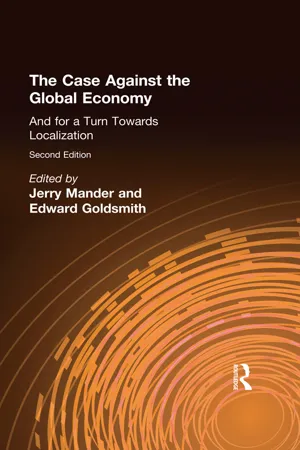
The greatest political debate of our time is about the blind rush towards a single global economy, its consequences for jobs, democracy, human well-being and cultural diversity, and its impact on the natural world that sustains us. Its effects will be profound and irreversible, but globalization itself is not inevitable. In The Case Against the Global Economy, 24 leading economic, agricultural, cultural and environmental authorities, drawn from across the world, argue that free trade and economic globalization are producing exactly the opposite results to those promised. From a detailed analysis of the new global economy, its structures and its full social and ecological implications, they show how it is undermining our liberty, our security and our well-being, and is devastating the planet. First published in the USA in 1996, in an edition focused on North America, the book won the American Political Science Association award for the Best Book in Ecological and Transformational Politics. This completely revised and updated international edition presents a passionate and persuasive case for the need to reverse course, away from globalization and towards a revitalized democracy, local self-sufficiency and ecological health.
Part 1
Engines of Globalization
Chapter 1
Development as Colonialism
The massive effort to industrialize the developing world in the years since World War II was not motivated by purely philanthropic considerations, but by the need to bring the developing world into the orbit of the Western trading system in order to create an everexpanding market for the West’s goods and services and to gain a source of cheap labour and raw materials for its industries. This was also the goal of colonialism, especially during its last phase which started in the 1870s. For that reason, there is a striking continuity between the colonial era and the era of development, both in the methods used to achieve their common goal and in the social and ecological consequences of applying them. With the development of the global economy, we are entering a new era of corporate colonialism that could be more ruthless than the colonialism that preceded it.
Edward Goldsmith is the founder of The Ecologist magazine (founded in 1969) and is author and coauthor of a number of books including A Blueprint for Survival (with Robert Allen, Tom Stacy Ltd, 1972), A Stable Society (Wadebridge Ecological Centre, 1978), The Social and Environmental Effects of Large Dams (with Nicholas Hildyard, Sierra Club Books, 1985) and The Way: An Ecological Worldview (Rider Books, 1992). He has taught courses at Michigan University at Ann Arbor and at what is now the University of Illinois at Springfields. He received the Honorary Right Livelihood Award in Stockholm in 1984 and is a member of the board of the International Forum on Globalization.
It is customary to trace the origin of the idea of development to a statement made by US President Harry Truman in 1949, who, in his inauguration speech before Congress, drew the attention of his audience to conditions in poorer countries and defined them for the first time as ‘underdeveloped areas’. Truman may have formulated the idea of development in a new way, but it is an old idea, and the path along which it is leading the countries of the developing world is a well-trodden one.
As François Partant, the French banker-turned-archcritic of development, has put it:
‘The developed nations have discovered for themselves a new mission – to help the Third World advance along the road to development … which is nothing more than the road on which the West has guided the rest of humanity for several centuries.’ (Partant, 1982)
The thesis of this article is that Partant was right. Development is just a new word for what Marxists call imperialism and what we can loosely refer to as colonialism – a more familiar and less loaded term.
A quick look at the situation in the developing world today undoubtedly reveals the disquieting continuity between the colonial era and the era of development. There has been no attempt by the governments of the newly independent countries to re-draw their frontiers. No attempt has been made to restore precolonial cultural patterns. With regards to the key issues of land use, the colonial pattern has also been maintained. As Randall Baker notes, ‘Essentially the story is one of continuity’ (Baker, 1984), while the peasants, who as Erich Jacoby writes, ‘identified the struggle for national independence with the fight for land’ never recovered their land. ‘National independence simply led to its take-over by a new brand of colonialists’ (Jacoby, 1961).
SAME GOALS
If development and colonialism (at least, in its last phase from the 1870s onwards) are the same process under a different name, it is largely that they share the same goal. This goal was explicitly stated by its main promoters. For instance, Cecil Rhodes – Britain’s most famous promoter of colonialism in the 1890s – declared that:
‘We must find new lands from which we can easily obtain raw materials and at the same time exploit the cheap slave labour that is available from the natives of the colonies. The colonies would also provide a dumping ground for the surplus goods produced in our factories.’
Similar sentiments were expressed openly during the late 1800s by Lord Lugard, the English governor of Nigeria, and by former French president Jules Ferry.
But many countries in Asia and elsewhere were simply not willing to allow Western powers access to their markets or to the cheap labour and raw materials required. Nor were they willing to allow corporations to operate on their territory and undertake large-scale development projects such as road building and mining.
In Asia a small number of states were eventually bullied into complying with Western demands. Thus, in 1855, Siam signed a treaty with Britain, as did Annam with France in 1862. However, China was not interested, and two wars had to be fought before it could be persuaded to open its ports to British and French trade. Japan also refused, and only the threat of an American naval bombardment persuaded its government to open its ports to Western trade.
By 1880, European powers had obtained access to the markets of most of Asia’s coastal regions, having negotiated special conditions for expatriate residents, such as greater freedom of activity within the countries concerned and the right to build railways and set up enterprises inland.
However, just as is the case today, commercial interests continued to demand and often obtained ever more comprehensive concessions, creating ever more favourable conditions for European corporations. Eventually, in China, Western commercial activities, as Harry Magdoff notes, largely ‘escaped China’s laws and tax collections. Foreign settlements had their own police forces and tax systems, and ran their own affairs independently of nominally sovereign China’ – a situation reminiscent of what goes on today in the developing world’s free trade zones.
‘At the same time, the opium trade which had been forced on the Chinese government militarily was legalized, customs duties reduced, foreign gunboats patrolled China’s rivers and foreigners were placed on customs-collection staffs to ensure that China would pay the indemnities imposed by various treaties.’ (Magdoff, 1978)
In Egypt, Britain and France managed to obtain even more favourable conditions for their commercial enterprises by imposing the famous ‘capitulations’ on the Ottoman sultan which provided all sorts of concessions to foreigners operating within his empire. In Egypt, they could import goods at the price they saw fit, they were largely exempt from taxes and constituted a powerful pressure group well capable of defending its commercial interests and of ensuring that the interest on the Egyptian bonds of which they were the principal holders was regularly paid. Throughout the non-industrial world, it was only if such conditions could no longer be enforced, usually when a new nationalist or populist government came to power, that formal annexation was resorted to. As D K Fieldhouse puts it, ‘colonialism was not a preference but a last resort’ (Fieldhouse, 1984).
D C Platt, another contemporary student of 19th century colonialism, adds that colonialism was necessary ‘to establish a legal framework in which capitalist relations could operate’. If no new colonies were created in Latin America in the late 19th century, it is largely because a legal system ‘which was sufficiently stable for trade to continue was already in existence’. This was not so in Africa, where the only way to create the requisite conditions was by establishing colonial control (Platt, 1976).
Slowly, as traditional society disintegrated under the impact of colonialism and the spread of Western values, and as the subsistence economy was replaced by the market economy on which the exploding urban population grew increasingly dependent, the task of maintaining the optimum conditions for Western trade and penetration became correspondingly easier. As a result, says Fieldhouse, by the mid-20th century:
‘European merchants and investors could operate satisfactorily within the political framework provided by most reconstructed indigenous states as their predecessors would have preferred to operate a century earlier but without facing those problems which had once made formal empire a necessary expedient.’ (Fieldhouse, 1984)
In other words, formal colonialism came to an end not because the colonial powers had decided to forgo the economic advantages it provided, but because, in the new conditions, these could now largely be obtained by more politically acceptable and more effective methods.
THE ‘LEVEL’ PLAYING FIELD
This was probably clear to the foreign policy professionals and heads of large corporations that began meeting in Washington, DC, in 1939, under the aegis of the US Council on Foreign Relations, to discuss how the postwar, postcolonialist world economy could best be shaped in order to satisfy US commercial interests.
In 1941, the council formulated the concept of ‘the Grand Area’ – that area of the world that the US would have ‘to dominate economically and militarily’ to achieve its purposes, and which would have to include most of the Western hemisphere, what remained of the British Empire, the Dutch East Indies, China and Japan – and which could be expanded as circumstances allowed.
The US Department of State was also thinking along these lines and created its own Advisory Committee on Post War Foreign Policy. Like the council, with which it was in close contact, it was committed to the idea of creating a vast economic empire that would provide US corporations with the export markets they required and the necessary sources of cheap raw materials. Economic development was the means for achieving this goal and it was by promoting free trade that this could be maximized.
Free trade is said to involve competition on ‘a level playing field’, and nothing could seem fairer. However, when the strong confront the weak on a level playing field, the result is a foregone conclusion, as it was at the Bretton Woods conference in 1944 when the Allies set up the World Bank and the IMF. (The GATT was set up four years later.) At the time of that conference, in the twilight of World War II, the US totally dominated the world politico-economic scene; the European industrial powers had been ruined by the war, their economies lying in tatters, and Japan had been conquered and humiliated.
We must not forget that a century earlier, it was Britain that was preaching free trade to the rest of the world, and for the same reasons. At that time, Britain effectively dominated the world economy. Not only was a quarter of the world’s terrestrial surface under Britain’s direct imperial control, and not only did its navy control the seas, but the City of London was the world’s financial centre and was capable of financing the industrial expansion that free trade would make possible. Besides, according to Hobsbawm (1986), Britain already produced about two-thirds of the world’s coal, perhaps about half its iron, five-sevenths of its steel, half of its factory-produced cotton cloth, 40 per cent (in value) of its hardware and a little less than one-third of its manufactures. Labour in Britain was also cheap and plentiful, for the population had more than trebled since the beginning of the industrial revolution and had accumulated in the cities, while there was little social regulation to protect the rights of the workers.
In such conditions, Britain was incomparably more ‘competitive’ than its rivals and free trade was clearly the right vehicle for achieving its commercial goals. As George Lichtheim, another well-known student of imperialism, puts it:
‘A country whose industries could undersell those of its competitors was favourably placed to preach the universal adoption of free trade, and so it did – to the detriment of those among its rivals who lacked the wit or the power to set up protective barriers behind which they could themselves industrialize at a pace that suited them.’ (Lichtheim, 1971)
As a result, between 1860 and 1873, Britain succeeded in creating something not too far removed from what Hobsbawm refers to as ‘an all embracing world system of virtually unrestricted flows of capital, labour and goods’, though clearly on nothing like the scale that this is being achieved today after the signature of the GATT Uruguay Round Agreement. Only the US remained systematically protectionist, though it reduced its duties in 1832 to 1860 and again between 1861 and 1865 after the Civil War.
By the 1870s, Britain had lost its competitive edge over its rivals. Partly as a result, British exports declined considerably between 1873 and 1890, and again towards the end of the century. At the same time, between the 1870s and 1890s, there were prolonged economic depressions, which also weakened the belief in free trade. Tariffs were raised in most European countries, especially in the 1890s, though not in Belgium, The Netherlands or Britain. Companies now found their existing markets reduced by these factors and started looking abroad towards the markets of Africa, Asia, Latin America and the Pacific, which, with the development of faster and more spacious steamships, had become much more accessible. As Fieldhouse notes, if free trade did not work, the answer was to take over those countries where goods could be sold at a profit without having to worry about competition from more efficient European countries (Fieldhouse, 1984). There followed a veritable scramble for colonies. In 1878, 67 per cent of the world’s terrestrial area had been colonized by Europeans. By 1914, the figure had risen to 84.4 per cent.
SETTING UP INDIGENOUS ELITES
The most effective means of colonizing developing world countries is undoubtedly to set up a Westernized elite hooked on economic development, a process which this elite is willing to promote regardless of its adverse effects on the vast majority of its fellow citizens. This has now been very effectively achieved, and, as a result, the interests of developing world governments today, as Francois Partant says, are ‘largely antagonistic to those of the bulk of their countrymen’. The developing world elites are, in fact, the West’s representatives in the countries they dominate, probably to the same extent as were the colonial administrators that they have supplanted.
The need to create such elites was, of course, well known to the Western powers during the colonial era. During the debate in British political circles after the 1857 Indian Mutiny, the main question at issue was whether an anglicized elite favourable to British commercial interests could be created in time to prevent further uprisings. If not, it was generally conceded, formal occupation would have to be maintained indefinitely (Danaher et al, 1988).
Of course, the elite must be suitably armed if it is to impose economic development on the population, since it must necessarily lead to the expropriation and impoverishment of a very large number of people. Today, this is one of the main objects of our so-called aid programmes, some two-thirds of US aid taking the form of ‘security assistance’. This includes military training, arms and cash transfers to governments that are regarded as defending US interests.
Even food aid provided by the US is security related. US politicians have openly stated that food is a political weapon, Vice President Hubert Humphrey once declaring:
‘If you are looking for a way to get people to lean on you and to be dependent on you, in terms of their cooperating with you, it seems to me that food-dependence would be terrific.’
Most of the governments that have received security aid are military dictatorships such as those in Nicar...
Table of contents
- Cover
- Title Page
- Copyright Page
- Table of Contents
- Acknowledgements
- Acronyms and abbreviations
- Introduction: Facing the Rising Tide
- Part 1: Engines of Globalization
- Part 2: Impacts of Globalization
- Part 3: Steps Towards Relocalization
- References
- Index
Trusted by 375,005 students
Access to over 1.5 million titles for a fair monthly price.
Study more efficiently using our study tools.
Frequently asked questions
Yes, you can cancel anytime from the Subscription tab in your account settings on the Perlego website. Your subscription will stay active until the end of your current billing period. Learn how to cancel your subscription
No, books cannot be downloaded as external files, such as PDFs, for use outside of Perlego. However, you can download books within the Perlego app for offline reading on mobile or tablet. Learn how to download books offline
Perlego offers two plans: Essential and Complete
- Essential is ideal for learners and professionals who enjoy exploring a wide range of subjects. Access the Essential Library with 800,000+ trusted titles and best-sellers across business, personal growth, and the humanities. Includes unlimited reading time and Standard Read Aloud voice.
- Complete: Perfect for advanced learners and researchers needing full, unrestricted access. Unlock 1.5M+ books across hundreds of subjects, including academic and specialized titles. The Complete Plan also includes advanced features like Premium Read Aloud and Research Assistant.
We are an online textbook subscription service, where you can get access to an entire online library for less than the price of a single book per month. With over 1.5 million books across 990+ topics, we’ve got you covered! Learn about our mission
Look out for the read-aloud symbol on your next book to see if you can listen to it. The read-aloud tool reads text aloud for you, highlighting the text as it is being read. You can pause it, speed it up and slow it down. Learn more about Read Aloud
Yes! You can use the Perlego app on both iOS and Android devices to read anytime, anywhere — even offline. Perfect for commutes or when you’re on the go.
Please note we cannot support devices running on iOS 13 and Android 7 or earlier. Learn more about using the app
Please note we cannot support devices running on iOS 13 and Android 7 or earlier. Learn more about using the app
Yes, you can access The Case Against the Global Economy by Jerry Mander in PDF and/or ePUB format, as well as other popular books in Business & Business General. We have over 1.5 million books available in our catalogue for you to explore.