- 128 pages
- English
- ePUB (mobile friendly)
- Available on iOS & Android
eBook - ePub
About this book
When you're trying to improve quality and productivity, it's essential to target the right problems, get the right people involved in solving them, and make sure the solutions work. CEDAC will help you do all three. CEDAC, or Cause-and-Effect Diagram with the Addition of Cards, is a modification of the ""fishbone diagram,"" a standard QC tool. One of the most powerful, yet simple problem solving methods to come out of Japan (Fukuda won a Deming Prize for developing it), CEDAC actually encompasses a whole cluster of tools for continuous systematic improvement.They include: Window analysis for problem identification.The CEDAC diagram for problem analysis and development of standards.Nearly 50 illustrations and sample forms suitable for transparencies.Window development for ensuring adherence to standards.Here, in his own words, is Fukuda's how-to manual for the in-house support of improvement activities using CEDAC. Previously available only to his own clients, it provides step-by-step directions for setting up and using CEDAC. With a text that's concise, clear, and to the point. The manual is an ideal training aid.
Information
Publisher
Productivity PressYear
2018Print ISBN
9781563271403
9781138464278
Edition
1eBook ISBN
9781351462075
CHAPTER 1
The Three Driving Forces for Promoting Improvement Activity
This chapter discusses how three forces work together for continual improvement.
• Developing a Reliable System
• Creating a Favorable Environment
• Practicing Together
• Actualizing the Three Driving Forces: The CEDAC System
Developing a Reliable System
Imagine a system that could reduce the number of manufacturing defects by 50% or ensure the reduction of work-in-process and production lead time. Such a system would be ideal, if it could be used successfully by anyone (not necessarily a specific person in a specific factory), anywhere and at anytime. Management techniques such as Quality Control, Production Control, and Industrial Engineering (improvements in the workplace, not only in the manufacturing plants) developed out of needs for such a system.
Such management techniques cannot be carried out by one person; only when they are implemented by a group of people are they effective. When a group works toward the completion of a project, if there is a system that everyone can depend on, everyone’s actions become more efficient, and progress occurs according to plan.
Mere lecturing on the importance of increasing quality will not improve quality. A reliable system is necessary. And that will produce results only if everyone cooperates diligently and follows its steps.
Managerial Techniques That Work
• Management systems are tools.
• A useful tool must be applicable anywhere, anytime, and by anybody.
• An outstanding tool should work effectively on a company’s worst problems.
A useful tool must be adaptable and easy to use. For a tool to be used to its full potential, it must be made to perfectly fit the time and place of its use. When we install a new piece of equipment or use a newly bought jig or other tool, we improve it if it does not work well in our plant. Likewise, since managerial engineering is a tool, we should be able to improve and adapt it to meet our specific needs in the best possible way.
Useful Tools
• Tools must be widely applicable.
• They must satisfactorily meet the requirements of the users.
Just as it is important to technology, so it is to managerial engineering that a company possess techniques developed on its own. The CEDAC* System introduced in this book is such an original system, and a most useful tool, created out of necessity to carry out all kinds of improvement activities.
Over the years, CEDAC has been improved to become the final product discussed in this book. These modifications are based on practical experience. It can be used on any problem needing improvement, not necessarily those pertaining only to quality control.
Creating a Favorable Environment
Creating an environment that produces results is the second indispensable driving force of managerial engineering. Leadership and education are two of the most vital concerns related to the development of a favorable environment for continual improvement, and both are necessary to apply the CEDAC System effectively.
Leadership: Commitment of Resources for Improvements
There is a big difference between plants in which managers and supervisors provide effective leadership and those that don’t. Those with strong leadership have a greater potential for improvement.
Since the CEDAC System is basically a group activity which involves the whole organization, the leadership of those in managerial positions becomes extremely important.
Furthermore, it is the higher managers who have the decisive power over the allocation of the necessary resources such as manpower, material, money, and time. Therefore, one of the crucial ways that leaders demonstrate their commitment is to allocate those resources properly to the company’s improvements.
Education: Density of the Improvement Force
Another essential factor related to fostering a favorable environment is the percentage of people in the group or company who have mastered the “reliable system,” the number of people who are educated about the system.
The ratio of the number of people who have mastered the reliable system to the total number of employees is the density of the improvement force. One should aim for a density of at least 10% for the best results.
If ten people are meeting to reduce defects by 50%, at least one of those ten must have the ability to lead the meeting. He or she must be able to tell the others how to use the system, designed to successfully reduce defects.
Of course, at the beginning of a project, there are many unknowns to be addressed. To avoid project members sitting around not knowing what to do, it is crucial that at least 10%, one out of every ten employees, can organize a scenario for successful improvement.
It is always important for a company to educate and train its employees. Among the so-called excellent companies, the author has not seen one that is indifferent to educational matters of this kind.
Practicing Together
The CEDAC System is a useful tool to ensure daily practice of reliable managerial engineering systems such as QC, IE, and Production Control.
For example, any golf novice will probably purchase an introductory book on golf and take lessons. However, what happens when he takes his first swing and fails miserably?
Few people would blame the book. Most people would modestly admit their own lack of practice. Then, after returning home from work, or perhaps on the weekends, they would take the time and spend part of their pocket money to practice earnestly.
In the case of management techniques, however, people often fail to read the basic instruction manuals thoroughly, or abandon them if things fail to go smoothly, even on the first try. Without sufficient practice, they might skim through several instruction manuals, one after the other, without success. In such cases, how can they ever hope to perfect their management techniques?
Skill can only be acquired when a reliable system is used in a favorable environment and practiced constantly. These are the key principles necessary in managerial engineering.
Lacking a suitably reliable system and shifting from system to system is like playing a game with constantly changing rules.
The success of a project depends on timing as well as the proper amount of the three driving forces for improvement, as illustrated in Figure 1. At the planning stage of a new project, we should examine our situation and foresee our chance of success by asking these three questions:
• Do we have a reliable system?
• Is the environment favorable?
• Have the members of the team concerned practiced the system enough?
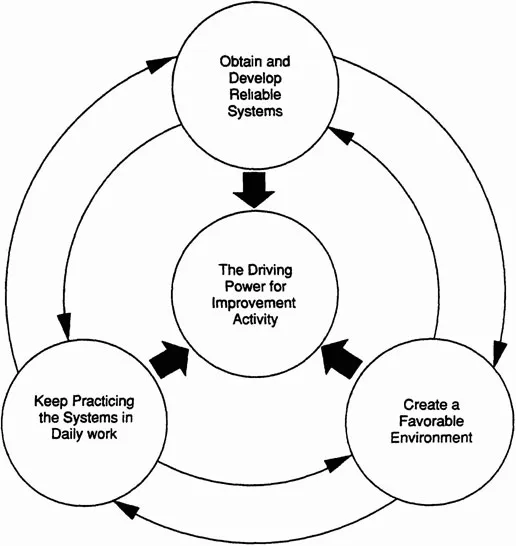
Figure 1. The Three Driving Forces
If the answers are negative, what right do we have to expect success? The combined strength of the system, the environment, and the skill of the project team must outweigh the difficulty of the project. This is the key to success.
Another extremely important condition for success is the degree of worker involvement in improvement activities. We can attain greater results when everyone participates than when only managers and professional staff are involved in improvements. In order to facilitate worker involvement, we have devised simple and easy-to-use systems for improvement activities.
Traditionally, managers and staff have been responsible for making improvements. It was a big revolution to change the approach to involve every worker in improvement activities as well. Constant practice in daily work is the key to successful involvement of the whole workforce.
The article included as the Appendix of this book offers case studies of successful applications of the CEDAC System. Based on actual data, the article demonstrates the importance of worker involvement for success.
Each improvement the first line workers bring about may not be significant in itself. However, no matter how slight it may be, it adds a competitive advantage. Competitiveness is built on the consideration of such slight differences. What makes a company excellent in the long run is competitiveness built up by valuing every possible improvement margin.
The following story makes the point:
Two men were hiking along a mountain path when they encountered a large bear. One man quickly took off his hiking boots and put on a pair of running shoes. Watching him, the other man said, “That can’t possibly save you. After all, the bear is familiar with these mountain paths, and is certainly much quicker than you.” The man wearing the running shoes said, “That doesn’t matter, as long as I can outrun you! ”
The CEDAC system described in this textbook serves the function of the running shoes. Hopefully, this book will help you use the system more effectively and obtain excellent results.
Actualizing the Three Driving Forces: The CEDAC System
The three driving forces have been explained. But, especially for those practitioners who may feel that you know too well what “must be done” or what “should be done,” the important question is how to materialize these forces.
The CEDAC system is an extremely effective tool for generating these three ...
Table of contents
- Cover
- Half Title
- Title Page
- Copyright Page
- Table of Contents
- List of Figures
- Publisher’s Foreword
- Author’s Preface
- Chapter 1. The Three Driving Forces for Promoting Improvement Activity
- Chapter 2. Window Analysis: Accurate Fact-finding for Preventive Countermeasures
- Chapter 3. Establishing Standards (Right Methods) for Everyone to Use
- Chapter 4. Knowing and Adhering to the Standard (Right Method)
- Appendix
- Notes
- About the Author
- CEDAC Analysis Forms
Trusted by 375,005 students
Access to over 1.5 million titles for a fair monthly price.
Study more efficiently using our study tools.
Frequently asked questions
Yes, you can cancel anytime from the Subscription tab in your account settings on the Perlego website. Your subscription will stay active until the end of your current billing period. Learn how to cancel your subscription
No, books cannot be downloaded as external files, such as PDFs, for use outside of Perlego. However, you can download books within the Perlego app for offline reading on mobile or tablet. Learn how to download books offline
Perlego offers two plans: Essential and Complete
- Essential is ideal for learners and professionals who enjoy exploring a wide range of subjects. Access the Essential Library with 800,000+ trusted titles and best-sellers across business, personal growth, and the humanities. Includes unlimited reading time and Standard Read Aloud voice.
- Complete: Perfect for advanced learners and researchers needing full, unrestricted access. Unlock 1.5M+ books across hundreds of subjects, including academic and specialized titles. The Complete Plan also includes advanced features like Premium Read Aloud and Research Assistant.
We are an online textbook subscription service, where you can get access to an entire online library for less than the price of a single book per month. With over 1.5 million books across 990+ topics, we’ve got you covered! Learn about our mission
Look out for the read-aloud symbol on your next book to see if you can listen to it. The read-aloud tool reads text aloud for you, highlighting the text as it is being read. You can pause it, speed it up and slow it down. Learn more about Read Aloud
Yes! You can use the Perlego app on both iOS and Android devices to read anytime, anywhere — even offline. Perfect for commutes or when you’re on the go.
Please note we cannot support devices running on iOS 13 and Android 7 or earlier. Learn more about using the app
Please note we cannot support devices running on iOS 13 and Android 7 or earlier. Learn more about using the app
Yes, you can access Cedac by Ryuji Fukuda in PDF and/or ePUB format, as well as other popular books in Business & Human Resource Management. We have over 1.5 million books available in our catalogue for you to explore.