- 256 pages
- English
- ePUB (mobile friendly)
- Available on iOS & Android
eBook - ePub
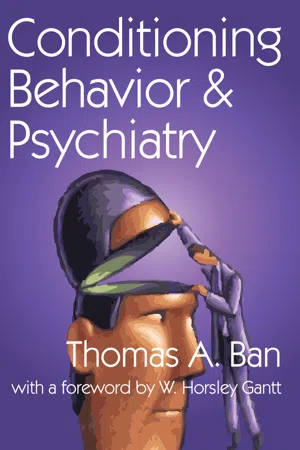
Conditioning Behavior and Psychiatry
About this book
Conditioning is one of the core methods of psychiatry. It is a behavioral method, with a stimulus-response constellation. The stimulus itself can be measured, changed, and combined, and the responses can be measured qualitatively and quantitatively. Conditioning uses the conditional reflex phenomenon. During the conditioning procedure, responses to certain stimuli are acquired where no responses existed previously. Over time behavioral conditioning expanded to include neurophysiological aspects and has been correlated with psychic manifestations. This comprehensive work deals with the conditioning method, covering fully its behavioral, neurophysiological, and psychiatric aspects.The volume is divided into five parts. Part I summarizes present-day knowledge on the neurophysiology of conditioning. Part II sets out the historical sequence in the correlation between psychopathology and pathological brain functions. Part III describes the best-known conditioning techniques applied in human testing, particularly those which are applicable for diagnostic purposes, is discussed. Part IV is concerned with clinical applications of the method and discusses the findings and the implications that it has for psychopathology and therapy or, in general, for psychiatry. Part V contains a critical evaluation of the matter presented, followed by a bibliography and index."Conditioning Behavior and Psychiatry" describes the development of conditioning procedures since the concept was first introduced. It is primarily concerned with the analysis of elementary and complex behavioral observations, of neurophysiological and neuropathological discoveries as seen from the standpoint of psychiatric disorders. The psychiatric view presented is, not purely the Pavlovian, but a modern approach to psychiatry stemming from a Pavlovian orientation.
Information
Part One
From Overt Behavior to Neurophysiology
1
Introduction and Historical Background
CONDITIONING is a method that utilizes what has come to be known as the “conditional reflex phenomenon.” The following definition is given in the Oxford English Dictionary: “Conditional: subject to, depending on, or limited by, one or more conditions, not absolute.” For our purposes conditioning may be described as referring to the learning of some particular response. The conditional stimulus is one that was originally ineffective but that, after being paired with an unconditional stimulus, evokes the conditional response.
The first description of this phenomenon may be traced to an observation made in 1852 by Bidder and Schmidt. In the course of their experiments they discovered that teasing a dog with food led to gastric secretion. About the same time a similar observation was made by Claude Bernard. He noticed, while collecting gastric secretion from a horse, that after several repetitions the mere fact of his entering the stable provided sufficient stimulus to induce gastric secretion. Further observations of a similar kind were reported by Thorndike. All these phenomena remained a matter of mere academic interest until Pavlov together with Shoomova-Simanovskaya experimented with sham feeding of an esophagotomized dog in the early years of the twentieth century. The observation that mere sham feeding produced gastric secretion turned Pavlov’s interest to what he termed “psychic secretion.” Assisted by Wolfson and Snarski, he began to investigate these phenomena. The term “psychic secretion” was to be replaced sometime later by the term “conditional reflex” secretion. The word “reflex” is defined as “involuntary action of muscle, gland, or other organ, caused by the excitation of a sensory nerve being transmitted to a nerve centre and thence ‘reflected’ along an efferent nerve to the organ in question” (Oxford Dictionary).
The process by which Pavlov deduced the term “conditional reflex” followed these lines. The occurrence of gastric secretion required direct stimulation (food); sham feeding of an eso-phagotomized dog also produced secretion, the secretion this time being obtained without actual stimulation of the stomach by food. Secretion was thus induced by the indirect stimulation of the stomach through the visual, olfactory, or gustatory characteristics of the food by the highest centers of nervous activity. This model was made the basis for his concept of “conditional reflex action.”
The conditional reflex phenomenon had been known, but not referred to as such, before Pavlov’s time. Bidder and Schmidt inferred a connection between behavior and cerebral activity from their observations of intact animals. Thorndike and his school (Yerkes, Watson, Parker, etc.) worked along the same lines, and their experiments constituted a major step forward. Perhaps the basic contribution made by Pavlov, and one which set the stage for further progress, was his adoption of the principle that in any experiment there should be only one variable, which could be measured against a controlled background. This basic principle had not been adhered to prior to Pavlov’s time; never had one simple measurable behavioral function been isolated and then exposed alone to investigation. It becomes apparent then that Pavlov’s success lay in his ability to reach a situation in which his experimental variable could be isolated. As Grey Walter expressed it: “His fame rests on his measurement of the responses to stimuli.”
As the importance of this basic principle cannot be overemphasized, the procedure whereby it was observed and adopted is of primary interest. Pavlov’s first experiments with his conditional reflex phenomenon were conducted under Botkin. At first, dogs were shown bread, and then they were given the bread to eat. This pattern was continued until the presentation of bread alone elicited salivation. Thus the presentation of bread could, after a while, elicit the same response as had previously been obtained by placing the bread in the dog’s mouth. A visual signal replaced and elicited the same response as a gustatory signal. At this point Pavlov introduced artificially colored bread. This bread was then presented to the dog and elicited no salivary response whatsoever. At the same time, however, the dog continued to respond to the familiar visual signal (naturally colored bread), while remaining completely unresponsive to the unfamiliar visual signal (artificially colored bread). The basic part of the experiment was thus completed.
At this point Pavlov made a number of further observations. First, he saw that it was imperative to separate the animal from the investigator. Isolation of the animal was important, since any activity or movement might prove a disturbing factor. It was necessary to deprive the dog of all outside influences except the stimulus. This observation came about as a result of someone’s entering the room during one of his experiments, a fact that caused the dog to be diverted, with the subsequent cessation of salivary secretion. Second, he saw that other artificial signals, differing in quality, such as a light or a bell, could be made to replace the presentation of bread. The procedure followed was exactly as before: a bell was rung, and the dog was given bread to eat. Salivation was elicited. After a number of repetitions the bell was rung but no bread was placed in the dog’s mouth. As in the previous experiment, salivation was elicited by the mere ringing of the bell. This time, however, an entirely alien signal (a bell) was capable of eliciting salivary response.
About this time Pavlov devised a simple operation that would enable him to measure quantities of salivary secretion accurately. This operation consisted of exposing the internal end of the salivary duct by an opening in the dog’s cheek. At the beginning of each experiment thereafter, Pavlov determined the amount of saliva elicited by a food stimulus (placing bread in the dog’s mouth), such stimulus being adequate for salivary secretion. This he called the unconditional stimulus. Then he combined this unconditional stimulus with a neutral, or as he called it conditional stimulus, which initially did not elicit salivary secretion. The measurement of these conditional reflex responses and their developmental patterns and peculiarities formed the basis from which Pavlov generated his concept and interpretations of inferred brain mechanisms.
Other contemporary investigators were interested in the same phenomenon, although their descriptions and selections of systems were somewhat different. Pavlov concentrated primarily on the unconditional reflex food response and the unconditional reflex to acid. The reflex action in both these instances was salivary secretion. The unconditional reflex food response has already been described, and Pavlov elicited a similar response by placing acid in the dog’s mouth. He believed the reflex to acid to be defensive by nature. Bekhterev had worked on another defensive reflex phenomenon, namely, the unconditional defensive reflex to painful irritation, which consisted of a withdrawal movement. His measurements were not clearly defined, however, since more than one variable was involved. He described the conditional reflex phenomenon as an “associative reflex.” In Germany, Kalischer was concerned with motor activity. He called his conditioning method die Dressurmethode (“training method”) and investigated the reflex food response, measuring the motor activity that is concomitant with secretion. The measurement of the response to stimulation that Kalischer used was difficult to calculate, being the degree of motor activity associated with salivation. Pavlov, however, worked out all the aspects and patterns of the conditional reflex phenomenon. He applied them and inferred a complete reflex theory, in which all human behavior may be seen as unconditional and conditional responses in varying patterns. As a result, preference was given eventually to Pavlov’s terminology, which became accepted usage in conditioning studies. To Pavlov, conditioning was the beginning of a science and not a means to an end.
Pavlov’s behavioral observations were extremely accurate in their description, but his functional brain model and his hypothetical constructions were schematic in their form.
It is widely acknowledged today that the application of the conditioning method is a valuable contribution to the understanding of certain brain functions. The original method, however, has now been supplemented by electrophysiological approaches and provides a basis for correlating behavioral, neurophysiological, and electrophysiological responses. These two aspects of conditioning, the behavioral and the electrophysiological, form the basis of the discussion developed in Part I. The conditioning method, with the inclusion of the electrophysiological approach places the Pavlovian “system” in a modern frame of reference.
The nineteenth century was to prove a milestone in the history of mankind, for it was in the course of this century that humanity at last began to place more importance on its own capacity for inventiveness than on the services that nature could render it. The social, the economic, and the scientific worlds were progressing by giant strides in their separate but interdependent ways. Industrialization reached hitherto undreamed-of heights, and its economy needed and therefore produced machinery of increasing refinement. This refinement in machine production gave rise to new scientific techniques, which in turn led to further scientific discoveries. These revolutionary changes altered the structure of society and led to a change in perspective of man’s role in the order of things. In viewing the new “dominant man” of the industrial age, philosophers began to see humanity as the powerful shaper of its own destiny.
Although the concept of evolution was ancient and well known, its first appearance in philosophy came about in this period (Goethe, Erasmus Darwin, Lamarck). An evolutionary hierarchism was postulated by Spencer, gained wider acceptance, and was finally adapted to the field of neurophysiology in the work of Jackson.
Two widely accepted and flourishing doctrines of the nineteenth century were Locke’s doctrine of the infant mind as a tabula rasa, to be written on by later experience, and Hartley’s association principle elaborated upon by Bentham. In both cases the revolt against classical systems of thought is apparent. The progress of the human mind, in Locke’s view, was from nil (the tabula rasa) through every collected and stored experience, the sum of which provided man with his knowledge, incentive, and capabilities. The new wave of scientists, arising in the latter half of the nineteenth century, found these deterministic philosophical theories congenial, and it was a mere step to transfer a philosophical concept to the field of physiology. We shall return to Locke’s philosophy later in discussing his influence on Sechenov. Bertrand Russell has declared that Bentham’s doctrine embraces, in its essence, the Pavlovian theory of the conditional reflex. Pavlov’s concepts, however, because of their physiological nature, gave rise to a physiological explanation of psychological phenomena, while Bentham’s association of ideas, because of their philosophical basis, led to a psychology independent of physiology.
The major historical trend of philosophy, which has been briefly outlined, is to be found in the background of both the German and the French school of physiology. Both followed the new trend, which viewed man in a more deterministic fashion. Typical of the German school was Dubois-Reymond’s assertion that all properties of living matter are subject to physical and chemical laws. He denied any notion of a mystical vital force supposedly working in biological systems (a position, however, from which he was to retreat sometime later). Not only basic scientists but also clinicians joined the new approach. Griesinger, for example, made the now-famous declaration that “mental diseases are somatic diseases: that is diseases of the brain.” He also asserted that there are no differences between organic and functional disorders, that psychiatry and neuropathology are, not merely two closely related fields, but one field in which “one language should be spoken” and in which the same laws prevail.
Among the leaders of the French school was Claude Bernard, who believed in the possibility of the organism as an entity that could be completely understood. He asserted that all functions are interrelated in varying patterns, thus forming a total organism, counteracting and interacting with outside influences. He also believed in an internal synthesis, which was the central nervous system. Bernard’s concept of nervous inhibition (introduced by Budge and Hoffman in 1843) greatly influenced Sechenov, whose main work was on the analytical investigation of neuronal inhibition. He conducted his experiments on the central nervous system of the frog, and in his monograph Reflexes of the Brain, elaborated the idea that all activity, including the psychological, is reflex and as such follows fixed laws determinable by investigation.
The particular aspect of the historical and philosophical streams that was to become the forerunner of the conditioning method is to be found in the rise of neurophysiology, the origins of which lie in the supposition that the brain is the central organ of the higher forms of activity. This view had been in existence but remained a hypothesis unsupported by evidence for many centuries. Its modern development can be traced to the introduction of the theory of reflex activity. Descartes published his reflex theory on the philosophical level, which led to the introduction of the term “reflex” into physiology by Prokhaska (1788). Prokhaska considered the reflex as “reflection of a sensation in action.” The discovery of the importance of the reflex arc in the nervous system, however, came only with Magendie and Bell, when it was adopted into neurophysiology. Prior to the time of Magendie and Bell, only a few investigators, such as Whyte and Hales, had pointed to the importance of the spinal cord in reflex action. The main emphasis had hitherto been placed (by Pfleuger and others) on investigating the patterns of the reflex arc and the functional manifestations of the reflex act. Such investigators as Sherrington, Magnus, Beard, Ukhtomski, Orbeli, and others contributed immensely to our knowledge of the functions of the different parts of the central nervous system, built upon the basic notion of reflex activity. Their precise recording of phenomena, together with studies of the morphological substrata, contributed decisively to our knowledge of the reflex activity of the lower part of the central nervous system.
The turning point of the investigation of the physiological functions of the brain came in the seventies of the last century. Two new methods, stimulation and ablation, were introduced. In 1870 Fritsch and Hitzig demonstrated that electrical stimulation of certain cortical areas of a dog elicited movement of the contralateral extremity, while ablation of the same areas led to absence of, or disturbance of, motor functions. These experiments were later verified by Ferrier, Schafer, and Horsley. For the first time, experimental approach had demonstrated that the cortex is composed of “projective areas” that are the cortical counterparts of particular motor functions. The other areas of the cortex had not at this time been mapped out; their exact functions were unknown, and they were defined as “associative areas.” The functional topography of the cerebral cortex having been described in this fashion, it was believed for many years that nothing further remained to be done in the field of reflex analysis. The neurophysiologist of that day, with the contemporary means at his disposal, could discern little in the nervous system of the consequences of previous experience apart from temporary alterations in the threshold.
The decisive and revolutionary contribution made by Pavlov altered and strengthened the whole approach. With his perfection of the scientific method of conditioning, it became apparent that the reflex concept had by no means been fully exploited, and a whole new road was opened leading to the systematic study of cerebral functions. The concept of the conditional reflex has from that time received the same emphasis, in regard to higher functions of the nervous system, as the concept of the spinal reflex has in regard to lower functions.
Pavlov’s procedure in studying and applying the conditional reflex phenomenon can be outlined in three stages (Konorski). In the first stage the “foundations” of the conditional reflex were laid down, beginning with the circumstances necessary for the formation of the conditional reflex. At this point Pavlov made the important discovery that, besides the excitatory or positive reflex, there existed also an inhibitory or negative conditional reflex. The second stage consisted of studies carried out to determine the dynamics of the cortical processes and mutual interrelations of positive and negative conditional reflexes. Subsequently, the theory was formulated that cortical function represented a peculiar, continuously changing interplay of the excitatory and inhibitory processes. These were found to arise constantly in various parts of the cortex, extending and restricting each other in accordance with the ever changing external environmental conditional stimuli. In the third and final stage the phenomena of functional pathology were studied and related to typological problems.
The well-defined model, developed by Pavlov through these three stages, enabled him and his early followers to set out their findings in a systematic manner, to interpret them, and to lay the groundwork for further experiments. The purely neurophysiological nature of this model, based on the application of conditioning procedures, made possible a detailed and ordered notation of behavioral observations. These, then, in the hands of Pavlov’s later followers, became the basis of a method of systematic physiological studies designed to describe the patterns of normal psychological activity and also their alterations or psychopathology.
2
Behavioral Observations
THE PATHWAY TO the quantitative analysis of behavioral manifestations was opened by the research of Pavlov and his collaborators. The basic phenomenon that they investigated intensively was the conditional reflex, conditioning being the method devised to approach this problem. Pavlov’s experiments were conducted on dogs that had undergone a simple operation consisting of exposing the internal end of the salivary duct through an opening made in the cheek. This operation made possible an accurate measurement of the salivary secretion, either by counting the drops or by collecting them in a graded container. The animal was isolated in order to exclude any foreign, external stimulation, and the experimenter observed its behavior from an adjoining room, aided by mirrors. The experiments conducted by Pavlov follow, in order of sequence.
1 Experiment
A dog was fed by placing food in its mouth. Salivary secretion was observed to start one or two seconds after feeding began.
Terminological Description. Food in close connection with the sensory end organs of the oral cavity consistently elicits salivary secretion. The food, therefore, is called an unconditional stimulus of alimentary salivation, and the resulting salivary secretion ...
Table of contents
- Cover Page
- Title Page
- Copyright
- Foreword
- Contents
- Preface
- Part One From Overt Behavior to Neurophysiology
- 1 Introduction and Historical Background
- 2 Behavioral Observations
- 3 Pavlov’s Brain Model and Concepts
- 4 The Neurophysiological Basis of Conditioning
- 5 Pavlovian General Psychopathology
- 6 Pavlovian Clinical Psychopathology
- 7 Conditioning Techniques
- 8 Diagnostic Test Procedures
- 9 General and Clinical Psychopathology
- 10 Treatment in Psychiatry
- 11 Critical Evaluation
- Bibliography
- Index of Names
- Subject Index
Trusted by 375,005 students
Access to over 1.5 million titles for a fair monthly price.
Study more efficiently using our study tools.
Frequently asked questions
Yes, you can cancel anytime from the Subscription tab in your account settings on the Perlego website. Your subscription will stay active until the end of your current billing period. Learn how to cancel your subscription
No, books cannot be downloaded as external files, such as PDFs, for use outside of Perlego. However, you can download books within the Perlego app for offline reading on mobile or tablet. Learn how to download books offline
Perlego offers two plans: Essential and Complete
- Essential is ideal for learners and professionals who enjoy exploring a wide range of subjects. Access the Essential Library with 800,000+ trusted titles and best-sellers across business, personal growth, and the humanities. Includes unlimited reading time and Standard Read Aloud voice.
- Complete: Perfect for advanced learners and researchers needing full, unrestricted access. Unlock 1.5M+ books across hundreds of subjects, including academic and specialized titles. The Complete Plan also includes advanced features like Premium Read Aloud and Research Assistant.
We are an online textbook subscription service, where you can get access to an entire online library for less than the price of a single book per month. With over 1.5 million books across 990+ topics, we’ve got you covered! Learn about our mission
Look out for the read-aloud symbol on your next book to see if you can listen to it. The read-aloud tool reads text aloud for you, highlighting the text as it is being read. You can pause it, speed it up and slow it down. Learn more about Read Aloud
Yes! You can use the Perlego app on both iOS and Android devices to read anytime, anywhere — even offline. Perfect for commutes or when you’re on the go.
Please note we cannot support devices running on iOS 13 and Android 7 or earlier. Learn more about using the app
Please note we cannot support devices running on iOS 13 and Android 7 or earlier. Learn more about using the app
Yes, you can access Conditioning Behavior and Psychiatry by Thomas A. Ban,W. Horsley Gantt in PDF and/or ePUB format, as well as other popular books in Medicine & Psychiatry & Mental Health. We have over 1.5 million books available in our catalogue for you to explore.