eBook - ePub
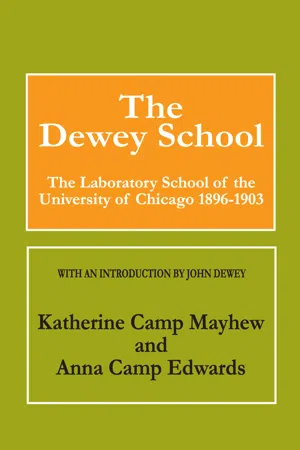
The Dewey School
The Laboratory School of the University of Chicago 1896-1903
- 489 pages
- English
- ePUB (mobile friendly)
- Available on iOS & Android
eBook - ePub
About this book
This book talks of perhaps one of the greatest education experiments in the history of America. In 1894 John Dewey moved his position as Chairman of the Philosophy Department at the University of Michigan to assume the position as Chairman of the Department of Philosophy, Psychology, and Pedagogy at the University of Chicago. He would remain there until 1904, his departure prompted in great part by his dissatisfaction regarding his wife's treatment by the administration in her role of principal of the Laboratory School. At this time Dewey was anxious to translate his more abstract ideas into practical form and he saw the position at Chicago affording him a rare opportunity to do this.The school itself was conceived by Dewey as having an organic functional relation to the theoretical curriculum. Just as Dewey was anxious to merge philosophy and psychology and to relate both of these disciplines to the theoretical study of education, similarly he saw the school as a laboratory for these studies analogous to the laboratory used in science courses. This effort to merge theory and practice is perhaps the major characteristic of Dewey's entire professional career. In the opening sentence of Dewey's remarks in his essay in this volume, "The Theory of the Chicago Experiment," we see the extent to which this problem preoccupied him: "The gap between educational theory and its execution in practice is always so wide that there naturally arises a doubt as to the value of any separate presentation of purely theoretical principles."This book is an accurate and detailed account of one of the most interesting experiments ever undertaken in America. It provides the reader with the complexity of John Dewey's abstract philosophy experimentalism.
Information
PART I
HISTORICAL DEVELOPMENT AND ORGANIZATION
CHAPTER I
GENERAL HISTORY
THE following pages tell the story of one of the earliest experiments in what later came to be known as progressive education. This experiment was an integral part of the University of Chicago during the years 1896 to 1904, and was an undertaking which aimed to work out, through the University, a school system which should be an organic whole from the kindergarten to the university. Conducted under the management and supervision of the University’s Department of Philosophy, Psychology, and Education, it bore the same relation to the work of that department that a laboratory bears to biology, physics, or chemistry. Like any such laboratory it had two main purposes: (1) to exhibit, test, verify, and criticize theoretical statements and principles; and (2) to add to the sum of facts and principles in its special line. In consequence, it was often called the Laboratory School. The name is significant. John Dewey, when called to be the head of the department in 1894, had arrived at certain philosophical and psychological ideas which he desired to test in practical application. This desire was not merely personal, but flowed from the very nature of the ideas themselves. For it was part of the philosophical and psychological theory he entertained that ideas, even as ideas, are incomplete and tentative until they are employed in application to objects in action and are thus developed, corrected, and tested. The need of a laboratory was indicated. Moreover, the inclusive scope of the ideas in question demanded something more than a laboratory of experimentation in its restricted technical sense. The materials with which they dealt were the continuing development of human beings in knowledge, understanding, and character. A school was the answer to the need.
During the years at Chicago, Mr. Dewey’s thought along these lines was greatly stimulated and enriched. One of the important influences affecting the distinct advance in the psychological formulations of this period was the coöperative thinking and pooled results of a close-knit group of colleagues, all concentrating under one leadership, James R. Angell was then working out his ideas of functional psychology. George H. Mead, who earlier had been a colleague of Mr. Dewey’s at the University of Michigan, was developing the psychology of the act on the basis of wide biological knowledge, and James H. Tufts collaborated with Mr. Dewey in a course for the parents of the school. These men and others in related departments of the University made up a united and enthusiastic group of investigators and teachers.
Mr. Dewey’s thinking was further supplemented by the work of the various study clubs of which he was a member and the groups of graduate and undergraduate students under his direction. He early joined the Illinois Society for Child Study, which included among its members many able educators. In the transactions of this society, which were being watched and commented upon by leaders in psychological thinking, Mr. Dewey took an active part. A number of his earliest statements were published by this organization and by the newly organized National Herbart Society.
As a result of all this original and coöperative effort, there were gradually built up the psychological and sociological principles, which, together with their many implications, form the basis of Mr. Dewey’s theory of education. Statements of these appeared from time to time in various periodicals and in other forms.1
Many of the interested group and their friends were parents, and the idea of a school which should test in practice these newly stated principles of education grew out of their desire that their own children should experience this kind of schooling. The ideas of the group were formulated by Mr. Dewey in a privately printed brochure, “Plan of Organization of the University Primary School” This plan as summarized by Mr. Dewey follows.2
“Because of the idea that human intelligence developed in connection with the needs and opportunities of action, the core of school activity was to be found in occupations, rather than in what are conventionally termed studies. Study in the sense of inquiry and its outcome in gathering and retention of information was to be an outgrowth of the pursuit of certain continuing or consecutive occupational activities. Since the development of the intelligence and knowledge of mankind has been a coöperative matter, and culture, in its broadest sense, a collective creation, occupations were to be selected which related those engaged in them to the basic needs of developing life, and demanded coöperation, division of work, and constant intellectual exchange by means of mutual communication and record. Since the integration of the individual and the social is impossible except when the individual lives in close association with others in the constant free give and take of experiences, it seemed that education could prepare the young for the future social life only when the school was itself a coöperative society on a small scale. Therefore, the first factor in bringing about the desired coördination of these occupations was the establishment of the school itself as a form of community life.
“The primary skills, in reading, writing, and numbers, were to grow out of the needs and the results of activities. Moreover, since basic occupations involve relations to the materials and forces of nature, just as the processes of living together involve social invention, organization, and establishment of human bonds, making the development of individuals secure and progressive, knowledge was to grow out of the active contact with things and energies inherent in consecutive activities. History, for instance, was to be a deepening and an extension of the process of human invention and integration. The development of character and the management of what is ordinarily called discipline, were to be, as far as possible, the outgrowth of a shared community life in which teachers were guides and leaders. The substratum of the educative process was thus to develop from the idea that the young have native needs and native tendencies of curiosity, love of active occupation, and desire for association and mutual exchange which provide the intrinsic leverage for educative growth in knowledge, understanding, and conduct.
“The significance of these principles for the educational experiment that was undertaken can best be gathered from the account of the actual life of the school. The controlling aim of the school was not the aim of present progressive education. It was to discover and apply the principles that govern all human development that is truly educative, to utilize the methods by which mankind has collectively and progressively advanced in skill, understanding, and associated life.
“The basic principle necessarily demanded a very considerable break with the aims, methods, and materials familiar in the traditional school. It involved departure from the conception that, in the main, the proper materials and methods of education are already well-known and need only to be furthered, refined, and extended. It implied continual experimentation to discover the conditions under which educative growth actually occurs. It implied also much more attention to present conditions in the life of individuals, children, and contemporary society than was current in schools based chiefly upon the attainments of the past. It involved the substitution of an active attitude of work and play and of inquiry for the processes of imposition and passive absorption of ready-made knowledge and preformed skills that largely dominated the traditional school. It implied a much larger degree of opportunity for initiative, discovery, and independent communication of intellectual freedom than was characteristic of the traditional school.
“Thus the name Laboratory School (originally suggested by Ella Flagg Young) gives a key to the work of the school. A laboratory is, as the word implies, a place for activity, for work, for the consecutive carrying on of an occupation and in the case of education the occupation must be inclusive of all fundamental human values. A laboratory also implies directive ideas, leading hypotheses that, as they are applied, lead to new understandings. It demands also workers, who without being enslaved to the past, are acquainted with achievements of the past in science and art, and who are possessed of the best skills that have been worked out by the coöperative efforts of human beings. Like every human enterprise the Laboratory School came far short of achieving its ideal and putting its controlling ideas into successful operation. But some knowledge as to what the ideals and ideas were is necessary to give unity and coherence to an account of its detailed work.”
The practical difficulties of creating a new school as compared with the formulation of theoretical principles were recognized from the start. The idea of education as growth was new. Since growth is the characteristic of all life, education is all one with growing; it has no end beyond itself; it goes on during the whole life span of the individual; it is the result of the constant adjustment of the individual to his physical and social environment which is thus both used and modified to supply his needs and those of his social groups. All these new theoretical statements presented practical difficulties. There were no precedents for this type of schooling to follow, and there was need to study the growing child in relation to his environment and to experiment with subject-matter and method to find what ministered best to his growth.
With faith in the soundness of the experimental approach to education that should test in practice the value of the theory, the school opened in January, 1896, in a private dwelling with sixteen pupils and two persons in charge. The first six months was a “trial-and-error” period and was chiefly indicative of what not to do. The school reopened on a new basis in October, 1896, at 5718 Kimbark Avenue with thirty-two children ranging in age. from six to eleven and a staff of three regular teachers, one in charge of science and the domestic arts, one of literature and history, and one of manual training. A part-time instructor in music was also on the staff, and three graduate students gave all or part of their time to the school. The school continued at these headquarters until January, 1897, when, owing to inadequate space, it removed to the old South Park Club House, at the corner of Rosalie Court and 57 th Street. The number of teachers was increased and new pupils were received, making the enrolment forty-five.
By December, 1897, the staff of teachers had grown to sixteen, the children numbered sixty, and the school again faced the need of larger quarters. In October, 1898, the school opened in an old residence at 5412 Ellis Avenue. At this time the school took on its subsequent departmental form, thus harmonizing with the University. A sub-primary department was added to include children of four and five. Eighty-two children were enrolled. New quarters included a gymnasium and manual training rooms in a barn connected with the house by a covered way. Art and textile rooms occupied the large attic rooms. The science department had two laboratories, one for combined physics and chemistry, and one for biology. The history department shared three special rooms with the English department. Domestic science now had a kitchen large enough for two groups to work together and two dining rooms properly equipped for serving.
In these quarters the school entered upon another stage of its history. The experience of two years and a half of success and failure afforded a basis out of which there grew an ever developing curriculum. Through the years 1900, 1901, and 1902 the school continued to increase in numbers until it reached a maximum of one hundred and forty children. The teaching staff increased to twenty-three teachers and instructors with about ten assistants (graduate students of the University). With its increase in size the organization of the teaching staff had become more formal in character. Mr. Dewey continued as Director, and Ella Flagg Young of the Department of Education was Supervisor of Instruction. Mrs. Dewey’s previous informal connection now became official as principal of the school. She was also director of the Department of English and literature, and had general oversight of the language expression of the school. The relationship with the University continued as before, insuring stability and continuity to the work, as well as providing the advantages of expert advice, planning, and supervision of instruction.
The administration of the school was, particularly in its formative years, so much a matter of the coöperation of those directing and teaching that it is difficult to say where executive or administrative responsibilities ended and those of teaching began. As head of the Department of Pedagogy, Mr. Dewey was at all times head of the Laboratory School; but for the first three years of its existence the various administrative duties fell in great part to members of the teaching staff, were informally determined in conference with the director, and shifted constantly to meet temporary exigencies and changing needs. The teaching staff in these years, therefore, was the administratiye, with the exception of certain administrative functions, chiefly financial, which were carried out by the University Department of Pedagogy. In later years when the greatly increased staff necessitated a more formal organization, the school was departmentalized, and while the administrative staff was still composed of teachers, a division of responsibility was made. One, as principal, took charge of all contacts with parents, graduate student-teachers, and visitors, and one, as vice-principal, continued to assume responsibility for the curriculum. At this time also, a supervisor from the Department of Pedagogy of the University was added to the staff. She also conducted classes with the pedagogical students working in the school and doing laboratory work as assistants,3 where the principles and practices of the school were discussed and related. The early meetings, of the experimental years, however, being smaller, had included, in addition to the teachers, all of the Fellows, and most of the students and instructors in the University’s Department of Pedagogy.
In retrospect, the coöperation of the many departments of the University, particularly in all forms of science is acknowledged with gratitude. Heads of these departments, as well as individual staff members, were generous with their time and facilities. ’ In addition to this whole-hearted aid in material ways, intellectual resources were freely put at the disposal of the teachers. Of immeasurable, stabilizing value was the relationship to the University. As the laboratory of the Department of Pedagogy, the school shared with the other laboratories of the University the benefits of such intimate relationship. This gave an easy accessibility for teachers desiring it to many scientists who were, or since have become, leaders of thought and accomplishment in their various fields. Many of these men had, in addition to special attainments, unusual pedagogical interests which led to their giving constant intellectual and material help to the teachers of the school.4
As time went on, it became clear that this experiment in education required also experimental administrative methods. A school that was a social institution modeled after the organization of an ideal home required a special arrangement and organization of its directing factors. Instead of a group of persons who planned on paper a program which they then required a staff of teachers to teach to the pupils, these experimenters were confronted with a different problem. The aid of the teachers (as well as of the pupils) was a fundamental and primary requisite to even the theoretical formulation of an educative program. Plainly, therefore, all three factors, administrators, teachers, pupils, must share in the functions of managing and executing the teacher-learning process. Indeed, such an experiment in education as this could not go on except through a group of persons all of whom were intellectually and socially coöperating in a constantly developing educational plan. In such an endeavor the parents of the children were also factors, whose help was essential in countless ways for the successful accomplishment of the experiment. The focus of all this coöperative endeavor was the child—his physical and mental growth in a well-balanced and, therefore, happy fashion. Along many lines of approach help and suggestion flowed in and were integrated and correlated by the child’s activities. At the request of the authors, Mr. Dewey has recently made the following comment on the relation of the theory to the practice in the actual working out of the school.
“In dealing with principles underlying school activities, it is easy, especially after a lapse of years, to read into a statement of them what one has learned in subsequent experience. Another danger more serious and more difficult to avoid lies in the gap between any formal statement of principles and ideals and the way things work out in actual practice; in the temptation to idealize the latter by assuming a greater conformity with theoretical principles than is attained. The concrete circumstances of school life introduce many factors that are not foreseen and taken account of in theory. This is as formal and static as the life of teachers and children in school is moving and vital.
“The principles stated were not intended to serve as definite rules for what was done in the school. They furnished a point of view and indicated the direction in which it was to move. Not merely the concrete material, the subject matter of the pupils’ studies, but the. methods of teaching were developed in the course of the school’s own operations. This development signifies, of course, that the experience of one year taught something about what was to be done the next year and how it was to be better done. But it also meant something more than this, material and methods which worked with one group of children would not give the same results with another group of supposedly about the same attainments and capacities, and quite radical changes would have to be introduced in the actual process of teaching.”
The school always faced a serious financial situation. In five years it had outgrown three buildings, none of which had been adequately equipped. Because tuition fees had been kept low 5 for the sake of the parents who might otherwise have coveted in vain such an education for their children, there had been a yearly deficit. Each year, however, this deficit had been met by the parents and friends, staunch supporters of the school who had caught a vision of its worth and meaning for their own and other children. At the beginning the University assured Mr. Dewey only the sum of Ş 1,000 to cover the initial expense. This sum, moreover, was not in cash but in tuitions of graduate students who were to teach in the school. At the end of the first six months the generous gift of $1,200 by Mrs. Charles R. Linn enabled the school to begin anew in the fall of 1896 with a staff of three teachers. In the years following funds to cover the deficit were forthcoming from the loyal group of parents and friends.
In 1902, the Chicago Institute (formerly the Cook County Normal School of Chicago) heavily endowed by Mrs. Emmons Blaine, and the University of Chicago consummated a plan whereby the former became incorporated with the University. Two other schools had been included in the merger, the Chicago Manual Training School and the South Side Academy. The Chicago Institute was primarily a school for training teachers and was under the leadership of Colonel Francis W. Parker. The faculty of the Institute numbered thirty-five persons. There were about one hundred students in the pedagogical and one hundred and twenty in the academic departments, one of which was an elementary school and kindergarten. The University accordingly found itself possessing two elementary schools. One, a practice school for the training of teachers under the leadership of Colonel Parker, was heavily endowed. The other, the Laboratory School of the University’s Department of Pedagogy directed by Mr. Dewey, had no endowment, but had been, even then, characterized as one of the “greatest experiments in education ever carried on.” Both schools were progressive; both had made outstanding contributions to the principles and practice of education. But while similar in these larger aspects of general purpose, the two schools differed rather widely in theory, method, and practice.
For the solution of the problem thus presented, various plans had been discussed by the President and Trustees of the University. Of these, two plans only seemed feasible. The first was to continue both schools as separate organizations; one, the Dewey School, to be a laboratory of the Department...
Table of contents
- Cover Page
- Halftitle Page
- Title Page
- Copyright Page
- Contents
- Preface
- Introduction
- Part I Historical Development and Organization
- Part II The Curriculum-Social Occupations
- Part III Educational Use of Scientific Method
- Part IV Personnel-Organization-Evaluation
- Appendices
- Index
Trusted by 375,005 students
Access to over 1.5 million titles for a fair monthly price.
Study more efficiently using our study tools.
Frequently asked questions
Yes, you can cancel anytime from the Subscription tab in your account settings on the Perlego website. Your subscription will stay active until the end of your current billing period. Learn how to cancel your subscription
No, books cannot be downloaded as external files, such as PDFs, for use outside of Perlego. However, you can download books within the Perlego app for offline reading on mobile or tablet. Learn how to download books offline
Perlego offers two plans: Essential and Complete
- Essential is ideal for learners and professionals who enjoy exploring a wide range of subjects. Access the Essential Library with 800,000+ trusted titles and best-sellers across business, personal growth, and the humanities. Includes unlimited reading time and Standard Read Aloud voice.
- Complete: Perfect for advanced learners and researchers needing full, unrestricted access. Unlock 1.5M+ books across hundreds of subjects, including academic and specialized titles. The Complete Plan also includes advanced features like Premium Read Aloud and Research Assistant.
We are an online textbook subscription service, where you can get access to an entire online library for less than the price of a single book per month. With over 1.5 million books across 990+ topics, we’ve got you covered! Learn about our mission
Look out for the read-aloud symbol on your next book to see if you can listen to it. The read-aloud tool reads text aloud for you, highlighting the text as it is being read. You can pause it, speed it up and slow it down. Learn more about Read Aloud
Yes! You can use the Perlego app on both iOS and Android devices to read anytime, anywhere — even offline. Perfect for commutes or when you’re on the go.
Please note we cannot support devices running on iOS 13 and Android 7 or earlier. Learn more about using the app
Please note we cannot support devices running on iOS 13 and Android 7 or earlier. Learn more about using the app
Yes, you can access The Dewey School by Anna Edwards in PDF and/or ePUB format, as well as other popular books in Education & Education General. We have over 1.5 million books available in our catalogue for you to explore.