eBook - ePub
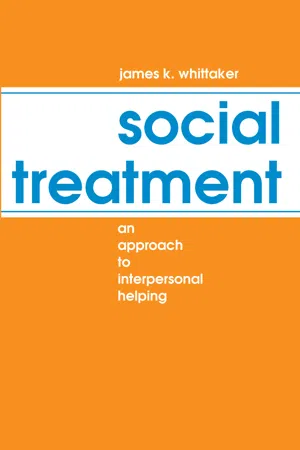
Social Treatment
An Approach to Interpersonal Helping
- 270 pages
- English
- ePUB (mobile friendly)
- Available on iOS & Android
eBook - ePub
About this book
The book has two principal purposes: To provide an introduction to interpersonal helping in the context of social work practice, and to develop a conceptual framework for interpersonal helping --called social treatment--that will enable the social worker and members of other helping professions effectively to use all the various methods and strategies currently practiced. The book offers an orderly and systematic way of proceeding through a complex and often confused area of practice; in it, large issues--such as remediation versus prevention--are explored along with concrete suggestions for intervention with individuals, families, and small groups.Theoretical systems are considered not merely for the techniques they suggest but also for the values and views of man inherent in them. The helping process itself is analyzed from the point of view of the consumer as well as the worker. A conceptual framework for practice is developed that allows for systematic eclecticism in theory and technique, providing a framework for evaluating and comparing different methods of social treatment. The author defines social treatment as "an approach to interpersonal helping which utilizes direct and indirect strategies of intervention to aid individuals, families, and small groups in improving social functioning and coping with social problems."Beginning with a discussion of the concept of remediation within the context of the larger contemporary issues of social reform and environmental protection, Professor Whittaker proceeds to consider several critical issues in present social work practice, such as client advocacy, service delivery systems, and professionalization. Subsequent chapters discuss the multiple roles that social work practitioners perform, the major theoretical bases of social treatment, the treatment sequence from intake to after care, and the full range of helping activities that practitioners undertake indirectly on behalf of their clients. The fin
Information
1 Dilemmas of the Helping Person in an Age of Ecological and Social Crisis
Increasingly, members of the helping professions are being asked to address themselves to what the historian Crane Brinton has called “the Big Questions”: From whence have we come and where are we going?
At no other time in recent history have the concept of interpersonal helping and the professions dedicated to implementing that concept come under such intensive scrutiny. Two forces would appear to be at least partially responsible for this questioning: the increasing popularity of large-scale, macro interventions designed to effect changes within organizations and communities and the growing concern with environmental protection and ecology.
Many within the helping professions have argued persuasively for one particular type of treatment over others: family mode versus individual mode; group approach versus one-to-one encounter; long-term versus short-term treatment; professional versus nonprofessional practitioner. Indeed, the dialogue carried out in the professional literature,
This chapter is adapted from an earlier journal version: Dilemmas of the mental health practitioner in an age of ecological crisis, Mental Hygiene, in press.
at conferences, and in actual practice has undoubtedly had a beneficial effect on the remedial field generally, and in many instances has resulted in a more informed and innovative practice. But while many have energetically argued the case for one or another type of treatment, until relatively recently few have called into question the whole notion of remediation per se.
The profession of social work, with its long history of providing help to those in need when they need it, finds the notion of moving from an individual case approach to a more community or institutionally focused form of intervention particularly discomforting. Yet the growing body of literature critical of the effectiveness of case-by-case intervention; the proposition that if pathology in fact exists, it lies within our societal institutions and not within those individuals who have difficulty adapting to them; the increasing fascination of government and private funding sources with larger and more basic forms of social intervention—all these must cause the professional helping person, regardless of his particular theoretical or practice orientation, to feel that all is not entirely well.
At an even more basic level a potentially more far-reaching conflict would appear to be emerging between the concerns of environmental protection and those of social welfare, whether achieved by micro or macro intervention. If the controversy between small-and large-scale intervention for purposes of human betterment is only now in its nascent phase, the conflict between the forces of conservation and those of social welfare is still in embryo. W. C. Berleman paints the scenario vividly (1972, p. 229):
In our time two small armies of crusaders have declared war each upon its particular heathen. One band is bent upon a “war on poverty,” while the other is thinly arrayed about the ravaged citadel, Earth, hoping to preserve it. Probably neither group now sees the other as representing “the foe,” but suppose the ranks of social reform stumble frontally upon the conservationists’ picket line, would there be rejoicing or would battle ensue?
We may hope that together, these two sets of conflict—between individual helping and larger scale community or societal intervention and between social welfare concerns and environmental concerns—will produce in the future a rethinking and reordering of priorities based on a single value framework that extends from the broadest planetary concerns to the narrowest of individual problems This rapprochement would appear to be light-years away, however; for the present the professional social worker faces a series of dilemmas that strike at the core of what he is supposed to be about: helping individuals, families, and small groups to help themselves. Let us take a look at some of the particular problems and pitfalls faced by the professional social worker.
Areas of Potential Conflict
Remediation vs. Prevention
The first dilemma has already been alluded to: how does one continue to justify any form of teatment or remediation when massive social problems like poverty, inferior education, and urban blight so clearly demand large-scale programs aimed at basic systemic change? Aren’t any efforts directed toward remediation just futile attempts to apply band-aids when what is needed is major surgery? This is the position taken by some social activists who view pathology as societal and not individual. They would have us direct our efforts at change not at individuals and families, but at the unjust and inadequate social systems in which those individuals are caught. Thus communities themselves or social organizations become the targets for change, ultimately resulting in the remediation of individual problems.
Beyond this hue and cry for less individual treatment and more community treatment or social action is heard the even louder call of the environmentalists. Enhancement of social welfare and amelioration of human misery, they argue, simply cannot be based any longer on the notion of an infinitely expanding technology and economy, which will provide whatever measures of improved social welfare are deemed desirable. The notion of more and more people sharing in the good life and increasing consumption may, in fact, produce such a drain on renewable and nonrenewable resources that the planet will suffer irreparable harm. Thus social welfare measures must no longer be predicated on the concept of a cornucopia of resources awaiting only the guiding hand of the social reformer to direct its boundless contents to a greater multitude, but rather on Kenneth Boulding’s (1966) notion of “spaceship earth,” with its limited amount of life’s basic resources, which, once depleted, are gone forever. Finally, at least implicit in the argument of the ecologically concerned is the judgment that certain problems, such as overpopulation and the rape of the environment, are so pressing, so ubiquitous, and so much at the root of all other human problems that they deserve the highest priority in the hierarchy of concerns and should command the major share of resources.
Hence the professional social worker interested in interpersonal helping finds himself in a kind of no man’s land between those who argue for more social action and large-scale system intervention, on the one hand, and those who cry for an even more basic attempt to deflect society’s present collision course with the physical environment, on the other. When posed against such ominous problems requiring such massive resources, the argument for remedial efforts with individuals pales considerably and the helping person engaged in such efforts must feel increasingly uncertain that what he is doing is any longer justified. In sum, the basic question appears to be: Can one continue to make a case for social treatment? The answer is yes.
While it is clear that justification for any form of remediation or interpersonal helping has come under intensive scrutiny in recent times, it is equally clear that much of the criticism would have us jettison the whole because of malfunctions in some of the parts. It is undoubtedly true that radical changes in our social welfare system are needed and that these changes will require a concerted effort at social action on the part of professionals and nonprofessionals alike. Furthermore, it appears evident that efforts at individual helping have not brought about these needed changes, and in fact have contributed at least partially to the problem by attempting to help individuals adjust to essentially pathological social conditions. Finally, in a certain sense, the entire field of interpersonal helping can be accused of merely ministering to the symptoms of the problem while leaving the root causes untouched.
What is easy to argue in the abstract, however, becomes more difficult to defend in the specific. Who will presume to deny help to the family in a state of emotional crisis, or the juvenile offender frustrated in his attempts to cope with the world around him, or the lonely young adult who is terrified of social relationships yet longs for warmth and acceptance? On what grounds will help, however inadequate, be denied to these individuals? Without question, the provision of temporary remediation to these symptoms will not solve the basic problems of family disorganization, poverty, inferior education, and anomie which underlie the specific manifestations. But in carrying forward the banner of social reform, can we ignore completely those who have already felt some pain?
At another level, even given the most enlightened and progressive social institutions, it is naive to assume that the society will be free of all individuals requiring treatment or help. Too often social activists fall into the trap of explaining all individual problems as socially determined: simply modify the environment and the problem will disappear. Suffice it to say that this kind of logic blunts individual differences and underplays the function of organism in the paradigm stimulus-organism-respnnse.
The solution to this first dilemma would appear to lie in a more socially conscious and informed helping professional who will link his remedial efforts with those of the social activist which are directed at more basic reforms. Exactly how this rapprochement comes about is of course the nexus of the dilemma. But difficult as this “both/and” approach may be to implement, it is far more desirable than the simplistic “either/ or” view that holds that improved social conditions will do away with the need for all remedial helping, or that individual treatment is all that is needed to solve society’s problems. The major difficulty occurs when we mistakenly ascribe the goals of one to the other. Interpersonal helping will not of itself bring about needed reform in our social institutions, nor will improvements in those social institutions do away completely with the need for remedial efforts.
Value Questions
A second dilemma lies in the potential clash of professional values with some of those set forth by the ecological movement. For example, in supporting the notion of a limited family size, perhaps enforced by government sanction, is not the professional compromising the basic principle of the client’s right to self-determination? What is a moot point in the abstract becomes an increasingly uncomfortable reality for those professionals charged with counseling clients in the area of family planning. Some ecologically minded persons would argue that it is not simply a question of individual freedom to have as many children as one can care for adequately, but that the ability of society to absorb the increasing number of children, each taxing the already dwindling supply of nonrenewable resources, should be the primary factor in the decision.
At what point, then, should the “rights” of society supersede those of the individual? The professional social worker may soon be forced to choose between the individual client’s right to self-determination in matters of family size and a policy of limitation that may be ecologically sound but which infringes upon individual rights.
The issue of overpopulation as a global problem will shortly have to be faced by every professional, for it appears as a major concern of many ecologists (Ehrlich & Ehrlich, 1970; Berelson, 1969; Harkavy, Jaffe, & Wishnik, 1969; Blake, 1969). “Population control,” as population biologist Paul Ehrlich says, “is not a ‘panacea’ but ‘absolutely essential’” if the problems now facing mankind are to be solved. “Whatever your cause, it’s a lost cause without population control” (Ehrlich & Ehrlich, 1970, p. 111).
More recently, Barry Commoner (1971) has disputed Ehrlich’s claim of the centrality of population pressures as a major causative factor in the environmental crisis. Commoner argues rather that the particular nature of post-World War II technology, with its enormous dependence on synthetic, polluting materials, and the profit system that supports that technology represent the major threats to the biosphere. The implications in either case are clear: improved social conditions can no longer be purchased at the expense of the basic life systems of earth, water, and air.
But if the professional social worker reads Ehrlich and Commoner, he also hears the numerous voices of those who view population control as a means of controlling the poor and oppressed by limiting their number. Indeed, at a time when the notion of power and equal participation in the larger society is becoming less of an illusion and more of a reality for many low-income and minority groups, to speak of limiting births to a group that already finds itself under-represented is to run the risk of being labeled racist or elitist. One wonders what arguments, what rationale will be available to those helping professionals who find themselves at the precarious point of contact between the disenfranchised seeking to grow in strength and numbers and those who would seek to limit population or consumption. In a delicate and infinitely complex area of controversy, the question for the professional social worker may be simply reduced to: Whose side are you on?
For the individual professional and his national association, a related dilemma concerns the norms and guidelines to be used in planning interventive strategies. A step in the direction of short-term gain may, for reasons already alluded to, prove ecologically unsound in the long run. On the other hand, even if one accepts the Tightness of working on underlying ecological problems, how are we to deal with the victims of the many other problems that beset society—poverty, racism, inferior education, mental illness, and so on? Even further assuming some consensus on the hierarchy of problems confronting us, at what level should they be attacked? Given limited manpower and financial resources, should greater attention be paid to the young or to those who have suffered longer under the yoke of social problems? What might have been armchair discussion even a few years ago now becomes daily reality for the legislator, private foundation executive, and professional social worker forced to decide where to direct already scant resources and plagued with the underlying fear that what they can do will have virtually no effect anyway.
For all practitioners and especially for those just beginning their careers, the knowledge that what they are capable of doing can make a difference is becoming increasingly rare. Buffeted from all sides by an awareness of his own limitations, by the exhortations of the environmentalists and the social activists, and by the demands of his clients, the professional social worker must at times feel as if the value framework within which he operates is as outdated as the taxonomy of psychiatric labels that he discarded long ago as being irrelevant to his practice. What steps are to be taken, then, to overcome these considerable difficulties?
In the past two decades the technology of interpersonal helping—the various treatment modalities, strategies, and techniques of individual change—have undergone considerable investigation and have emerged greatly strengthened and refined. Perhaps it is now time to turn with equal vigor and resolve to a careful examination of the values underlying that technology. In light of what many feel to be the impending environmental crisis, it would be well to reexamine our long-held belief in the individual’s right to self-determination and to see how this articulates with the needs and demands of an increasingly densely populated world.
On a broader scale, the value base that underlies social welfare generally must be reexamined. Are we in fact, as Berleman (1971) has suggested, basing our social welfare goals on the premise of an ever expanding economy with limitless resources? If this is true, as it appears to be, how do we bring our goals for both large-scale and individual change into harmony with the principle of a sound ecology?
When the various dilemmas of the helping person in an age of ecological and social crisis are examined, the answer often seems to lie not with the creation of new technology— we are fully provided for in that area—but in the creation of a new value framework that can relate itself to the extremely complex problems of our age, an “age of perfect means and confused goals,” as Albert Einstein said.
Working Within the System
Another problem for the practitioner concerns his locus of practice. How does one continue to work within the system (in this instance, the social welfare system) when in many instances the most serious pathology lies not within individual clients, but within the very social service network of which the professional is a part? Can one retain professional integrity and uphold a primary allegiance to clients in a social welfare bureaucracy that may at times dehumanize clients or base priorities on organizational expediency rather than on client needs? In short, when the helping professional becomes a part of the social welfare establishment, does he not run the risk of placing allegiance to the organization before allegiance to clients?
Clearly the professional code of ethics would speak forcefully against this type of compromise in principle. But the question here is not really one of intent. The issue is whether or not segments of our social welfare system have gotten so large, so unwieldy, and so far diverted from their original purposes that professional practice within them almost automatically runs the risk of becoming organization-centered rather than client-centered.
Assuming for a moment that this were a reality even for a single social welfare bureaucracy, what should be the decision of the professional social worker regarding practice within that system? To work within the system would almost certainly mean that some professional values would be compromised, if only in the sense that the professional would have to cooperate in some degree with the policies and practices of the organization. On the positiv...
Table of contents
- Cover Page
- Half Title
- Title Page
- Copyright Page
- Dedication
- Contents
- Preface
- 1 Dilemmas of the Helping Person in an Age of Ecological and Social Crisis
- 2 Issues in Social Treatment
- 3 Social Treatment: An Introduction
- 4 Theoretical Bases of Social Treatment
- 5 The Social Treatment Sequence I: Direct Helping in the Beginning, Intermediate, and Ending Phases
- 6 The Social Treatment Sequence II: Indirect Intervention on Behalf of Clients
- 7 The Future for Social Treatment
- Appendix: Differential Approaches to Social Treatment
- References
- Name Index
- Subject Index
Trusted by 375,005 students
Access to over 1.5 million titles for a fair monthly price.
Study more efficiently using our study tools.
Frequently asked questions
Yes, you can cancel anytime from the Subscription tab in your account settings on the Perlego website. Your subscription will stay active until the end of your current billing period. Learn how to cancel your subscription
No, books cannot be downloaded as external files, such as PDFs, for use outside of Perlego. However, you can download books within the Perlego app for offline reading on mobile or tablet. Learn how to download books offline
Perlego offers two plans: Essential and Complete
- Essential is ideal for learners and professionals who enjoy exploring a wide range of subjects. Access the Essential Library with 800,000+ trusted titles and best-sellers across business, personal growth, and the humanities. Includes unlimited reading time and Standard Read Aloud voice.
- Complete: Perfect for advanced learners and researchers needing full, unrestricted access. Unlock 1.5M+ books across hundreds of subjects, including academic and specialized titles. The Complete Plan also includes advanced features like Premium Read Aloud and Research Assistant.
We are an online textbook subscription service, where you can get access to an entire online library for less than the price of a single book per month. With over 1.5 million books across 990+ topics, we’ve got you covered! Learn about our mission
Look out for the read-aloud symbol on your next book to see if you can listen to it. The read-aloud tool reads text aloud for you, highlighting the text as it is being read. You can pause it, speed it up and slow it down. Learn more about Read Aloud
Yes! You can use the Perlego app on both iOS and Android devices to read anytime, anywhere — even offline. Perfect for commutes or when you’re on the go.
Please note we cannot support devices running on iOS 13 and Android 7 or earlier. Learn more about using the app
Please note we cannot support devices running on iOS 13 and Android 7 or earlier. Learn more about using the app
Yes, you can access Social Treatment by James K. Whittaker,Christina Behrendt in PDF and/or ePUB format, as well as other popular books in Social Sciences & Psychotherapy Counselling. We have over 1.5 million books available in our catalogue for you to explore.