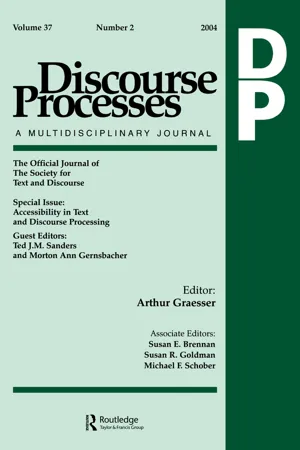
This special issue shows how accessibility phenomena need to be studied from a linguistic and psycholinguistic angle, and in the latter case from interpretation, as well as production. The contributions augment the growing knowledge of accessibility in text and discourse processing. They also illuminate how accessibility is marked in a text or a discourse, how readers and listeners respond to those markings, and how mental representations evolve and change as a direct result of accessibility. The editors hope is that the text affects the readers' representations in ways that linguists and psycholinguists theorize as beneficial.
eBook - ePub
Accessibility in Text and Discourse Processing
A Special Issue of Discourse Processes
- 112 pages
- English
- ePUB (mobile friendly)
- Available on iOS & Android
eBook - ePub
Accessibility in Text and Discourse Processing
A Special Issue of Discourse Processes
About this book
Information
Subtopic
LinguisticsReference Management in Instructive Discourse
Alfons Maes
Communication and Cognition Group
Tilburg University, The Netherlands
Communication and Cognition Group
Tilburg University, The Netherlands
Anja Arts
Discourse Studies Group
Tilburg University, The Netherlands
Discourse Studies Group
Tilburg University, The Netherlands
Leo Noordman
Discourse Studies Group
Tilburg University, The Netherlands
Discourse Studies Group
Tilburg University, The Netherlands
This article investigates the effect of 2 language-in-use factors on the introduction and maintenance of referents in instructive discourse. These factors, implemented as conditions in an instructive production task, were the assumed visual identity for the reader of the objects or referents to be referred to in the instructions (visually same vs. visually different) and the assumed goal of the reader (reading to do vs. reading to learn).
The results show that both factors have a strong impact on the writers' referential behavior. Visually same referents are introduced and reintroduced fairly systematically by means of perceptually overspecified NPs. Visually different referents are introduced systematically by extra propositional identification speech acts and they are reintroduced more often by attenuated anaphoric expressions. Apart from that, writers show a number of referential strategies which fit in with the assumed reader's goal. Writers in the reading to learn condition use more overspecified expressions than writers in the reading to do condition.
The results contribute to a more comprehensive understanding of the factors that determine the form of referential expressions in discourse. Referential expressions which are more informative than necessary for identification purposes do not only occur when the activation level of discourse referents is low, but also when the writer anticipates specific conditions in which the information will be used by the reader. The main goal of recent theories of discourse reference, such as Accessibility (e.g., Ariel, 1990), Centering (e.g., Grosz, Joshi, & Weinstein, 1995) orGivenness (e.g., Gundel, Hedberg, & Zacharski, 1993), is to provide an explanatory account of the relation between types of referential expressions on the one hand, and degrees of mental activation of discourse referents on the other. The general idea is that referential expressions need more coding material as the referent is less activated and vice versa. In analytical as well as experimental reference research, a large number of factors are uncovered, which are considered to affect the activation level of discourse referents. These factors can be distinguished into different levels: on the one hand surface level characteristics of discourse, such as order of mention (Gernsbacher & Hargreaves, 1988), sentence position, syntactic role (e.g., Gordon, Grosz, & Gilliom, 1993; Gordon, Hendrick, Ledoux, & Yang, 1999), depth of embedding (Gordon & Hendrick, 1997; Ward, Sproat, & McKoon, 1991), competing candidates or referential distance (Ariel, 1988); on the other hand more conceptual characteristics, such as the conceptual structure of discourse in terms of episode shifts (Anderson, Garrod, & Sanford, 1983), protagonist-hood (Francik, 1985), thematic structure (Vonk, Hustinx, & Simons, 1992) or topicality (Morrow, 1985). Apart from that, intricate combinations of surface and conceptual factors are studied, such as morphological gender and conceptual content (Carreiras & Gernsbacher, 1992) or morphological gender and pragmatic-conceptual inferences (Garrod, Freudenthal, & Boyle, 1994).
Research into the mental activation of discourse referents attempts to disentangle the way in which language users distribute and manage their mental attention over referents, a process which is highly determined by the limitations of working memory. A number of heuristics which we use in interpreting referential expressions suggest that attention management is guided by referential economy and efficiency. One such heuristic is the propensity not to expect or use more referential material than necessary to uniquely identify a discourse referent. Another heuristic is that we expect discourse referents to be introduced in their full form and afterwards reintroduced in weakened forms, which is why (1) and not (2) sounds natural to us:
- (1) John is back home again. He traveled through Asia for the last 5 months.
- (2)?He/John is back home again. John traveled through Asia for the last 5 months.
These intuitions make clear that using referential expressions to efficiently activate referents is a solid part of our discourse competence. Yet, they also suggest that referential expressions are monofunctional, which is not. Referential expressions can display additional functions. One such function is adding new information about referents, as is shown in empirical (e.g., Almor, 1999) as well as analytical studies (e.g., Maes & Noordman, 1995). Likewise, one can easily collect referential phenomena which deviate from the idea of economic activation. If for example a novelist decides to introduce and maintain his character by using a pronoun only, if children never talk about their mother by using a pronoun or if defendants and plaintiffs in Flemish court orders are hardly ever pronominalized (Maes, 1991), apparently other than economic activation considerations come into play.
One can take up different theoretical positions to deal with these "non-standard uses" of referential expressions. On the one hand, one can claim that they are all (deliberate) violations of the basic activation pattern. On the other hand, one can think of different basic systems which—in interaction—are responsible for the use of referential expressions. Apart from activation, one can think of a number of performance based aspects of discourse, such as discourse goals, types of relationships between discourse participants, different modes of communication and situational conditions. These aspects can be seen as parameters with different settings, the interaction of which explains referential patterns and strategies in any specific language-in-use context. So, applied to the previous example, a pronoun introducing a main character in a novel can be looked at as being peculiar and deviant, because it violates normal activation procedures of referential expressions, or as normal, given our prior knowledge about specific narrative (literary) conventions and strategies used by novelists.
It is difficult to determine at this moment which theoretical position is the most sensible one. We first need more systematized, controlled, and generalizable knowledge about the language-in-use factors that affect reference, about the interaction of these factors and their effect on referential patterns and strategies.
This article intends to contribute to this type of knowledge. It focuses on a discourse type which is preeminently affected by performance factors, that is, instructions for use. Instructions for use typically intermediate between the mental representation of users on the one hand and the physical execution of tasks on the other. They support the execution of tasks, such as the installation and tuning of computer, video and camera equipment or household appliances, and they imply that users manipulate objects in a physical task environment. In designing these instructions, writers have to take into account the relevant characteristics of users and tasks, and have to assume specific goals, levels of experience, prior knowledge and task conditions of the readers or users. Practice and research in the field of instructive text design uncovers a large number of textual variables which are related to these conditions of use (see e.g., Jansen...
Table of contents
- Cover
- Title
- Contents
- Copyright
- Accessibility in Text and Discourse Processing
- Accessibility Marking: Discourse Functions, Discourse Profiles, and Processing Cues
- Reference Management in Instructive Discourse
- Managing Mental Representations During Narrative Comprehension
- Fluctuations in the Availability of Information During Reading: Capturing Cognitive Processes Using the Landscape Model
Trusted by 375,005 students
Access to over 1.5 million titles for a fair monthly price.
Study more efficiently using our study tools.
Frequently asked questions
Yes, you can cancel anytime from the Subscription tab in your account settings on the Perlego website. Your subscription will stay active until the end of your current billing period. Learn how to cancel your subscription
No, books cannot be downloaded as external files, such as PDFs, for use outside of Perlego. However, you can download books within the Perlego app for offline reading on mobile or tablet. Learn how to download books offline
Perlego offers two plans: Essential and Complete
- Essential is ideal for learners and professionals who enjoy exploring a wide range of subjects. Access the Essential Library with 800,000+ trusted titles and best-sellers across business, personal growth, and the humanities. Includes unlimited reading time and Standard Read Aloud voice.
- Complete: Perfect for advanced learners and researchers needing full, unrestricted access. Unlock 1.5M+ books across hundreds of subjects, including academic and specialized titles. The Complete Plan also includes advanced features like Premium Read Aloud and Research Assistant.
We are an online textbook subscription service, where you can get access to an entire online library for less than the price of a single book per month. With over 1.5 million books across 990+ topics, we’ve got you covered! Learn about our mission
Look out for the read-aloud symbol on your next book to see if you can listen to it. The read-aloud tool reads text aloud for you, highlighting the text as it is being read. You can pause it, speed it up and slow it down. Learn more about Read Aloud
Yes! You can use the Perlego app on both iOS and Android devices to read anytime, anywhere — even offline. Perfect for commutes or when you’re on the go.
Please note we cannot support devices running on iOS 13 and Android 7 or earlier. Learn more about using the app
Please note we cannot support devices running on iOS 13 and Android 7 or earlier. Learn more about using the app
Yes, you can access Accessibility in Text and Discourse Processing by Ted J.M. Sanders, Morton Ann Gernsbacher, Ted J.M. Sanders,Morton Ann Gernsbacher in PDF and/or ePUB format, as well as other popular books in Languages & Linguistics & Linguistics. We have over 1.5 million books available in our catalogue for you to explore.