eBook - ePub
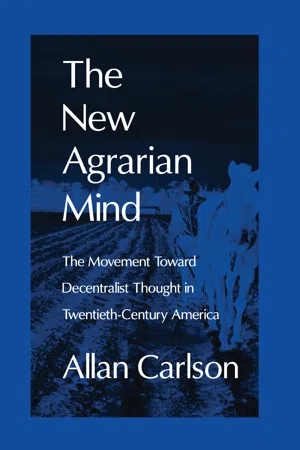
The New Agrarian Mind
The Movement Toward Decentralist Thought in Twentieth-Century America
- 232 pages
- English
- ePUB (mobile friendly)
- Available on iOS & Android
eBook - ePub
The New Agrarian Mind
The Movement Toward Decentralist Thought in Twentieth-Century America
About this book
The self-sufficiency and regional outlook of farm life characterized the United States until the Civil War period. With the triumph of the industrial North over the rural South, the expansion of urbanism, and the closing of the frontier, the agrarian sector became an economic and cultural minority. The social benefits of rural life - a sense of independence, commitment to democracy, an abundance of children, stable community life - were threatened. This volume examines the rise of a distinctive agrarian intellectual movement to combat these trends. The New Agrarian Mind, now in paperback, synthesizes the thought of twentieth-century agrarian writers. It weaves together discussions of major representative figures, such as Liberty Hyde Bailey, Carle Zimmerman, and Wendell Berry, with myth-shattering analyses of the movement's cultural diversity, intellectual influence, and ideological complexity. Collectively labeled the New Agrarians to distinguish them from the simpler Jeffersonianism of the nineteenth century, they shared a coherent set of goals that were at once socially conservative and economically radical.
Information
1
Toward a New Rural Civilization:
Liberty Hyde Bailey
As America’s best-known plant scientist and as an innovative university administrator, Liberty Hyde Bailey left a large mark on his nation. In addition, for a critical twenty-five years of his life, Bailey focused his energies on building an Agrarianism fit for the twentieth century. From 1903 to 1928, he campaigned to craft a new rural civilization, one that could weather the economic and social storms that had shaken American agriculture during the prior thirty years. With a remarkably fertile mind and a prolific pen, Bailey created the Country Life movement. While many other well-known Americans— from Theodore Roosevelt to Henry Wallace—joined in this campaign, its leading historian concludes that Bailey “looms largest...during the opening decades of the twentieth century.”1 Moreover, he crafted a set of goals, themes, and arguments that would, at once, guide and haunt this New Agrarianism as an intellectual movement for the remainder of this century. He redefined the agrarian mind in progressive, forward-looking ways. But ironically, Bailey would also guide this pattern of thought into paths that rejected the only forms of rural community and home reconstruction that proved able to meet the modernist challenge.
The “Outlook”
Liberty Hyde Bailey was born in western Michigan on the Ides of March, 1858, to a father bearing the same name and to a mother from the prominent Harrison family of Virginia. She died when young Liberty was six years old, and the elder Bailey became the shaping force in his son’s life. A large man, powerful and rugged, who clung to homemade candles and homespun cloth long after they had disappeared elsewhere in their Michigan township, Bailey senior was the quintessential Yankee. Reared in Vermont, he was a strident abolitionist, known for his temperance, quiet strength, and simplicity. While of Congregational religious antecedents, Bailey senior found his spiritual home among the Freemasons. He would pass the Masonic vision of spiritual unity and universal brotherhood on to his son, with significant results.
The Bailey family planted and operated a large apple orchard in southwestern Michigan. According to his biographers, young Liberty absorbed here the lessons of nature and gained his deep love for the flora of North America.2 Gaining stature at a youthful age for his skills at grafting apple trees, young Bailey began to intellectualize his work as well. At age fifteen, he read a paper on “Birds” to the South Haven [Michigan] Pomological Society, leading to his election as ornithologist of the society. Four years later, he entered Michigan Agricultural College in East Lansing, as a student of horticulture and agriculture. He became fascinated by the Rubus genus of blackberries and other brambles, and produced a string of attention-getting academic papers.
On graduation, Bailey chose not to return to the family orchard, viewing such work as intellectually confining. Instead, he became a newspaperman for a year, until receiving an offer to enter Harvard University as special assistant to the famed botanist, Asa Gray. In 1884, Bailey also joined the editorial staff of the American Cultivator. The next year, with some graduate education under his belt, he accepted an offer from Michigan Agricultural College to return as its first professor of horticulture. Full of energy, Bailey set out to transform the field from mere gardening into something more grand. As he explained, “Horticulture the art is old; horticulture the science is new.”3 Books began to appear in amazing profusion, eventually including his magisterial Cyclopedia of American Horticulture (four volumes), Cyclopedia of American Agriculture (four volumes), The Annals of Horticulture (five volumes), Botany, Principles of Agriculture, and The Plant Life of North America. In 1888, the offer came to assume the Chair of Practical and Experimental Horticulture at Cornell University.
Bailey became a legend and institution-builder at the Ithaca, New York campus. In an 1893 address to the university’s Agriculture Association, he called for a state-fostered agricultural school that was “free from bigotry and convention and inspired with patriotic hope,” adding: “Let that institution be Cornell!”4 With state grants in 1894 and 1897, he created “experiment stations” for horticultural investigations and a model program of “extension agents,” who would carry research results directly from the University to New York’s farmers. He called these innovations “a plain, earnest and continuous effort to meet the needs of the people on their own farms.”5 Bailey authored monthly nature-study leaflets for children (e.g., “How a Squash Plant Gets Out of Its Seed,” “A Child’s Garden”) that went to 3,000 New York grade school teachers, and he spoke to hundreds—eventually thousands—of rural audiences. He was founding editor of the journals Country Life in America (1901) and the Cornell Countryman (1903). In 1904, with a grant of $250,000 from the New York Legislature, he created the College of Agriculture at Cornell, becoming its first dean. By 1913, student enrollment had climbed from 100 to 1,400, the faculty had grown from eleven to 100, and Cornell stood as the preeminent agricultural school in the country. He retired that year, to become a private scholar, a “separate soul,” and to accelerate his work on social and political questions.
While part researcher and scientist, Bailey was also poet and metaphysician. He wrote hundreds of poems, some of them collected into volumes of verse (e.g., Wind and Weather). He saw poetry as “prophecy,” a way to gain hold of aspirations that were “elemental and universal.”
At the turn of the century, Bailey turned increasingly to philosophy, an emphasis that would flower into his Country Life campaign. In an 1899 essay for the Independent, a magazine of “free opinion,” entitled “An Evolutionist’s View of Nature and Religion,” Bailey laid out for the first time his personal world view and the role of evolution as a, new, progressive faith.6 He expanded these arguments into a 1905 book, The Outlook to Nature, which he dedicated to his ninety-year-old father. Early portions of this extended essay bore a Whitmanesque quality in their lyrical praise for the commonplace:
I would preach the surface of the earth, because we walk on it....I would preach the sky....One must have a free vision if he is to know the sky....I preach the mountains, and everything that is taller than a man.7
However, at the core of the book lay a discussion of evolution and Christianity, where the author cut to the heart of human purpose and meaning. Bailey began with a compelling distinction, using Scripture to deny that faith and science were in conflict. “I find nothing in Scripture to make me disbelieve evolution,” he wrote. “Strictly speaking, evolution does not attempt to explain creation, but only the progress of creation. Whatever its form, it begins where Genesis does—‘In the beginning, God.’” He saw the whole scheme of evolution as “a design,” arguing that “the fact that we have only now been able to apprehend this scheme is all the more proof that it is divine.”8
Yet from this relatively benign start, Bailey moved on to jettison, with subtlety and wit, virtually the whole of Christian doctrine. He noted, for example, that “the evolution philosophies” altered one’s point of view toward “all problems of life and destiny.” Evolution demanded “that we be willing to free ourselves from every bondage of doctrine and dogma, from traditions and superstitions, from ‘authority’ and prejudgments.” Evolution bid us “to a high place.” It magnified individual effort, kindled the inner light of conscience as opposed to authority, lessened belief in “mere wonders,” stimulated reason, and emancipated the man. “It asks us to lay aside prejudice and small dogmatisms.”9
Lest the reader not understand, Bailey specified the sort of “small dogmatisms” that ought to be put away. “Salvation is not the highest goal of religion,” he explained. “[T]he emphasis is being transferred from salvation to service,” and from blind obedience to “observation” and “study,” where man became “a partaker” in the evolutionary process. Indeed, Bailey praised the changes already occurring among leadership elites in the Protestant churches: “[T]he layman...may be little aware of the progressive attitude of the church as a whole, of its full acceptance of the results of scientific research, its growing spirit of freedom from the non-essentials on which men differ, the new leadership that it has acquired.” Equally promising, in his view, was the budding ecumenical spirit, the tendency “for men to determine wherein they agree rather than wherein they differ.”10
Bailey concluded that the “supernatural” had been over-emphasized in the old faith. “Religion,” he explained, “is as natural and normal as other human activities and aspirations.” It was “an evolution” itself, where “our conception of God will enlarge as our horizon enlarges.” At the same time, he implied, the supernatural had been under-emphasized in nature. As Bailey wrote: “Evolution implies that God is not outside nature, but in nature, that he is an indwelling spirit in nature as truly as in man.” Accordingly, the study of evolution would “impel us to a new and great reverence for The Power,” one that bound all humanity and one that resided in the natural world.11
This celebration of God as the unifying force of human brotherhood, this injection of divine force into nature, this affirmation of ecumenism, and this dismissal of the “small dogmatisms” of Original Sin, the Incarnation, the Atonement, the miracles of Jesus, and the Trinity were all consistent with the Freemason creed. In a 1911 poem, also bearing the title, “Outlook,” Bailey honed and elevated this post-Christian world view into a celebration of Nature as God:
They [aspects of nature] teach that all the world is good.
Alike for man and brute and wood
All set in one vast fellowhood
Nor innate guilt appears....
And I blaspheme not
The perfecting works of God;
And I build my holy fires
Where every living thing aspires.
And I am I.
Dominion unto me is given
As my fertile years go by
To win my way to heaven
Myself I must redeem –
All nature helps me on
And all good saints of here and yon –
My soul must be supreme:
Within myself my kingdom lies
Nor any fatal faiths shall blind my eyes
When my soul would take its wings and rise....
From first unto the last
Some mighty essence runs
It moveth in the worlds and riseth in the suns:
Its scheme I would forecast....
When I consider the heavens, the stars, and the moon
My spirit out wings its small forenoon
With pride of master and man
To partake in the plan.
We helpless gaze unto the stars:
But some great day we shall in signal be with Mars
And in a twinkling shall sense a wider brotherhood
Than any man hath ever understood –
A kinship that encompasseth the universe
Wherein will all our feeble cults disperse
And all the worlds our neighbors be
In one vast fraternity.12
This spiritualized ecological approach would animate and guide the Country Life movement then taking form. As such, its precepts— hostility to the Christian faith found among the country people, the celebration of s...
Table of contents
- Cover
- Title page
- Copyright Page
- Contents
- Acknowledgements
- Dedication
- Introduction: The New Agrarians
- 1 Toward a New Rural Civilization: Liberty Hyde Bailey
- 2 Building a Science of Rural Society: Carle C.Zimmerman
- 3 Crafting a Decentralist Economics: Ralph Borsodi
- 4 The Jeffersonian Restoration of Louis Bromfield
- 5 The New Agrarianism, Southern Style: Lytle, Owsley, Cauley
- 6 The American Distributists and the Quest for Fusion: Herbert Agar
- 7 God, Land, Community, and Father Luigi Ligutti
- 8 The Agrarian Elegy of Wendell Berry
- 9 Lessons from the Plain People
- Index
Trusted by 375,005 students
Access to over 1.5 million titles for a fair monthly price.
Study more efficiently using our study tools.
Frequently asked questions
Yes, you can cancel anytime from the Subscription tab in your account settings on the Perlego website. Your subscription will stay active until the end of your current billing period. Learn how to cancel your subscription
No, books cannot be downloaded as external files, such as PDFs, for use outside of Perlego. However, you can download books within the Perlego app for offline reading on mobile or tablet. Learn how to download books offline
Perlego offers two plans: Essential and Complete
- Essential is ideal for learners and professionals who enjoy exploring a wide range of subjects. Access the Essential Library with 800,000+ trusted titles and best-sellers across business, personal growth, and the humanities. Includes unlimited reading time and Standard Read Aloud voice.
- Complete: Perfect for advanced learners and researchers needing full, unrestricted access. Unlock 1.5M+ books across hundreds of subjects, including academic and specialized titles. The Complete Plan also includes advanced features like Premium Read Aloud and Research Assistant.
We are an online textbook subscription service, where you can get access to an entire online library for less than the price of a single book per month. With over 1.5 million books across 990+ topics, we’ve got you covered! Learn about our mission
Look out for the read-aloud symbol on your next book to see if you can listen to it. The read-aloud tool reads text aloud for you, highlighting the text as it is being read. You can pause it, speed it up and slow it down. Learn more about Read Aloud
Yes! You can use the Perlego app on both iOS and Android devices to read anytime, anywhere — even offline. Perfect for commutes or when you’re on the go.
Please note we cannot support devices running on iOS 13 and Android 7 or earlier. Learn more about using the app
Please note we cannot support devices running on iOS 13 and Android 7 or earlier. Learn more about using the app
Yes, you can access The New Agrarian Mind by Allan C. Carlson in PDF and/or ePUB format, as well as other popular books in Storia & Storia nordamericana. We have over 1.5 million books available in our catalogue for you to explore.