eBook - ePub
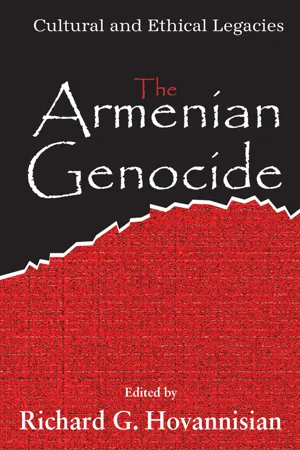
The Armenian Genocide
Wartime Radicalization or Premeditated Continuum
- 461 pages
- English
- ePUB (mobile friendly)
- Available on iOS & Android
eBook - ePub
About this book
World War I was a watershed, a defining moment, in Armenian history. Its effects were unprecedented in that it resulted in what no other war, invasion, or occupation had achieved in three thousand years of identifiable Armenian existence. This calamity was the physical elimination of the Armenian people and most of the evidence of their ever having lived on the great Armenian Plateau, to which the perpetrator side soon gave the new name of Eastern Anatolia. The bearers of an impressive martial and cultural history, the Armenians had also known repeated trials and tribulations, waves of massacre, captivity, and exile, but even in the darkest of times there had always been enough remaining to revive, rebuild, and go forward.This third volume in a series edited by Richard Hovannisian, the dean of Armenian historians, provides a unique fusion of the history, philosophy, literature, art, music, and educational aspects of the Armenian experience. It further provides a rich storehouse of information on comparative dimensions of the Armenian genocide in relation to the Assyrian, Greek and Jewish situations, and beyond that, paradoxes in American and French policy responses to the Armenian genocides. The volume concludes with a trio of essays concerning fundamental questions of historiography and politics that either make possible or can inhibit reconciliation of ancient truths and righting ancient wrongs.
Part 1
History and Philosophy
1
The Armenian Genocide: Wartime Radicalization or Premeditated Continuum?
Richard G. Hovannisian
World War I was a watershed, a defining moment, in Armenian history. Its effects were unprecedented in that it resulted in what no other war, invasion, or occupation had achieved in more than 3,000 years of identifiable Armenian existence. This calamity was the physical elimination of the Armenian people and most of the evidence of their ever having lived on the great highland called the Armenian Plateau, to which the perpetrator side soon assigned the new name of Eastern Anatolia. Bearers of an impressive martial and cultural history, the Armenians had also known repeated trials and tribulations, waves of massacre, captivity, and exile, but even in the darkest of times there had always been enough of them remaining to revive, rebuild, and go forward.
The Total War Ethic
The technology and totality of twentieth-century warfare changed all of this and no longer facilitated just oppressive rule but also the virtual annihilation of the targeted group. Total war and genocide are often associated with modernism and industrialization, but even in the backward Ottoman Empire in 1915 possession of the telegraph alone was a major asset in the hands of the perpetrators, ensuring coordination and surveillance of the genocidal operations, allowing Talaat Pasha in the Ministry of Interior to cajole and intimidate recalcitrant officials and to be kept informed by Dr. Behaeddin Shakir and other Young Turk central committee members in charge of overseeing the cleansing process.
The combination of a xenophobic nationalist mindset and a total war ethic produced a lethal atmosphere from which the Armenians could not escape. In recent years, renewed interest has been shown in the concept of total war, a strategy that views all of the enemy’s resources as being valid, justified targets in order to break and demoralize the opponent’s armed forces and civilian population in order to attain a swift victory. Terms such as “collateral damage” or “shock treatment” are now used as euphemisms for civilian casualties in time of war, usually with the intent to display such an awesome show of power as to bring about the collapse of the perceived enemy. Of course, one need not look simply at military operations in Panama, Serbia, or Iraq to discover such examples, for like examples can be found in whole or in part much earlier in the German Blitzkrieg, the saturation bombings at Dresden and Leipzig, and the mushroom clouds at Hiroshima and Nagasaki.
Some scholars have linked these tactics to those of the Prussian military school and perhaps specifically to Helmuth von Moltke and his strategy of an overpowering show of force as demonstrated in the Prussian offensives in Denmark, Austria-Hungary, and France in the process of German unification.1 Von Moltke previously served as a military adviser in the Ottoman Empire, assisting the sultan to reorganize his outmoded and inefficient armed forces, introducing Prussian models and the structure of a regular army supported by reserves and a home guard or gendarmerie. The Prussian model approached the concept of total war, which was adopted in the Ottoman Empire even before World War I. It has been suggested that the principle of total war is applicable both in a “small war” and in a “great war” situation. The chronic crises in the Balkans during the nineteenth century might be regarded as “small war” situations involving insurgent districts and guerrilla fighters that the Ottoman sultan dealt with through tactics of total war on a local scale. Some regular army detachments joined larger irregular forces to attack all elements of the restive group, whether or not they were involved in the fighting. Hence, the massacre of entire villages of Greeks, Serbs, and Bulgars as a means to quell uprisings and preserve the status quo became a recognizable model. In such cases, the participation of the regular armed forces might be only ancillary to the bashibozouk and irregular mounted units that generally were employed.2
The pattern of a small total war also held true on a larger scale for the widespread massacres of Armenians in the Asiatic provinces of the Ottoman Empire during the 1890s. In that decade, tens of thousands of Armenians lost their lives, and nearly all Armenian communities suffered enormous individual and collective material losses. The armed forces often stood on the periphery while frenzied mobs, Kurdish irregulars, and Muslim refugees (muhajirs) from the Caucasus and the Balkans vented their rage on Armenian businesses, city quarters, and villages and on any hapless Armenian who was unable to hide or flee. The mayhem lasted from a day to a week, but eventually the regular army interceded to reestablish order. Sultan Abdul Hamid II had given a frightful lesson to the Armenians, whose leaders had solicited outside pressure on the sultan to bring about reforms to safeguard Armenian life and property in a time of heightened insecurity and arbitrariness.3
Whether or not one wishes to view the Hamidian massacres of the 1890s as an adaptation of total war tactics applied to a “small war” (which was also used to force semi-autonomous Muslim chieftains into submission), there can be no doubt that World War I was in fact a “great war” in which the total war ethic with all its implications prevailed. It was no longer primarily irregulars and mobs that engaged in the operations, although they were always present, but rather the regular armed forces and the shady Special Organization that functioned under the Young Turk central committee and especially the Ministry of War (Enver Pasha) and Ministry of the Interior (Talaat Pasha). Now, the impact of total war struck with full force. Nearly all Armenians without regard to age, sex, economic status, or religious denomination were targeted for elimination while they were also dispossessed of everything they owned personally and communally. The result was genocide.4
Incremental Cleansing or Premeditated Genocide?
To a large extent, the escalation of the massacres of the 1890s into the genocide of 1915 is accepted by almost all serious scholars. What still is open to differing views and interpretations is whether the genocide was premeditated before the outbreak of World War I in 1914 or whether the “total war” policies simply got rolling after Turkey entered the conflict and things then progressed from bad to worse, with the various repressive measures and the decision to deport most of the Armenian population deteriorating or radicalizing into the most extreme form of persecution and a point of no return—genocide.
By and large, Western scholars such as Jay Winter, Norman Naimark, Ronald Suny, and Donald Bloxham adhere to the latter position. Explaining that when mixed with other ingredients the conditions of total war led to the Armenian Genocide, they do not necessarily negate a preexisting Turkish desire to be rid of the Armenians, just as the Nazis wanted to be rid of the Jews. They maintain, however, that without the Great War there would not have been or could not have been a genocide. Most scholars in Armenia, on the other hand, and a number of their American and European colleagues such as Yves Ternon, Vahakn Dadrian, and Tessa Hoffman believe that the genocide was premeditated and that figuratively the death warrant for the Armenian people had already been issued in secret meetings of the Young Turk dictators before the Ottoman Empire entered the war as an ally of Germany. Various plans to deal with the Armenians, they assert, had been devised previously in the inner circles of the Ittihad ve Terakki (Committee of Union and Progress—CUP) ranks. All concur, however, that the war created the conditions in which the genocide could be implemented, whether its blueprint had been drafted earlier or evolved as the war progressed.
The attempt of Minister of War Enver Pasha in December 1914 to encircle the Russian army at Sarikamish as a way of achieving a swift victory in the Caucasus and advancing as far as Baku and even beyond reflects the strategy of taking risks in an all-out offensive to catch the enemy by surprise, break military and civilian morale, and emerge auspiciously triumphant. Yet Enver disregarded the advice of his general staff in throwing an army of 90,000 men into an impossible campaign in blizzard conditions. What had served the Prussians well decades earlier spelled defeat and humiliation for Generalissimo Enver by the first week of January 1915, when he returned to Constantinople/Istanbul feigning success but smoldering with humiliation and rage.5 His praise of the valor of the Armenian troops notwithstanding, it was the Armenians who were to be made the scapegoats for his defeat. Among the first tangible steps in the Turkish final solution to the Armenian Question were the directives to dismiss Armenians in the local militias and gendarmeries and most civil servants, to segregate the Ottoman Armenian soldiers into unarmed labor battalions (where most would die or be killed), and the decision in March 1915 to deport the proud and defiant Armenians of the mountainous stronghold Zeitun (Zeytun) in the region of Cilicia.6
I can make no claim to having the answer to many questions relating to the Armenian Genocide. Here, there will be only an attempt to offer an overview of the arguments and evidence relating to the issues of intent, premeditation, and timing. Unless and until the records of the Ottoman government, Young Turk central committee, and the Special Organization (Teshlikat-i Mahsusa)—if such exist—are made available and examined thoroughly, a final determination of the question of premeditation cannot be made with absolute certainty. At present, one must rely on memoirs, testimonies of Turkish, Armenian, and other officials, reports of foreign diplomatic, missionary, and relief personnel, incomplete and often sanitized compilations of documents, and unconfirmed and contested yet probably largely truthful diaries and accounts, and circumstantial evidence.
In courses on modern Armenian history, I present the arguments for and against a continuum of genocidal intent and contend that these are not mutually exclusive. The genocide of 1915, I believe, was different quantitatively and qualitatively from the Hamidian massacres of the 1890s. The Hamidian regime used plunder and massacre in a desperate, futile effort to preserve the status quo, that is, to keep afloat the sinking ship of state. Forces loyal to Sultan Abdul Hamid intended to punish the Armenians for seeking European intervention, to set them back economically, and to alter the demographic balance and advance the process of Islamization. Yet it is unlikely that the sultan thought he could simply eradicate all Armenians.
The extreme wing of the CUP, on the other hand, did not want to maintain the status quo but rather to alter it drastically by creating a new society based on a single ethno-religious, linguistic, and cultural identity. In espousing the concept of Turkism, the Talaat-Enver-Shakir-Nazim clique rejected the old system of plural society and the confessional-based millet system. Rather, they sought means to accelerate the new order in which the Armenians, along with Assyrians, Greeks, and other non-Turks and non-Muslims, had either to be assimilated fully or else eliminated in one way or another. Hence, there were essential differences between the 1890s and what transpired under the cover of World War I.
That important difference notwithstanding, the entire period from the 1890s (perhaps even from the 1870s) to the 1920s also constituted a continuum of ethnic cleansing, forced religious conversion, and de-Armenianization of the Ottoman Empire and the Republic of Turkey. Throughout this period, Armenians were being dispossessed of their lands, entire villages were being coerced into conversion under threats of death and destruction, and growing numbers of people fled or immigrated to other lands. The murderous raids after the Russo-Turkish war of 1877-78 and Russian withdrawal from Erzerum, Bayazid, and Alashkerd were followed in 1894 by the indiscriminate massacre in Sasun, which drew the European powers limply back to the Armenian Question. Then came the 1895-96 general massacres, which affected virtually every Armenian-inhabited city, town, and village in the six Ottoman Armenian provinces and adjacent regions. Many thousands of people were killed or maimed as the Armenian quarters and villages were looted and burned. This deadly violence gave way in 1909 to the Cilician inferno in which an estimated twenty to thirty thousand more Armenians were killed and the entire Christian population of the Adana vilayet and the northern counties of Aleppo (Aintab and Marash) were terrorized.7 It was only five years after that round of bloodletting that the wholesale destruction of the Armenians of the Ottoman Empire began during the first year of the Great War. It may be concluded, therefore, that a valid case can be made for both interpretations—a clear and sharp distinction between the massacres of the nineteenth century and the genocide of the twentieth century, yet also a continuum with the incremental use of unbridled violence that reached a crescendo in 1915-16.
The Degeneration of War
Was the Armenian Genocide premeditated outside the context of the totality of World War I and as a fundamental policy that linked the nineteenth and twentieth centuries and the seemingly incongruous regimes of Sultans, Ittihadists, and Kemalists? A number of scholars do not think so. They maintain that without the war there would not have been, indeed could not have been, genocide. In his development of the “total war” thesis, American historian Jay Winter describes the Armenian Genocide as incremental. He doubts that there was a single decision or order to annihilate the Armenian population. Enver’s failure at Sarikamish was followed by the daring British plan to knock Turkey out of the war by striking at the Ottoman capital through the Gallipoli peninsula in the spring of 1915. These factors only added to the Young Turk junta’s sense of fear and danger and triggered the decision to deport the Armenians. Winter says:
What turned a war crime into a genocidal act was the context of total war, a context that transformed deportation swiftly into the mass slaughter, abuse, and starvation of an entire ethnic group potentially troublesome to an authoritarian regime at war. . . . Total war entailed the obliteration of the distinction between military and civilian targets and the ruthless use of terror in the suppression of domestic groups suspected of offering the enemy tacit or active support.8
Though the assessment seems logical, there remains the question of why even a sense of endangerment would turn the full fury of the state against entirely he...
Table of contents
- Cover
- Half Title
- Title
- Copyright
- Dedication
- Contents
- Preface
- Part 1: History and Philosophy
- Part 2: Literature, Art, Film, and Music
- Part 3: Education
- Part 4: Comparative Dimensions
- Part 5: Historiography and Reconciliation
- About the Contributors
- Index
Trusted by 375,005 students
Access to over 1.5 million titles for a fair monthly price.
Study more efficiently using our study tools.
Frequently asked questions
Yes, you can cancel anytime from the Subscription tab in your account settings on the Perlego website. Your subscription will stay active until the end of your current billing period. Learn how to cancel your subscription
No, books cannot be downloaded as external files, such as PDFs, for use outside of Perlego. However, you can download books within the Perlego app for offline reading on mobile or tablet. Learn how to download books offline
Perlego offers two plans: Essential and Complete
- Essential is ideal for learners and professionals who enjoy exploring a wide range of subjects. Access the Essential Library with 800,000+ trusted titles and best-sellers across business, personal growth, and the humanities. Includes unlimited reading time and Standard Read Aloud voice.
- Complete: Perfect for advanced learners and researchers needing full, unrestricted access. Unlock 1.5M+ books across hundreds of subjects, including academic and specialized titles. The Complete Plan also includes advanced features like Premium Read Aloud and Research Assistant.
We are an online textbook subscription service, where you can get access to an entire online library for less than the price of a single book per month. With over 1.5 million books across 990+ topics, we’ve got you covered! Learn about our mission
Look out for the read-aloud symbol on your next book to see if you can listen to it. The read-aloud tool reads text aloud for you, highlighting the text as it is being read. You can pause it, speed it up and slow it down. Learn more about Read Aloud
Yes! You can use the Perlego app on both iOS and Android devices to read anytime, anywhere — even offline. Perfect for commutes or when you’re on the go.
Please note we cannot support devices running on iOS 13 and Android 7 or earlier. Learn more about using the app
Please note we cannot support devices running on iOS 13 and Android 7 or earlier. Learn more about using the app
Yes, you can access The Armenian Genocide by Richard G. Hovannisian in PDF and/or ePUB format, as well as other popular books in History & Asian History. We have over 1.5 million books available in our catalogue for you to explore.