eBook - ePub
International Simulation and Gaming Research Yearbook
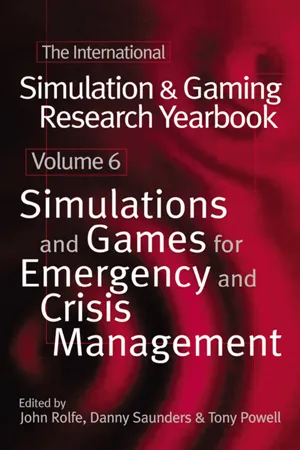
Simulations and Games for Emergency and Crisis Management
- 320 pages
- English
- ePUB (mobile friendly)
- Available on iOS & Android
eBook - ePub
International Simulation and Gaming Research Yearbook
Simulations and Games for Emergency and Crisis Management
About this book
The theme of this volume is emergency and crisis management and how games and simulations are effective tools in dealing with these issues. The work brings together topical contributions from international figures in the field of games and simulations.
Information
SECTION 1: Simulations and games
for crisis and emergency
management
Chapter 1
The needs of the many must outweigh
the needs of the few
Peter Stuart
ABSTRACT
Disasters have been an unwelcomed companion of mankind since early times. There is nothing new in the concept of contingency planning for an impending disaster. The Bible contains one of the earliest recorded contingency plans:
‘Make for yourself an ark out of wood of a resinous tree. You will make compartments in the ark and you must cover it inside with tar.’Genesis 16: 14
Religious and cultural issues have always been important factors and in some quarters they are as valid and important in today's high-pressured society. With the dawn of a new millennium, are we experiencing the creation of a new supreme being identified as ‘instant gratification’? Public expectation, driven by technological innovation, especially in the media sector, increases at a rapid pace. Within minutes of a disaster a highly technical and orchestrated news gathering operation swings into gear, with images, sounds and opinions flooding our intellect. With a touch of a button, or in some cases a click of a mouse, the public can access instant information, form instant opinions and pay homage to the new supreme being.
Lifestyles are changing, they are becoming more complex and more dynamic, with an increasing awareness of the social and economic issues that disasters can create or destroy.
As lifestyles change, so must our approach to disaster management, especially the way respective professionals are trained, educated and exercised. Traditional tactically based exercising and training for the blue light emergency services must continue in order to enhance efficiency skills. However, a fresh approach to exercises and training methods needs to be developed in order to address the needs of the ever-increasing integrated strategic level of disaster management, thus improving their collective effectiveness.
The needs of the many must outweigh the needs of the few, especially at the strategic level of crisis management.
INTRODUCTION
In presenting an emergency practitioner's viewpoint on training for emergencies, I come from a police background, having served with the Metropolitan Police at Heathrow Airport over a period of 19 years. In my early years at the airport, I recall a senior colleague (who had been the senior police officer at the Staines aircrash in 1972) warning me: ‘Nothing is going to prepare you for the next disaster and anyway the vast majority of emergency service personnel will go through their entire careers without ever being involved with a single major incident.’
Now with experience gained with direct involvement in over 13 large-scale disasters both at home and abroad, I can happily disagree with the first comment whilst agreeing with the second. This is based upon the foundation that the first is a pure matter of professional responsibility, whilst the second is a matter of luck.
I have always counted myself very privileged to have been in the right job at the right time and to have been exposed to a variety of differing disasters. As well as being involved, I have also had the opportunity to plan and prepare a variety of training sessions and exercises to improve professionalism.
BACKGROUND
Within the UK, there is no nationally led approach to civil emergency management. That is to say that executive government supports the view that disasters are best left to local officials using local resources. Every city, county or other defined area is in the main responsible for their own disaster planning and exercising. An environment does not exist whereby a systematic approach to civil emergency management or exercising would thrive. Whilst those in the front line, the ‘blue light brigade’ have made chivalrous strides forward towards a common approach, they have had a small degree of token moral support from the ‘movers and shakers’ at national level. Many local authorities have also valiantly joined the progressive march forward to a more co-ordinated approach to civil emergency management.
At national government level, each minister and his or her respective department have responsibilities for various aspects of civil emergency management. There is a bewildering array of differences in each department's approach to the subject. Many ‘grey areas’ exist concerning policy and direction, and co-ordination of effort is spasmodic.
I recall reading Fennell's (1988) report into the Investigation of the King's Cross fire and becoming perplexed. In his report he stated:
‘Safety specialists scattered over three directorates focused on occupational and operational safety, but passenger safety was neglected.’‘The Chairman of London Regional Transport … told me that whereas financial matters were strictly monitored, safety was not … In my view, he was mistaken as to his responsibility.’
I became perplexed simply because if you change some of the words used, from ‘safety’ to ‘civil emergency management’, ‘passenger’ to ‘public’ and ‘the Chairman of London Regional Transport’ to ‘government officials’, a sense of familiarity about the national system sprang to mind.
Later, reading Lord Cullen's (1990) report into the events that led to the Piper Alpha disaster, the same similarity applied when appropriate words were substituted.
‘The management of Occidental was incapable of fulfilling its duties adequately … the viewpoint on serious questions of safety was not that of a Hawk but of the Ostrich.’‘Training for emergencies was cursory and inconsistent.’‘Management adopted a superficial attitude to the assessment of major hazard risks. They failed to ensure that emergency training was being provided as they intended.’
Therefore, in the context of civil emergency exercises as in civil emergency management there does not exist in the UK a harmonious co-ordinated environment.
At local level, some degree of harmony has been achieved by the common adoption of the Gold, Silver, Bronze model of civil emergency management. Gold, Silver and Bronze are titles of functions adopted by each of the emergency services (see Metropolitan Police, 1997). These functions are equivalent to those described as strategic, tactical and operational. It should be understood that the titles do not convey seniority of service or rank but depict the function being carried out by that particular person.
In summary the role of each is described as:
Gold (strategic)
Gold is the commander in overall charge of each service, responsible for formulating the strategy for the incident. Each Gold is in direct command of the resources of their own service but delegates tactical decisions to their respective Silver. Each service Gold will consult with each other service Golds, liaise with central government and other bodies, provide additional resources for the scene and maintain a strategic overview.
Silver (tactical)
Silver will attend the scene, take charge and be responsible for formulating the tactics to be adopted by their service to achieve the desired goal. Silver should not become personally involved with activities close to the incident but remain detached.
Bronze (operational)
Bronze will control and deploy the resources of their respective service within a geographical sector or specific role, to implement the tactics defined by Silver (Metropolitan Police, 1997).
LARGE-SCALE EXERCISES
Large-scale practical exercises have always been viewed by many as the ultimate test of any contingency plan. There may be some value in this assumption, however one should consider a number of factors that continue to influence the planning and execution of these exercises.
First is the historical perspective of exercise planning which, in the main, is handed down from planner to planner, albeit over a period. Within the scope of the Gold, Silver Bronze system these field exercises are plainly designed for the benefit of the Silver and Bronze participants. In the vast majority of cases the role of Gold is either assumed or pretended.
Second, there is the element of whether or not these exercises should be considered as some kind of validation or test as to an organization's or individual's competency. Even where exercise documentation states that it is not a competition or a test, some degree of competition prevails. None of the organizations involved or their representatives want to be shown up in a bad light and many essential players become somewhat preoccupied with secret unknown factors that planners may present just to spice up the exercise. In many cases a ‘catch them out’ culture still prevails, either in fact or in the minds of the participants.
Third is consideration of the time factor. Time is of the essence and many consider a fast response to be a true measure of efficiency. One should consider normal expectations of service delivery with targets being published and judgements made on poor achievements. A visual example of just how important these response times are can be seen around any major airport at exercise time. The outlying roads surrounding the airport are full of a vast array of emergency service vehicles packed to the gunnels with staff, parked up just waiting for the call.
Another factor that always seems to have an unnatural influence on these exercises is the preset timetable of events. Again, airport aircraft accident exercises provide a ready example: in 19 years' experience at Heathrow nearly every exercise started between 19.00 and 19.30 hours and was finished by 22.30 hours.
In addition, I would observe that there is an enormous amount of ‘organizational conditioning’ when it comes to exercise planning. In his book Teaching the Elephant to Dance, Professor James Balasco (1990) of San Diego State University identifies the following:
‘Most organizations and the people involved within them learn by conditioning just like young circus elephants. Trainers shackle them with heavy chains, attached to deeply embedded stakes. In this way the creature learns to stay in one place or at best has a restricted area of movement. This conditioning process continues and even when fully grown, the elephants in general never try to leave, although they have the strength to pull any stake and move forward. The continued presence of a small metal bracelet around one foot not even attached to anything is enough to reinforce the conditioning.’
Within the current spectrum of large-scale exercises, this conditioning process continues to prevail. What is really needed is an independent study as to their true worth.
A final consideration is the cost of these exercises. Large-scale exercises are becoming increasingly costly to organize and yet at best only a relatively small proportion of the available staff and exercise players can participate on the day.
For the purposes of an illustration let us say that within a fictional county there are 5000 individuals who belong to various organizations that have a role to play when a disaster or crisis strikes. Clearly, it is impossible to create a...
Table of contents
- Cover
- Half Title
- Title Page
- Copyright Page
- Table of Contents
- Foreword
- Preface
- Section 1: Simulations and games for crisis and emergency management
- Section 2: Applications of gaming and simulation
- Section 3: The design and evaluation of interactive training methodologies
- Section 4: Current awareness update
Trusted by 375,005 students
Access to over 1.5 million titles for a fair monthly price.
Study more efficiently using our study tools.
Frequently asked questions
Yes, you can cancel anytime from the Subscription tab in your account settings on the Perlego website. Your subscription will stay active until the end of your current billing period. Learn how to cancel your subscription
No, books cannot be downloaded as external files, such as PDFs, for use outside of Perlego. However, you can download books within the Perlego app for offline reading on mobile or tablet. Learn how to download books offline
Perlego offers two plans: Essential and Complete
- Essential is ideal for learners and professionals who enjoy exploring a wide range of subjects. Access the Essential Library with 800,000+ trusted titles and best-sellers across business, personal growth, and the humanities. Includes unlimited reading time and Standard Read Aloud voice.
- Complete: Perfect for advanced learners and researchers needing full, unrestricted access. Unlock 1.5M+ books across hundreds of subjects, including academic and specialized titles. The Complete Plan also includes advanced features like Premium Read Aloud and Research Assistant.
We are an online textbook subscription service, where you can get access to an entire online library for less than the price of a single book per month. With over 1.5 million books across 990+ topics, we’ve got you covered! Learn about our mission
Look out for the read-aloud symbol on your next book to see if you can listen to it. The read-aloud tool reads text aloud for you, highlighting the text as it is being read. You can pause it, speed it up and slow it down. Learn more about Read Aloud
Yes! You can use the Perlego app on both iOS and Android devices to read anytime, anywhere — even offline. Perfect for commutes or when you’re on the go.
Please note we cannot support devices running on iOS 13 and Android 7 or earlier. Learn more about using the app
Please note we cannot support devices running on iOS 13 and Android 7 or earlier. Learn more about using the app
Yes, you can access International Simulation and Gaming Research Yearbook by Tony Powell,John Rolfe,Danny Saunders in PDF and/or ePUB format, as well as other popular books in Didattica & Didattica generale. We have over 1.5 million books available in our catalogue for you to explore.