eBook - ePub
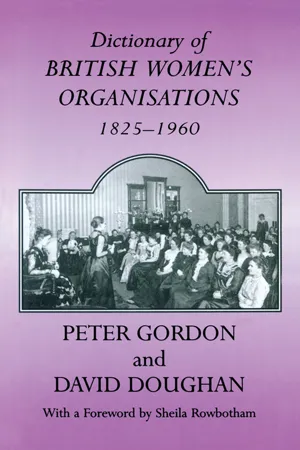
Dictionary of British Women's Organisations, 1825-1960
- 232 pages
- English
- ePUB (mobile friendly)
- Available on iOS & Android
eBook - ePub
Dictionary of British Women's Organisations, 1825-1960
About this book
This dictionary is the first attempt to identify systematically the large heterogeneous group of women's organisations that grew up from the early 19th century up to the beginning of the modern women's movement, from women abolitionists and Chartists through Social workers, nurses, suffragists and sexual reformers to women pilots, journalists and cricketers. The work brings together over 500 separate entities on a wide variety of societies, associations, clubs, unions and other professional, social and political bodies organised by women or for men.
Information
Abortion Law Reform Association
This was formed in 1936. By the mid-1930s, reports of maternal mortality had revealed the existence of an illegal culture of back-street abortion, and for this among other reasons growing numbers of contraception advocates came also to support the decriminalisation of abortion, illegal under the 1861 Offences Against the Person Act, only marginally modified by the Infant Life (Preservation) Act of 1929 – although Marie Stopes remained resolutely opposed. A major turning point came when the Women’s Co-operative Guild approved reform of the law in 1934, and finally the Abortion Law Reform Association was formed, with Janet Chance as chairman and Alice Jenkins as honorary secretary. Its initial objects were stated to be the ending of a pregnancy on request where necessary to preserve the woman’s physical or mental health, or when there was a risk of birth defects, or when pregnancy resulted from rape. Its campaigning remained relatively low key until the early 1960s, when Vera Houghton was chairman, and committee members included Dr Martin Cole and Madeleine Simms, who edited the Association’s newsletter. Under the Association’s auspices a parliamentary campaign was undertaken which resulted in David Steele’s Private Member’s Bill becoming the Abortion Act of 1967. At the time of writing, the Association continues to campaign for women’s reproductive rights.
(Leathard, 1980)
Active Service League
Started in February 1914, this was a suffrage ginger-group under the auspices of the National Union of Women’s Suffrage Societies with the intention of broadening the organisation’s base, especially by attracting younger women. It was mainly based in Oxford. It did not survive the outbreak of the First World War.
(Crawford, 1999)
Actresses’ Franchise League
Founded in 1908 by Gertrude Elliott, Winifred Mayo, Sime Seruya and Adeline Bourne, this represented actresses of both militant and non-militant suffrage tendencies, and included a number of famous names, such as Lena Ashwell, Edy Craig, Cicely Hamilton, Lillie Langtry, Kitty Marion, Elizabeth Robins, Athene Seyler and Sybil Thorndike. Its main activity was producing suffrage propaganda plays in conjunction with the Women Writers’ Suffrage League. Its colours were pink and green. During the First World War it travelled round military camps and hospitals entertaining and propagandising in good agitprop style. It remained in existence until at least 1934.
(A. J. R., 1913; Crawford, 1999; Stowell, 1992)
Albemarle Club
Established at 13 Albemarle Street, London, W1, in 1881 by a progressive group including Elizabeth Malleson and Henry Holliday, the club was open to both men and women. Prominent members included Millicent Fawcett, Lilias Ashworth Hallett and May Sinclair. It moved later to nearby premises at 37 Dover Street, and was still active in 1923.
Alexandra Club (1)
Founded in 1884 at 12 Grosvenor Street, Piccadilly, this exclusive club was for ladies eligible to attend the Queen’s Drawing Rooms, which seems to have excluded (among many others) divorcees. Residential accommodation was provided. One of its rules forbade the entertaining of male visitors on the premises and smoking was not allowed. The entrance fee was five guineas, and annual subscriptions were five guineas for town members and four guineas for country members. It was still in existence in 1928.
Alexandra Club (2)
A club at 133–5 St Stephen’s Green, Dublin, established in 1892 for social purposes. Membership was by nomination of two members and election by the Committee. Accommodation was provided on a permanent or temporary basis. In 1906 there were 350 members. The entrance fee was two guineas, as was the annual subscription. The secretary was Miss Ewing Kennedy. It was affiliated to a number of London Clubs including the Green Park Club, the New Victorian Club, the Grosvenor Crescent Club and the New Era Club.
All-England Women’s Hockey Association
Although the all-male Hockey Association was formed in 1886, it was not considered a major sport at public schools. The first private women’s hockey club was founded the following year. Following the lead of the Irish Ladies’ Hockey Union formed in 1892, a meeting was held in November 1895 at Westminster Town Hall of representatives of women’s colleges from Oxford, Cambridge and London as private ladies’ clubs. The Ladies’ Hockey Association was subsequently established with Miss Lilian Faithfull, head of the Ladies’ Department, King’s College, London as its president. After a rebuff from the Hockey Association for affiliation, the LHA set up the All-England Women’s Hockey Association (AEWHA), stipulating that no man could ever hold an executive office in that Association. The first county team was formed in Sussex in 1898, to be followed by many others. Welsh and Scottish Associations were established in 1902 as was the official organ of the Association, the Hockey Field, issued as a weekly paper. In the same year, four territorial organisations – North, South, West and Midlands – were formed in England to administer the game. The sport became popular at school and college levels and the AEWHA was involved in making rules, fixing fees and selecting an England team. The measure of its success can be seen in the spread of the sport by the outbreak of the First World War to include five territorial and 36 county associations, more than 300 school, college and private clubs and matches at all levels including the international. By 1939, there were over 2,000 affiliated clubs.
(All-England Women’s Hockey Association, 1950; McCrone, 1988)
Alliance Club
Advertised as ‘for ladies interested in Christian work’, the Club had an Evangelical basis. It was situated at 61 Curzon Street, Mayfair, London, W. The entrance fee in 1906 was two guineas with annual subscriptions varying between two and three guineas.
Amazon Defence Corps
Soon after the inauguration of the Local Defence Volunteers (later the Home Guard) in June 1940, women started campaigning to become members. This corps appears to have been one of the earliest organisations attempting to have women helping to defend Britain. Its aims were to obtain training for women in the use and handling of firearms and other weapons of defence; that trained women should be admitted as members of Local Defence Volunteers on terms of equality with men; to urge training in the use of firearms for all women of the services; and to encourage in women the spirit to resist the invader by all means available. Membership was one shilling per annum. The organising committee included Venetia Foster, Nora Robbins, L.E. Alton, Juanita Francis, Elizabeth MacDonald and Edith How-Martyn. Its activities may have been continued by Women’s Home Defence.
Anglican Group for the Ordination of Women to the Historic Ministry of the Church
The Group was formed in about 1931 in the wake of the 1930 Lambeth Conference, although its first annual general meeting did not take place until 1933. Its aim was to secure effective recognition of the Christian principle of spiritual equality between men and women by urging upon the Church of England the admission of women to the threefold ministry of bishops, priests and deacons. Its vice-presidents were the Bishop of Lichfield and the Dean of Canterbury; its Council included several prominent Anglican clergymen as well as prominent women, such as principals of women’s colleges, the Headmistress of Roedean School and the actress Dame Sybil Thorndike; its first secretary was Mrs Ronald Best. It was wound up in the mid-1970s.
Arachne Club
This Club, founded in 1905 at 66 Russell Square, London, W, was for training women in cooking and general domestic work. Its secretary was Mrs Armstrong.
Artists’ Suffrage League
The League was founded in January 1907. Its chairman was Mary Lowndes, and its members were practising artists, including the Australian, Dora Meeson Coates, Mary Sargeant Florence, Bertha Newcombe and Caroline Watts, designer of the ‘Bugler Girl’. Its main activity was producing visual suffrage propaganda in the form of cartoons, often in conjunction with the Women Writers’ Suffrage League, postcards, posters and especially banners (Mary Lowndes’s design book for posters and banners is held in the Women’s Library). It worked mainly for the National Union of Women’s Suffrage Societies; its artistic techniques were relatively conventional as compared to those of the Suffrage Atelier.
(Crawford, 1999; Tickner, 1987)
Associate Institution for Improving and Enforcing the Laws for the Protection of Women
Established in 1844 by the amalgamation of a number of societies which had sprung up during the late 1830s and 1840s, to promote female protection. It sought to legislate against brothels and those who profiteered from the earnings of ‘fallen women’. Lord Robert Grosvenor was chairman. It was apparently male-dominated. Its organ was the Female Friend.
(Gleadle, 1995)
Association for Moral and Social Hygiene
This Association was formed in 1915 from an amalgamation of the Ladies’ National Association and the British section of the British, Continental and General Federation for the Abolition of Government Regulation of Prostitution. Its first, and extremely influential, secretary was Alison Neilans, who held the post till her death in 1942. The Association continued the tradition of its predecessors in opposing state regulation of prostitution, notably in regard to the provisions of the Defence of the Realm Acts in both World Wars (Sections 40D and 33B respectively). Additionally it was concerned with a wide range of issues relating to sexuality in general, especially sex education. It took a more consistently feminist line than other contemporary organisations, such as the National Vigilance Association. Unlike many other progressive organisations between the wars, it had strong reservations about eugenic policies, and was particularly opposed to measures allowing the sterilisation of the unfit. After the Second World War it seems to have lost some of its campaigning vigour; for example, it was not particularly assiduous in making representations to the Wolfenden Committee on Homosexual Offences and Prostitution, 1954–57, though it became very vocal in its criticism of the 1959 Sexual Offences Act, which in part emanated from the report of that Committee. In 1953 it changed its name to the Josephine Butler Society. Its organ was the Shield.
Association for Promoting the Higher Education of Women in Cambridge
The creation by Cambridge University of the Higher Local Examinations for women over 18 years of age in 1869 led to a group of Cambridge individuals, led by Henry Sidgwick, the philosopher, and Millicent Garrett Fawcett, to press for lecture courses to prepare women living within 80 miles of the city for the examination. As a result, a lecture committee was formed which became the Association for Promoting the Higher Education of Women in Cambridge. The enterprise was a successful one but the Association was unable to bear the responsibility of further expense towards women’s education. Within two years, a residence for students had been acquired at Cambridge and Sidgwick persuaded Anne Jemima Clough, a leading figure in the North of England Council for Promoting the Higher Education of Women, to take charge. By 1872, on Sidgwick’s initiative, a new residence, Newnham Hall, had been built. Clough became its first Principal with its staff of tutors.
(Burstyn, 1980; Kamm, 1965)
Association for Promoting Trained Nursing in Workhouse Infirmaries
Although Florence Nightingale had attracted many middle-class women to became trained nurses, the Poor Law infirmaries presented a different picture. Poor Law Guardians were reluctant to pay the same rates as voluntary hospitals or to provide similar standards of accommodation and working conditions. As a result, much of the nursing in workhouses in the nineteenth century was undertaken by pauper women selected by the matron, in some cases in return for beer and 2s 6d a week. Despite protests by the Poor Law Board on the employment of pauper nurses, no official action was taken. A number of ladies had undertaken the task of helping to supply Boards of Guardians with trained nurses for workhouse infirmaries, especially in London, Liverpool and Birmingham. Miss Louisa Twining had been instrumental in setting up the Workhouse Visiting Societ...
Table of contents
- Cover
- Half Title
- Title Page
- Copyright Page
- Table of Contents
- List of Illustrations
- Foreword by Sheila Rowbotham
- Acknowledgements
- Introduction
- Dictionary of Women’s Organisations
- Bibliography
- Index to Entries
Trusted by 375,005 students
Access to over 1.5 million titles for a fair monthly price.
Study more efficiently using our study tools.
Frequently asked questions
Yes, you can cancel anytime from the Subscription tab in your account settings on the Perlego website. Your subscription will stay active until the end of your current billing period. Learn how to cancel your subscription
No, books cannot be downloaded as external files, such as PDFs, for use outside of Perlego. However, you can download books within the Perlego app for offline reading on mobile or tablet. Learn how to download books offline
Perlego offers two plans: Essential and Complete
- Essential is ideal for learners and professionals who enjoy exploring a wide range of subjects. Access the Essential Library with 800,000+ trusted titles and best-sellers across business, personal growth, and the humanities. Includes unlimited reading time and Standard Read Aloud voice.
- Complete: Perfect for advanced learners and researchers needing full, unrestricted access. Unlock 1.5M+ books across hundreds of subjects, including academic and specialized titles. The Complete Plan also includes advanced features like Premium Read Aloud and Research Assistant.
We are an online textbook subscription service, where you can get access to an entire online library for less than the price of a single book per month. With over 1.5 million books across 990+ topics, we’ve got you covered! Learn about our mission
Look out for the read-aloud symbol on your next book to see if you can listen to it. The read-aloud tool reads text aloud for you, highlighting the text as it is being read. You can pause it, speed it up and slow it down. Learn more about Read Aloud
Yes! You can use the Perlego app on both iOS and Android devices to read anytime, anywhere — even offline. Perfect for commutes or when you’re on the go.
Please note we cannot support devices running on iOS 13 and Android 7 or earlier. Learn more about using the app
Please note we cannot support devices running on iOS 13 and Android 7 or earlier. Learn more about using the app
Yes, you can access Dictionary of British Women's Organisations, 1825-1960 by David Doughan,Professor Peter Gordon,Peter Gordon in PDF and/or ePUB format, as well as other popular books in Social Sciences & British History. We have over 1.5 million books available in our catalogue for you to explore.