eBook - ePub
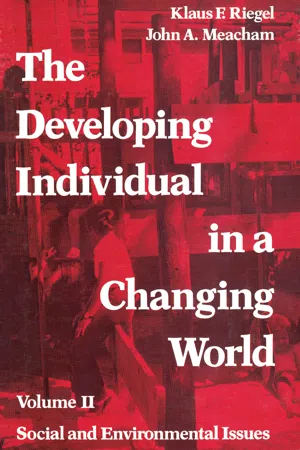
The Developing Individual in a Changing World
Volume 2, Social and Environmental Isssues
- 361 pages
- English
- ePUB (mobile friendly)
- Available on iOS & Android
eBook - ePub
The Developing Individual in a Changing World
Volume 2, Social and Environmental Isssues
About this book
This two-volume work levels both criticism and challenge to traditional developmental psychology. For too long, developmental psychologists have been studying individuals as if they developed in a sociocultural vacuum. As psychologists began to study the individual's development more broadly, they considered the impact of a number of other factors in the physical and social environment: early education, sociocultural differences, mass communication, alternative living arrangements, and medical care--to name but a few.Volume I, Historical and Cultural Issues, examines the problems of behavioral development from historical, political, theoretical, and cultural points of view. A number of content areas already familiar to developmental psychologists are discussed: Piaget's theory, perceptual development, socialization, and language acquisition. In addition, topics relatively unfamiliar to American psychologists are included: the contribution of early European developmentalists such as William and Clara Stern, Alfred Binet, and Eduard Spranger; and an introduction to recent Soviet developmental theory.Volume II, Social and Environmental Issues, considers the effects of changes in social and environmental conditions upon individual development. The expanding impact of technology such as the communications media, the importance of nutrition, and the design of playgrounds and other spaces for growing children are among the changes examined, as are the impact of social organizations and interactions within small groups, focusing upon preschool education, interaction within the family, and personality development throughout the individual's life.
Information
Table of contents
- Cover Page
- Title Page
- Copyright
- Contents
- Section IV Environmental conditions and the development of the individual
- 1 The responsive environment: Interdisciplinary developmental issues
- A Environmental Ontogeny: a Cognitive View
- B Environmental Reciprocity: a Socio-Emotional View
- C Histories and Futures: Aspects of a Study of The Child's Relation to the Land and the City
- 2 Effects of nutrition on development
- A Role of Nutrition in Human Development
- B Malnutrition In Infancy And Intellectual Development
- C Protein Malnutrition in Monkeys
- 3 Effects of communication media on child development
- A The Means of Instruction in the Attainment of Educational Goals
- B Cognitive Effects of Visual Media
- C Television and the Development of Social Behavior
- Section V Social organizations and the development of the individual
- 1 Variations in home-based early education: Language, play, and social development
- A The Construction and Selection of Environments: Design of the Study
- B Play: The Elaboration of Possibilities
- C Language: The Formation of Discourse
- D Social Development: Enriching Connections
- E The Emperor's New Clothes
- 2 Comparison of model preschool programs
- A Remarks About Curriculum Implementation
- B Short-Term Cognitive Effects of Eleven Preschool Models
- C Dimensional Analysis of Preschool Programs
- D Comparing Model Preschool Programs
- 1 Social interaction and personality development
- A Social Perspective-Taking Training; Empathy and Role-Taking Ability of Preschool Children
- B Levels and Patterns of Social Engagement and Disengagement from Adolescence to Middle Adulthood
- A Education as an aid to Adaptation in the Adult Years
- D Interaction of Personality, Ses, and Social Participation in Old Age
- D The Generation Gap: Imagination or Reality?
- F Affluence, Reciprocity, and Solidary Bonds
- 2 Variations in infant-caretaker interactions
- A Family Interaction in The Newborn Period: Some Findings, Some Observations, and Some Unresolved Issues
- B The Relation of Infant's Temperament and Mother's Psychopathology to Interactions in Early Infancy
- C Mother-Infant Interaction, Attachment, and Mother's Psychopathology
- D Cohort Effects and Apparent Secular Trends in Infant Research
- 3 Sibling influences on the development of the individual
- A Sibling Position, Sex of Child, and Maternal Involvement
- B On the Extent of Sibling Influence
- C Sibling Interaction and Cognitive Development
- D Social Class, Family Size, and Cognitive Performance
- E The Assessment Of Stability And Change In Peer Interaction Of Normal Hearing And Deaf Preschool Children
- Bibliography
- Index
Trusted by 375,005 students
Access to over 1.5 million titles for a fair monthly price.
Study more efficiently using our study tools.
Frequently asked questions
Yes, you can cancel anytime from the Subscription tab in your account settings on the Perlego website. Your subscription will stay active until the end of your current billing period. Learn how to cancel your subscription
No, books cannot be downloaded as external files, such as PDFs, for use outside of Perlego. However, you can download books within the Perlego app for offline reading on mobile or tablet. Learn how to download books offline
Perlego offers two plans: Essential and Complete
- Essential is ideal for learners and professionals who enjoy exploring a wide range of subjects. Access the Essential Library with 800,000+ trusted titles and best-sellers across business, personal growth, and the humanities. Includes unlimited reading time and Standard Read Aloud voice.
- Complete: Perfect for advanced learners and researchers needing full, unrestricted access. Unlock 1.5M+ books across hundreds of subjects, including academic and specialized titles. The Complete Plan also includes advanced features like Premium Read Aloud and Research Assistant.
We are an online textbook subscription service, where you can get access to an entire online library for less than the price of a single book per month. With over 1.5 million books across 990+ topics, we’ve got you covered! Learn about our mission
Look out for the read-aloud symbol on your next book to see if you can listen to it. The read-aloud tool reads text aloud for you, highlighting the text as it is being read. You can pause it, speed it up and slow it down. Learn more about Read Aloud
Yes! You can use the Perlego app on both iOS and Android devices to read anytime, anywhere — even offline. Perfect for commutes or when you’re on the go.
Please note we cannot support devices running on iOS 13 and Android 7 or earlier. Learn more about using the app
Please note we cannot support devices running on iOS 13 and Android 7 or earlier. Learn more about using the app
Yes, you can access The Developing Individual in a Changing World by Georgy Gounev,John A. Meacham in PDF and/or ePUB format, as well as other popular books in Psychology & Developmental Psychology. We have over 1.5 million books available in our catalogue for you to explore.